Passover (Pesach in Hebrew) is known as the "holiday of freedom." It is an 8 day holiday (in Israel, seven days) and is celebrated from the 15th through the 22nd of the month of Nisan (sundown of April 12 - nightfall of April 19, 2025).
What is the meaning of Passover?
Passover commemorates the Jewish Exodus from Egypt following 210 years of slavery. It is regarded as the "birth" of the Jewish nation, and its lessons of struggle and identity continue to form the basis of Jewish consciousness 3,300 years after the event. The name ‘Passover’ is derived from the fact that during the final plague – the slaying of the first born – God “passed over" the Jewish homes.
How to celebrate Passover
Below are the main Passover practices and traditions that are carried out as part of celebrating Passover.
SEDER NIGHT
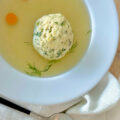
The holiday is marked by the celebration of an elaborate Seder on the first two nights (in Israel, on the first night only). The Seder is designed to give each Jew the experience of "going from slavery unto freedom." As recorded in the Haggadah, we tell the Exodus story and recount the Ten Plagues. We eat symbols of slavery and freedom, and the festive meal includes many delicious recipes for foods that people look forward to all year (think matzah balls!). We recite the Hallel prayer of praise, and end the Seder with the hope of “Next year in Jerusalem!”
The Seder is a special tie of family bonding and children are a particular focus of the night. They enjoy a variety of Passover songs like the Four Questions (Ma Nishatana), tell of the Four Sons, sing the “Dayenu” song, try to "steal" the Afikoman, and open the door for Elijah the Prophet.
MATZAH
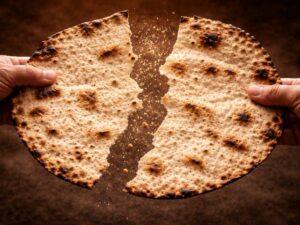
At the Seder, it is a special mitzvah to eat matzah, the Seder’s main symbol. Everyone should try to eat 2/3 of a square matzah (or 1/2 of a round matzah) within 4 minutes, while leaning to the left. The most common reason for eating matzah is that on the morning of the Exodus, the Jews were so rushed in getting out of Egypt that the bread didn’t have time to rise. At the end of the festive meal, the special “dessert” is another piece of matzah, called the Afikoman. Explore our article here to learn more about the inner meaning of matzah.
FOUR CUPS
At the Seder, we drink four cups of wine – corresponding to the four expressions of freedom mentioned in the Torah (Exodus 6:6-7). Everyone should have their own cup, which holds minimally 98cc (3.3 oz). Try to drink the entire cup for each of the Four Cups (or at least drink a majority) within 4 minutes. And as an expression of freedom, we lean to the left and back while drinking the Four Cups.
KARPAS
Toward the beginning of the Seder, we eat karpas – a vegetable (e.g. celery, parsley, potato) dipped in saltwater, to commemorate the tears of hard labor.
BITTER HERBS
Later in the Seder, we eat Marror, the bitter herbs. Though many have the custom of using horseradish, Romaine lettuce is also used. (“Red horseradish” in jars bought from the stores should not be used, since it’s a mixture of mostly beets with some horseradish.) The Marror is dipped into Charoset, a bricks-and-mortar mixture of dates, wine, nuts and apples. Explore our article here to learn more about why we have bitter herbs on Passover.
SEDER CHECKLIST
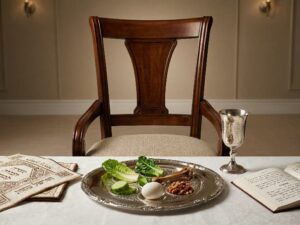
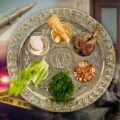
Seder means "order" because there are so many details to remember. Your Seder table should include:
- a Seder plate with:
- Celery, parsley or potato (Karpas)
- Lettuce (Marror)
- Horseradish (Chazeret)
- Charoset
- Roasted chicken wing (Zero'ah)
- Hard-boiled egg (Beitzah)
- matzah cover with 3 matzot (and extra matzah)
- wine and grape juice
- Haggadahs
- cup for Elijah
- saltwater
- Kiddush cups
- pillows for reclining
- Afikomen prizes
REMOVING CHAMETZ
During the week of Passover, Jews are forbidden to eat or possess any chametz (leavened grain). For this reason, we dispose of (or sell) all bread, cookies, pasta, beer, etc. – and purchase only products labeled "Kosher for Passover." (Ashkenazi Jews also refrain from eating kitniyot – rice, beans, etc.) To avoid any problems of residual chametz, we also have special sets of dishes and pots for Passover. As a practical consideration, many people begin cleaning for Passover weeks before the holiday begins.
BEDIKAT Chametz
On the evening before Passover, we conduct a careful search of the home for chametz. It is done by candlelight and is a memorable experience for the whole family. Bedikat Chametz is done using a candle, feather, wooden spoon, and a bag in which to place any chametz that is found. Families generally place ten pieces of bread around the house to be found during Bedikat Chametz.
Burning Chametz
Any remaining chametz is either burned the next morning (in a ceremony called Sray'fat Chametz), or is sold to a non-Jew for the week of Passover. The sale must be serious and legally binding; it should be done only through the assistance of a qualified rabbi. Any food that is sold must be put in a cabinet and taped shut.
» Click here for the complete Passover section «
FAQs
What are the Passover rules and traditions?
- There are many rules and traditions involved in the holiday of Passover. The Passover Seder is one of the main laws and customs, and it is conducted on the first and second night of Passover (only the first in Israel). It involves the practices of telling the story of Exodus, drinking four cups of wine, and eating Matzah and bitter herbs.
What does Passover mean?
- The name ‘Passover’ is derived from when God liberated the Jewish people from slavery in the story of Exodus, and He “passed over" the Jewish homes during the final plague – the slaying of the first born.
What does Passover celebrate?
- Passover celebrates freedom, as the holiday commemorates the Jewish Exodus from Egypt following 210 years of slavery.
What is the history of Passover?
- The history of Passover dates back to biblical times, as it commemorates the story of Exodus. God freed the jewish people after 210 years of slavery under the Egyptians. After 10 miraculous plagues from God on to the Egyptians and the ‘splitting of the sea’, the Jewish people entered freedom, which is why Passover is regarded as the "birth" of the Jewish nation.
How long is Passover?
- Passover lasts for 8 days (7 in Israel). According to the Hebrew calendar it commences on the 15th day of the month of Nissan, and ends on the 22nd. Learn more here.
How to Wish Someone A Happy Passover?
- There are a few ways to wish someone a ‘Happy Passover’. Many people say ‘Chag Sameach’ (meaning ‘Happy Holiday’) or ‘Good Yom Tov’ (meaning have a ‘good Holiday’). You can also wish someone a ‘Happy Passover!’ too.













 Three Things Every Jew Needs to Hear at the Seder This Year





Happy Passover!