




 Why the World Can't Stop Talking About the Jews

5 min read



5 min read


Judaism’s chain has survived persecution, exile, and catastrophe. What it can’t survive is indifference.
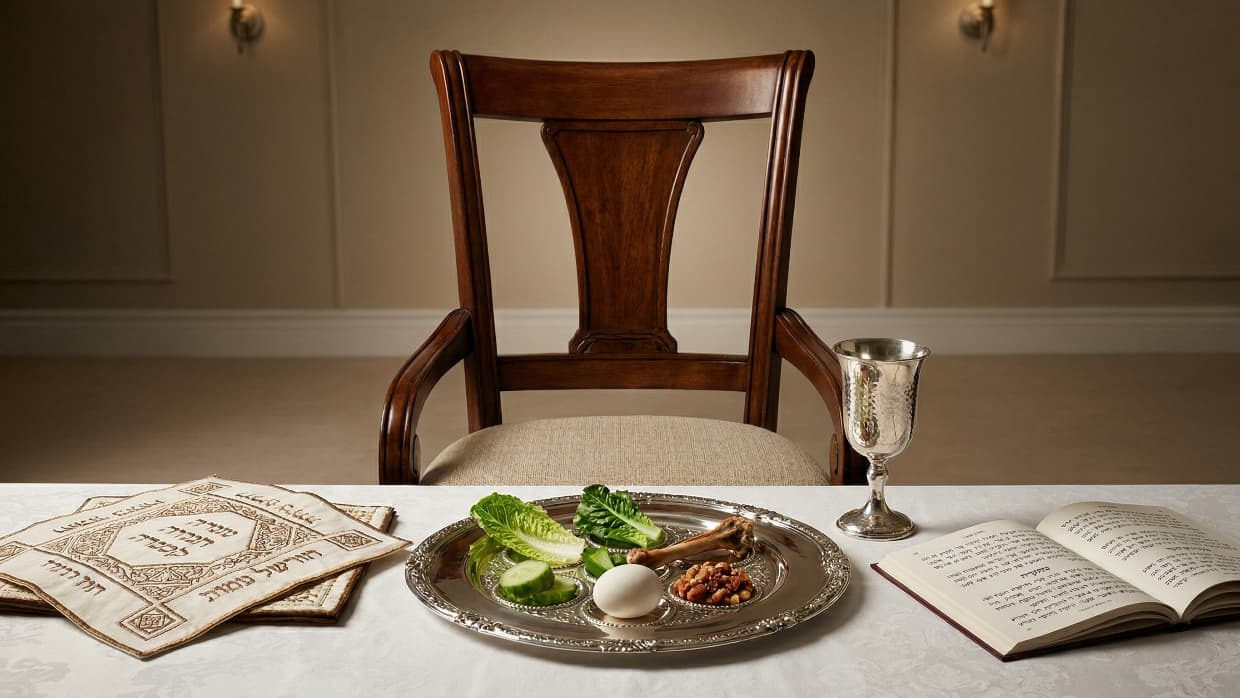
Each year at the Seder, we speak about four sons: the wise son, the rebellious son, the simple son, and the one who does not know how to ask. These figures are usually understood as personality types, or different levels of Jewish knowledge. But they can also be read as describing a gradual shift in how Jewish identity is experienced, held, and passed on.
The wise son is engaged. He asks questions, seeks understanding, and assumes that what he has received contains depth worth exploring. His identity is active and alive. The rebellious son comes next. He is not ignorant; he knows enough to challenge, but something has shifted. He places himself at a distance and speaks about the story as something that belongs to others. "What is this service to you?" he asks. He is still present but no longer fully inside.
Then comes the simple son. He doesn’t resist but he has less to work with. The richness of what was once transmitted has thinned. His question is brief because his inner framework is limited.
And after him, the one who does not know how to ask. Here the disengagement is quieter still. No argument, no rebellion, just a lack of connection. The Jewish story has not yet become his story. He is sitting at the table but something essential is missing.
The Haggadah doesn’t mention the absent fifth son because he can't be addressed. The conversation has already ended.
At that point, the Haggadah stops. It does not describe what comes next. But the direction is unmistakable. One more step and we reach the son who is no longer at the table at all.
The Haggadah doesn’t mention the absent fifth son because he can't be addressed. The conversation has already ended.
Much attention is rightly given to the losses caused by persecution throughout Jewish history. But running alongside that has always been a quieter erosion, the gradual disappearance of people who simply drifted away. Those who sat at Seders, went to Hebrew school, perhaps had a bar or bat mitzvah, and somewhere along the way the Jewish story stopped feeling like their story. No dramatic break. No declaration. Just a slow, barely visible distance that, by the next generation, hardened into absence.
The Haggadah draws a boundary with the four sons: they represent the full range of Jewish engagement, from depth to near-disconnection, but all four are still present. The rebellious son still shows up, even if he challenges. The simple son is still part of the conversation, even if his grasp is limited. Even the one who doesn't know how to ask is there, and that presence matters. As long as someone is still at the table, there is a point of contact, a foundation on which something can grow.
This is why the Seder places such weight on questions. A question signals engagement; it reflects the sense that what is happening matters enough to explore. Where there are questions, there is still a living relationship with the story.
For the son who doesn't know how to ask, the Torah shifts the responsibility squarely onto us: you open for him. We do not wait for curiosity to arrive on its own. We create the conditions in which it can begin. Because without that opening, silence doesn't stay neutral. Over time it becomes distance, and distance becomes absence.
The deeper issue is not what a person knows. It is whether the story feels like it belongs to them. Jewish continuity doesn't run on information alone. It runs on connection, on the experience of being inside a story that carries meaning and makes a claim on your life.
The four sons are not only children in the Haggadah. They are also states that exist within each of us. A person can be deeply engaged at one stage of life and quietly distant at another. That movement is ongoing, shaped by attention, by learning, and by the environment we build around ourselves and the people we love.
The absence of the fifth son asks each of us a quiet, uncomfortable question: what are we doing, at this table and beyond it, to make sure the chain continues?
The Seder brings this into focus with unusual directness. It is not only a reenactment of the past; it’s an act of transmission happening in real time. The way the story is told, the space made for questions, the seriousness or lightness with which the night is approached — all of it shapes whether the next generation experiences this as something real and theirs, or something observed from the outside.
The absence of the fifth son is meant to be felt. It asks each of us a quiet, uncomfortable question: what are we doing, at this table and beyond it, to make sure the chain continues?
That chain has survived persecution, exile, and catastrophe. What it can’t survive is indifference. As long as someone is still at the table, the story isn’t over.
It’s up to us to open the door and invite them in.
The ideas in this article are drawn from my forthcoming book, The Fourth Son: Jewish Identity, Self-Hatred, and the Courage to Stand Alone, scheduled for publication at the end of 2026.











The concept of the fifth son who is not at the seder seems to have been first coined by the last Lubavitcher Rebbe in 1957. I would say that there are a number of 5th sons each with different reasons for not being at the seder. Son 5.1 is the workaholic that can't take the night off. Son 5.2 is the one that is not at his parents seder but goes to an authentic seder because he finds what they have to say more meaningful than what his father has to say. Son 5.3 is organizing his own seder for his friends at college. Son 5.4 doesn't want anything to do with Judaism. Son 5.5 doesn't want anything to do with his father. The list goes on.
How many generations has it been since the original Passover night. One time I did the math. Consider a Passover Generation to be one Grandparent, parent and grand child sitting at the table. If my table is one then my grandfather sitting as a boy with his grandfather would be two. I believe there have only been 54 Passover Generations since that fearful night.
So interesting, right to the poitsnt and poignant! What´s the answer to it? Just as the fourth son doesn´t know what to ask, many of us don´t know how to answer to this phenomena
This takes me to the plague of darkness in Mitzraim. It is described as darkness so thick it could be felt. Sadly there will be many absences from our tables this year. Absence of those who have made the sacrifice with their lives defending and protecting AM Yisrael from this generation of those who seek to destroy us, those still on duty guarding and protecting AM Yisrael from the evils much to much of the world still chooses to embrace and pepetuate, and yes those who have turned their backs and run in denial of both their heritage and their destiny in service to Hashem. All such darkness will be felt this reverberating the darkness of millenia ago.
We read that in every generation that they are enemies of the Jews come to destroy us but Hashem saves us from them, it sad when Jews deny their heritage and destiny but their are non Jews are happy to convert and embrace the heritage and destiny of the Jews, one of the Marx brothers made a joke you doesn't want to join a club that excepts him, I guess some people have a problem with being one of the tribe members, and others want to join our tribe and club
Outstanding. As I read it, I thought of the many 20- and 30-somethings I know, children of friends and relatives, who are totally disengaged from Judaism. They had Reform education, if you can call it that, so thin it made zero impression. A few may go to a seder, but it is likely to be one that is so woke they'll have an orange on the seder plate as a symbol of Palestinian suffering.
My children went to day schools. They hated it. They are not going to be at a Seder tonight. We are heartbroken.
Article brought tears to my eyes, may all our lost sons return.
Amen to that
WONDERFUL!
What an excellent, thought provoking article. I am going to try and send this to friends