







 The Macklemore Mess: What Pink Got Right and Everyone Else Got Wrong
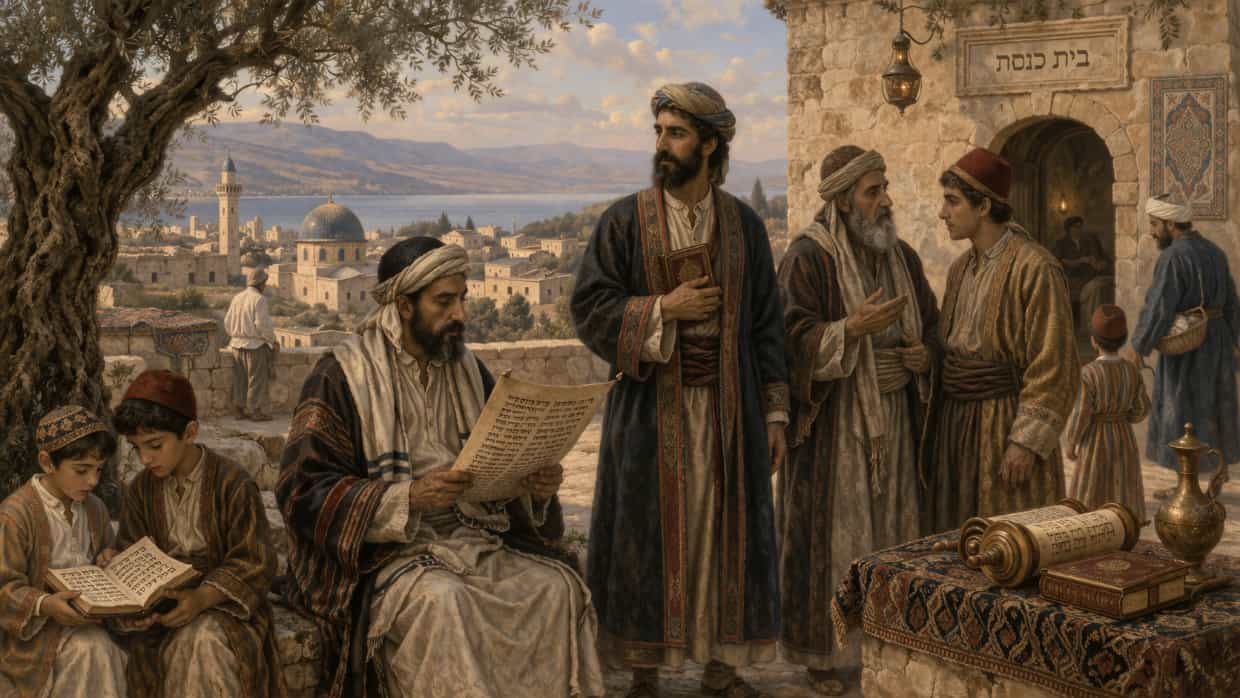








For 2,000 years, while Jews scattered across the globe, a small group never left the Land of Israel. Almost no one has heard of them.
When we learn Jewish history, the story of the Jewish people in the Land of Israel seems to end with the Jewish-Roman wars of the 1st and 2nd centuries. From there, normative history courses shift to the Diaspora: the Talmudic academies in Babylonia, the Golden Age in Spain, Jewish life in Eastern Europe. The implied takeaway is that the Jewish population in the Land of Israel rapidly collapsed and was virtually nonexistent for 2,000 years, until the waves of mass immigration in the late 19th and early 20th centuries.
In this perspective, the Land of Israel is depicted as a memory, a place to long for in prayer, but long since left behind, until modern times.
While anti-Zionist critics tend to embrace this narrative, historians and scholars like Dore Gold, Alan Dershowitz, and Rabbi Jonathan Sacks point to a continuous Jewish presence in the Land of Israel for the past 3,700 years, an unbroken chain of generations who never left.
In remote Galilean villages like Peki'in there are Jewish families with genealogies stretching back to Biblical times.
Famous historical figures including the Ramban (Nachmanides), Ovadia of Bartenura, and the Ari (Rabbi Isaac Luria) all had documented encounters with native Judeans who had never been exiled. Yitzhak Ben-Zvi, Israel's second president and a serious historian, traveled to remote Galilean villages like Peki'in in the 1920s and 30s, documenting Jewish families with genealogies stretching back to Biblical times.
So who were these people? Distinct from Mizrahi, Sephardic, and Ashkenazi Jews, they were native Judeans who simply never left, and yet almost no one has ever heard of them.
On the eve of the Great Revolt in 66 CE, many historians place the Jewish population of the Land of Israel at close to three million, based on the density of villages recorded in the Talmud, Roman records, archaeological surveys, and the writings of Josephus. Within less than a century, that number dropped by 60 to 70 percent, the result of deliberate civilian massacres during the Jewish-Roman wars, forced displacement throughout the Roman Empire, and waves of refugees fleeing to other lands (Mesopotamia, Persia, etc.).
Jews remained the demographic majority of the ancient country's population until the 5th century.
And yet, Jews still numbered in the hundreds of thousands. They remained the demographic majority of the ancient country's population until the 5th century. While the Romans devastated Jerusalem and the Judean countryside, Jewish life and rabbinic leadership simply shifted north. The Galilee and Golan Heights became the new fortress of Jewish survival. Many scholars believe Jews remained a majority in the northern regions well into the 7th and 8th centuries.
It was during this post-Temple period that Jews still in the land produced some of the most foundational works in Jewish literature: the Mishna, the Tosefta, the Jerusalem Talmud, and the Midrash. A form of the Sanhedrin continued to function in the Galilee for centuries after the destruction of the Temple. Archaeologists have uncovered over 100 ancient synagogues from this period, most fully operational between the 2nd and 8th centuries.
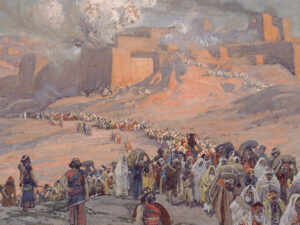
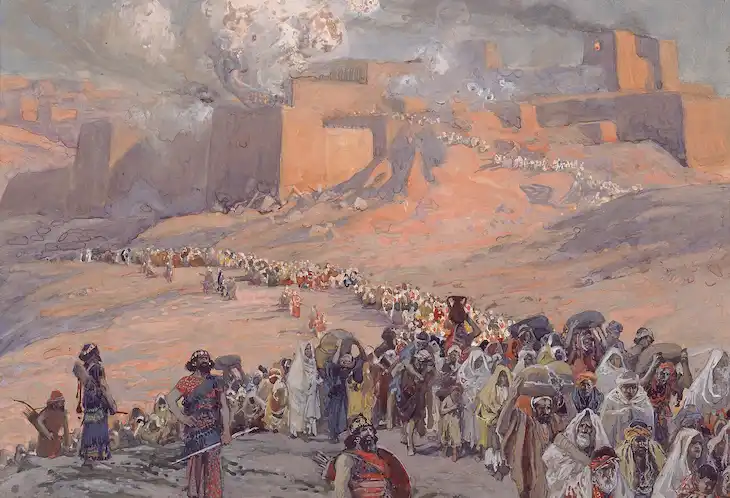 The Flight of the Prisoners (1896) by James Tissot; the exile of the Jews from the Land of Israel to Babylon (Wiki)
When the Roman Empire became the Christian Byzantine Empire, these Jews faced mounting religious discrimination, which pushed many to emigrate to more welcoming regions like the Sassanid Empire in present-day Iraq and Iran. Still, by 614 CE, when a Jewish revolt broke out against Byzantine rule, sources from the period estimated 20,000 to 26,000 Jewish fighters, representing a far larger underlying population, possibly in the vicinity of 150,000 to 200,000. By this point, however, other groups such as Greeks, Samaritans, Nabateans, and Christian immigrants from as far as Armenia and Georgia, had grown more numerous, and Jews had become a minority in their own land.
In the 630s, Arab tribesmen from Arabia overtook Byzantine forces and changed everything. Over the following centuries, the ethnic and religious communities of the Land of Israel went through a sweeping cultural Arabization. Under the newly introduced Dhimmi system, the legal framework governing non-Muslim subjects, Jewish leaders were made responsible for collecting the Jizya (poll tax) and had to master Arabic to deal with the authorities. Over generations, this filtered down from leaders to ordinary people.
High taxes on agricultural land also made farming less profitable, pushing many Jews out of small Galilean villages and into rising urban centers like Tiberias, Ramla, and Jerusalem, where Arabic dominated the streets and markets. To do business across the vast Islamic Empire, stretching from Spain to India, you had to speak the language of the empire. Arabic replaced Hebrew, Aramaic, and Greek as the language of economic survival. By the time the Crusaders arrived in 1099, the native Jews of the land were fully Arabic-speaking, both in public and at home. They looked, dressed, and spoke like their neighbors while maintaining Jewish religious practice and Hebrew-Aramaic liturgy.
This community prayed according to a rite called Nusach Eretz Yisrael, a liturgical tradition that predated the standardized prayer books of the Diaspora. They read the Torah on a triennial cycle, a three-to-three-and-a-half-year rotation that allowed for slower, deeper immersion in the text, and their prayers were rich with piyyutim (Hebrew liturgical poems) rooted in the local landscape. Perhaps most striking were their Sukkot traditions: Jews from across the land made an annual pilgrimage to Jerusalem, just as they had during Temple times. Unlike the Romans, who had banned Jewish entry to Jerusalem for 500 years, the Muslim rulers allowed it. For centuries, native Judeans physically circled the exterior of the Temple Mount on Sukkot in a massive, festive procession that echoed the ancient Temple rituals.
This era reached its cultural peak in the 10th century with the production of the Aleppo Codex, known in Hebrew as Keter Aram Tzova, the "Crown" of the Hebrew Bible. Compiled by the Masorete Aaron ben Asher in Tiberias, it standardized how the Biblical text is read and pronounced, inserting vowels and cantillation marks that shaped Jewish practice across the entire Diaspora.
Despite real achievements and periods of prosperity, the Jewish community in the Land of Israel went through a long and painful decline from the 4th through the 11th centuries. Religious restrictions under both Christian and Muslim rule, being barred from public office, prohibited from building or renovating synagogues, burdened with discriminatory taxes, combined with devastating wars, political upheaval, and massive earthquakes (including a major one in 749 CE) left the country economically broken and accelerated Jewish emigration. The Sages tried to push back against this tide as forcefully as they could. The Talmud states:
"A person should always live in the Land of Israel, even in a city where most of the inhabitants are idolaters, and should not live outside the Land, even in a city where most of the inhabitants are Israelites; for whoever lives in the Land of Israel is like one who has a God, and whoever lives outside the Land is like one who has no God." (Ketubot 110b)
Conversion also took its toll. During the Byzantine period, Emperor Justinian I banned synagogue worship and stripped Jews of basic civil rights to pressure baptism. In the early Muslim period, many converted to Islam to escape the crushing Jizya poll tax. During rarer episodes of state-sponsored forced conversion, such as the 11th-century decree of the "Mad Caliph" Al-Hakim, the choice was stark: convert or leave.
Through conversion, intermarriage, and assimilation, the native Jewish community shrank dramatically.
Historians estimate that roughly 20 to 30 percent of the Jewish population converted to Christianity during the Byzantine era, and perhaps 30 to 40 percent of the remaining Jewish and Samaritan rural population converted to Islam in the first centuries of Muslim rule. Through conversion, intermarriage, and assimilation, the native Jewish community shrank dramatically. Historians note that a significant number of Palestinian families, particularly in the Galilee and the Hebron hills, maintain traditions of Jewish ancestry, though exact figures are impossible to verify.
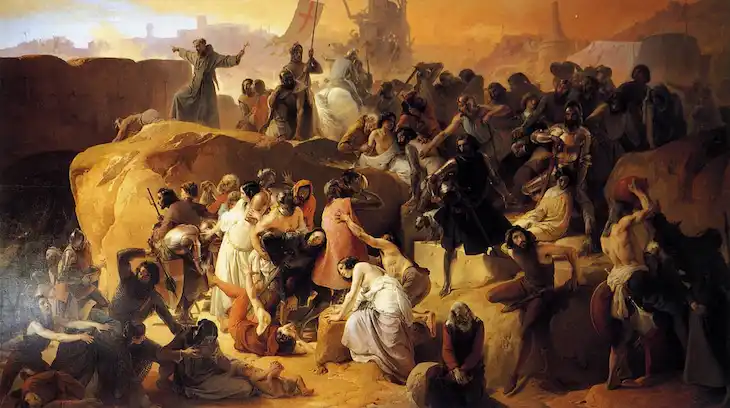 Francesco Hayez (1791-1882), Crusaders Thirsting near Jerusalem, c. 1836 - 1850
The final blow came with the Crusades. Crusading armies, fired up with religious zeal, slaughtered Jewish residents without mercy in cities like Jerusalem, Acre, and along their routes of conquest. Synagogues and communal institutions were destroyed. Survivors faced forced conversion or displacement. Before the Crusades, the Jewish population in the Land of Israel may have been 15,000 to 20,000. By the end of the Crusader period in the late 13th century, however, it had likely fallen to around 5,000. Those who survived were scattered across a handful of urban centers, Jerusalem, Safed, Acre, Gaza, Shechem (Nablus), and the Hebron area, along with a few ancient agricultural villages in the Galilee: Peki'in, Kafr Yasif, Ein Zeitim, Al Ja'una, Hittin, and Kfar Kana. The Jewish demographic presence in the Land of Israel had reached its lowest point in history.
When waves of Sephardic exiles began arriving after the Spanish Expulsion of 1492, and later when Ashkenazi groups immigrated in the 18th and 19th centuries, they encountered the remnants of these native Judeans. Seeing their Arab dress, customs, and language, they gave them a name: Mista'arvim in Hebrew, or Musta’arabim in Arabic, meaning "those who are Arabized" or "those who live among the Arabs." In the medieval mindset, "Arab" was a genealogical term, meaning you descended from the tribes of Arabia. Since these Jews were clearly Bnei Yisrael (Children of Israel), they couldn't be Arabs by blood. Musta'arabim was the perfect middle ground, acknowledging their Jewish lineage while describing their Arabic culture. They had absorbed the surrounding culture without abandoning their religious identity.
The relationship between the Musta'arabim and the Jewish newcomers during the Ottoman period (1517-1917) was a mix of genuine cooperation and real friction. Initially, the Musta'arabim served as indispensable intermediaries, bridging the gap between Jewish immigrants and Ottoman authorities through their fluency in Arabic and knowledge of local customs. But the social tensions ran deep. The Sephardim arriving from Spain and Portugal weren't just refugees, they were the elite of the Jewish world: former doctors, royal advisors, and wealthy merchants. The Musta'arabim, by contrast, were almost exclusively farmers, tending ancient stone terraces, pressing olive oil, and herding sheep. Sephardic newcomers dismissed them as "Primitive Jews," a condescending shorthand for people who had become too "Oriental" or "Arabized." Rather than joining existing Musta'arabi communities, the Sephardim generally marginalized them.
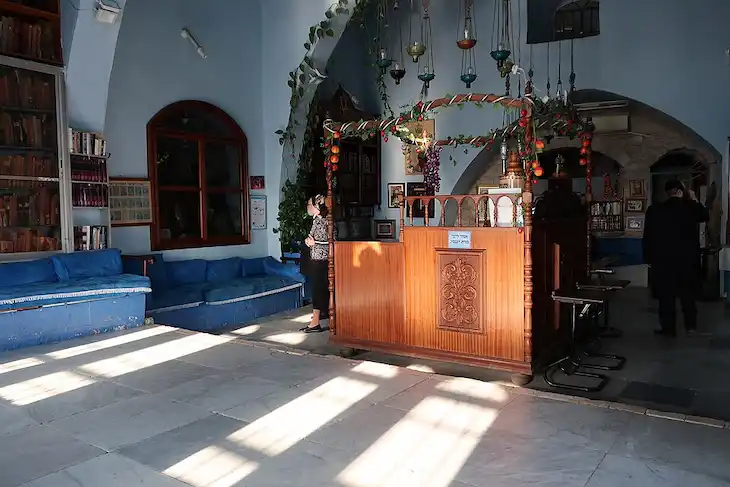 Interior of the Rabbi Yosef Karo Synagogue in Safed (Wikipedia, by Davidbena)
Although the Musta'arabim had their own ancient prayer rite dating back to the Byzantine and Talmudic era, Sephardic leaders, including giants like Rabbi Yosef Karo, author of the Shulchan Aruch (the definitive code of Jewish law), considered their own Nusach Sefarad more authoritative. Jewish printers in Venice and Istanbul were churning out thousands of Sephardic and Ashkenazi prayer books. The Musta'arabi community was small and poor. They couldn't afford to print their own. They kept using handwritten manuscripts into the mid-16th century, but eventually it became cheaper and more socially acceptable to simply buy a printed Sephardic prayer book.
There were also bitter disputes over kosher meat. Sephardim followed strict rules for examining cattle lungs, known as Glatt or Chalak. The Musta'arabim followed older, slightly different local traditions. Sephardic families refused to eat meat slaughtered by Musta'arabi butchers. This wasn't merely a religious disagreement. It was an economic blow that threatened families who had run the local butcher shops for generations, forcing them to either abandon their traditions or lose their livelihoods.
By the end of the 16th century, Sephardic rabbis in Safed and Jerusalem had established themselves as the supreme legal authorities, pushing the Musta'arabim to the margins. With greater numbers, stronger leadership, richer scholarship, more resources, and newly built synagogues and schools, the Sephardim gradually absorbed the Musta'arabi community. The Musta'arabim adopted Sephardic customs and prayer rites, while the Sephardim adopted Arabic, replacing Ladino and Spanish as their primary spoken language. As had happened in other Middle Eastern and North African communities, the two groups slowly merged into one, which explains why most people have never heard of the Musta'arabim.
Despite centuries of assimilation, Musta'arabi Jews still existed in the 19th and 20th centuries, though in dwindling numbers. They were the smallest Jewish community in the Old Yishuv (the pre-Zionist Jewish settlement in the land) during the late Ottoman and British periods.
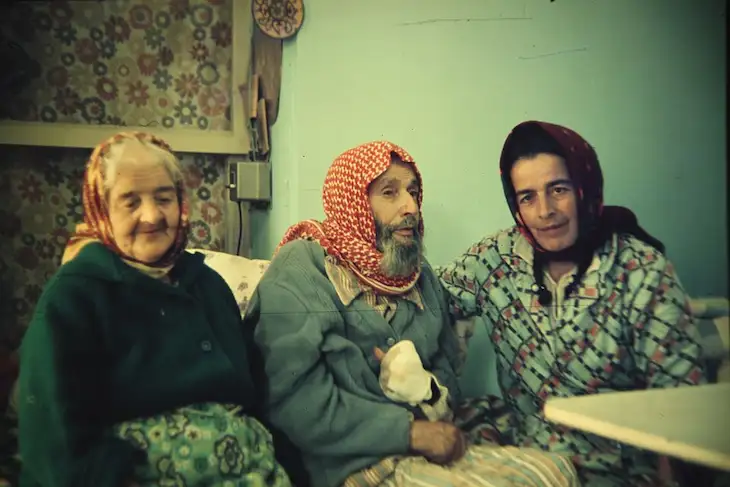 Mazal-Saada, Margalit and Yosef Zinati in their home in Peki'in. This is the last photo of Yosef before he passed away
Today, only one known Musta'arabi family remains in Israel: the Zinatis. They preserved their identity and customs without assimilating into Sephardic or Mizrahi communities. According to their own tradition, the Zinatis are one of three priestly families (Kohanim) who fled the violence of the Bar Kokhba Revolt in the 2nd century and relocated to the north. This isn't family legend alone. A beraita (an early rabbinic teaching) in the Talmud mentions 24 priestly families who relocated to the Galilee at exactly this time, and stone inscriptions found in ancient synagogues in Caesarea and Ashkelon, and in the Cairo Geniza, list which families settled in which towns. The Zinati family has lived in the village of Peki'in in the upper Galilee for the past 1,900 years. Peki'in is also home to a famous cave where, according to the Talmud, Rabbi Shimon bar Yochai and his son hid from the Romans for 13 years, during which he recorded the Zohar.
 Margalit Zinati
Today, Peki'in is an Arab village of Muslims, Christians, and Druze. Most of the Musta'arabi Jews fled Peki’in during the Arab Revolt of 1936 to 1939 or relocated to Israeli cities in later decades. The Zinatis stayed. Only one member of the family is still alive: Margalit Zinati, who never married and is considered the last Musta'arabi Jew in the Land of Israel. Born in 1931, she has lived her entire life in the same house her family has inhabited for generations, tending the ancient synagogue built with stones reportedly brought from the Second Temple. Researchers found two stone tablets inside the synagogue walls, carved with a Menorah, a Shofar, and a Lulav, dating to the 2nd or 3rd century, the same era as the priestly migration from Judea to the Galilee.
Margalit Zinati is a living testament to the fact that the Jewish presence in Israel isn't only a story of return after 2,000 years of absence. It is also the story of a 2,000-year presence.
The Musta'arabi Jews make a vital point in today's debate over Jewish indigeneity. We are not colonizers arriving on a foreign shore. We are a people returning to our family home, where a small, stubborn group of relatives kept the lights on and refused to leave. While the rest of the nation scattered like seeds to the wind, these Jews stayed.
The Musta'arabim no longer exist as a distinct group, but an estimated 10 percent of Israeli Jews are their descendants, an unbroken chain reaching back to Biblical times.
The prophet Isaiah wrote:
"And the Lord removes the people far away, and the deserted places be many in the midst of the land. And when there is yet a tenth of it, it will again be purged, like the terebinth and like the oak, which in the fall have but a trunk, the holy seed is its trunk." (Isaiah 6:12-13)
The branches scattered. The trunk held.
Sources:









Wow! "Historians note that a considerable number of Palestinian families—especially in Galilee and the Hebron hills—preserve traditions pointing to Jewish descent, though exact figures are impossible to ascertain. When the first waves of Sephardic exiles arrived following the 1492 Spanish expulsion, and later when Ashkenazi groups came in the 18th and 19th centuries, they found the surviving remnants of these indigenous Jewish communities."
The Musta'arabim: Jewish Continuity and the Palestinian QuestionA Historiographical AnalysisThe history Avi Abrams presents about the Musta'arabim Jews offers an important counterpoint to the narrative that Jewish presence in the Land of Israel was completely interrupted for two millennia. However, critical examination is necessary, especially when the text suggests implications about contemporary Palestinian identity.
I. Historical Evidence of Jewish ContinuityDocumentation of continuous Jewish presence in Galilee and other regions is substantial. Archaeological evidence of synagogues from the 2nd to 8th centuries, the literary production of the Mishnah and Jerusalem Talmud, and accounts from Jewish travelers attest that there was never a complete Jewish emptying of the region.
What an amazing enlightenment.Excellent historical facts but sadness too.
Am Yisrael Chai
Excellent article on an incredibly important subject: The indigenous continuity of Jews throughout history in the Land of Israel. In addition to the Musta’arabim Jews, other Mizrachi Jewish communities remained nearby throughout the Levant, from Syria and Lebanon to Jordan and Iraq.
A wonderful, illuminating account of our history and inalienable right to this land!!
Thank you Aish!!!
So the Jews who converted to Islam became the Palestinians?
Do Hamas and Fatah know that they are Jews?
No. Some might be, but the vast majority are Arabs from Egypt, Syria and a few other places.
This is in fact one of the claims of Anti-Zionism: that the “Palestinians” are the real Jews and the Jews who returned from exile are usurpers.
Thanks. Interesting and important.
With DNA results, every Jewish person can be identified Righteously. . . I checked myself, and I am not of Jewish ancestry!!!
DNA can provide info about genetic ancestors, but unless the person is the child of a Jewish woman, the person is not a Jew. And of course it doesn’t test for religious conversion. My children are Jewish, but that’s due to my conversion years before they were born.
Although 100 percent jewish through both parents, with thousands of years in Russia/Ukraine, my mother via Ancestry.DNA is 50% Canaanite. What does this mean exactly? It means the groups of exiled jews stayed in small towns and communities without outsider gene pool influence. By choice, and by persecution. I challenge anyone to state that by biology I am not linked to the holy land.
Shameful how the Sephardim treated these stalwart Jews who loyally clung to their homeland instead of fleeing it. Rather than being seen as 'primitive' by these Sephardic newcomers, the completely indigenous Mista'arvim should have been viewed as royalty. Their unbreakable bond to their homeland should have been highly rewarded, not eschewed.
How imperfect we are when we imagine that theory is superior somehow to simple truth.
Amazing! It should be taught in our schools! Thank you to the person who wrote it, and thanks to Aish for publishing it.
This is absolutely fantastic, Avi. Hazak ubaruch!
Wow, that was a fascinating article. Thank you for spending the time to write it and to share it with us.
Another excellent article, and fully documents the continued and unbroken presence of the Jewish people in Eretz Yisrael.