







 What Two Hebrew Words Reveal About Israeli Democracy
Jewish Geography
Jewish Geography






For 1,500 years, a Jewish community lived in the Caucasus Mountains as warriors, horsemen, and clan fighters. Most Jews have never heard of them.
From the hills of Jerusalem to the rivers of Babylon, finding their way to the highest peaks of the Caucasus — a story of a Jewish community that didn't just preserve their faith, but weaponized it for survival.
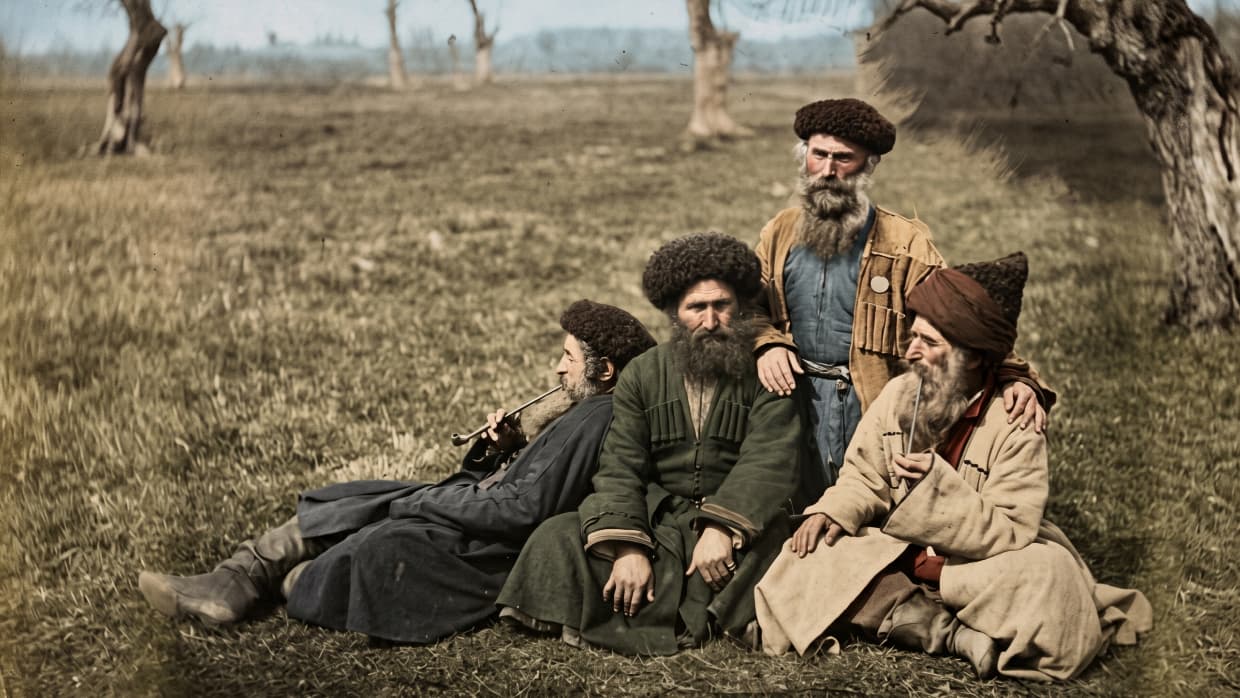
In the mid-19th century, a group of European Jewish travelers stumbled upon a sight they couldn't explain. Deep in the rugged Caucasus Mountains, they encountered men with sun-bronzed skin, thick beards, and the sharp eyes of eagles speaking a mysterious Persian dialect peppered with ancient Hebrew.
These men weren't hunched over books in a dimly lit study hall. They were on horseback, draped in wool chokhas (long cloaks) with cartridge pockets across their chests and silver-handled kindjal daggers at their waists. They looked like the fierce highland tribes of the region — Circassians and Dagestanis, but were they Jews?
These people had never heard of the Crusades, the Inquisition, or the Enlightenment.
And when the sun began to set, they turned toward Jerusalem and prayed.
This was the European "discovery" of the Juhuro (Mountain Jews). But the Juhuro had never been lost. They had been standing guard for 1,500 years.
How did a Jewish community end up in the mountain fortress of the Caucasus? The journey begins at the rubble of the First Temple.
Some oral traditions claim they descend from the Ten Lost Tribes exiled by the Assyrians, but historical and linguistic evidence points to a more specific path. Their language, Juhuri (Judeo-Tat), is a southwestern Iranian tongue rooted in the communities of ancient Persia and southern Iraq — regions that held the world's largest Jewish population for centuries after the Babylonian exile. That exile began in 586 BCE, when Nebuchadnezzar destroyed Jerusalem and deported the Jews of Judah to Babylon. The Persian Empire soon replaced Babylon, and while a small number of Jews returned to rebuild Jerusalem and usher in the Second Temple period, the vast majority stayed and lived under Persian rule for centuries.
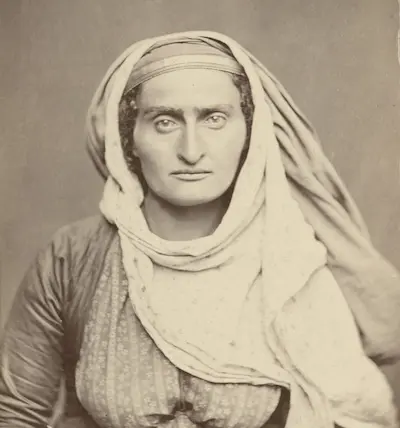 Mountain Jewish woman from Dagestan. 1870–1880.
Approximately one thousand years later in the 5th century CE, the Sassanid Persian Empire expanded its northern frontier into the Caucasus. To hold those mountain passes against raiders and invaders from the north, they needed loyal frontier populations. Their solution: move entire Jewish military colonies into the mountains. These weren't refugees stumbling through history. They were Jewish soldiers of the Persian Empire.
Modern DNA studies confirm that Mountain Jews share their closest genetic profile with Persian and Iraqi Jews, with the majority of their ancestry rooted in the Levant (the Land of Israel). Ancient gravestones in the Caucasus — some over a thousand years old — bear Hebrew inscriptions matching the script used by Persian Jewish communities.
In many ways, the Mountain Jews were the Native Americans of the Jewish world. Like the Apache or the Comanche, they developed a culture forged by isolation and high-altitude survival. Life in the mountains was tribal. You didn't just identify as a "Jew" — you identified with your teip (clan). Each clan had its own territory, its own elders, and its own blood-feud customs. If a member of another tribe harmed a Juhuro, the clan was expected to exact justice. This was a stark contrast to the retreat strategy most European Jews had no choice but to adopt.
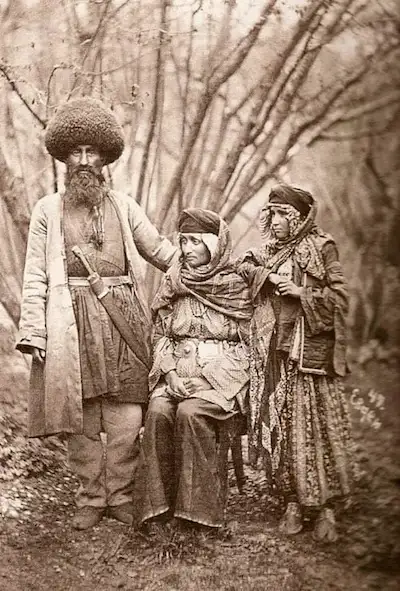 Like indigenous peoples of North America, they mastered a frontier where survival meant strength, mobility, and readiness for conflict. European Jews were often legally barred from bearing arms, which left them vulnerable to mob violence and pogroms. In most Islamic states, non-Muslims faced similar restrictions, though tribal frontier zones were frequent exceptions. Mountain Jews had no such limitations. They lived among powerful, battle-tested neighbors — and proved themselves just as formidable.
They were renowned for winemaking, carpet weaving, and leatherworking. But above all, they were master horsemen and capable fighters. They endured not by hiding, but by belonging to the world they lived in.
Between the 7th and 10th centuries, most Jews in the world lived under Christian or Muslim rule. The Caucasus, sitting at the crossroads of Eastern Europe and West Asia, became a buffer zone between those two rising religious empires. In that space, a multi-ethnic state emerged: the Khazar Khaganate.
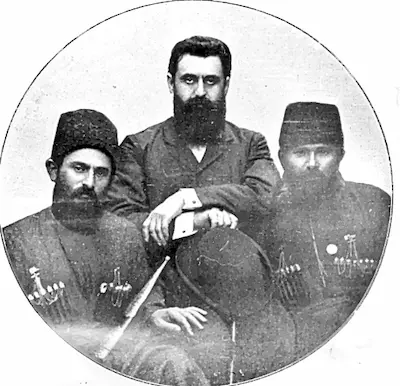 Mountain Jewish delegates with Theodor Herzl at the First Zionist Congress, held in Basel, Switzerland (1897)
The so-called Khazar theory — popular on antisemitic websites — claims that most Ashkenazi Jews descend primarily from the Turkic Khazar population rather than from ancient Israelites. Historians, linguists, and geneticists have widely discredited this claim. Modern genetic studies consistently show that Ashkenazi Jews share substantial Levantine (Middle Eastern) ancestry with other Jewish groups. Historical sources do support the view that the Khazar royal family and portions of the aristocracy may have embraced Judaism, likely for political reasons, to maintain balance between the Christian Byzantine Empire to the west and the Muslim caliphates to the south. But the broader population remained ethnically and religiously diverse — Turkic pagans, Christians, Muslims, and Jews. The Khazar realm was a pluralistic steppe empire, not a Jewish kingdom.
Still, for Mountain Jews, the arrangement offered real benefits. None of the discriminatory laws found in Christian and Muslim empires applied here. Jews could practice openly, maintain synagogues, run their own courts, and trade freely along the Silk Road — all while enjoying state protection from violence and persecution. Jewish, Muslim, and Christian writers describe Khazar rulers using Hebrew in official documents, maintaining Jewish courts, and minting coins with Hebrew inscriptions. One striking example: a 9th-century coin that imitates an Islamic dirham but bears the Arabic inscription "Musa rasul Allah" — "Moses is the messenger of God" — an echo of the Islamic Shahada ("Muhammad is the messenger of God"), with Moses in Muhammad's place. It's a small coin that tells a large story. For Mountain Jews, it was a golden age.
As the Russian, Persian, and Ottoman empires collided in the Caucasus, the Mountain Jews found themselves caught in the middle. While they often lived peacefully under Muslim Khans, they were frequently targeted during ghazavats (holy wars). In the late 18th century, the Persian conqueror Nader Shah brought them to the brink of annihilation.
It was then that Huseynali Khan, ruler of the Quba Khanate — a semi-independent state in what is today Azerbaijan — established a protected settlement for the Mountain Jews on the northern bank of the Gudyalchay River. He granted them land, protection, and a measure of autonomy. That settlement became Krasnaya Sloboda, known today as the last all-Jewish town outside of Israel.
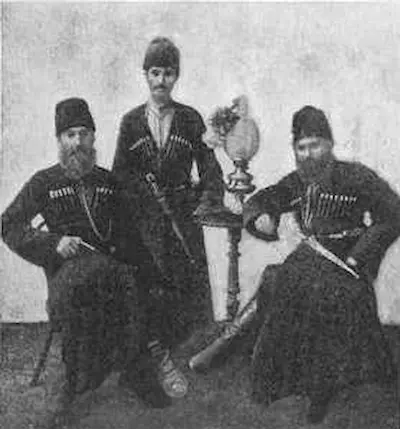 Mountain Jewish men, c. 1900.
Life there revolved around synagogues, Torah study, family networks, and trades: commerce, craftsmanship, winemaking, leatherworking. The community observed Jewish law, celebrated festivals together, and maintained a culture of self-defense and solidarity. During World War II, the Nazis advanced into the Caucasus but never reached the main Mountain Jewish strongholds, which sat some 300 to 400 kilometers from the front lines. At its peak in the 1980s, Krasnaya Sloboda was home to about 18,000 residents — roughly a third of all Mountain Jews in the Caucasus. Today, only 3,000 to 4,000 remain.
During the Soviet period, authorities attempted to dissolve Mountain Jewish identity by classifying them officially as "Tats," a Persian-speaking ethnic group. The goal was to deny their existence as a distinct Jewish group, but the community adapted. Many accepted the administrative label outwardly while quietly preserving Jewish life inside their homes, using the designation as a kind of legal camouflage that sometimes kept synagogues open longer than elsewhere in the Soviet Union.
Families maintained traditions through storytelling and ritual, found creative workarounds for religious observance, and passed down faith through tight family networks. Stories from the era describe miniature tefillin, small enough to hide so that prayer could continue under Soviet surveillance.
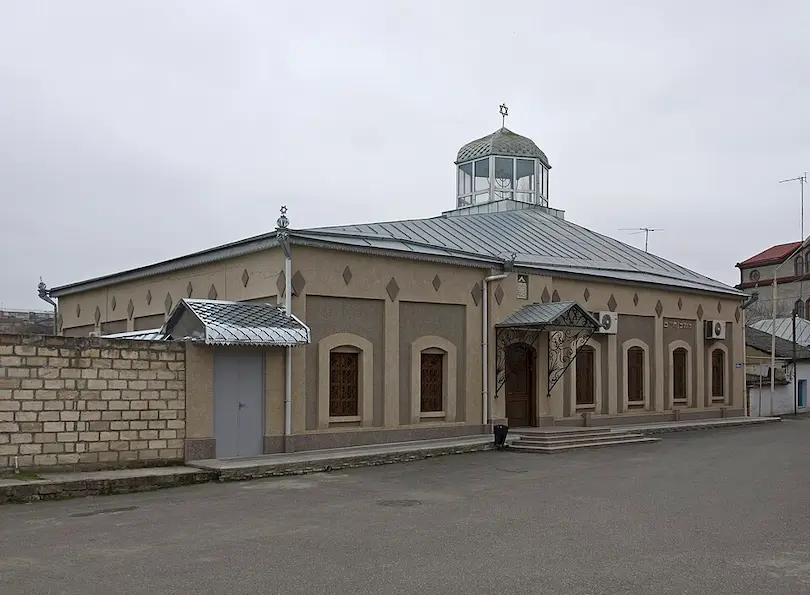 Hilaki Synagogue, Krasnaya Sloboda
After the USSR collapsed in the early 1990s, the floodgates opened. Large numbers of Mountain Jews made aliyah to Israel, settling in cities like Or Akiva and Hadera, while others built new communities in Moscow and Brooklyn. Yet Krasnaya Sloboda didn't disappear. Every summer, former residents return from abroad for family reunions, restoring synagogues, building new homes, and keeping this "Caucasian Jerusalem" alive as a living link to their past.
Centuries of isolation in the Caucasus gave Mountain Jewish culture a character shaped by both Jewish law and the surrounding tribal world. Many families carried surnames tied to their original village or clan, reflecting the kinship networks central to mountain life. At weddings, communities sing the Benigoru, an emotional song reciting the names of departed relatives, as if inviting them to share in the celebration. Before a bride enters her new home, she smears honey on the doorway, a custom symbolizing sweetness and blessing in married life. During Passover, Mountain Jews follow Sephardi and Mizrahi practice by eating rice, though they traditionally refrain from it on the first two nights, a local custom they preserved within their own community.
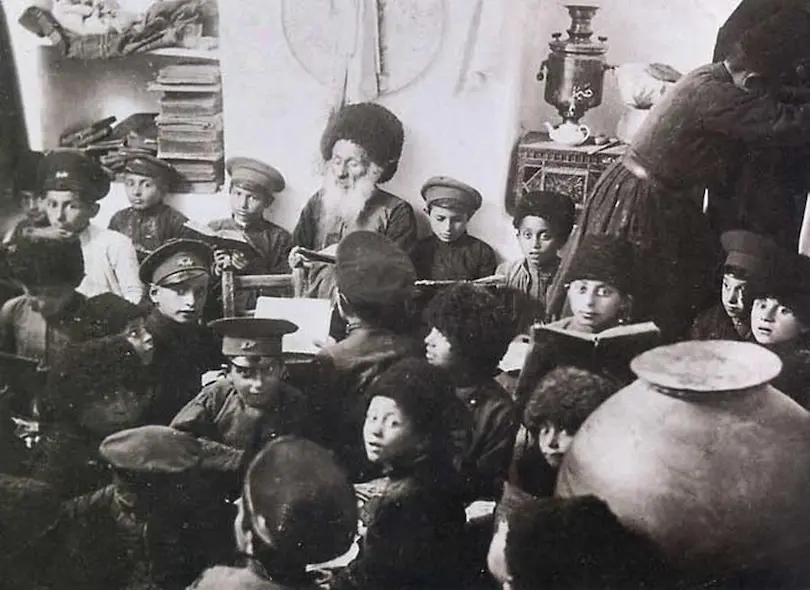 Class held at a primary Mountain Jewish school in Quba. Early 1920s. (Wikipedia)
In prayer, they follow Nusach Kavkazi, a rite closely related to Sephardi-Mizrahi liturgy but enriched with local melodies, distinct pronunciation, and piyyutim (liturgical poems) passed down orally for generations. Polygamy existed among some families historically — more as a regional custom than a religious norm — but it largely disappeared in the 20th century and is not practiced today.
What remains most distinctive is a tight combination of traditional Jewish observance with tribal-style communal identity: extended families living close to one another, deep respect for elders and ancestors, and a culture of collective celebration and mutual responsibility that runs strong even among younger generations.
In Israel, Mountain Jews are commonly called Kavkazim and fall administratively within the broader category of Mizrahi (Middle Eastern) Jews. Among the most prominent Israeli cultural figures of Kavkazi origin is Sarit Hadad, one of Israel's most successful Mizrahi pop singers, whose family roots trace to the Mountain Jewish community. Avraham Tal is another well-known performer, recognized for blending spiritual themes with contemporary Israeli music.
 Sarit Hadad (Wikipedia)
In sports, Olympic medalist Yarden Gerbi, who won bronze at the 2016 Games, has partial Caucasian Jewish heritage. In philanthropy and community leadership, figures like Yevda Abramov and German Zakharyayev have played major roles in strengthening Mountain Jewish institutions in Israel and the Diaspora. Small in number but outsized in influence, the Kavkazi community has left a distinct mark on Israeli music, business, and communal life.
For 1,500 years, the Mountain Jews have proved that Jewish survival takes many forms, not only through scholarship or assimilation, but through strength, adaptation, and fierce communal loyalty. From ancient Judean exiles to frontier horsemen of the Caucasus, from hidden prayer under Soviet rule to thriving communities in Israel and the Diaspora, their story is one of continuity against all odds. Their mountain villages may be quieter than they once were, but the spirit of the Juhuro endures, rooted in faith, family, and an unbroken chain of generations.








Did they wear Tefillin
Of Course
My Mother’s zt’l DNA said Caucasus and I did not know what that meant at first. I then traced her to Persia Babylonia when her family the Gaon’s came from to Spain. I’m thankful for this article and in getting to know more of our history.
What a fascinating, historical and very well written story about an ancient Jewish sect. Kudos to the author, Avi Abrams. I would love to hire him as a tour guide the next time my wife and I visit Israel.
God Bless the Juhuro Jewish Community.
Very interesting. Curious to learn more about this Quba that’s named in one photo as my father always said he was born there-but he’s been deceased since1976 and there’s no one to ask.
My Grandfather was from Baku and was a mountain Jew who left in 1918. We don't know much about what happened to his family, but I am fascinated by the culture.
what was the the status of women in these communities?
The best article about an exotic Jewish people and their culture that I’ve read for a very long time., thank you.
Fascinating, thank you!
Caucasus Jews, Mountain Jews, Gorsky Evre-im, Qawqazim, Kavkazim have a name in Israel of being able to be tough. This is a GREAT article because it explains why and also explains how they became so communally observant (observing TOGETHER). Among my favourite singers is the 'Omer Adham!!! He's Qawqazi & sticks up for Judaism! WHAT A VOICE!!! One of our nieces married a Qawqazi guy in NY. My wife's wig stylist is Qawqazi adjacent to the Jerusalem Central Bus Station. Someone played me an audio clip of Yighdal & it sounded EXTREMELY similar to the YEMENITE version.
My grandmother told us we were descended from a small european country in which the rulers converted to Judaism. She did not mention the name. My father didn’t know either….just a family tale….but Apparently her maiden name was an identifier of her heritage. Did we ever ask questions? Show curiosity ?…no…kids……..
Could be Subbotniks (Russian Gentiles who came in close contact with Russian Jews & decided to convert to Judaism). https://religion.fandom.com/wiki/Subbotniks
Heroes!
The Khazars were a Jewish kingdom who dictated terms to the Arabs and other Muslims.
They should be admired.
How great to know about these admirable people!
Of course, the toughest Jews in history are the members of the IDF, may they all be blessed and guarded by Hashem.
Amen , to that
Excellent and informative
Would love to visit this community.
"Historical sources do support the view that the Khazar royal family and portions of the aristocracy may have embraced Judaism"
There isn't really any historical evidence for even that limited claim.
Fabulous article!!!!