




 University of Michigan Crossed a Dangerous Line with Jewish Students




5 min read


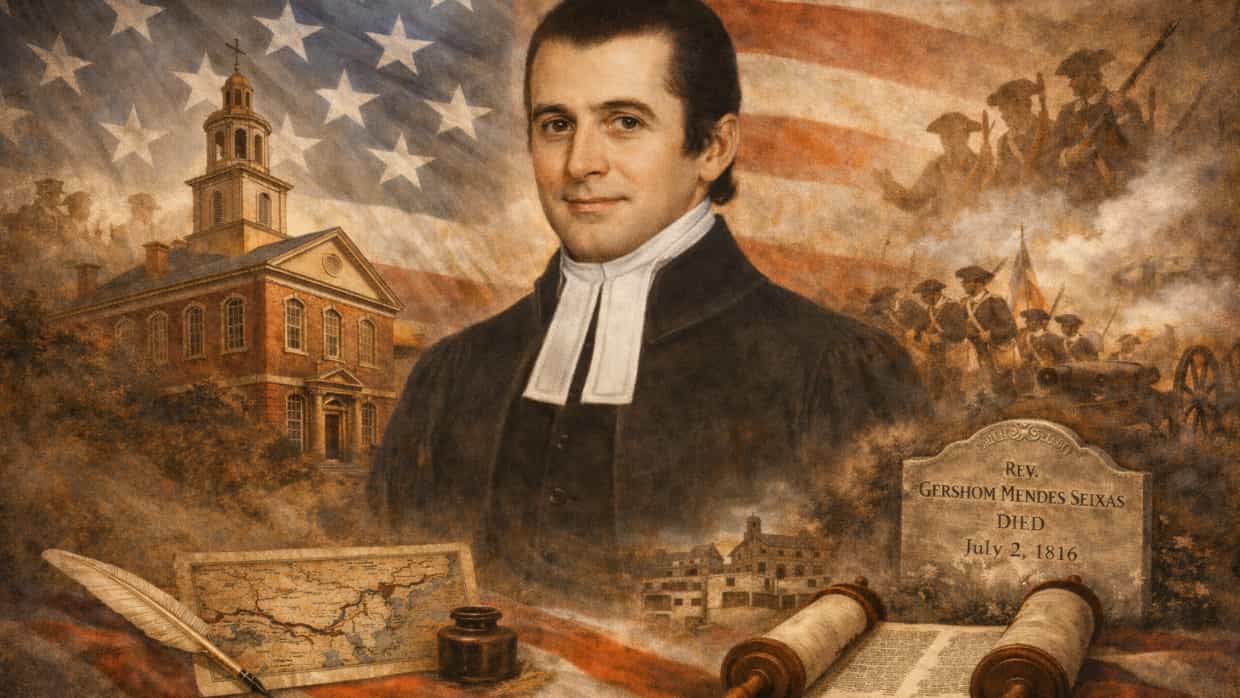
Gershom Mendes Seixas led his congregation through revolution, exile, and near-collapse. Contemporary American Jewish life is built on his groundwork.
Long before there were synagogues across America, Jewish life here was fragile, scattered, and at serious risk of fading away. One man quietly changed that. His name was Gershom Mendes Seixas, and without him, the Jewish community we take for granted today might never have taken root.
Today, few people outside of historians have heard of him. But in many ways, he was America's first homegrown Jewish religious leader, the spiritual architect of the early American Jewish community.
Gershom Mendes Seixas was born in New York City on January 14, 1745. His father, Isaac Mendes, was of Sephardic background and had fled Portugal, where Jews were forced to practice Judaism secretly as Marranos (crypto-Jews who practiced in hiding). In America, for the first time, he could live openly as a Jew. His mother came from an Ashkenazic German family. The Jewish community of colonial New York had been founded by Sephardic Jews, and all newcomers agreed to follow Sephardic customs within Congregation Shearith Israel, the first Jewish congregation in America.
Young Gershom received both a Jewish and secular education at the community school attached to Shearith Israel. He learned Hebrew, the Bible, and Jewish law, alongside practical skills for life in colonial America. He was also deeply influenced by Rabbi Yosef Yeshurun Pinto, who led the congregation for eight years before returning to his native London.
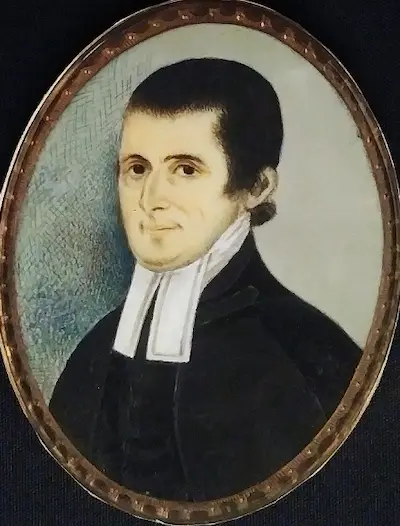 Gershom Mendes Seixas, c. 1784 (Wiki Commons)
At the time, no ordained rabbis were living permanently in America. Visiting leaders like Pinto would come from England and elsewhere to teach and inspire, but the day-to-day spiritual leadership fell to learned laymen who served as prayer leaders, teachers, ritual slaughterers, circumcisers, and communal guides.
In 1766, at just 23 years old and not yet married, Seixas applied to lead Shearith Israel. He was competing against older, European-born candidates. He won unanimously, becoming the first American-born Jewish religious leader to head a congregation in the New World.
His responsibilities were enormous. He led prayers, read from the Torah, taught the young, performed circumcisions, officiated at weddings and funerals, and answered questions of Jewish law. He was, essentially, New York's only Jewish religious authority. His salary was modest and occasionally cut when the congregation hit financial trouble.
In 1776, as British forces moved to take New York, Seixas instructed his community to leave the city, fearing, at minimum, that they would be forced to house or supply British troops. He relocated with his family to Connecticut, taking Torah scrolls and sacred objects with him for safekeeping. Later, he moved to Philadelphia, temporarily leading Congregation Mikveh Israel, before returning to New York after the war.
When American independence was won, Jews found themselves with full civil rights in a republic built on religious liberty. Seixas celebrated this in his sermons, often expressing gratitude to God for the blessings of freedom. But he also pushed back against a comforting illusion: political liberty did not mean freedom to assimilate. America was generous but Jews were still in exile. Their covenant with God still mattered.
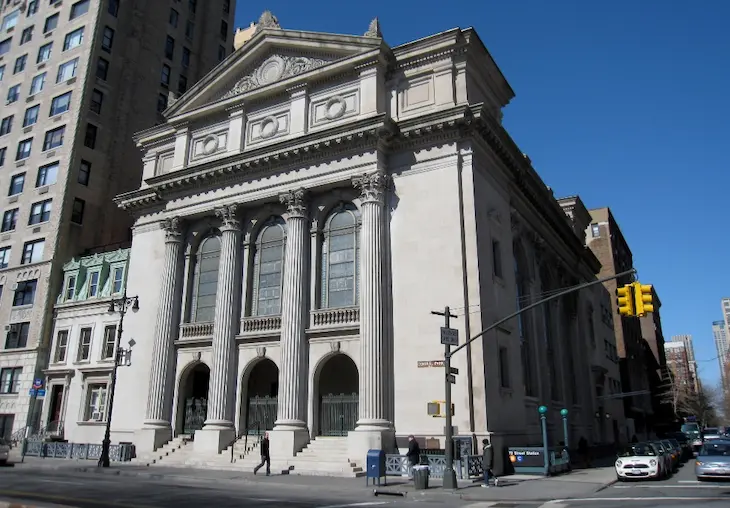 Congregation Shearith Israel in Manhattan
In one address, he declared that Jews were "more called upon to return thanks for the many and various blessings that have been graciously bestowed upon us." Gratitude, for him, was a religious obligation.
Seixas was also a communal builder. He organized charitable societies to care for the poor. He founded what may have been America's first free Jewish burial society, ensuring that even those without means could be buried with dignity. He worked to strengthen Jewish education and raise the level of Torah study. Later in life, he was assisted by his son-in-law, Rabbi Yisrael Ber Kursheedt, who had studied in Europe and brought serious Talmudic scholarship to American shores.
He was also active in broader American civic life. He served as a trustee of Columbia College and sat on the Board of Regents of the University of the State of New York. He was among the clergy invited to participate in President George Washington's inauguration in 1789.
His life was not without hardship. After ten years of marriage, his first wife, Elkaleh, died, leaving him with four young children. He remarried and fathered eleven more. Financial struggles persisted throughout his career. His health declined in his later years. Yet he kept serving his congregation, faithfully, for nearly 50 years.
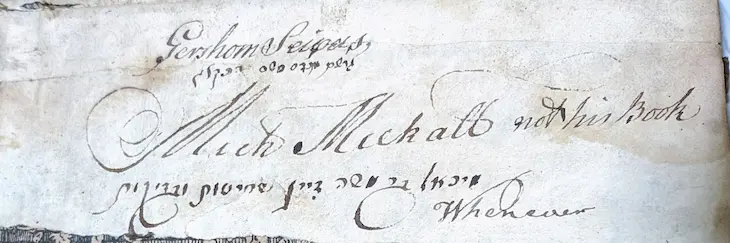 Hebrew and English signatures of Gershom Mendes Seixas (Wiki Commons)
In 1811, at 66, he made an arduous journey to Canada to perform circumcisions in several Jewish communities, a trip lasting over a month. Even in old age, he felt responsible for Jews wherever they were.
He died on July 2, 1816. He is buried in the Shearith Israel cemetery in Lower Manhattan, where his grave remains today.
The American Jewish world we know today — the synagogues, schools, organizations — didn't build itself. In the eighteenth century, it was barely hanging on.
Seixas built the institutions, educated the next generation, cared for the poor, and kept his community Jewish through war, hardship, and the constant pull of assimilation. He made sure there was something left to build on.
He taught that freedom should deepen gratitude to God and strengthen Jewish commitment, not weaken it. He showed that Jews could be loyal American citizens without giving up who they were. He insisted that even in this land of opportunity, the covenant between Jews and God still came first.
Gershom Mendes Seixas’s name may not be widely remembered but his legacy lives on wherever Jewish life flourishes on American soil.






I read about this wonderful man, also a lot of Crypto Jews ended up in places in the world, where outwardly Jews couldn't be there at the time, for instance England and also Mexico was under the Spanish and Portuguese inquisition, also before New York was called New York, it was called New Amsterdam and a certain anti semite did want for Jews/ or Crypto Jews to settle in then New Amsterdam in a ironic twist the company, that send them to New Amsterdam were owned by Jews, so these Jews ended up settling in then New Amsterdam, which is a true story that is in history
Great article!
Much appreciated!
Crypto Jews are not called marranos any more
A wonderful and very enlightening article. Thank you.
Thanks so much
https://sapirjournal.org/aspiration-ii/2026/the-future-is-sephardic/
As we approach America250, it’s wonderful to read about Jews in Revolutionary America.
Amazing article!
Thank you very much!
Thank you, Reb Yosef, for a very informative and inspiring article. Rabbi Seixas must have had many merits.
Much appreciated, R' Eliyahu. Yes, indeed. Especially, in view of the fact that he was away from home for weeks to perform brisen in many places.
Congregation Shearith Israel (better known as "The Spanish Portuguese Synagogue,") pictured in the article, is on Central Park West on New York City's Upper West Side. The rabbi there is Meir Soloveichik, a VERY learned man! He has an in-depth grasp of American Jewish history, and he often gives lectures on that topic in his synagogue to a full house. His lectures include:
Attending his lectures is a real treat and an opportunity to learn everything about Judaism in early America. Within the synagogue is a display of its history and many other displays.
A great man!
We are not all living in America! Ther are Jews who are neither American or Israeli.
your point being what exactly?
IT'S CALLED HISTORICAL EMPATHY! AND APPRECIATION!
NO NEED TO HIDE IT...JUST PRIDE IT!