








 The Macklemore Mess: What Pink Got Right and Everyone Else Got Wrong
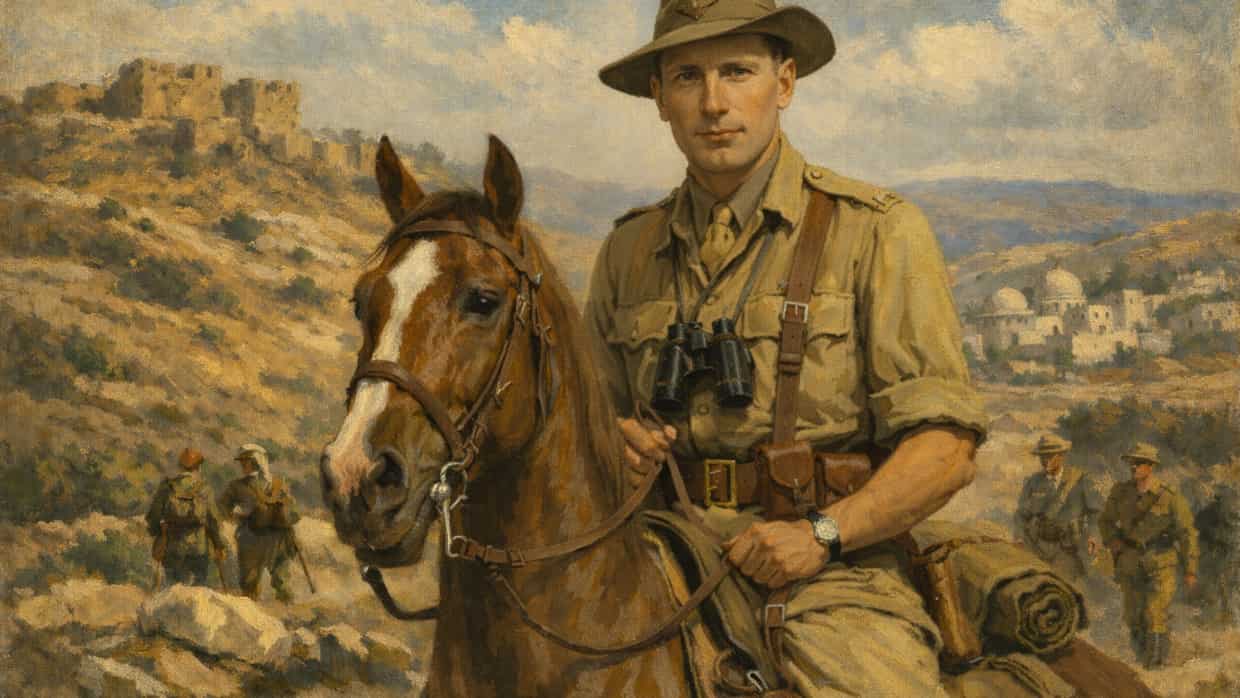








The great British military leader helped shape Israel's army and was an unorthodox, controversial tactician.
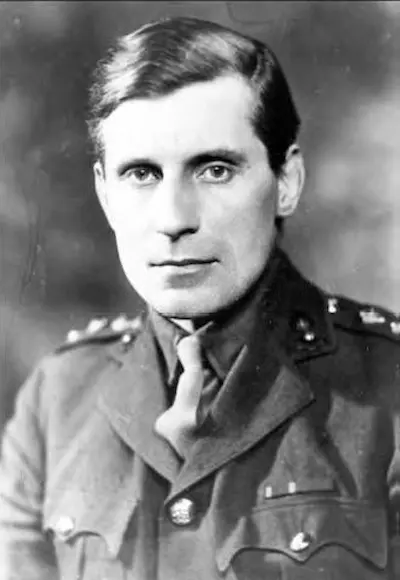
Orde Charles Wingate was known by many monikers during his lifetime. A decorated British Army officer who rose to Colonel, he was known for innovative brilliance and a willingness to court controversy. In Israel today, he's remembered as the father of the Israel Defense Forces. During his lifetime, Jews in the Land of Israel simply called him Hayedid -- "The Dear Friend."
Here are a few facts about the complex man who helped mold today's Israeli army.
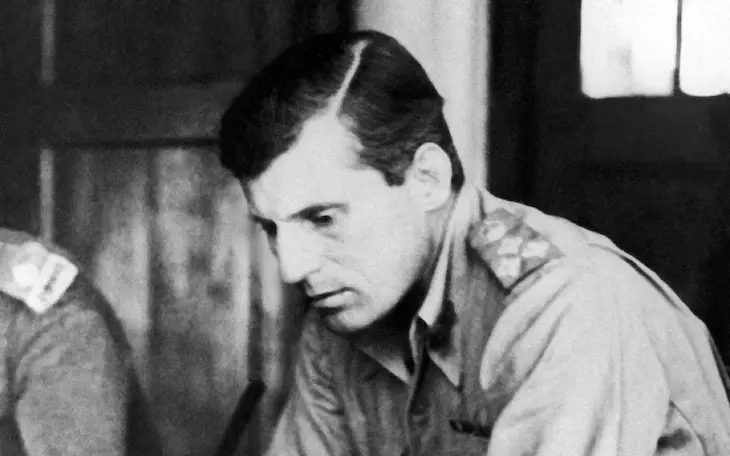
Orde was born in 1903 in India, where his father George was stationed as a British Army colonel. His family were deeply religious Christians. (Ironically, given how ardently Wingate would champion Jewish interests, his grandfather William Wingate devoted his life to converting Jews to Christianity, even learning German and Hebrew to better reach Jewish communities.)
With relatives serving throughout Britain's overseas military, Orde's path into the army was never in doubt. He was drawn to the Middle East, the setting of the Biblical stories he'd grown up with. His relatives advised him to learn Arabic and mentioned that he was a distant relation of T.E. Lawrence, "Lawrence of Arabia", who had stoked Arab nationalist sentiment and led revolts against the Ottoman Empire. Orde studied Arabic in London, then was posted to Sudan, where he became fluent.
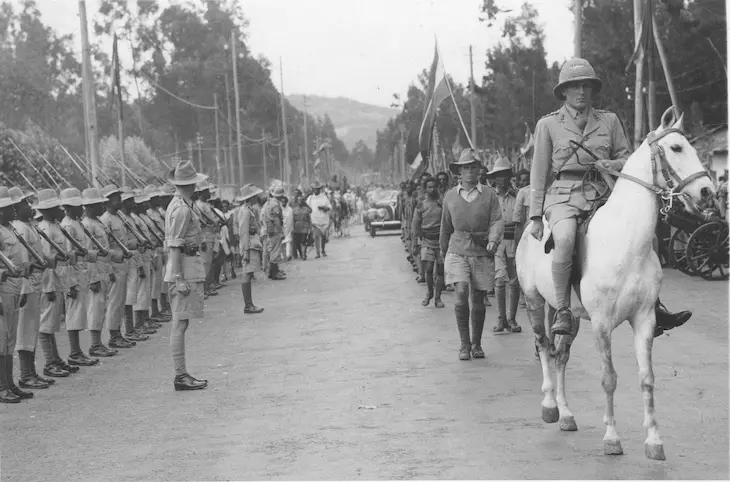 Orde Wingate, 1941, enters Addis Ababa on horseback.
He saw action in Sudan and Ethiopia, leading troops to stop illegal slave trading and ivory poaching. On a trip home to England, he met his future wife Lorna. Both were eccentric and bohemian; they kept unusual pets (including a goat and a monkey) and practiced yoga, virtually unheard of outside India at the time. At dinner parties, Orde would hold forth on politics and culture, speaking fast and with intensity. Lorna would jump in and debate him vigorously while their astonished guests watched.
In 1936, Orde was transferred to the Fifth Division of British Army Headquarters in Haifa, in what was then Mandatory Palestine.
For 400 years, from 1517 to 1917, Haifa and what is now modern Israel had been ruled by the Ottoman Empire, part of a district that included present-day Lebanon and Syria, with Damascus as its regional capital. That ended when the Ottomans allied with Germany in World War I and lost, forfeiting most of their outlying territories. Present-day Israel and Jordan became Mandatory Palestine, governed by the British. (Notably, the term "Nakba" -- Arabic for "disaster" -- which anti-Zionists today apply to Israel's founding, was originally used by locals to describe the disaster of no longer being part of Syria after 1917.)
In 1922, the British installed King Abdullah of the Syrian Hashemite family as Jordan's king, helping him suppress his enemies and establishing a quasi-independent Kingdom of Jordan under British control. (Jordan became fully independent in 1946.) That left present-day Israel, Gaza, and the West Bank as "Mandatory Palestine," ruled directly by British forces.
Within 48 hours of taking command in Haifa, four of Orde's men were shot dead in an Arab ambush.
 Jewish and Arab immigration to Mandatory Palestine had both been rising since the early 1930s. Thousands of Jews fleeing antisemitism in Europe were arriving in the Land of Israel, but for every Jewish immigrant, two Arab immigrants arrived from elsewhere in the Middle East, drawn by the economic boom Jewish immigration created. Despite sharing the land, many Arab residents were bitterly opposed to living alongside their Jewish neighbors.
Haj Amin al-Husseini, the Grand Mufti of Jerusalem, called for a massive Arab revolt to expel both Jews and British troops. Attacks spread across modern-day Israel, leaving hundreds dead and thousands wounded. Years later, Golda Meir, who would become Prime Minister, described what daily life felt like:
The riots started in April, 1936. By that summer it was no longer safe for Jews to travel from one city to another. Whenever I had to go from Tel Aviv to Jerusalem for a meeting -- which was frequently -- I kissed the children good-bye in the morning knowing that I might well never come home again, that my boys might be ambushed, that I might be shot by an Arab sniper at the entrance to Jerusalem or stoned to death by an Arab mob on the outskirts of Tel Aviv. (My Life, Golda Meir, 1975)
Arab militias of 50 to 200 fighters -- many recruited from Syria -- controlled vast stretches of territory. British police stations stood abandoned. Main roads through Judea, Samaria, and the Galilee were controlled by militias and in some cases mined. Arms flowed in from Lebanon and Syria, often funded by Nazi Germany.
British officers made little secret of their sympathy for the Arab side, even as their own soldiers were being targeted. One officer put it bluntly: "Certainly the Jews were white, but they didn't speak English. Yes, they worked like hell -- few of us had ever seen Jews work like that before, and they turned great sandy deserts into beautiful green oases with oranges, lemons, and fresh vegetables. But give me the Arab every time, said Tommy Atkins (Tommy Atkins being a moniker for a regular British soldier, like GI Joe in America)." (Fire in the Night: Wingate of Burma, Ethiopia, and Zion, Bierman and Smith, 1999)
Orde was not one to follow the crowd. Soon after arriving in Haifa, he told his friend Lt. Tony Simonds: "Everyone's against the Jews, so I'm for them."
Orde befriended Chaim Weizmann, who would become Israel's first President, and other Jewish leaders. Weizmann later recalled being drawn to Orde's spirituality and personal magnetism. "My wife and I loved and revered him," he wrote. Orde began learning Hebrew and built relationships with the Haganah, the underground Jewish defense force that was the precursor to the Israel Defense Forces.
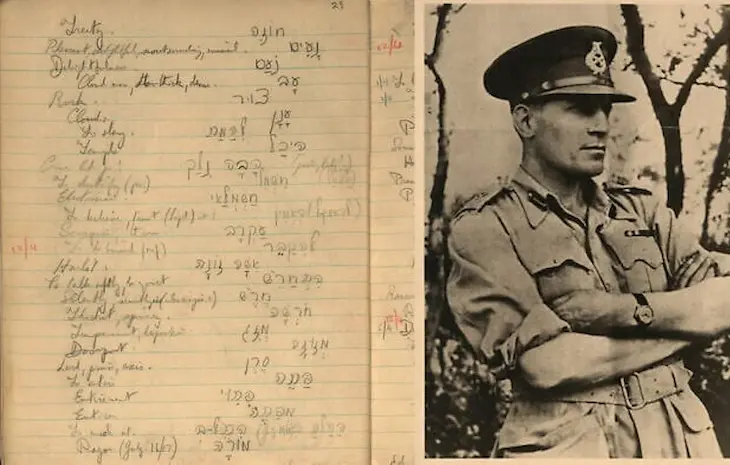 Left: An undated entry from British officer Orde Wingate's personal notebook showing his notes in studying Hebrew, now available at the National Library in Jerusalem; Right: A 1944 photograph of British officer Orde Wingate, available at the National Library in Jerusalem. (Orde Wingate Archives, National Library of Israel)
He wrote that during the Arab Revolt, Jews "had to witness their work destroyed, their families threatened, their blood spilt, and the blame for all laid on their shoulders" by the British army. Yet he argued forcefully to his superiors that the Haganah could be a potent partner:
The Jews are loyal to the Empire. The Jews are men of their word.... You can have no idea what they have already done here. You would be amazed to see the desert blossom like a rose -- intensive horticulture everywhere, such energy, faith, ability and inventiveness as the world has not seen.... The Jews will provide better soldiery than ours. We have only to train it.
Two years after Orde arrived, the Arab Revolt was winning. Arab militias controlled vast swaths of countryside and openly murdered Jews, British soldiers, and any Arabs suspected of cooperating with Jews. Only two British Brigades were stationed across all of Mandatory Palestine, and they were outnumbered. When militias began attacking the pipeline carrying oil from Iraq to Haifa, British commanders knew they had to try something new.
Orde spent two months going out on patrols with Haganah fighters and residents of Jewish towns who stood guard every night. He studied the militias' tactics up close their surprise attacks and ambushes, and became convinced that the only answer was to go on the offensive. He proposed a bold plan: let him form a dedicated counterterrorism unit combining British forces and Jewish fighters. His superiors approved it.
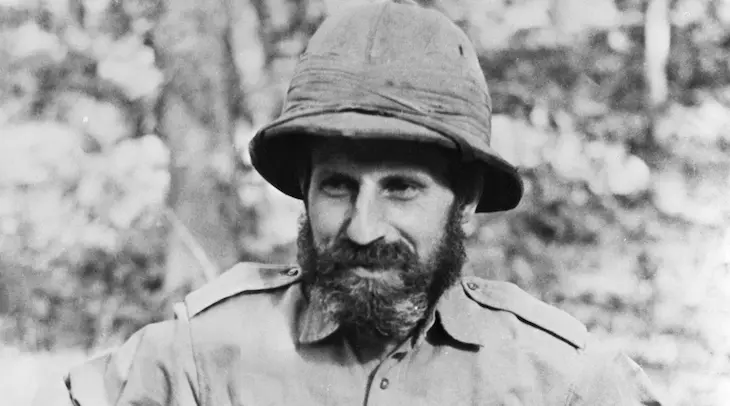
He assembled a force of 80 Jewish fighters and 40 British soldiers, calling them the Special Night Squads. They operated for just five months, but succeeded in reopening main roads and breaking the militias' grip.
Based at Kibbutz Ein Harod, the Special Night Squads trained hard. When darkness fell, they moved out. Soldiers on foot were expected to cover at least 15 miles a night, moving in complete silence, with bayonets wrapped in dark cloth so no glint of metal would give them away. Orde even ordered corks placed on bayonet tips to prevent accidental wounds during pitch-black marches.
Other units headed out in truck convoys. Here too, Orde devised new methods. Covered trucks left Ein Harod nightly, with no way for enemy spies to tell which carried troops and which were decoys. When soldiers arrived near a militia-held area, the trucks parked at a distance. Soldiers slipped out silently and encircled villages and lookouts without making a sound.
Discipline was absolute. Anyone with a cold who might sneeze was left behind. Anyone who coughed was beaten. No extra gear was permitted, only ammunition.
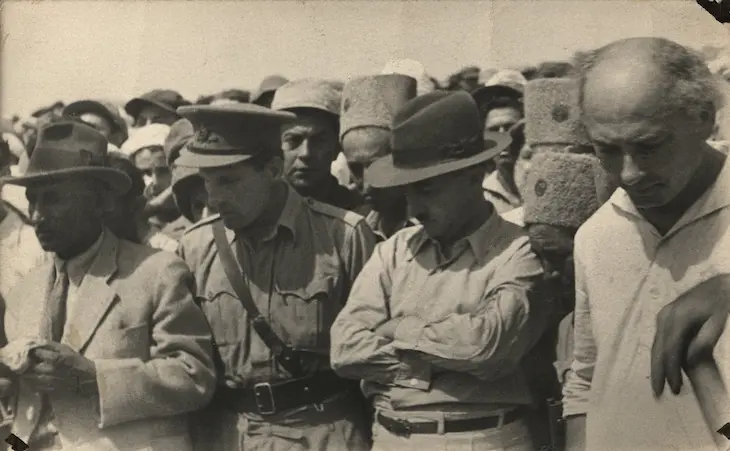 A 1938 photograph of British officer Orde Wingate (2nd from left), available at the National Library in Jerusalem. (Orde Wingate Archives, National Library of Israel)
Despite the severity, Orde was a respected leader. He transformed the thinking of Haganah fighters. "He taught us to go beyond the wire," said Zvi Brenner, a Jewish fighter whose military career began in the Special Night Squads. "Not just to defend our settlements, but to go out and confront the enemy in his lair."
The Special Night Squads had been running for three months when an incident in September 1938 planted the seeds of their end. Orde was mid-lecture to fellow officers when a subordinate burst in with news: Chaim Sturmann, a Jewish communal leader and close friend of Orde's, had been killed driving over a militia landmine.
Orde ran to his car. He led a group of soldiers into an Arab neighborhood in nearby Beit Shean and went on a rampage, running into stores and destroying merchandise. Locals said several people were killed. Even some of his strongest supporters were shaken. There was a painful irony: Chaim Sturmann, whose death triggered the rampage, had been known as a devoted friend of local Arab communities who had spent his life working to improve Jewish-Arab relations.
It wasn't the first time Orde had crossed a line. Some soldiers who served with him later recalled him beating civilians suspected of sheltering militants to extract information. In one well-documented case, he brought two Arab civilians to Kibbutz Ein Harod to question them about militias they'd helped. His methods turned violent, and kibbutz residents tried to intervene.
On October 2, 1938, Arab militants entered a Jewish neighborhood in Tiberias and launched a killing spree, shooting and stabbing as many Jews as they could find. Nineteen were murdered, including 11 children. The militants set a synagogue on fire and threw some of the stabbed children into the flames while still alive. British soldiers at the scene did not intervene.
 Orde received radio reports of the attack and rushed to Tiberias. By the time he arrived, the militants had begun looting Jewish shops and drinking stolen liquor. Drunk and weighed down with loot, they were easy targets. Orde and his Special Night Squad soldiers killed between 40 and 50 of them. Two days later, Orde tracked the cell behind the attack to an Arab village called Dabburiya and called in Royal Air Force support; an RAF bomb killed 14 more militia members.
The British authorities were alarmed by the militia casualties. The Special Night Squads' success was also radicalizing more Arab residents and swelling the ranks of new militias. Orde's superiors ordered him to disband the unit. In a stunning act of insubordination, he refused. In October 1938, the Special Night Squads were shut down by force. Orde Wingate was ordered out of Mandatory Palestine -- and the British Army took the unusual step of banning him from ever returning.
Orde continued his military career. In 1941, he led Allied forces against Italian troops in Ethiopia and helped liberate the country. He went on to fight in Burma, organizing the Chindits, a highly trained covert force that operated behind Japanese lines. In 1944, at age 41, he was killed when his plane crashed in Burma shortly after takeoff.
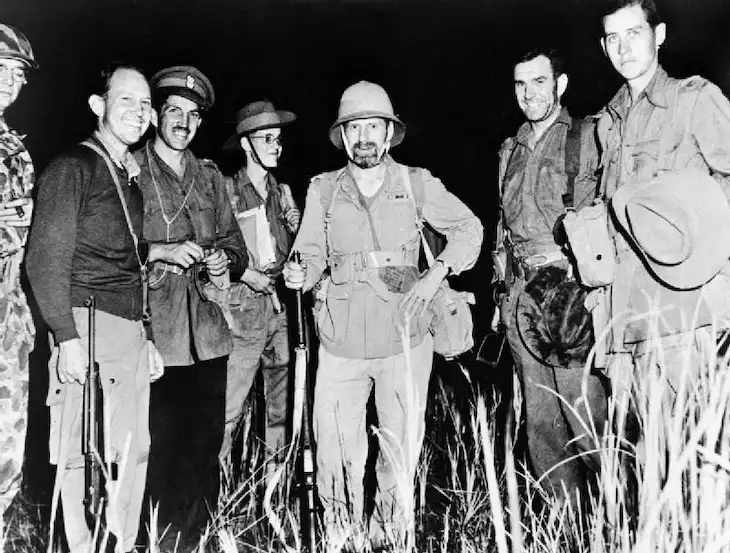 Wingate with Chindit leaders
His legacy in Israel runs deep. Orde Wingate trained some of Israel's greatest military minds, including General Moshe Dayan. Pinchas Kopel, who founded Israel's Border Police, was among his early fighters. The Hebrew word sayeret -- "reconnaissance unit" -- derives from the foot patrols Orde pioneered. Many of those who fought alongside him, however, remained troubled by his excesses.
After his death, memorial services were held at synagogues in London and Jerusalem. Today, dozens of Israeli streets and squares bear his name, and the Wingate Institute for Physical Education and Sports serves as Israel's national athletics center. In 1948, as Israel fought for survival in its War of Independence, his widow Lorna traveled to Israel to perform one last service for the soldiers of Kibbutz Ein Harod, the men and women her husband had commanded more than a decade before.
Ein Harod was surrounded by Arab forces, cut off, its defenders unable to get ammunition or supplies. The situation was desperate. Lorna sent Orde's Bible -- one of his most prized possessions -- to a group of women and children who had been evacuated from the kibbutz. She inscribed it to the defenders: "Since Orde Wingate is with you in spirit, though he cannot lead you in the flesh, I send you the Bible he carried in all his campaigns and from which he drew the inspiration of his victories. May it be a covenant between you and him, in triumph or defeat, now and always."
With Orde's Bible in hand, the fighters of Ein Harod held on.
His Bible is displayed at the kibbutz to this day, an enduring reminder of Hayedid: Israel's complicated, controversial, deeply flawed, and nonetheless precious friend.
Note: In recent years, Wingate's legacy has been targeted by what appears to be a coordinated anti-Zionist campaign. A wave of online articles and memes accuse him of grotesque human rights abuses unsupported by serious scholarship. Readers who want to learn more should start with the definitive biography: Fire in the Night: Wingate of Burma, Ethiopia, and Zion by John Bierman and Colin Smith (Random House, 1999).









I thoroughly enjoyed this article. Having read numerous books on Zionism, I am very interested in anything having to do with the rebirth of modern Israel and the men and women who lived, fought and died for her existence.
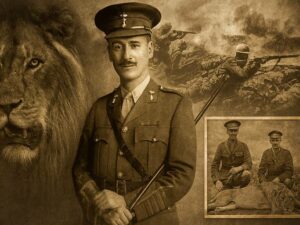
Orde Wingate was wonderful to the Jewish people. But before him was John Henry Patterson. He helped train the first Jewish soldiers in World War I.
I have read of him before, a true righteous gentile! However, it is NOT 'the west bank,' that is antisemites' term. It is Judea and Samaria! Am Yisrael Chai!
Why do Jews call it the " west bank" it is called Judea and Samaria and it was ancient biblical Israel and if there is a " west bank" there is also a " east bank " which was also ancient biblical Israel and now it is called Jordan, and in the United Nations partition Israel only got 20% and the Arsbs got 80% which was technically ancient biblical Israel, and as a religious zionist the term the " west bank" is insulting to the holy of Judea and Samaria where the forerunner of the holy temple of Jerusalem stood, and also Am Yisrael Chai
Thank you, Ephraim Ponce and Judy, for explaining the correct terms and why "west bank" is a problematic term, meant to erase the innate Jewish relationship to that God-given area.
In addition to all the great points you both made, many Jews living in the so-called "west bank" cannot even see the river on which they supposedly bank.
That's a pretty big bank! [sarc]
Cities like Modiin and Kiryat Sefer are actually closer to the Mediterranean Sea than to the Jordan River, yet the Jew-haters insist they live in "the west bank."
So that's another point I tell people, just to prove to what extremes Jew-haters go just to delegitimize Jewish possession of the Land.
I'm a licensed Israeli tour guide... I met a very old man at Ammunition Hill in Jerusalem who says he knew Wingate and told me the true story behind the nickname "HaYedid"- The Friend. write to me if you're interested in reading what the old man told me.
Please! I would really like to know!
An Incredible informative article. thank you!
Gary Please share your the deeper meaning of the title "Ha-Yedid."
Shabbat Shalom
Me too!
I was under the impression that it was Mickey Marcus who forged the IDF by merging the various Jewish militias into a single fighting force during the late 40's?
Yes, Mickey Marcus organised them into a cohesive defensive fighting force- Haganah- defense, but Wingate taught them strategy & tactics to be also offense- precursor of the Palmach striking force of the Haganah.
Actually, there is a Hollywood movie about Micky Marcus called " Cast a Giant Shadow" I actually saw the movie
"Excesses"?
There were none!
When you're faced with a ruthless enemy, you have to be equally ruthless, ferocious even, or you will be lost.
Look at the Milchemet Mitzvah!
Thank you for this article
I am struck by the expression, "the more things change, the more they stay the same". I appreciate all Wingate did to mold the future Zahal. Arabs are evil and the mention of them stabbing children and burning them alive, all those years ago, is no different than Hamas today. Israel is the only country in the world that understands Arab mentality and how to fight such evil.
I knew about the Wingate Institute but never knew the story. Fascinating. Interesting also to read the way events unfolded with Arabs/ Muslims and the way they behaved and how they were funded by history's worst regimes, nothing has changed much.
Was George Wingate related to him? (As in George Wingate HS in Brooklyn)
No, Wingate HS was named for a Union officer in the American Civil War. Orde Wingate's father was also named George but not related.
Thank you for this article, I had no idea - a true gibor.
Right, and it looks like he was a righteous gentile too