






 In Poland, Even Winnie-the-Pooh Has a Holocaust Story
Jewish Geography
Jewish Geography




13 min read


Millions visit Sicily every year. Few know it was once home to one of the world's largest Jewish community whose fingerprints are still everywhere.
Tourism to Sicily is booming. Dubbed the “White Lotus” effect, after the hit HBO series filmed there, the number of visitors to Italy’s largest region has increased dramatically.
Visitors marvel at Sicily’s natural beauty and its outsized role in popular culture: the island has long been associated the mafia, colorful pageants on Catholic holidays, and some of Italy’s most iconic cuisines and music. The UN has highlighted Sicily’s Arab heritage as one of its most important legacies.
Yet for over a thousand years Sicily was home to a vibrant Jewish community, at times one of the largest in the world, which profoundly shaped the island’s heritage, customs, and culture. Here are little-known fascinating Jewish facts about Sicily that deserve to be remembered today.
The largest island in the Mediterranean, Sicily has always been a crossroads. The earliest settlers were the Elymians, migrants from modern-day Turkey, and the Sicani, whom the historian Thucydides traced to Spain or Portugal. They were later joined by Phoenician Greeks (who also settled in present-day Gaza) and the Siculi from mainland Italy, who gave the island its name.
Greek merchants began settling Sicily in the 8th century BCE, establishing trading posts along the coast. Among them were Jews, who founded the island's first Jewish communities. Later, under Roman rule, the Jewish population grew, including Jews brought to the island as slaves.
One of these slaves was the great 1st century Roman rhetorician Caecilius of Calacte. He was originally named Archagahus and seems to have adopted the name of his former owner. Caecilius became famous for writing about the Slave Wars, a series of uprisings of Sicily’s enslaved peoples against their masters during Roman rule.
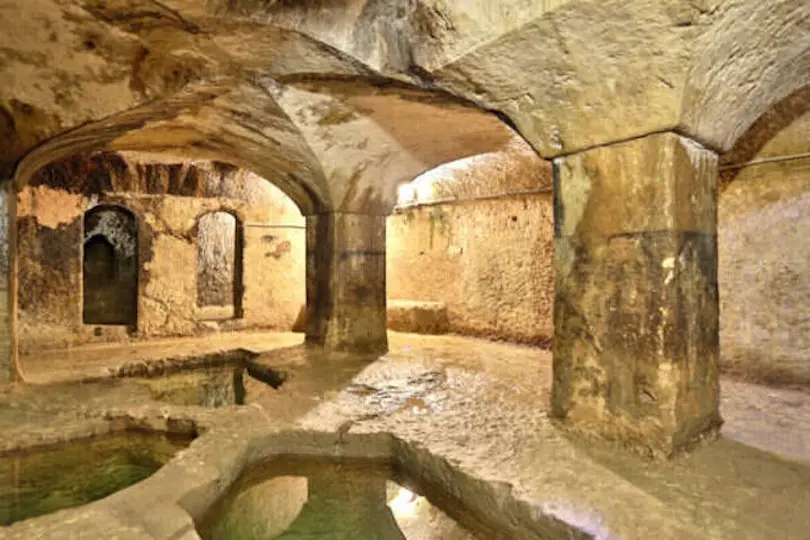 The ancient mikveh discovered underneath a Sicilian hotel
The oldest mikveh, or Jewish ritual bath, in Europe was discovered in 1987 in Syracuse, on Sicily’s east coast. Built in Roman times, it had been buried, probably by Jews seeking to preserve it before they were expelled from Sicily in the 15th century. When it was discovered, the mikveh was in such perfect repair that it still contained fresh water from natural springs which flowed into the building.
After the fall of Rome in 476, the Roman Empire’s eastern empire continued for another thousand years under the Byzantine Empire. From the 530s on, for the next 300 years, Sicily was governed by the Byzantine Empire. For a time, the Sicilian metropolis of Palermo was even the capital city of the entire Byzantine Empire. Jews continued to call the island home, though they faced growing harassment from Sicily’s Christian authorities, including forced conversion to Catholicism.
The thriving Jewish community in Palermo built a synagogue and a hospital with an adjacent garden. In the late 500s, the Bishop of Palermo seized them all and declared that the synagogue would henceforth be a church. Sicily’s Jews contacted the Jewish community in Rome, who sent intermediaries to Pope Gregory I, asking him for help.
Pope Gregory agreed to aid Palermo’s Jews. He ordered Palermo’s bishops to cease forced conversions, and to restore the Jews’ property. The bishops refused to return the synagogue, arguing that it was now a church, but paid restitution to the city’s Jews.
The north-African based Aghlabid Dynasty tore through the Mediterranean in the 9th century, capturing Malta, parts of southern Italy, and Sicily. They began their attacks in Syracuse, a major city in the east of the island, which was home to a large, thriving Jewish community. In 827, then again in 878, Aghlabid forces besieged Syracuse, eventually conquering it. With Syracuse as their base, the Aghlabids eventually conquered all of Sicily by 965.
Slave traders seized Jews from Syracuse and other strongholds, selling them across the Mediterranean. Among those captured was Shabbatai ben Avraham ben Yoel, known as Shabbetai Donnolo, born in Oria in southern Italy. Relatives ransomed him, but his parents and siblings were sold into slavery in Palermo and North Africa.
Shabbetai became both a great Jewish scholar and physician, credited as the first philosopher to write about medicine in Western Europe. His "Sefer HaMirkachot" (Book of Compounds) contains recipes for over a hundred medicinal compounds treating a range of conditions. Unusually for Italian philosophers of his era, he wrote his celebrated works in Hebrew.
Arab and Jewish traders introduced many of Italy's most iconic foods, bringing chocolate (considered a "Jewish" food in medieval Europe), oranges, pistachios, and sugar cane to Sicily before the rest of Italy. But the food most associated with Sicilian Jews was eggplant. They embraced it so enthusiastically that they gave Italian cuisine one of its most beloved dishes: Caponata, a sweet and sour eggplant dish originally called Caponata alla Guidia, meaning "Jewish Caponata."
Spiritually, Sicilian Jews saw themselves as connected to the Land of Israel. They followed the Jewish customs of Jewish communities in the Land of Israel, and were frequently visited by eminent scholars and teachers from the Holy Land.
When a freed Jewish slave named Bundar of Palermo died in 980, his will specified that one quarter of his estate be sent to Israel “to the poor of Jerusalem, may it be rapidly rebuilt…” It was delivered by an Israeli rabbi who was then visiting Sicily.
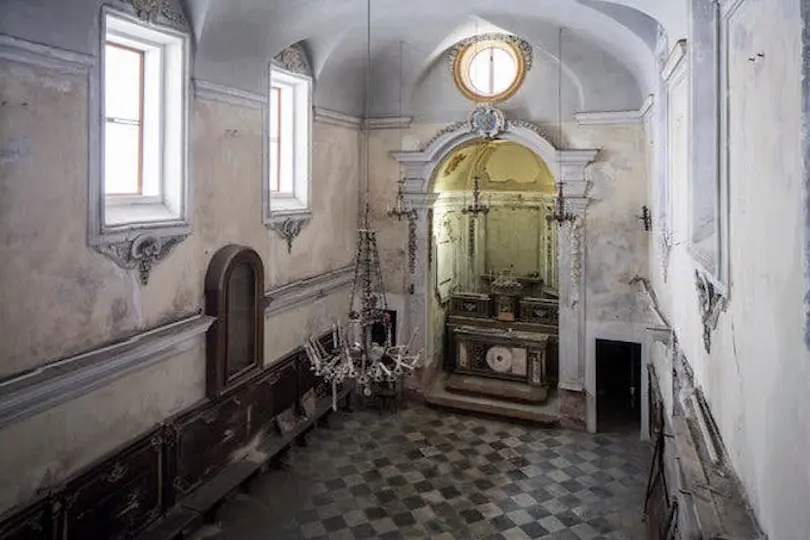 The former Baroque oratory known as Santa Maria del Sabato, or Holy Mary of Saturday, in the ancient Jewish quarter of Palermo, Sicily. It will soon become Palermo’s first synagogue in 500 years. Credit: Gianni Cipriano.
In the 11th century, Rabbi Josiah ben Aaron, the spiritual leader of the Jews in the Land of Israel at the time, appealed to the Jews of Sicily for funds. The Jews of Palermo read this letter out load in their synagogue the following Shabbat, and then subsequently each year on the first day of the month of Elul, which precedes Rosh Hashanah, a time when it is customary to give charity. (Discussed in The Jews of Sicily, in Jews in Islamic Countries in the Middle Ages by Moshe Gil, translated by David Strassler.)
Arab control of Sicily was short-lived. In 1060, the island fell to the Normans, the same group of Christians from northern France who would go on to conquer England in 1066. Early Norman rule slowed persecution of Sicily’s Jews and allowed Jewish communities to rebuild and grow.
Much of what we know from this period comes from the great Medieval Spanish Rabbi, Benjamin, the son of Jonah, also known as Benjamin of Tudela. In the 1160s, a century before Marco Polo undertook a similar journey, Benjamin left his home in the town of Tudela in northern Spain and began to travel east, in a decade-long journey that would take him all the way to China. His travel writings describe visiting thriving Jewish communities in Sicily, in the cities of Palermo and Messina, where Benjamin described seeing a Jewish community made up of about 200 families.
Sicily’s Jews gained a champion in 1198 when King Frederick II gained the throne. Many Jews in Sicily at the time worked in the textile industry, which was a royal monopoly owned by the Crown. King Frederick II insisted that all his textile managers be Jewish artisans. He changed the status of Sicily’s Jews, making them servi camerae, or “servants of the royal chamber.” In practice, this transformed Jews into property of the king, a distinction that rendered them more valuable and protected.
At a time when blood libels, the false claim that Jews murdered Christian children to drink or cook with their blood, wracked Europe, King Frederick II took a stand to stop blood libels in Sicily and elsewhere under his control. Investigating a blood libel in Germany in 1236, King Frederick II was convinced that local Jews were innocent. He issued a declaration barring blood libels anywhere in his reign, including Sicily.
Perhaps the most important way in which King Frederick II saved Jewish lives was by forbidding Crusader violence.
Between 1096 and 1291, Europe's Jewish communities were devastated by the Crusades, wave after wave of military expeditions marching toward the Land of Israel. Hundreds of thousands of soldiers heeded the call to fight "infidels" in the Holy Land, and as they swept across Europe, they targeted Jewish communities, massacring thousands, looting property, and leaving survivors traumatized. In 1220 and again in 1224, King Frederick II ordered his Crusaders to leave Jews in his lands alone.
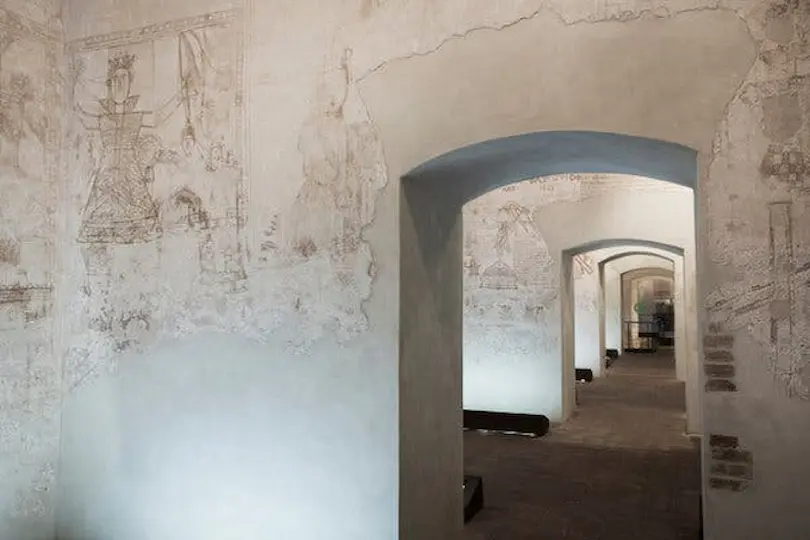 Palazzo Chiaramonte-Steri, today part of the University of Palermo, served as the prison and tribunal of the Inquisition. Its walls bear the writing of past inmates, including some in Hebrew. Credit: Gianni Cipriano
King Frederick II surrounded himself with Jewish and Christian scholars alike, enjoying debates on Biblical interpretation. But his enthusiasm had limits. After the Church's Fourth Lateran Council decreed in 1215 that Jews must wear distinctive clothing, Frederick complied: Jewish men were forced to wear blue coats and grow beards; Jewish women had to display a blue stripe on their outer garments.
Sicily was home to remarkable Jewish scholarship. Moses ben Solomon of Agrigento, also known as Ferragut and Faraj ben Salim, was a Jewish sage who worked as a physician and the official translator to Charles I of Anjou, King of Sicily. Samuel ben Nafusi of Palermo wrote exquisite religious Hebrew poetry. Ahitub ben Isaac translated the Jewish sage Rambam’s treatises on Logic into Hebrew from Judeo-Arabic. Aaron ben Gershon of Catania (also known as Aldabi or Alrabi) was a rabbinical scholar who wrote a prominent defense of Judaism. The sage Ramban’s masterful commentary on the Bible, which is still studied today, was edited and printed by Jewish scholars in Messina in Sicily.
Legions of Jewish scholars filled Sicily with learning and dialogue about Torah, astronomy, philosophy, medicine, poetry, and song. In 1466, King John II allowed Sicily’s Jews to establish their own studium generale, or university, with the ability to appoint their own professors, set curricula, and award diplomas.
Jews continued to thrive in cities all over Sicily. In 1413, a prince demanded a loan from Sicily’s Jews and business people from 13 distinct Jewish communities on the island banded together to furnish it. Yet daily life was brutal; petty humiliations were commonplace and violence could erupt at any moment.
The walls closed in slowly. In 1296, Jewish physicians were barred from treating non-Jewish patients. By 1327, Frederick II's protections had begun unraveling, and Jews in many towns were forced to clean out Gentiles' stables on set days. In 1366, King Frederick III banned synagogue decorations, ordering the demolition of countless adorned houses of worship across Sicily. By 1369, the blue garments Jews were forced to wear were replaced with bright red badges worn on the chest.
In 1392, Sicily's Jews were forced into ghettos. Anti-Jewish violence became routine. In Syracuse, Catania, and San Giuliano, gangs rampaged through Jewish quarters every Sunday, attacking and murdering residents. In Marsala, organized groups pelted Jews with stones on Christian holy days. Over and over, Jewish communities were hit with absurd criminal accusations, then forced to pay large fines to make the charges disappear.
In 1474, Christian mobs launched deadly pogroms in two southern Sicilian towns. In Modica, 360 Jews were killed. In Noto, 500 were massacred.
In 1409, the Kings of Aragon became Sicily’s rulers and in 1479, Sicily was ruled directly by the King of Spain. The previous year, the Catholic Church in Spain had established the Spanish Inquisition, aimed at rooting out Jews and others who had converted to Catholicism yet still practiced their own religion in secret.
In 1492, King Ferdinand and Queen Isabella of Spain famously expelled all of Spain’s Jews. Less well known is the similar edict of expulsion they issued, forcing all Jews to leave Sicily. On May 31, 1492, a decree was issued ordering the expulsion of the Jews from Sicily. The decree was read out in each town on the island, accompanied by the blare of trumpets. Jews were given just over four months to leave; afterwards any Jew remaining in Sicily would be executed.
A few days later another decree was issued: Jews were forbidden to sell their belongings or to depart before the exile day. They were banned from carrying weapons. Officials appraised Jews’ belongings and carried them away to distribute to upper class Gentiles. When the Jews were finally ordered to leave Sicily, they were allowed to bring only the following items: one dress, one mattress, one blanked of either wool or serge, one set of used sheets, a small amount of food, and three coins.
Estimates of how many Jews fled range from 35,000 to 100,000. Many went to Naples. The following year Jews were blamed for an epidemic there and were forced to leave.
Some Jews did convert to Christianity and continue to practice their religion in secret. This became much more dangerous in 1517 when Spain’s Inquisition expanded to include Sicily. Nevertheless, Converso families remained in Sicily, befriending aristocrats and other prominent Gentiles in order to evade suspicion. They were even joined by a handful of Converso families from Spain.
Yet the Inquisition was never far away. Countless Jews were tortured into confessing their secret allegiance to the Jewish religion. The torture chambers of the Sicilian Inquisition, now part of the University of Palermo, still bear inscriptions written in Hebrew on the walls, including the anguished word “Jerusalem,” carved by a long-ago Jew who suffered inconceivable torment.
The rulers of Sicily invited Jews back to Sicily in the late 1600s and again in the 1700s, though no Jewish communities were ever reestablished there. A few Jews moved to Sicily in the early 1900s and even established a synagogue in Palermo. The synagogue was shuttered by Mussolini and the tiny Jewish population of Sicily was rounded up and sent to prison camps elsewhere in Italy.
In 1943, Allied soldiers stationed in Sicily re-opened the shuttered synagogue and held services there, with scores of Jewish servicemen attending.
Today’s many visitors to Sicily can honor the memories of the many richly tapestried Jewish communities who once called this island home by learning about them and visiting the sites they left behind.








You're inverting the history. I have a friend who's father was Italian and his mother was Jewish (or so they thought). When he took a DNA test with Living DNA he came out with 84% Italian DNA. His supposedly Jewish mother was actually biologically and genetically Italian. His Levant DNA came out to an insignificant 5%, with the rest unassigned and 2% Slavic. After centuries of intermarriage there was no "Jewish" or "Levantine' DNA. It was all Italian. So, any Jewish remnants in Italy/Sicily were strictly religious.
I had known about Sicily’s Jews for a long time but never to the depth referred to in this article. I am Sicilian and a former Catholic who converted many years ago. Imagine my surprise when I had my genetics done and found out I am 3% Jewish! This Jew came home again! BTW, an Italian is a Jew turned inside out!
"Arab and Jewish traders introduced many of Italy's most iconic foods, bringing chocolate (considered a "Jewish" food in medieval Europe)" Not possible. Chocolate is derived from cocoa which was brought to Europe only after the "discovery" of the Americas and the conquest of Mexico, where cocoa was consumed.
I had the exact same thought about chocolate.
I understand the desire to display cultural sensitivity, but I don't think you should put quotation marks around the word discovery. Since Europeans had no concrete knowledge of the existence of the Americas prior to Columbus, it was indeed discovered as far as they were concerned. In fact, all discoveries involve objects whose existence pre-dates their discovery -- things that do not already exist cannot be discovered, they must be invented.
Jews left important imprints everywhere they settled, despite being at the mercy of new rulers and the church. I'm a second generation Shoah survivor, and when I see the post Oct. 7 antisemitism in Europe, I'm hesitant to visit and contribute to their economy, as amazing the history and the sites are. Israel, home to around 2 million Arabs, Christians and others with full rights as citizens, is threatened once again.
My wife and I just returned from Sicily, making this article especially meaningful. We took a Jewish heritage tour in Palermo and were struck both by the beauty of the island and by how little visible evidence remains of the once-thriving Jewish communities that lived there. We were disappointed to encounter anti-Israel and what appeared to be antisemitic graffiti in several locations, but encouraged by efforts to preserve Jewish history in places such as Syracuse, Taormina, and Catania. Sicily is a remarkable place with a complex Jewish past, and articles like this help ensure that an important part of that history is not forgotten.As visitors interested in Jewish history, we left wishing Sicily would more openly acknowledge and celebrate this part of its heritage.
Thank you so much for this fascinating and tragic story of the history of Jews in Sicily. It’s so easy to be myopic given one’s place of residence. For instance, when a volunteer in Israel after the Yom Kippur War, I ventured to Jerusalem to see the King David Hotel. In an elevator, I was so surprised to hear a father and son speaking in Italian! Naively, I was so surprised! As Jews, I recommend it a priority for youth to study ‘Jewish Geography’ in Hebrew School; as youngsters, we need to begin our understanding of the place and role and history of our people internationally.
amazing island and the fact that after the destruction of the Second Temple, the roman empire settled the enslaved jews in Sicily aproximately 80 thousand then, and that the communities ended by the Inquisition and persecution is incredible, good to know about the site at the Syracuse and also in Palermo, as what was left of the synagogue is closed.
A very enthralling article about this interesting Jewish community. As a student of the Classical Hebrew language I was encouraged to see the word Mikveh correctly transliterated. The norm, unfortunately, is to see the word mistranslated as mikvah. There is no such word in correct Hebrew literature. My complements to the author Dr Alt Miller for correcting this common but nagging error.