








 Those Shameful Thoughts and What They Really Say about You
Jewish Geography
Jewish Geography





Though Israelis and Jews are banned from regions of the kingdom today, Jews have a long and surprising history in Saudi Arabia.
Today, Saudi Arabia is devoid of Jews. Jews and other non-Muslims are forbidden from entering the city of Mecca, and banned from Muslim holy sites in the city of Medina. Israelis are banned outright from visiting the country.
Yet for thousands of years, the areas making up modern-day Saudi Arabia were home to vibrant Jewish communities. Some cities in today’s Saudi Arabia once were predominantly Jewish.
Here are eight little-known facts about the history of Jews in Saudi Arabia.
Modern scholars believe that Jews might have lived in Arabia during the Time of the first Jewish Temple in Jerusalem, built by King Solomon in 825 BCE. That’s the contention of traditional Arab sources: the Kitab al-Aghani, a major source of Arab poems and legends, describes Jews fighting the tribe of Amalek, the sworn enemies of the Jewish people, in modern-day Saudi Arabia during the time of Moses.
In the year 422 BCE, Babylonian soldiers destroyed the First Jewish Temple and took thousands of Jews captive back to Babylon. Two hundred years later, when the last Babylonian King, Nabonidus (556-539 BCE), invaded modern day Saudi Arabia, Jewish soldiers were amongst his forces. The Babylonians conquered a number of cities that would go on to be settled by Jews.
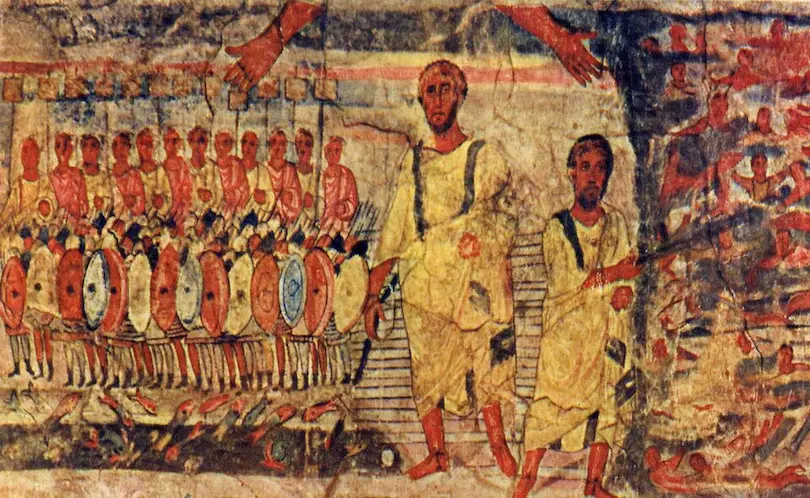 Jews cross Red Sea pursued by Pharoah. Fresco from Dura Europos synagogue
Although Jews in the Land of Israel began to build the Second Temple in Jerusalem in 352 BCE, scholars believe that substantial Jews communities continued to flourish in Saudi Arabia, particularly in the Hijaz region, a coastal area that today is home to the holy Muslim cities of Mecca and Medina.
By the time Roman forces destroyed the Second Temple in Jerusalem, the region of Saudi Arabia was home to numerous Jewish tribes and cities. Some of the Jewish refugees fled to Arabia, finding new homes amongst the Jews living there.
One of the primary tribes was known as the Banu Al-Nadir, which lived north of the city of Medina. Banu Al-Nadir Jews were known to be descended from Levites and Cohanim who’d once served in the Temple in Jerusalem. In Saudi Arabia, they built grand cities and homes and were known for their lush date plantations.
Nearby, the Jewish tribe of Banu Kuraiza also traced their founders to those who’d once worked in the Jewish Temple. Renowned wine merchants, Banu Kuraiza Jews built magnificent castles in the Saudi Arabian towns of Al-Buwailah, Baraj, Ghars, and Fadija.
The Jewish Tribe of Banu Kainuka were renowned goldsmiths and weapons manufacturers; a major regional market was named after the Jewish traders in the area.
These three Jewish tribes erected an elaborate system of sturdy fortresses to protect Jewish towns and habitations from marauding Arab raiders. The Jews of Saudi Arabia had their own royal dynasty too; modern inscriptions have unearthed the names of local Jewish princes who ruled over Jewish habitations. Tragically, each of these Jewish tribes maintained their separate identities instead of unifying as one Jewish people. At times, they even fought against one another.
Another Jewish tribe, known as Marhab, lived in the vicinity, north of Medina. They were skilled gold and jewelry smiths and built a magnificent palace in the hills high above the oasis of Khaybar. The nearby Khaybar Fortress protected local Jews from bandits and hostile armies.
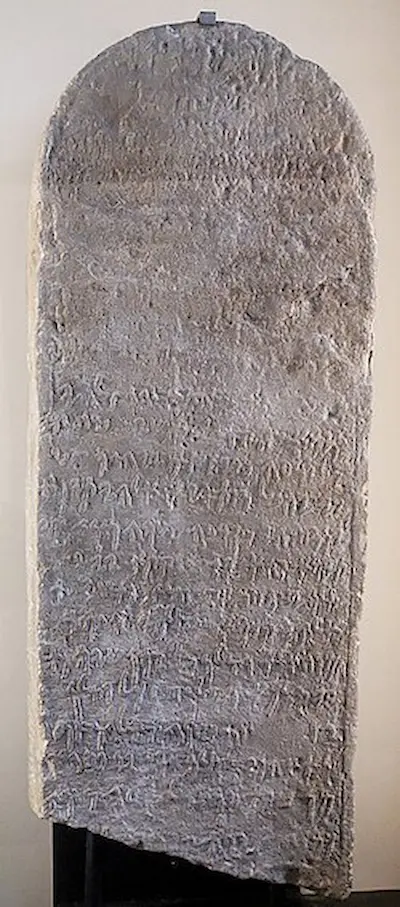 Aramaic inscription on Tayma Stone
Saudi Arabia’s oasis city of Tayma was historically known as a Jewish city. Carved stone records from the city are written in Aramaic, the language of the Talmud. Today, these priceless “Tayma stones” are located in the Louvre Museum in Paris. It’s believed that an ancient well in Tayma is the same one mentioned in the Hebrew Bible’s Book of Isaiah.
Mohammed, the founder of Islam, fled the city of Mecca in 622 and arrived in Medina later that year. He was welcomed by local Jews who forged a treaty with Mohammed and his followers.
At first, Mohammed adopted many of the customs of his Jewish hosts for his new religion. He taught his religious followers to avoid eating pork, as Jews do, and to pray facing towards Jerusalem, like Jews. Within two years, when he saw that he was unsuccessful in converting Arabia’s Jews, Mohammed turned against his Jewish hosts. He altered some religious practices that he espoused, like instructing his followers to pray facing the Arabian city of Mecca. He accused Arabia’s Jewish tribes of not abiding by his treaty with them and began seeking their destruction.
Mohammed’s first target was the Banu Kainuka tribe; his acolytes besieged the Jewish tribes’ towns, fortresses, and castles. Mohammed’s soldiers cut off the city for over two weeks, during which the Jewish inhabitants could find no food or water. Nearby Jewish tribes did nothing to come to the Banu Kainuka Jews’ aid.
After 15 agonizing days, the Jews of Banu Kainuka surrendered, and Mohammed ordered them bound in chains. Mohammed planned to kill all the Jewish men, but was dissuaded by one of his soldiers, agreeing to exile all the Jews instead and seize their substantial property.
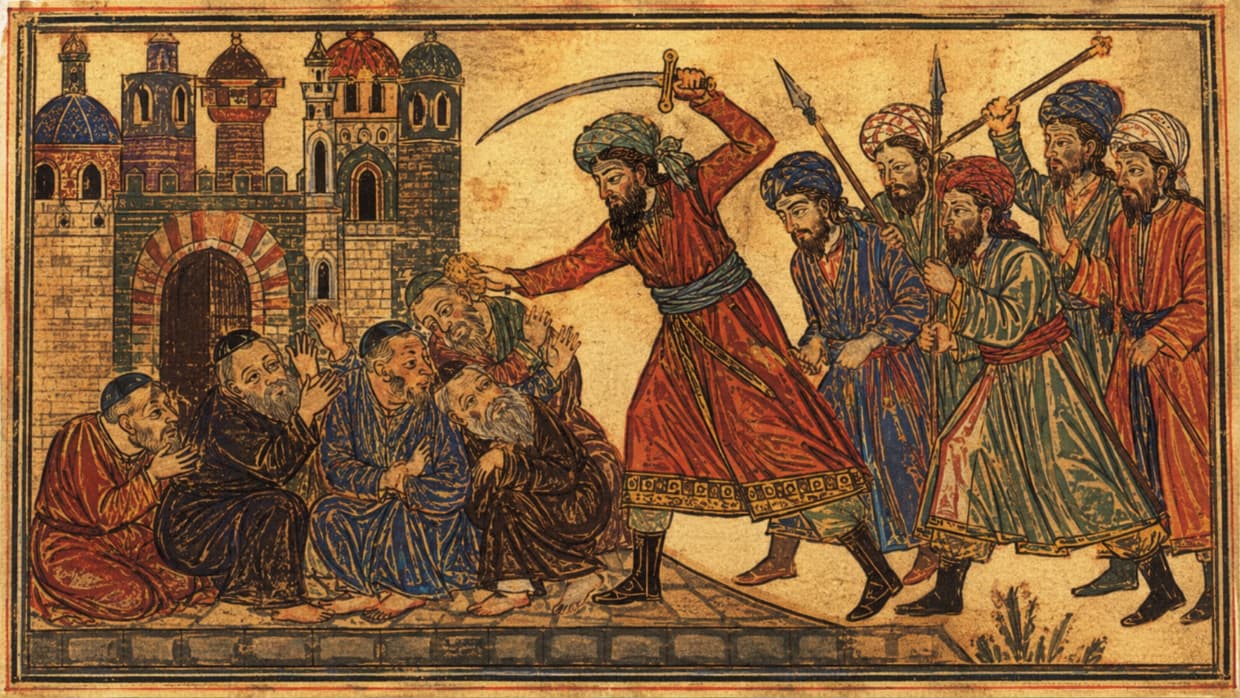
Next Mohammed turned on the Jews of the Banu Al-Nadir tribe. One immediate cause was his rivalry with Ka’ab b. al-Ashraf, a leader of the Banu Al-Nadir Jews and a renowned poet. al-Ashraf was sympathetic to those who opposed Mohammed’s incipient new religion, and composed poems that outlined critiques of Mohammed’s project. Mohammed hired an assassin to murder al-Ashraf by cutting off his head, then turned his hatred on Jews in general, urging his Arab followers to “kill them all!”
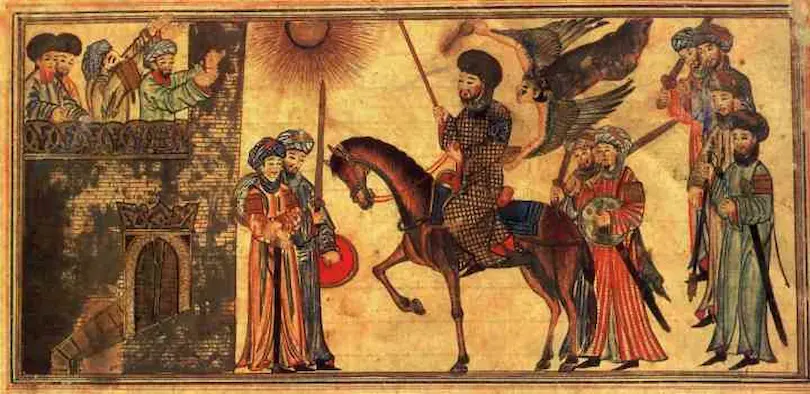 Mohammed receiving the submission of the Banu Nadir, a Jewish tribe he defeated at Medina. From the Jami'al-Tawarikh, dated 1314-5. In the Nour Foundation's Nasser D. Khalili Collection of Islamic Art, London.
Mohammed ordered his followers to burn down all of the Jews’ palm trees, in direct contradiction to the norms of warfare in the area. Again, the remaining Jewish tribes in the area did nothing to help the Jews of Banu Al-Nadir. After a lengthy siege which nearby Jewish tribes watched without fighting, Mohammed’s forces succeeded in capturing Banu Al-Nadir settlements. One of his confidants dissuaded Mohammed from massacring the Jews; instead, he and his fighters seized all their property and forced the Jewish survivors to flee. They were allowed to bring only enough provisions to be carried on one camel for every three people.
Mohammed’s pattern of death and destruction was repeated over and over, as he picked off Jewish tribes near Medina one by one. Arabia’s Jews again failed to come to the aid of Jewish tribes they perceived as different from them. With each new conquest, Mohammed’s armies emerged strengthened, as they plundered the fabulous wealth of various Jewish tribes. Jews from the Fadak, Taima, and Wadi-al-Kura tribes fell to Mohammed’s fighters’ swords.
By 628 CE, only two major Jewish tribes – the winemaking Banu Kuraiza Jews who lived near Medina and the Jews of Khaybar who lived north of Medina – remained.
Over the past two years, anti-Israel protests have frequently featured the popular rallying cry Khaybar, Khaybar, ya Yahud, jaysh Muhammad sawf ya’ud! It’s a catchy, rhyming phrase that many thousands of students in the West have heard and shared. It means “Khaybar, Khaybar, oh Jews! The army of Mohammed will return!” and refers to the final battle between Mohammed’s soldiers and the final remaining Jewish tribe in the area around Medina.
Known as a Jewish town, Khaybar was home to Jews who were skilled at date cultivation and other agriculture. The fearsome Khaybar Fortress, which still stands and is known as the Fortress of the Jews, became a refuge for Jews from other destroyed Jewish tribes. In the year 628 CE, Mohammed’s fearsome fighters turned their attention to Khaybar’s Jews. Fighting was intense and ranged across several fortified areas. The remaining Jews in the area again declined to come to their brethren’s aid. The Banu Kuraiza Jewish tribe had brokered a treaty with Mohammed; they credulously believed this would protect them, even though their fellow Jews were being killed with abandon. After two brutal months of fighting, the Jews of Khaybar were utterly defeated.
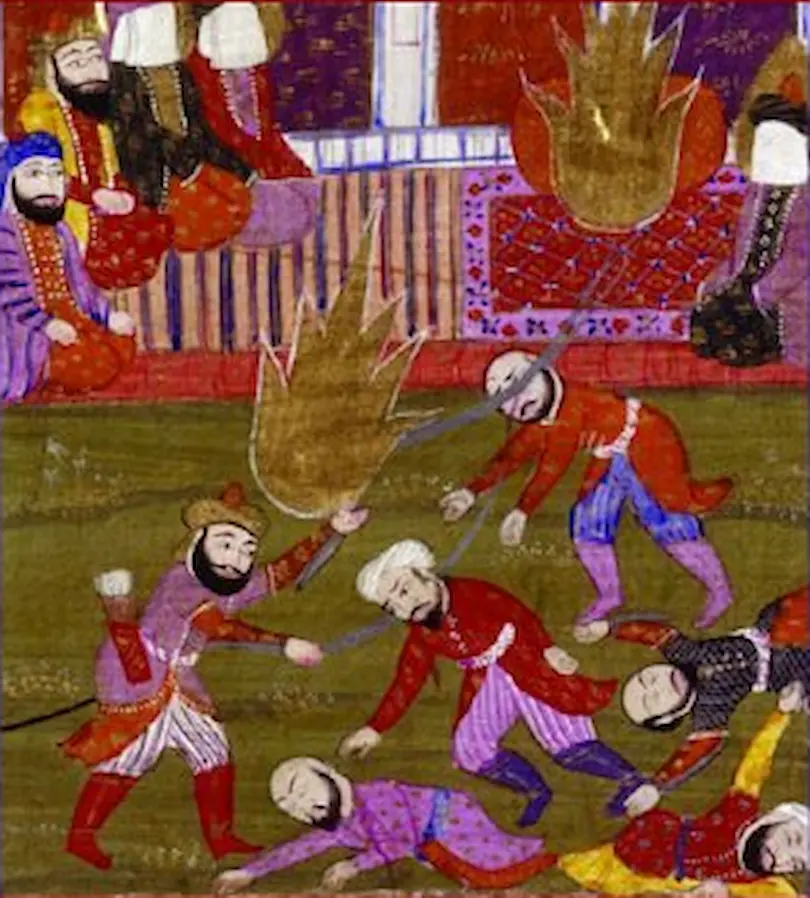 The execution of the Banu Kuraiza. Detail from miniature painting The Prophet, Ali, and the Companions at the execution of the Prisoners of the Jewish Tribe of Beni Kuraiza, illustration of a 19th century text by Muhammad Rafi Bazil.
Though they were generally happy to kill and enslave as many Jews as possible and plunder their property, Mohammed’s followers realized that they couldn’t possibly maintain the Jews’ lush date farms as effectively as their Jewish owners. Mohammed brokered an agreement allowing Jews to live in the area, on condition that they paid half of their yearly harvest to him and his followers. This arrangement lasted for a dozen years. After Mohammed’s death, his second successor, the Caliph Omar, broke this agreement, driving all the Jews north, out of present-day Saudi Arabia.
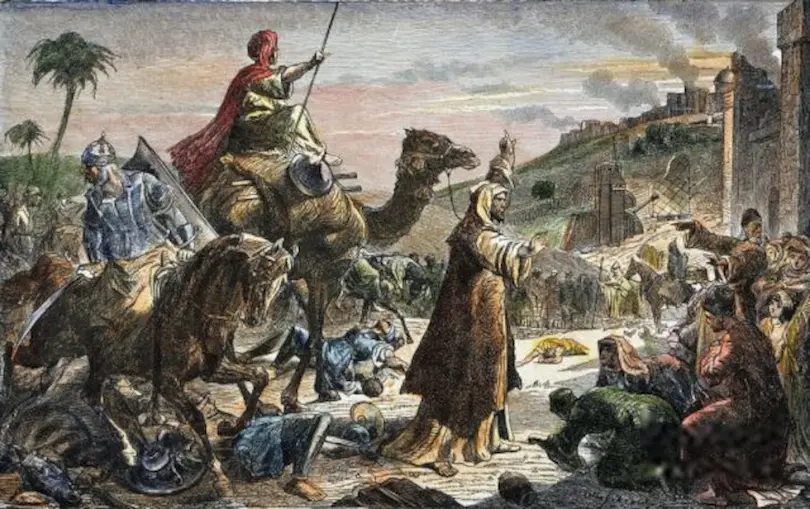 The entrance of Caliph Umar (581-644) into Jerusalem, 19th century colored engraving, via Wikipedia
With nearly all the Jews in Saudi Arabia killed or defeated, Mohammed’s fighters set their sights on the Banu Kuraiza Jewish community. Their treaty with Mohammed offered no protection. This time, Mohammed and his soldiers spared no one. After a 25-day siege, Mohammed offered the Jews of Banu Kuraiza a terrible choice: they would be spared if they converted to Islam. If they refused to convert, Mohammed told the men he would fight them fairly, on condition that they first killed their women and children.
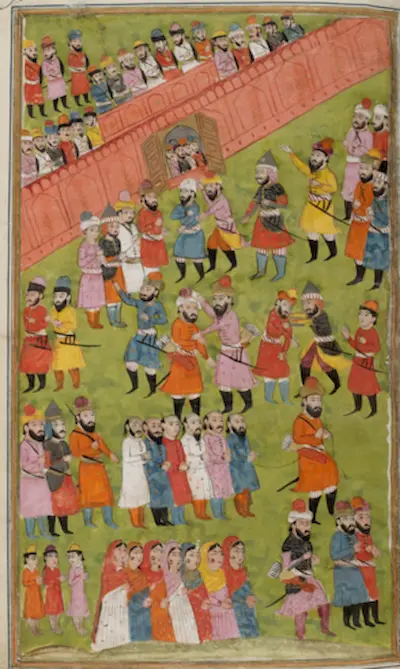 Seizure of the Banu Kuraiza stronghold. Illustration from Ḥamlah-i Ḥaydarī, by Muhammad Rafi' Bāzil.
Unsurprisingly, the Jews of Banu Kuraiza refused these outrageous demands and surrendered to Mohammed and his fighters. In the town square Mohammed’s followers beheaded all the Jewish men, numbering between 700 and 900, then distributed their wives and children to Mohammed’s fighters as slaves to do with what they chose. It was a bloody, gruesome fate and marked the end of the golden age of flourishing Jewish communities in Saudi Arabia.
Unlike neighboring Saudi Arabia, Yemen was long home to Jewish communities. In 1934, when the modern-day nation of Saudi Arabia was formed, it incorporated the border town of Najran, long considered part of Yemen. After centuries, Saudi Arabia was suddenly home to Jews once again. For a time, it’s new ruler, King Abdulaziz bin Abdul, tolerated these newly Saudi Jewish citizens.
“Jews lived in Najran long before Saudi rule,” reminisced David Shuker, the last living Jew from Najran, before his death in 2026. “In fact, there is evidence that Jews lived there as early as 2,000 years ago,” he claimed, saying that some asserted that Najran’s Jews were descended from exiles during the First Temple period. “We were openly Jewish. The relations between the Jewish and Muslim communities were very close. They even helped us keep Shabbat… But the (Saudi) rulers treated us like second class citizens… Jews were not equal to Muslims.”
That all changed in 1948 when the State of Israel was established. Suddenly, the ancient Jewish community of Najran was ordered to leave Saudi Arabia. They were given one day to leave. “The Jews were called by the king’s representative to gather in the main square,” Shuker recalled. “A convoy of camels was waiting there for 260 people, mostly children like me. Our families’ belongings were loaded onto camels, and before sunset we began walking toward the Yemeni border.”
Shuker and his family were later airlifted to Israel in Operation Magic Carpet, which brought approximately 50,000 Yemeni Jews to Israel to escape crushing persecution.
To this day, Israelis are formally barred from visiting Saudi Arabia, though exemptions exist, particularly for Israeli Muslims wishing to visit Islam’s holiest sites there. Jews and other non-Muslims are banned from visiting the cities of Mecca and from Muslim holy sites in Medina.
The lack of unity that allowed Mohammed to destroy the Jews in the 7th century CE should be a warning to us all today. The Talmud teaches that all Jews are responsible for one another (Shavuot 39a). The tragic history of Jews in Saudi Arabia shows what disaster can befall the Jewish people when we ignore this key Jewish value.







The chutzpah of Christianity and Islam they steal and distort and warp Judaism, and then they hste the Jews and try to vonvert us to Christianity and Islam, if there was no Judaism there wouldn't be Christianity and Islam, the Christians murdered Jews and the Muslims murdered Jews and they while trying to copy Judaism like saying Ishmael went to the be a sacrifice instead of Isaac and Christians worshipping a Jew and making him a man God, and these days the world seems to be against Jews and Israel which sounds like Tehillim/ Psalms 83 which isn't new to me as a child of a Holocaust Survivor ( obm )
Unbelievable and shameful that Jews did not help each other.
Saudi Arabia is hosting the Fifa World Cup in 2034.
It'll be interesting to see what'll happen if Israel qualifies and Jewish fans go to the World Cup.
A bit of an anachronism: The Arabian peninsula at that time - and really up to very recently - was not known as Saudi. The Hijaz region, which is the area of Mecca and Medina, was for most of history under the control of the Hashemite tribes. It was only after WWI, when Britain had to make good on the many conflicting promises it had made to the various Arab tribes, that the ibn Saud family was given control of the Hijaz (yes, as in colonial appropriation). The Hashemites, in compensation, were given the Transjordanian part of the Mandate in which Britain had been instructed to establish a Jewish homeland. The Hashemite Kingdom of Transjordan was created out of thin air -actually, out of 70+% of the Palestine Mandate. So it really irks me to have the area called 'Saudi' when it's not
Your dates for the building, destruction, then rebuilding after the Babylonian exile are incorrect. The first Temple was completed by Solomon in 958BCE, destroyed in 586BCE, and rebuilding was completed around 516BCE.
It seems to me that the only reason that Mohammed hated Jews and wanted them killed is Jews did not view him a messenger of God but believed in only one God as stated in the 10 Commadments.Christianity also taught hatred of Jews because they wouldn’t accept the Christian view that Jesus was the Son of God.Jesus was born to Jewish Parents,lived as a as a Jew and died as a Jew.Christianity was formalized a religion about 400 years after the death of Jesus.It is highly likely that if Jesus had lived,he would never have a become a Christian because he believed in the 10 Commandements which views only one God.The main source of antisemitism today are the teachings of Christianity and Islam going back to their Foundings 2000 and1400 yrs.ago respectively..
I don't think we should confuse Islamic Jew-hatred with Christian Jew-hatred. They need to be addressed differently.
Muhammad had to destroy the Jewish population because his power depended on his people's belief that he was a prophet. The Jews threatened that source of power. His ability to destroy the Chosen People was further proof that he was a true prophet.
What makes this different from Christianity is that this is all recorded in the Quran in Allah's own words and are, therefore, an immutable truth. This is the fundamental problem. Realizing this, I had to reconsider how we address truths like this.
The main difference is that Christianity has had time to mature and grow out of its need to be the replacement of Judaism (with the exception of a few fringe sects).
Also, it is by its nature a gentler religion. Think what the outcome would have been had Augustine, who in the 12th century (I think it was) set the Christian approach to Jews and Judaism for the next 8 centuries, was not the basically kind-hearted person he was, and called for the extermination of the Jews instead of designating them as a "witness" population?
True, he did specify that Jews needed to be kept subjugated and humiliated, but at least he didn't call for killing them all.
Any orgaization including Religions that promote hatred and violence against others should be charged in a court of law.
There exists no empirical evidence that Muslims ever faced Jerusalem in prayer. Had that been the case, Ibn Ishaq would have stated that in his biography, and it would have been stated in the Quran. Al Aqsa Mosque was identified as being in Jerusalem only after Omar stated this in 638 A.D., following the advice of Ka'ab ibn Ahbar. Until then, no one knew where the al-Aqsa was. Since "al-Aqsa" means "most distant", in 619 A.D., when Verse 17.1 (the Night Journey) was pronounced, the most distant mosque was in Massawa, Ethiopia; it is now called the Mosque of the Companions.
The "soldier" you speak of was Abdalah ibn Ubayyia, a great friend of the Jews and no real friend of Mohammed.
I always enjoy your articles, but we really need to stop buying into the Islamic myth about Jerusalem.
The changing of the qibla from Jerusalem to Mecca is described explicitly in the Quran (2:142-150). Mecca and Jerusalem are in opposite directions from Medina, so the reality is that the Muslims literally turned their backs on Jerusalem. It is an important section of the Quran when trying to understand Muhammad's growing hatred of the Jews.
However, we cannot totally dismiss the connection to Jerusalem that Judaism and Islam share with the story of the binding of the son. It is hard to deny such a connection when seeing the 7th Century Dome of the Rock dominating the skyline.
Respectfully, you need to read the verses without interpolations. Jerusalem is not a word found in the Quran. Read ibn Ishaq without Guillime's interpolation of Jerusalem. The qibla spoken of before the change is East of Damacus. Jerusalem is West. Ibn Ahbar was involved with identifying the Temple Mount as the al-Aqsa so that he could help Omar make the city important for Islam as well as Christians and Jews. It was politics. Read Verse 17.1 without interpolations. The Temple Mount was holy ground for centuries before Islam. Omar knew that in 638 A.D. The al-Aqsa is not on holy ground per Verse 17.1, so it can't be on the Mount. The Dome is not al-Aqsa, so what are you saying? I have more, but no space for it here. Nice talking.
I have no idea what you are saying. Why would Arabs (Jewish or otherwise) be praying towards a location East of Damascus?
The connection between Islam and Jerusalem is through Muhammad's theological (and supposed patriarchal) connection to Abraham. The place where Abraham's "submission to Allah" took place (supposedly marked by the Dome of the Rock) is of utmost importance for Islam. Don't be distracted by the Night Journey dream or the insignificant mosque built on the Temple Mount. The al-Aqsa mosque of the Night Journey exists in a dream that Muhammad had. The al-Aqsa mosque in Jerusalem didn't exist in Muhammad's time!
Have you read the writings (mosaics) that are on the interior of the Dome? It is the Dome that is political.
I just found a bit more space. Regarding "binding of the son", while the Quran does not name the son, most Islamic writers believe that it was Ishmael, and not Isaac. This follows the Islamophilic approach of adopting everything Jewish as Islamic, and not Jewish. It is the original "replacement". And they change the narrative in many cases. Poor Haman not only dies in the Jewish Purim story, but he also dies in the Islamic Exodus story, as well. And then there is the Christian story of Mary. Did you know that she was Mariam, the sister of Aaron and Moses?
If you read the Quran, particularly the Medinan chapters, as a political document, then it becomes clear why Muhammad retold the bible stories the way he did. It's a fascinating example of an ancient propaganda campaign.
And, yes, Islam is all about replacement. There are several verses like 5:54.
It is remarkable how much hatred is felt for Jews when, for example, Saudi Arabia had little contact, if any, with Jews for centuries. Can this be sourced just to the Koran? If so, its believers are as dumb as a rock (which is where?)
Read Verses 3.29, 3.30, 2.102 among about 100 others. The Quran is a good start for this hate of all which is not Islamic. Allah hates the non-believers. This is not to say that every Muslim hates everyone else, but the religion preaches this.
The Babylonian king Nebuchanezer destroyed the First Temple in 756/7 BCE not 422BCE as stated above
dR. mILLER, YOU SHOULD BE IN YOUR BOOK AS A HEROIC WOMAN. I WOULD LOVE TO MEET YOU AND SINCE I AM A GREAT GRANDMOTHER ALREADY, B'H, WE NEED SCHOLARS LIKE YOU TO SPEAK UP AT THE KNESSET AND IN EVERY COUNTRY ABOUT HOW IMPORTANT UNITY IS FOR JEWISH SURVIVAL IN ERETZ YISRAEL AND EVERYWHERE. THANK YOU B'SOROT TOVOT. MAY HASHEM BRING MASHIACH...LET US SEE THE TRUTHS AND LET ALL HUMANITY SEE THE TRUTH....AND NOT REPEAT THE SAME MISTAKES. RESPECT FOR EACH OTHER WITH GRATITUDE. ALL JEWS ARE TRYING THEIR BEST ACCORDING TO THEIR UPBRINGING. AISH IS A WONDERFUL KIRUV ORGANIZATION.
BS"D
Please go to the Knesset and spread this TRUTH. WE JEWS MUST BE UNITED....I AM RELIGIOUS, SHOMER SHABBAT...I LIVE IN A CHAREIDI NEIGHBORHOOD.
I AM FORMERLY FROM THE UNITED STATES, AND BORN IN HUNGARY. I AM AN ENGLISH TEACHER.
WE JEWS ARE SISTERS AND BROTHERS, REGARDLESS OF HOW RELIGIOUS WE ARE.
IF WE STAY UNITED, WE WILL SURVIVE IN ERETZ YISROEL. WE HAVE TO RESPECT EACH OTHER AND BE LIKE THE KIND RABBI MENACHEM MENDEL SCHNEERSON, WHO LOVED AND WELCOMED ALL JEWS....RESPECTED ALL HUMANITY.
THANK YOU FOR THIS ARTICLE.
I've seen this clip in Israel about the JEWISH REVENGE that happened AFTER KHAYBAR, but I can't find any substantiation. Can you find support for this clip by שרגא שמידלר - Shraga Shmaidler The revenge against the Muslims by the Jewish tribe in Khaibar - History of Judaism and Islam https://www.youtube.com/watch?v=GP80ItDG8mQ Seems his only source is Israel Shklov 1831. ChatGPT had many questions on it.