



 Visiting Auschwitz with Holocaust Survivors and a Nova Survivor





Before Israel, there was a Soviet Zion: a Yiddish-speaking Jewish homeland carved out of the Siberian swamps. The story of Birobidzhan is full of idealism, betrayal, and survival.
In the turbulent aftermath of the 1917 Bolshevik Revolution, the young Soviet state faced a complex geopolitical and demographic challenge: what to do with its millions of Jewish citizens.
Concentrated in the impoverished small towns and villages of the former Pale of Settlement, Jewish communities had been devastated by World War I, the Russian Civil War, and brutal pogroms. Economically, many Jews worked in occupations that strict Marxist-Leninist ideology branded as non-productive or bourgeois: small traders, artisans, shopkeepers, and clerks. The Soviet regime set out to turn this population into farmers and factory workers.
To achieve this, the government established the Yevsektsiya, the Jewish Section of the Communist Party, with the explicit goal of creating a Jewish culture that was “national in form but socialist in content.” Yet a deeper threat worried the Kremlin: Zionism. The dream of returning to the ancestral Jewish homeland was capturing the imaginations of Jews around the world. To counter the growing pull of Jerusalem, Joseph Stalin sought a rival Soviet Zion: a secular, Yiddish-speaking socialist enclave that would prove Communism, not biblical prophecy, held the key to Jewish liberation.
To counter the pull of Jerusalem, Stalin set out to build a rival Zion, one that would prove Communism, not biblical prophecy, held the key to Jewish liberation.
On March 28, 1928, the Soviet government made its choice official: a remote, undeveloped territory in the Russian Far East, about 200 miles from the Pacific coast and less than 80 miles from the Chinese border. On May 7, 1934, the area was formally designated the Jewish Autonomous Oblast (region), with the town of Birobidzhan as its administrative center. The location was neither accidental nor purely altruistic.
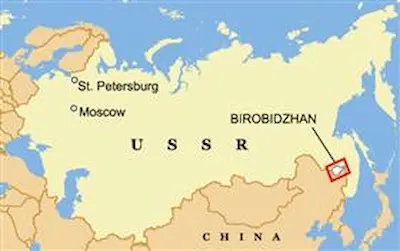
At the time, most of the USSR’s Jews lived in the western regions, in present-day Ukraine, Belarus, and western Russia. Their concentration there, in the area known as the Pale of Settlement, was the product of imperial law: a 1791 decree under Catherine the Great. Its purpose was to keep Jews from expanding economically and integrating into Russia’s central provinces and cities. A concentrated Jewish presence in the western borderlands also served as a human shield against European invasion.
By the late 1920s, however, the new Soviet administration worried more about aggression from the east than from the west. Europe was diplomatically divided, while the Soviet Far East faced an immediate military threat from Imperial Japan, which was pressing against Russia’s vast, underdefended Siberian frontier. Settling thousands of loyal Jewish citizens in the Far East would create a human buffer zone against expanding Japanese forces. The wilderness also held rich timber reserves, mineral deposits, and arable land waiting to be developed.
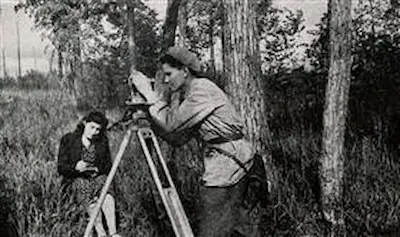 Women surveying land for a new Jewish settlement, Birobidzhan, ca. 1935. From an album produced by Ambijan, an American organization formed in the 1930s to promote and raise funds for Birobidzhan. (YIVO)
The region also offered an alternative to British Mandatory Palestine, one that appealed to young, idealistic, often socialist-leaning Soviet Jews, as well as those facing economic ruin and religious suppression under Bolshevik rule. The natural environment, however, was notoriously unforgiving. The region was a landscape of waterlogged taiga (subarctic forest), swampy marshes, and dense woods. Winter temperatures plunged below minus forty degrees, while summers brought swarms of mosquitoes, floods, and stifling humidity.
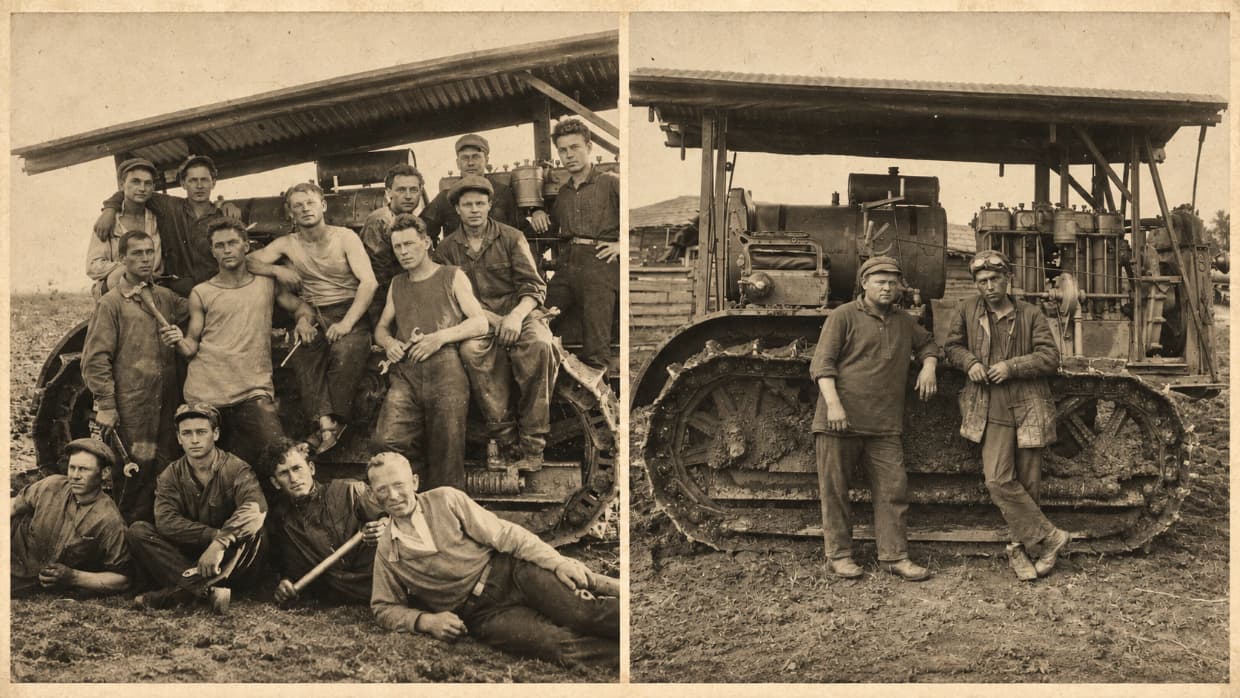
Despite these harsh conditions, the announcement sparked genuine enthusiasm among Soviet Jews. Propaganda posters blanketed Soviet cities, showing robust Jewish farmers driving tractors toward rising suns beneath bold Yiddish headlines. Between 1928 and the mid-1930s, more than forty thousand Soviet Jews made the grueling journey of over 4,000 miles across eight time zones on the Trans-Siberian Railway.
Propaganda posters blanketed Soviet cities, showing robust Jewish farmers driving tractors toward rising suns beneath bold Yiddish headlines.
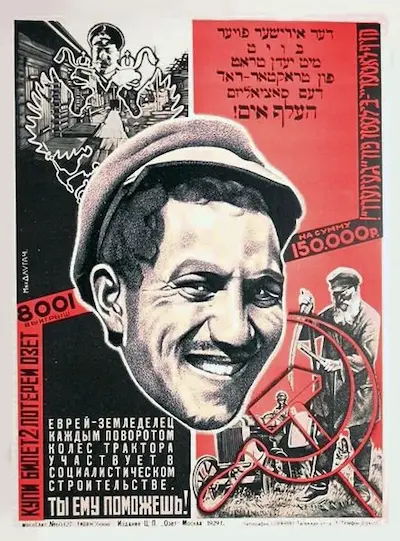 A smiling Jewish laborer in front of a modern tractor featured in a Soviet propaganda poster
Propaganda posters blanketed Soviet cities, showing robust Jewish farmers driving tractors toward rising suns beneath bold Yiddish headlines. Among the first wave of settlers, was a retired factory worker by the name of Lyubov Israelovna. Asked about his experience, he says, "It really was an empty place, there was nothing at all here. My father had to build our wooden house. We built the whole city from scratch ourselves. In the Ukraine, we were surrounded by Jewish culture, Jewish music, but here there was none of that. We stayed only because of the belief that we could somehow build a better life for ourselves."
Astonishingly, between 1,000 and 1,500 Jews from abroad joined the effort as well: idealists, communists, and refugees from Germany, Poland, France, Argentina, Mandatory Palestine, and the United States. Shloime Almazov was the national secretary of the American ICOR (Association for Jewish Colonization in the Soviet Union), a Jewish-American Communist organization promoting the settlement and development of Birobidzhan as a center of Yiddish-speaking Jewish culture. He captured the internationalist idealism that cast Birobidzhan as a bastion of hope for the Jewish future, writing in 1936:
“Where the Jews were given their emancipation, there culture is developing, while in the countries of fascism and anti-Semitism, the national minorities are pining away under an iron heel and culture is being wantonly destroyed.”
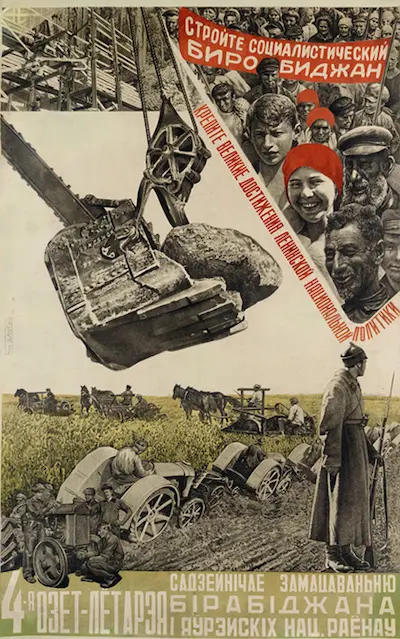
Against all odds, the early pioneers drained swamps, cut timber, and built basic infrastructure. A daily Yiddish newspaper, the Birobidzhaner Shtern (Birobidzhan Star), launched in 1930. A Yiddish national theater opened, libraries stocked thousands of volumes of Yiddish literature, and local schools taught in Yiddish. Street signs, official documents, and railway depots carried text in both Russian and Yiddish, while collective farms with names like Valdheim (Yiddish for “forest home”) were carved straight out of the wilderness. Between the late 1920s and the 1940s, roughly 15 to 20 designated Jewish settlements, collective farms (kolkhozes), and agricultural communes took root across the Jewish Autonomous Oblast.
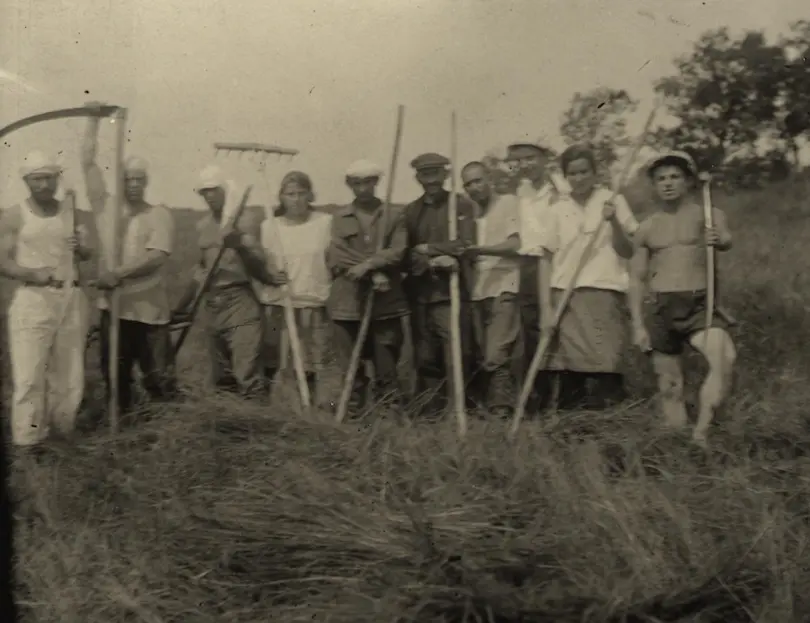 Jews working the land
This Jewish utopia was too good to be true, and it began to fracture almost as soon as it took off. At the heart of Stalin’s policy lay a fundamental contradiction: Yiddish was permitted as a secular language, while Judaism as a religion and Hebrew as a language were ruthlessly suppressed. Synagogues were closed, Torah scrolls were confiscated, and religious practice was driven underground. In the late 1930s, paranoia gripped the Kremlin, and the very international connections Birobidzhan had nurtured became its death warrant.
At the heart of Stalin’s policy lay a fundamental contradiction: Yiddish was permitted as a secular language, while Judaism as a religion and Hebrew as a language were ruthlessly suppressed.
Damning internal reports reached Stalin and shattered Moscow’s illusions. Census tallies revealed that more than half the settlers had abandoned the harsh swampland, exposing the region as an economic drain. At the same time, NKVD (Soviet secret police) intelligence files alerted Stalin to the Jewish region’s “international ties.” Foreign machinery, American aid dollars, and immigrants from Western Europe and the United States came to be seen as a dangerous “fifth column” operating inside Soviet territory. Jewish leaders, writers, intellectuals, and party officials in the region were accused of being Trotskyites, foreign spies, and bourgeois nationalists.
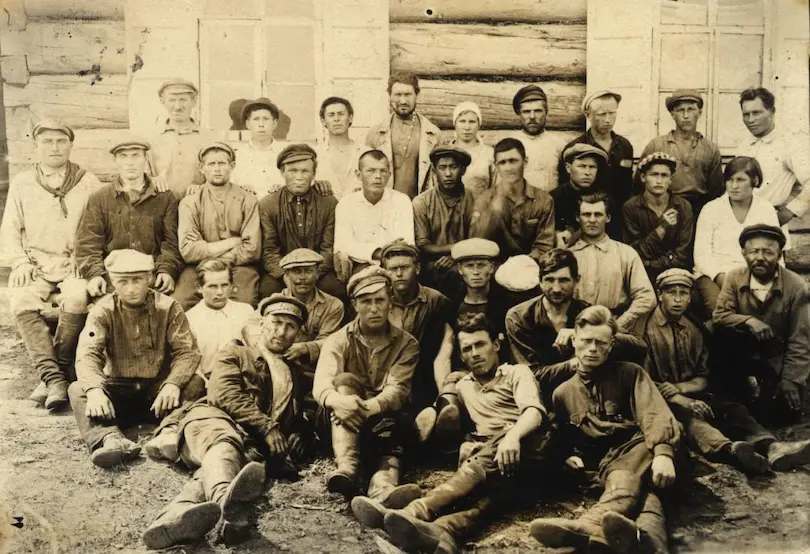 Jewish workers in Birobidzhan
During the height of Stalin’s Great Purge, between 1936 and 1938, the political and cultural leadership of the Jewish Autonomous Oblast was systematically arrested, imprisoned, or executed. The NKVD targeted the region’s founding figures, framing their international ties, their Yiddish revival, and their efforts to attract foreign Jewish settlers as proof of treason, espionage, and counter-revolutionary activity. Yiddish schools were purged of Jewish educational elements, books were burned, and local cultural organizations were dissolved. Demoralized by arrests, executions, and brutal living conditions, tens of thousands of settlers fled back to western Russia. The timing couldn’t have been worse.
Just a few years later, on June 22, 1941, Hitler launched a full-scale invasion of the Soviet Union. Einsatzgruppen (Nazi mobile killing squads) began massacring Jewish communities across western Russia, Ukraine, and Belarus. The territory that had been abandoned as a paranoid wasteland suddenly became a miraculous sanctuary, a place where Soviet Jews could escape the Holocaust. While most Jewish evacuees were routed to Central Asia and the Urals, several thousand were sent further east via the Trans-Siberian Railway to Birobidzhan. Driven by these renewed migration waves, the region's Jewish population reached its historical peak of approximately 45,000 to 50,000 people (nearly 25% of the total population) during the war.
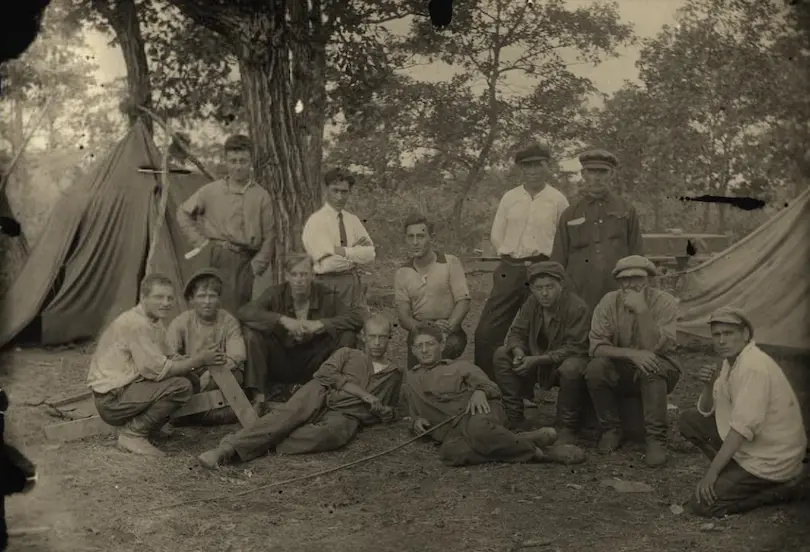
Stalin’s hostility toward Jewish cultural identity gave way to cold wartime pragmatism. Facing an existential threat, the Kremlin desperately needed Western money, military aid, and public goodwill, especially from the United States and Britain. Stalin paused his anti-Jewish purges and in 1942 established the Jewish Anti-Fascist Committee (JAC), enlisting prominent Yiddish writers, the actor Solomon Mikhoels, and other intellectuals to rally global Jewish solidarity and foreign funds for the Red Army. At home, the regime briefly allowed Yiddish publications and cultural appeals to build patriotic unity, while more than 500,000 Jewish soldiers fought in the Soviet armed forces.
Even after Nazi Germany’s defeat, displaced Jews kept trickling into the Jewish Autonomous Oblast, caught on the wrong side of a cruel geopolitical divide. Polish Jewish refugees who had fled to the Soviet Far East were allowed, under post-war repatriation agreements, to return to Europe and eventually emigrate to Mandatory Palestine or the West. Soviet Jewish citizens, on the other hand, received no such exit visa.
Returning to their liberated hometowns in Ukraine, Belarus, and western Russia, these survivors faced a devastating reality: hostile neighbors occupied their homes, antisemitism was rampant, and entire Jewish communities had been wiped out. With no options and trapped behind Soviet borders, hundreds of thousands were left homeless with nowhere to turn. For the Kremlin, sending organized transport trains to carry these displaced Jews thousands of miles east to Birobidzhan was purely pragmatic. It cleared destitute populations out of the war-torn west while repopulating the Far Eastern frontier.
A Jewish survivor who fled the devastated, antisemitic Ukraine of 1947 to seek safety in the Far East recalled:
“So, in 1947, when the recruiters came and proposed the journey to Birobidzhan, we all wanted to go. We were excited about the idea of a Jewish republic. And, in general, we weren’t disappointed. We were given bread and potatoes; we weren’t hungry anymore. For the first time, we could live a decent life.”
In the immediate post-war years, Soviet policy stayed somewhat sympathetic to Jewish self-determination. Stalin initially backed the creation of Israel in 1947, hoping a socialist-leaning state would push British influence out of the Middle East. When Israel quickly aligned with the United States and the West, Stalin realized his gamble had failed. Fueled by Cold War paranoia, and alarmed when thousands of Moscow Jews spontaneously cheered Israel’s new ambassador, Golda Meir, the Kremlin began viewing all Soviet Jewry as potential traitors.
In 1948 the hammer fell, and a second brutal purge struck Jewish life in Birobidzhan. Over the next few years, Stalin waged a lethal antisemitic campaign, dismantling the Jewish Anti-Fascist Committee he had created just a few years earlier and executing leading Yiddish writers and intellectuals. By the early 1950s, Birobidzhan’s remaining schools, libraries, and cultural institutions had been fully shut down, leaving “Stalin’s Promised Land” a frozen dream.
By the early 1950s, Birobidzhan’s schools, libraries, and cultural institutions had been scrubbed of Jewish identity, leaving the “Soviet Zion” a frozen dream.
After the Soviet Union collapsed in 1991 and travel restrictions were lifted, most of Birobidzhan’s remaining Jews left in a massive exodus. The overwhelming majority moved to Israel, while smaller numbers resettled in Germany, the United States, and the larger cities of western Russia. The exodus left behind a territory that is “Jewish” largely in name only.
Today, Jews make up less than one percent of the region’s population. Yet, paradoxically, it remains the only official Jewish autonomous territory in the world outside of Israel. The capital still has a menorah fountain outside its central train station, street signs in Yiddish script, and statues of classic Yiddish literary characters. A local Chabad synagogue and community center, along with some Yiddish classes, keep the last thread of Jewish heritage alive.
Birobidzhan is an extraordinary historical paradox: a Jewish homeland built without Jewish tradition, a secular Zion created by an anti-religious regime, and a Jewish autonomous region inhabited mostly by non-Jews. Its story is a bittersweet testament to the resilience of Jewish identity under one of history’s most brutal empires.