



 What Jensen Huang’s Downfall Teaches Us About Human Nature






Sometimes courage and compassion come from the most unexpected places.
During the Nazi occupation of Amsterdam, a little girl survived the Holocaust because a prostitute hid her in a tiny apartment behind a false wall.
The woman continued receiving customers, including German soldiers and Gestapo agents, while the child remained concealed just feet away. Eventually, courageous Dutch men and women helped them escape aboard a ship bound for Palestine.
The little girl was a family friend on my wife's side. She later settled in Israel but died without revealing the identity of the woman who saved her.
Her story stayed with me.
In 2009, I spent two days searching the archives of Yad Vashem, the World Holocaust Remembrance Center in Jerusalem, hoping to learn more about this extraordinary woman. I never found her. But I discovered accounts of other prostitutes who risked their lives to protect Jews during the Holocaust.
One story particularly captured my attention: Hedwig Porschutz, a Berlin prostitute who sheltered Jewish women, obtained food on the black market and helped people facing deportation.
A woman whom respectable society marginalized demonstrated a level of humanity that many others failed to show.
Her story reveals an extraordinary paradox: a woman whom respectable society marginalized demonstrated a level of humanity that many others failed to show.
Born in 1900, Hedwig Volker Porschutz struggled with poverty and unemployment. She worked various low-paying jobs before economic desperation led her into prostitution.
In 1940, she began working at a brush-manufacturing workshop owned by Otto Weidt, a partially blind businessman who employed blind and visually impaired Jewish workers. Weidt protected his Jewish employees by arguing that their labor was essential to fulfilling Nazi government contracts. He also organized clandestine efforts to help persecuted Jews obtain food and shelter.
Hedwig became an important part of his operation.
Officially a shorthand typist, she used her knowledge of Berlin's black market to acquire scarce groceries and consumer goods for Jews in hiding. She also obtained false documents and sheltered Jews in her apartment.
Her location made her actions particularly audacious. She lived on Alexanderplatz, directly across from the Reich Security Main Office, the center of Nazi security operations and persecution.
Her apartment served as both a hiding place and a place of business. She continued selling her services to German soldiers and civilians, sometimes allowing other prostitutes to bring customers there.
When customers entered through the front door, Jews hiding in the apartment could slip out the back and wait in the hallway until the visitors departed.
Imagine the nerve required to entertain German customers while concealing people the Nazi regime was determined to murder.
In January 1943, Hedwig hid twin sisters Marianne and Anneliese Bernstein in her one-and-a-half-room apartment. Two months later, she took in Grete Seelig and Lucie Ballhorn.
Four Jewish women were now living in her cramped apartment while she continued receiving customers.
When Jews hiding elsewhere in her building were discovered that summer, the authorities began paying closer attention to the property. Hedwig helped the four women find alternative hiding places and continued supplying them with food.
Three survived the Holocaust. Lucie Ballhorn was arrested in 1943, deported to Auschwitz and murdered.
Hedwig's assistance extended beyond those she sheltered. Working with Weidt, she helped organize food deliveries to Jews imprisoned in Theresienstadt, the Nazi ghetto and transit camp in what is now the Czech Republic. Although the Nazis deceptively presented it to some elderly Jews as a retirement community, it was part of the machinery of deportation and extermination.
In 1944, she was arrested and sentenced to 18 months in prison for black-market offenses and prostitution.
Hedwig's black-market activities eventually attracted official attention. In 1944, she was arrested and sentenced to 18 months in prison for black-market offenses. Authorities also charged her with "commercial fornication," the legal designation for prostitution.
Released at the end of the war in 1945, Hedwig returned to find her apartment destroyed by Allied bombing. She and her husband struggled to survive through intermittent, poorly paid employment.
She applied to the Berlin Compensation Office for recognition and benefits as a victim of politically motivated Nazi persecution. Her application was rejected.
In 1959, officials also denied her recognition as an "unsung hero," citing her occupation.
The woman had risked her freedom to shelter Jewish fugitives and help feed people facing deportation, yet authorities could not look beyond her profession.
Hedwig Porschutz died in 1977, largely forgotten.
Nearly 35 years later, a Berlin public prosecutor overturned her wartime conviction, describing the original judgment as a "shameful verdict." A commemorative plaque was installed at her wartime address, Feurigstrasse 43, and a street in Berlin was named in her honor.
Only after her death did she begin receiving the recognition she deserved.
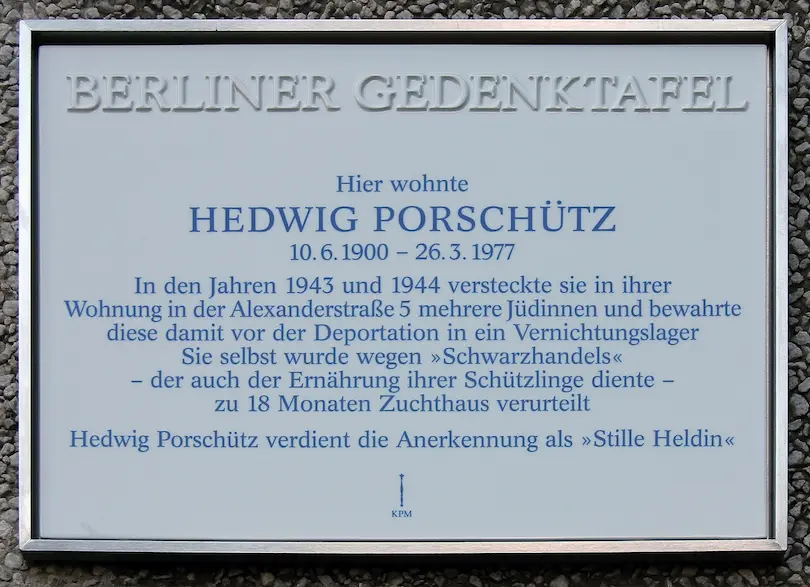 The memorial plaque in Berlin
The Holocaust produced countless stories of extraordinary courage. We remember diplomats, resistance fighters and individuals who organized elaborate rescue operations. But many who saved Jewish lives never became famous. Some acted alone, without recognition or any expectation of reward.
Among them were women like Hedwig Porschutz, whose social standing made their contributions especially easy to overlook.
Her story challenges us to reconsider how we define goodness and heroism. We often judge people by their professions, reputations and social standing. Yet during the Holocaust, some who occupied positions of respectability remained indifferent to suffering, while others whom society had dismissed demonstrated extraordinary compassion.
Jewish tradition places enormous value on preserving human life. The principle of pikuach nefesh teaches that saving a life is among our highest obligations. Hedwig was not Jewish, and we cannot presume to know what motivated her actions. But her courage reflected a profound respect for human life.
My search for the woman who saved a little girl in Amsterdam never uncovered her identity. But it led me to Hedwig Porschutz and other women whose names deserve to be remembered.
We may never recover all their stories. But we can recognize what they teach us: Humanity is not measured by social standing or reputation. It is measured by what we do when another person's life is at stake.
An earlier version of this article appeared in MOMENT Magazine.