



 The BBC Broke Her Because She’s a Jew





In 1943, a prisoner in a Nazi ghetto turned a tiny storeroom into a synagogue and covered its walls with prayers. They outlived him, and his words still haunt.
With high walls, barbed wire, and hundreds of local gendarmes and Nazi overseers, escape from Terezin (Theresienstadt) was virtually impossible.
Within the walls of this old garrison town, despite starvation, overcrowding, disease, and the constant threat of deportation, after long days of back-breaking labor Jewish inmates were relatively free to organize their own activities in the evenings.
At first, Jewish cultural activities were done secretly. Over time, that became unnecessary: the Nazis were more “hands-off” here than in other camps, partly to keep the prisoners occupied, but especially to use Terezin as a propaganda tool, claiming that the Jews were doing “just fine.” They even made these activities official with the creation of the Freizeitgestaltung, the “Administration of Leisure Time Activities,” which was run by Jewish inmates themselves, though its programs required SS approval.
The Terezin propaganda ruse worked, culminating in the infamous Red Cross visit of 1944, after which the ICRC (International Committee of the Red Cross) produced a favorable report about conditions in the ghetto—which was then used as cover for Nazi crimes.
What followed was an astonishing cultural life. Jewish musicians created choirs, operas, cabarets, and even a jazz band. Scholars estimate that over 1,000 concerts were performed.
Though very low on supplies, artists created thousands of drawings and paintings. Over 7,300 drawings survive in the Jewish Museum in Prague alone, including over 4,000 by children.
Over 2,400 lectures—on various subjects, usually connected to inmates’ areas of expertise—were organized during the ghetto's existence.
And Torah study halls were set up. We know this from personal testimonies and surviving texts. Approximately 60,000 books were held in the ghetto library, including Jewish and Hebrew books. A special Hebrew study room contained approximately 10,000 volumes of Hebraica, used primarily by scholars. There was even a special group called the Talmudkommando, consisting of rabbis and Jewish scholars assigned to catalogue confiscated Hebrew books.
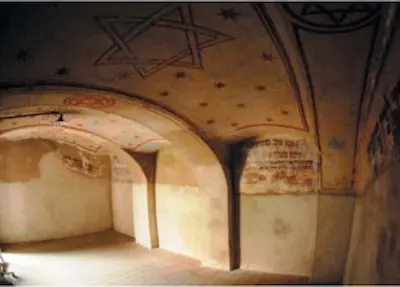 Inside the hidden prayer room
And the Jews prayed. The ghetto's rabbinate had access to approximately 8,000 siddurim and other liturgical books. Numerous minyanim and makeshift shuls were organized, in attics, cellars, storerooms, and other available spaces.
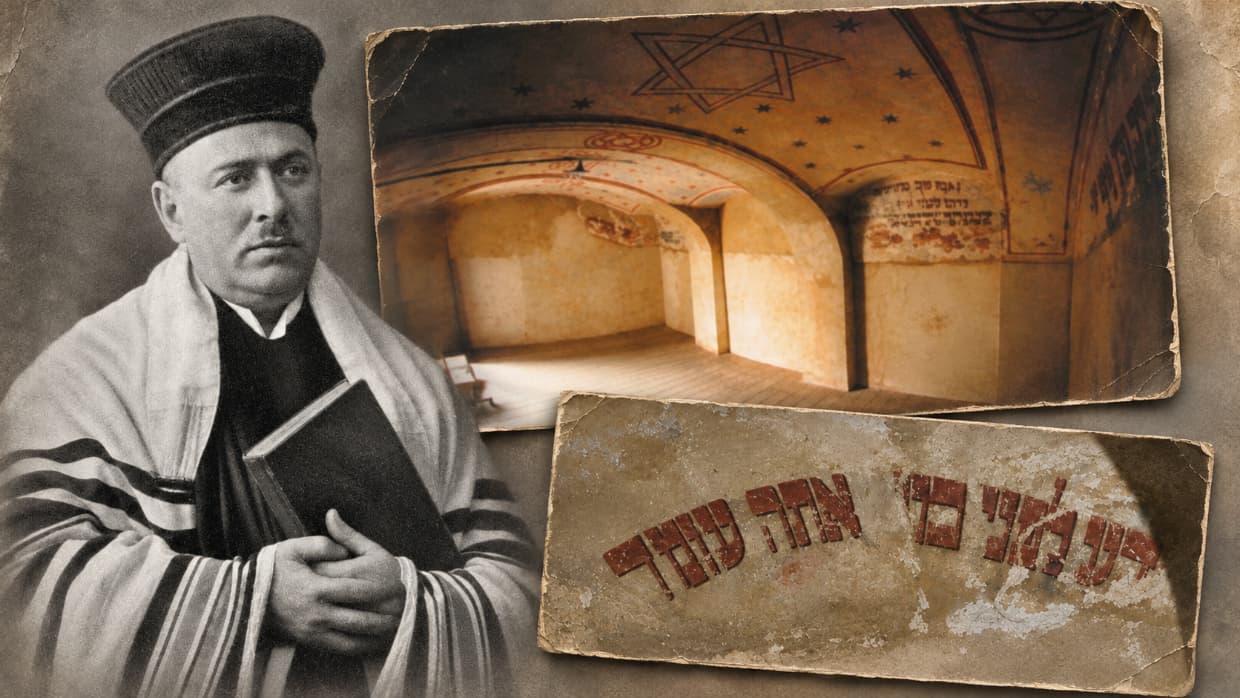
One of these shuls was created by Artur (Asher) Berlinger, born in Germany in 1899. An Orthodox Jew, he was a religious teacher, cantor, musician, calligrapher and artist. He had even served in the German army during World War I.
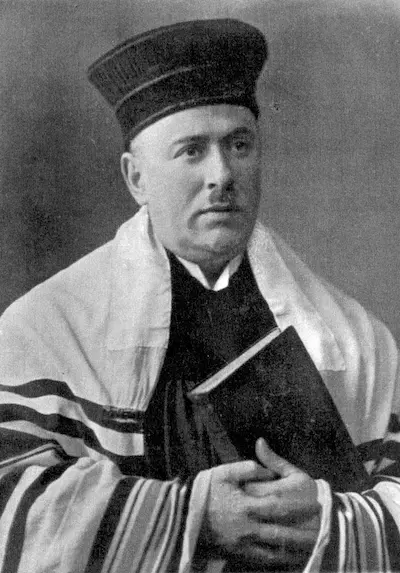 Asher Berlinger in the traditional garb of a cantor, Schweinfurt, Germany, before the war (Yad Vashem)
In September 1942, the Nazis deported him and his wife, Berta, to Theresienstadt. During 1943, with the help of other prisoners, he converted a small storage space (roughly 200 square feet, or 18–20 square meters) on Dlouhá (Long) Street into a functioning Jewish prayer room.
Using his artistic skills, apparently with materials obtained through the ghetto's workshops, he decorated the walls and vaulted ceiling with Hebrew verses and religious imagery. Its ceiling was decorated with stars, creating something resembling a night sky. He also conducted religious services there.
On September 28, 1944, Berlinger was deported to Auschwitz, where he was murdered. His wife followed eight days later and was also murdered. Their two daughters survived the Holocaust, having escaped to England on the Kindertransport.
Incredibly, Berlinger's shul survived.
The family that owned the building after the War knew about the room but did not publicize it during communist rule. Its existence became publicly known around 1989, and it was subsequently restored and opened to visitors.
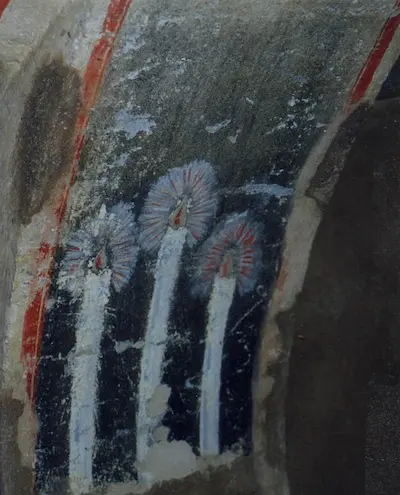 One of Berlinger’s drawings on the walls of the "Hidden Synagogue" in Theresienstadt. (Yad Vashem)
Despite serious flooding in 2002, which destroyed some of the original artwork, the shul remains accessible today. It is one of the very few places where religious artwork made by Holocaust prisoners survives in its original location.
Berlinger's daughter Rosie Baum visited the shul in 2002, accompanied by her own daughter. She recognized her father's artistic style in the surviving decorations and inscriptions. Reflecting on her parents' ordeal, she explained that they had been forced to give up their children and their possessions. The one thing they still had was their faith.
And that faith is literally written on the walls.
One wall includes the phrase “Know before Whom you stand,” based on the Talmud (Berakhot 28b). On another wall is a reference to Jerusalem: “If I forget you, Jerusalem, let my right hand forget its skill,” from Psalm 137:5.
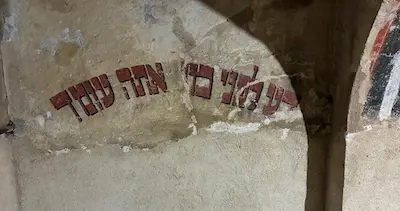 “Know before Whom you stand”
Synagogue walls commonly display biblical verses and familiar prayers. These two references are relatively common, in one form or another.
But the Theresienstadt shul was different. Its walls included two passages from the extended Tachanun prayer, the traditional penitential prayers recited on Mondays and Thursdays. Yad Vashem identifies these inscriptions as an exceptional feature of the synagogue.
These are not the usual decorative verses found in shuls. They are desperate appeals to God amid suffering and persecution.
One wall declares, “Please turn away from Your fierce anger, and have compassion on the people You chose as Your own.”
For me, the most moving is another inscription:
“For despite all this, we have not forgotten Your name. Please do not forget us.”
In the traditional Tachanun prayer, these words appear immediately after a description of Jewish suffering: “Look down from Heaven and see how we have become an object of ridicule among the nations. We have been regarded as sheep led to slaughter, to be killed, destroyed, struck and disgraced.”
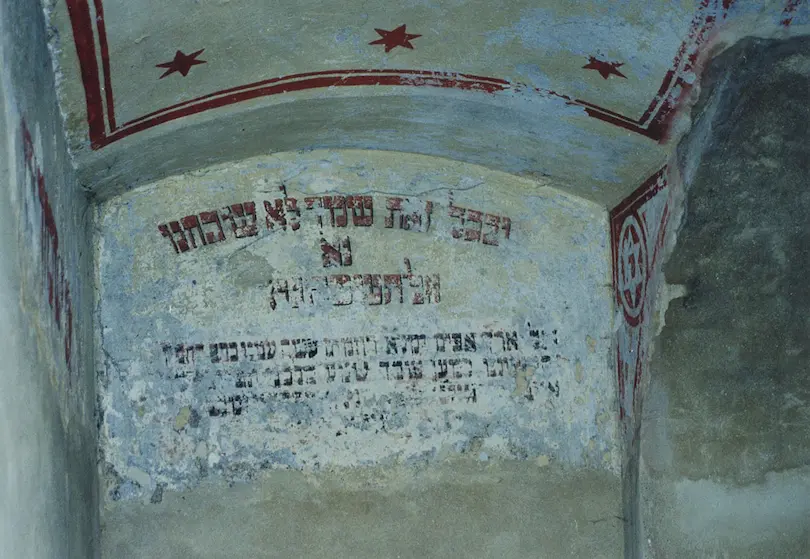 Photograph of the passages of Tachanun on the walls of the "Hidden Synagogue" in Theresienstadt (Yad Vashem)
Imagine choosing those words to decorate a synagogue in a Nazi ghetto in 1943.
Berlinger chose prayers – composed centuries before the Holocaust - that reflected the terrible reality around him. Words about persecution, suffering, God's anger, and the desperate hope that He would not abandon His people.
Over 140,000 innocent Jews were sent to Terezin during WWII. Approximately 88,000 were deported to Auschwitz and other extermination sites, and roughly 84,500 of those were murdered. Another 34,000 died in Terezin itself. Only a minority survived.
Artur Berlinger and his wife did not survive, but the prayers he painted on the walls of this simple shul did.
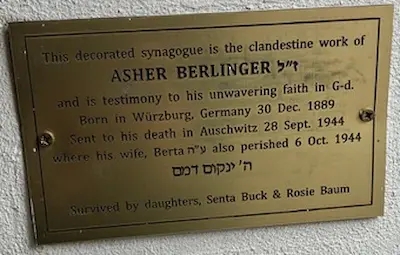
Using language within the Jewish prayer book that seemed almost written for his circumstances, perhaps it is fitting for us to declare: “Though times are tough, though the world seems to be turning against us, we have not forgotten that we are Jews. Please, God, don't forget us.”