



 The Red Cross’s Jewish Problem

9 min read





In 1944, the Red Cross toured a Nazi camp and wrote a glowing report. Last week, its president made a startling admission about the Israeli hostages in Gaza.
Last week, the head of the International Committee of the Red Cross (ICRC) acknowledged that the organization should have done more, earlier, to help secure the release of Israeli hostages held in Gaza. On October 10, 2026, the New York Times reported that Mirjana Spoljaric Egger, President of the ICRC, recently acknowledged in an interview that earlier pressure to release Israeli hostages from Gaza might have saved lives. Her exact words, as reproduced by The Times of Israel, were: “I personally think that pressure should have come earlier in the negotiations. We could have saved more lives.”
For me, the timing of her disclosure was eerie: I heard about it on the way to Theresienstadt, the notorious Nazi camp outside of Prague. Terezín (Theresienstadt) was different from the more (in)famous camps like Auschwitz or Treblinka: it wasn’t built as a death camp. Rather, it was a garrison town re-designed as a ghetto and transit camp. In the end, tens of thousands of Jews (and others) were imprisoned, starved, abused, and deported to their deaths elsewhere. Tens of thousands died in the camp itself. And it was the site of one of the most shameful episodes in the history of the International Red Cross.
In June 1944, the Nazis invited a Red Cross delegation to inspect the camp. Before the visit, the Nazis transformed it into an elaborate propaganda set. Buildings were painted. Gardens were planted. Shops and cafés were prepared. Special activities were arranged. Thousands of Jews were deported to Auschwitz to reduce overcrowding. Those remaining were under strict orders – and supervision – to “play the part” assigned to them by the Nazis and their collaborators.
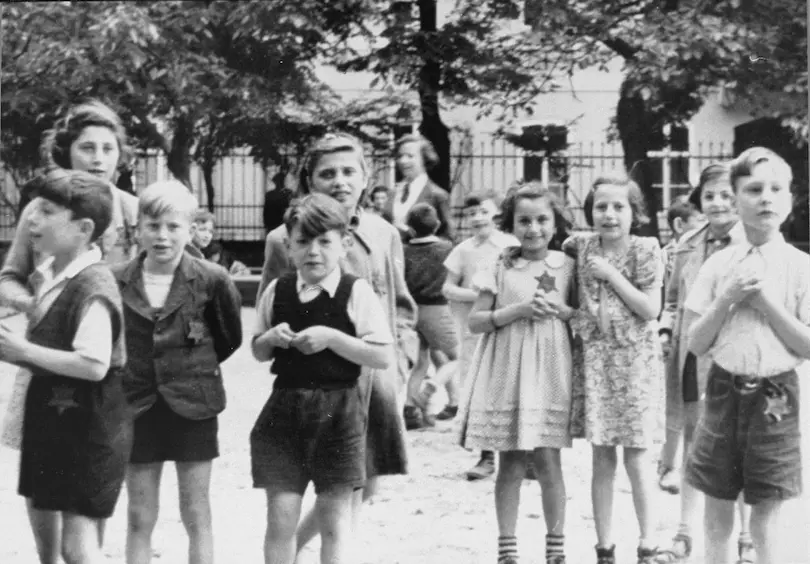 A photograph of Jewish children in the Theresienstadt ghetto. The photo was taken on June 23, 1944, by a representative of the International Committee of the Red Cross. (US Holocaust Memorial Museum)
The Red Cross visitors "fell" for it, though their “mistake” was hardly innocent. They knew they were visiting a facility controlled by a murderous regime, yet they failed to investigate what was happening beyond the staged scenes, didn’t deviate one inch from the path the Nazis planned, and required no independent testimony from prisoners – though the ICRC's own historian, Daniel Palmieri, confirms that such interviews were normally a non-negotiable requirement of Red Cross inspections.
All this despite the fact that by the time of the visit, the Nazis had already deported approximately 70,000 Jews from Terezín, mostly to their deaths in camps farther east - and killed nearly 30,000 inside the camp itself. Indeed, during the visit, thousands of others were starving, abused and diseased, just “out of sight”.
The Rׂׂed Cross failed to exercise the minimum of skepticism, independence, and moral courage that the situation demanded.
No surprise that the Nazis would try to pull off such a production. The problem was that the Red Cross failed to exercise the minimum of skepticism, independence, and moral courage that the situation demanded. Even worse, the ICRC produced a favorable report about the conditions at the camp – which would be used to strengthen Nazi rule.
Red Cross failures of that era went far beyond this one notorious visit. By 1942, the organization had received credible information about the systematic extermination of Europe's Jews, yet its leadership decided against publicly condemning the atrocities.
Red Cross travel documents were used by Nazi war criminals (including Mengele) to escape Europe.
After the war, another disturbing chapter emerged: Red Cross travel documents were used by Nazi war criminals (including Mengele, the notorious Auschwitz “doctor”) to escape Europe. The irony is painful: Despite warnings, the very organization that had failed so many innocent Jews during the Holocaust did almost nothing to prevent its documents being used by their persecutors to escape justice. The ICRC has subsequently acknowledged that its response to the Holocaust represented a grave failure. But its “Jewish Problem” continued after the war.
The Red Cross had long recognized the Red Crescent, used by Muslim-majority countries, and also the Red Lion and Sun, used by Iran. But when Israel's equivalent, Magen David Adom (the Red Star of David), sought recognition it was refused. This exclusion lasted for decades.
To her great credit, Dr. Bernadine Healy, president of the American Red Cross from 1999 to 2001, became a vocal advocate for ending the exclusion. Healy later maintained that her advocacy contributed to her departure from the American Red Cross. She also described an extraordinary exchange with ICRC president at the time, Cornelio Sommaruga, whom she accused of making an offensive comparison involving the Star of David and the swastika (he disputed her interpretation of his remarks.) Whatever he meant by the remark, the underlying discrimination was real.
Only in 2006, nearly six decades after Israel's establishment, was a compromise reached through the adoption of a new, neutral emblem known as the Red Crystal. Magen David Adom was finally admitted as a full member of the international movement, though without full equal use of its own symbol.
Then came October 7, 2023. Hamas terrorists murdered approximately 1,200 people in Israel and abducted 251 hostages into Gaza, including children, the elderly, women, and men. Some were wounded, others required regular medication. Their families desperately sought help from the Red Cross. What did it do? Not much.
The question on everyone’s minds was: Could it have done more? Until last week, it wasn’t completely clear: The Red Cross does not possess an army. It cannot force Hamas to cooperate. On the other hand, it has diplomatic channels, international standing, and enormous moral authority - and didn’t seem to be using much (if any) of its clout to help Jewish hostages. Last week, the head of the organization admitted what many already suspected: it could have done more.
The Red Cross is a valuable organization. It has helped – and is helping – countless innocents around the world. Over more than 160 years, it had built one of the most respected names in the world.
Which makes its “Jewish Problem” all the more disturbing: Though it has helped many Jews in many situations over the years, there is a clear and disturbing pattern stretching back over 80 years. In case after case, when it comes to helping Jews in need, the humanitarian organization does not try quite so hard. A great name – and great shame.