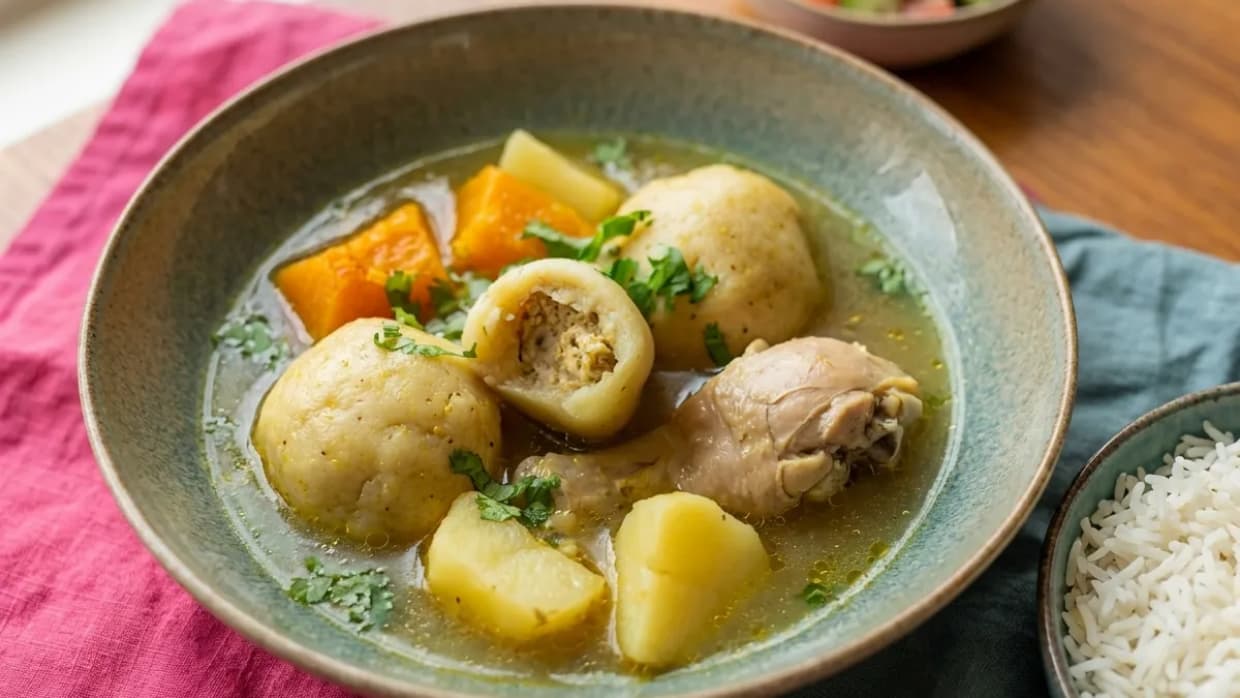
Marag is the soup my grandmother remembered from Jewish Calcutta. In our family, we ate it over white Basmati rice, with a salad on the side. Its depth comes from hamising, the Judeo-Baghdadi word for frying down a paste of onion, garlic and ginger, worked in slow circles with a wooden spoon until it softens and turns golden.
Turmeric, ground cumin and ground coriander give this Indian version its color and warmth. The koobahs - rice dumplings filled with chicken - are optional, but traditional, tasty and important.
Ingredients
Servings 6
Spice paste
- 2 large onions coarsely chopped
- 4 to 5 garlic cloves peeled
- 1 2-inch piece fresh ginger, peeled and coarsely chopped
Soup
- 2 tablespoons neutral oil canola, grapeseed or vegetable
- 1/4 to 1/2 teaspoon ground turmeric
- Ground cumin 3 teaspoons or to taste
- Ground coriander 2 teaspoons or to taste
- 1 3 1/4-pound / 1.5 kg chicken, cut into 8 pieces
- 1 1/2 teaspoons fine sea salt or to taste
- 1/4 teaspoon freshly ground black pepper or to taste
- 2 cardamom pods
- 6 to 8 cups 1.5 to 2 liters water or light chicken stock
Vegetables
- 2 cups coarsely chopped ripe tomatoes or 1 (14-ounce) can diced tomatoes
- 2 medium Yukon Gold or red potatoes cut into 1-inch cubes
- 1 1/2 to 2 cups peeled pumpkin such as butternut squash or kabocha, cut into 1-inch cubes (optional)
- Other vegetables such as carrots, green beans, cauliflower, zucchini, spinach or bok choy, cut into bite-size pieces (optional)
Dumplings
- 10 to 12 meat-filled rice koobahs fresh or frozen (optional)
To finish
- 1/2 cup chopped fresh cilantro fresh coriander
To serve
- Mounds of fluffy white Basmati rice
Nutritional Facts
Nutrition Facts
Marag: Jewish Indian Chicken Soup
Amount per Serving
Calories
134
% Daily Value*
Fat
5
g
8
%
Saturated Fat
0.4
g
3
%
Trans Fat
0.02
g
Polyunsaturated Fat
1
g
Monounsaturated Fat
3
g
Sodium
603
mg
26
%
Potassium
599
mg
17
%
Carbohydrates
21
g
7
%
Fiber
3
g
13
%
Sugar
4
g
4
%
Protein
3
g
6
%
Vitamin A
2975
IU
60
%
Vitamin C
27
mg
33
%
Calcium
43
mg
4
%
Iron
1
mg
6
%
* Percent Daily Values are based on a 2000 calorie diet.
Instructions
- Purée the onions, garlic and ginger in a blender or with a stick blender into a coarse paste, adding a spoonful of water only if the blades will not turn.
- Heat the oil in a 6-quart heavy pot over medium heat. Add the paste. Hamis the paste: fry it in slow circles with a wooden spoon until it softens, loses its raw edge and turns lightly golden and fragrant, 8 to 12 minutes, or longer if the paste is still wet. Do not rush it. This is where the soup gets its depth.
- Stir in the turmeric, cumin and ground coriander and cook until fragrant, 30 to 60 seconds.
- Add the chicken and turn the pieces in the paste until coated, a few minutes, without letting them brown. Add the salt, pepper and cardamom.
- Add enough water to cover the chicken generously. Bring to a boil, reduce the heat to low, cover and simmer for 20 minutes, skimming off any foam.
- Add the tomatoes, potatoes, pumpkin and any other vegetables. Simmer until the chicken and vegetables are tender, 20 to 30 minutes.
- Add the koobahs, if using, and simmer gently until cooked through, 20 to 30 minutes. Keep the heat low so they do not break.
- Stir in the cilantro. Taste and adjust the salt and pepper. Cover and rest off the heat for 10 minutes.
- Serve over rice. The soup should taste warming and ginger-forward, golden with turmeric, warm with cumin and coriander, fresh with cilantro and quietly deep from the hamis.
Notes
If you want to make your own koobahs, click this link. Note the Indian rice-cased version can be served at Passover in communities that eat rice; the linked semolina version cannot.
Reprinted with permission. Read the full story, Taking Center Stage, on Elli Benaiah’s Beyond Babylon for full article.