







 The Shofar: Beyond Words





The oldest complete Bible manuscript ever found is on rare display in Jerusalem. A veteran tour guide explains why it left him speechless.
As a licensed Israeli tour guide, I've crawled through Hezekiah's Tunnel, stood atop Masada, wandered through ancient synagogues and Crusader fortresses more times than I can remember. So forgive me if I occasionally feel a little jaded. It's a professional hazard. When your "office" is the Land of Israel, it takes a lot to make you stop and simply stare.
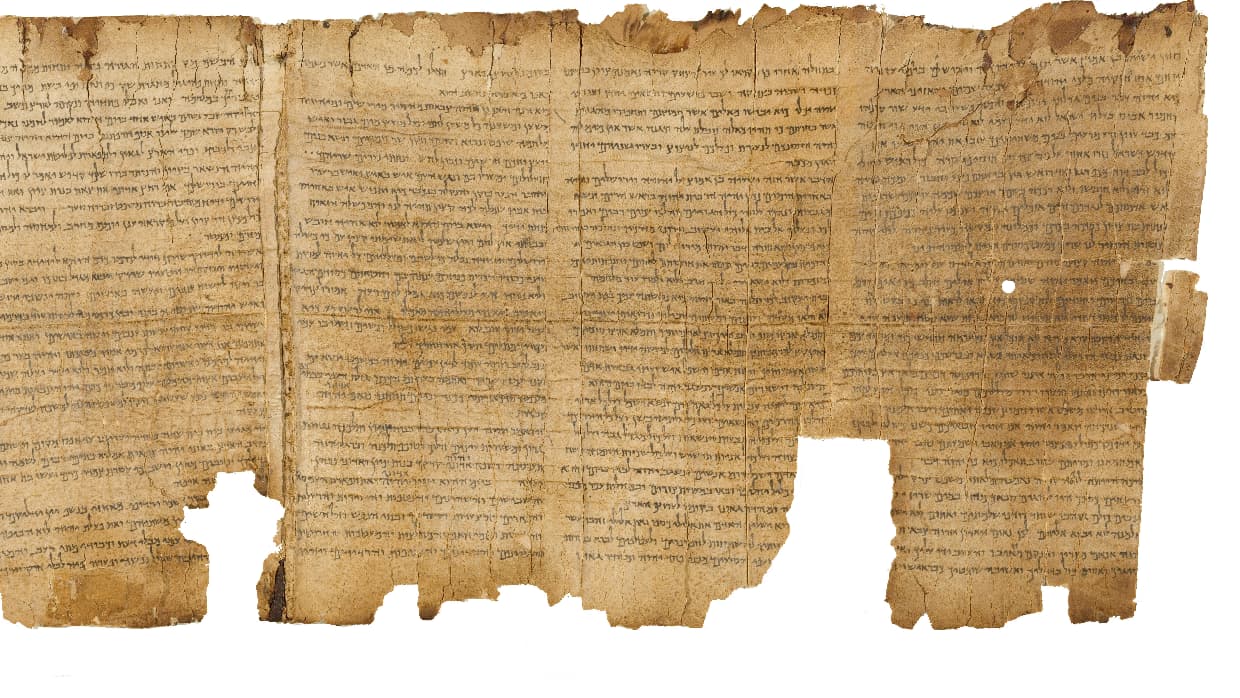
To my surprise and delight, last week, my jaw dropped, at a museum I've been to dozens of times. For the first time in nearly 60 years, the complete Great Isaiah Scroll, the oldest biblical manuscript ever found, was on full display.
To appreciate its awesomeness, a little background history is required.
Like so many great discoveries, these ancient texts were found by accident. In 1947, a bored young Bedouin shepherd tossed a stone into a cave near the northwest shore of the Dead Sea. Instead of hearing the thud he expected, he heard the sound of breaking pottery.
The ancient clay jars containing leather scrolls were one of the greatest archaeological discoveries in history.
Inside were ancient clay jars containing leather scrolls. He sold them to an art dealer in Bethlehem. They eventually made their way to one of Israel's leading archeologists, Professor Eleazar Sukenik (father of archeologist Yigal Yadin, who later became the IDF's Chief of Staff). Sukenik was the first to understand what they were: genuine treasures from the Second Temple period—and one of the greatest archaeological discoveries in history.
Over the next decade, nearly a thousand manuscripts and fragments were recovered from 11 caves around Qumran, preserving a remarkable window into Jewish life more than 2,000 years ago. Collectively known as the Dead Sea Scrolls, they are now housed in the Israel Museum's Shrine of the Book, one of Jerusalem's best-known landmarks.
A large replica of the most famous scroll, the Great Isaiah Scroll, is the centerpiece of the display. A replica because, in order to protect the fragile parchment, normally only a small section of the original can be exhibited.
Isaiah is one of Jewish history’s most famous prophets. His words were spoken in Jerusalem roughly 2,700 years ago and, according to Jewish tradition, preserved under King Hezekiah to ensure their accurate transmission from generation to generation. One of those copies—the Great Isaiah Scroll—was carefully written by a scribe while the Second Temple still stood, and then packed tightly into a clay jar and placed in a cave near the Dead Sea.
For the first time since 1968, visitors can view the entire original stretched out in all its ancient glory.
It is the oldest complete copy of the Book of Isaiah, and the oldest complete book of the Bible, ever discovered. This summer, for the first time since 1968, visitors can view the entire original stretched out in all its ancient glory.
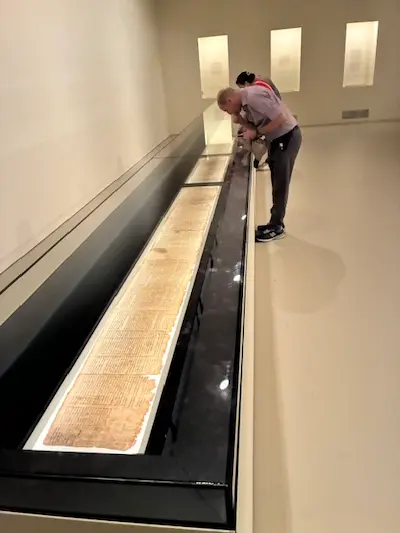 The museum prepares you for the experience. Visitors are admitted in small groups into a dimly lit, carefully climate-controlled room. Everything—from the lighting to the humidity to the amount of time the parchment is exposed—has been engineered to preserve a document that has survived more than 21 centuries. After a short introductory film, you are quietly ushered in and given just seven minutes to stand before the entire 7.17-meter (23.5-foot) scroll.
I'd seen photographs, replicas, and fragments of it for decades. I'd read books and countless articles about its historical importance. None of that prepared me for standing a few feet away from the actual scroll.
Suddenly, Isaiah was no longer just a prophet from long ago. He, and his message, became real and relevant. I couldn’t help thinking that the timing of the exhibition is fortunate: Every summer, around the world, Jews re-encounter Isaiah's prophecies in the weekly haftarah readings in synagogue. On the Shabbat before Tisha B'Av, we hear him remind the Jewish nation that ritual without morality is empty: "Learn to do good; seek justice, relieve the oppressed, judge the orphan, plead for the widow" (Isaiah 1:17).
After the fast, for seven consecutive weeks, we read his soaring words of comfort and redemption. We begin with perhaps the most famous words he ever wrote: "Comfort, comfort My people, says your God" (40:1). A few verses later comes the promise that has strengthened generations of Jews facing impossible circumstances: "Those who hope in God shall renew their strength; they shall soar on wings like eagles" (40:31).
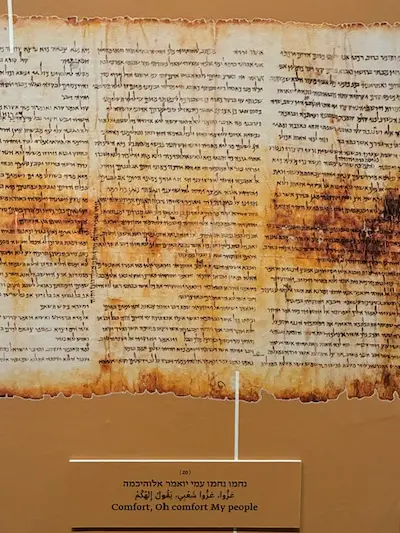 Standing there, I realized these weren't simply famous passages I had studied over the years. They were the very words lying before me. Not Isaiah's own manuscript, of course, but a copy written while the Second Temple still stood, centuries before its destruction. Generation after generation has read these same chapters, found comfort in these same promises, and wrestled with these same challenges.
Roughly 2,700 years ago, Isaiah walked the streets of Jerusalem. A sage and a prophet, he confronted kings. He challenged a complacent society. He warned of destruction while insisting that we not lose hope, for redemption would ultimately come. Today, the Jewish calendar still walks us through his message as he intended it: first honest self-examination, then comfort, then hope, then redemption. It is a powerful process, and a personal one.
This summer, in Jerusalem’s Israel Museum or in your local synagogue, try reading Isaiah’s words and reflecting on them. You may feel as though you've just met Isaiah.












Great!
I am learning about the Dead Sea Scrolls in an online group led by Prof. Rachel Elior. I had no idea that a portion of it was now on display. The coincidence of this article is quite intriguing.
I must say that if anyone is ever fortunate to be in a group or class led by Prof. Elior, you will not be disappointed. Her knowledge is vast and her ability to share that knowledge in a cohesive and exciting manner is incredible.
Great article - thank you.
How long will it be on display?
Thank you for sharing your feelings abouy the scroll. I love the fact that the whole dcroll of the profet was found. Telling a tale to those who want to have another writer, so some prophesies were not just that
People have been saying that the whole Tanach was in the Dead Sea scrolls. I always told them it was only Yeshaia.
there are other parts as well but the most complete book, by far, is Isaiah...
Approximately 1000 scrolls were found at Qumran. (A bunch of others found in the Dead Sea area are often lumped in, but are really separate.) About 20% of the scrolls, about 200 total, are of Biblical books. (The rest are either Apocryphal books that were already known or books unique to the Qumran sect that were almost all previously unknown.) As there are only 24 books in Tanakh, obviously many are found in multiple copies, some complete or nearly so, some partial, and some fragments. Some of those fragments are quite small. All books of Tanakh are at the very least represented, with the exception of Esther. (Why Esther is missing is a debated question. It was obviously already written by that point. It may just have been lost, or it may have been deliberately excluded.)
Very NICE exhibit and article