






 Biblical Imagery in Dolly Parton’s Music
Jewish Geography
Jewish Geography



10 min read


For centuries a Jewish community thrived in the heart of the Sahara Desert.
In 1984, an American doctor touring Algeria stumbled across something he never expected to find in the middle of the Sahara Desert: a synagogue.
Dr. Ronald Nagel, a hematologist, was on a scientific research trip when his hosts recommended he spend the weekend in the town of Ghardaia. "You cannot imagine how beautiful the place is," he was told. Dr. Nagel did find it beautiful, but what stopped him was a semi-destroyed building on Jerusalem Street with a Star of David made of iron above an old wooden door. It was clearly no longer in use.
Ghardaia is one of five fortified towns in Algeria's M’zab Valley, in the heart of the Sahara Desert. The towns were built in the 10th century by the Ibadites, a persecuted ascetic Muslim sect.
Each town sits on a rocky peak, with a mosque at its highest point. The mosque's minaret doubles as a watchtower, and the mosque itself serves as a defensive fortress with an arsenal and grain storehouse. Private homes are built around it in concentric circles, and each town is enclosed by a wall. Palm groves planted between the towns create an artificial oasis.
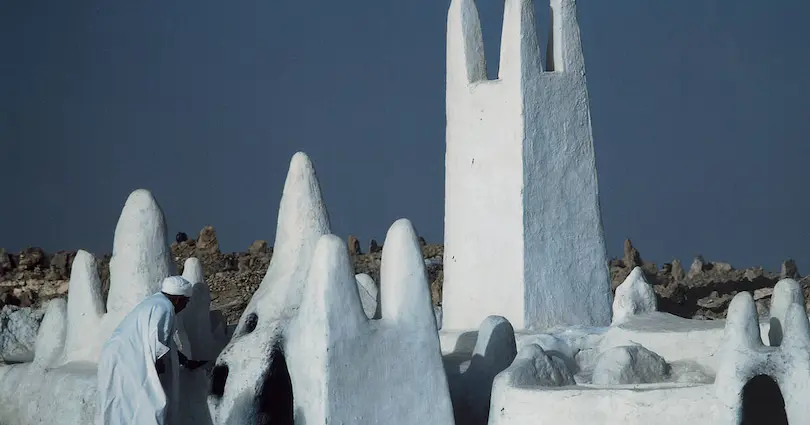
True to the Ibadites' value of simplicity, all the houses follow the same sturdy, uniform design: two stories, rectangular, built from limestone blocks, gypsum, and palmwood. The thick walls keep the heat out by day and the cold out by night.
According to local lore, in the 14th century the Ibadites brought four Jewish families from Djerba, an island off Tunisia, to work as metalworkers and jewelers. More families followed over time.
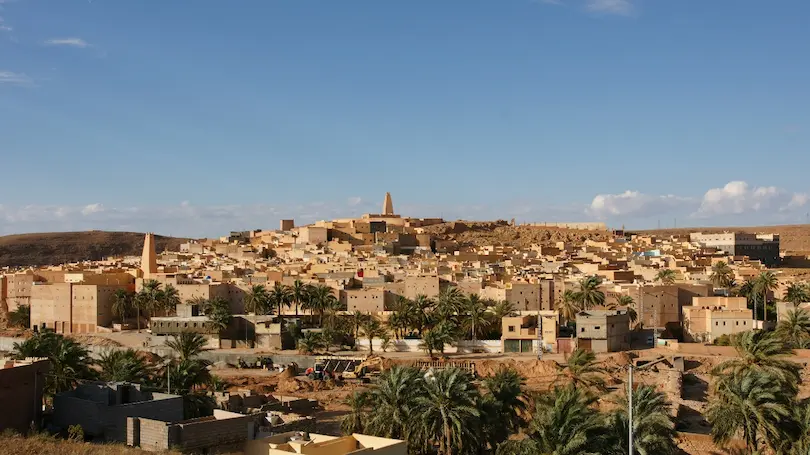 A view of Ghardaia today. (Daggett.fr, CC BY-SA 2.0 <https://creativecommons.org/licenses/by-sa/2.0>, via Wikimedia Commons)
As in any Muslim country of the era, Jews were considered dhimmi, second-class citizens subject to strict restrictions. They had to wear black turbans and outer garments, were forbidden from riding horses or donkeys, and had to walk barefoot.
The Jews lived in the Mellah, a separate Jewish quarter, and could not build above a certain height or have doors or terraces facing Muslim homes. Dr. Nagel described it1:
"The Mellah had very narrow streets, and only two were barely wide enough to allow a cart or a car to pass. It also had tunnels, some short but one that was particularly long, dark, and narrow. The walls of this tunnel were consolidated from the debris from much older houses... Small plazas dotted the place, some with wells. The main synagogue on Jerusalem Street was not in the square but was on top the narrowest of streets."
Despite these hardships, Jews were drawn to Ghardaia for a reason: they had complete freedom to practice their religion and participate in commerce -- neither of which could be taken for granted in nearby countries.
The Jewish community of Ghardaia remained small and tight-knit throughout its existence. Though they had occasional contact with other Jewish communities, they were largely isolated, with all marriages taking place within the group. Over the centuries they developed distinct physical characteristics – slightly elongated heads and a tendency toward blond or red hair – along with traditions entirely their own.
In 1954, American anthropologist Lloyd Cabot Briggs and nurse Norina Lami Guède conducted a study of the community, visiting families in their homes and observing celebrations and life-cycle events.
Some of what they documented will be familiar to Jews everywhere, like the circumcision ceremony. Others were unique to Ghardaia, none more elaborate than the kittab ceremony, marking a five-year-old boy's entry into religious studies.
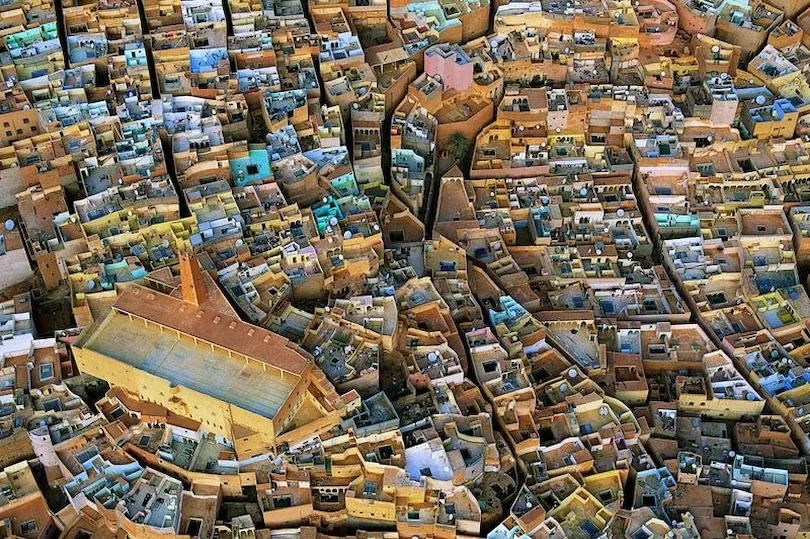 Fortified towns of M'Zab Valley
The ceremony unfolded over weeks. Fathers exchanged breakfast visits, sharing dates and whey. Twenty days later, families gathered around a wooden dish of dates and peanuts covered with a white cloth; each guest took scissors and made a cut in it.
A week after that came a full banquet, followed by days of preparation: the boys' hands and feet were dyed orange with henna, then each received a bath, a haircut, and special prayers. Each boy was dressed in a loose white cotton shirt, sewn from the very cloth the guests had cut, with the ragged edge trimmed off and a hand embroidered on the back in colored silk thread alongside the Hebrew inscription "Length of Days and Peace."
Over the shirt went a gold- or silver-embroidered overcoat, a silver chain with amulets, and soot markings drawn on the forehead with perfumed olive oil.
Finally, an elaborate turban was wound around a small velvet fez, six to eight feet of cloth, including the trimmed strip from the kittab shirt, extended with additional strips ideally taken from garments worn by the boy's grandmothers or earlier female ancestors. The older, the better.
Each boy was then seated in an armchair and handed a sword. Parents and relatives came forward, kissed his turban, and gave him a gift.
The next day, the fathers carried their sons to the synagogue, where "each father took his son in his arms and carried him up onto the platform running along the far wall, beneath the Tablets of the Law... Three times the men all broke into a loud prayer in unison, led by the chief rabbi, after which the women would applaud with a whooping 'you-you' on a high piercing note2."
For centuries, Jewish life in Ghardaia remained unchanged. That began to shift with French colonization in the 19th century. The French took control of the northern coastal areas and slowly moved south, annexing the Mzab Valley in 1882.
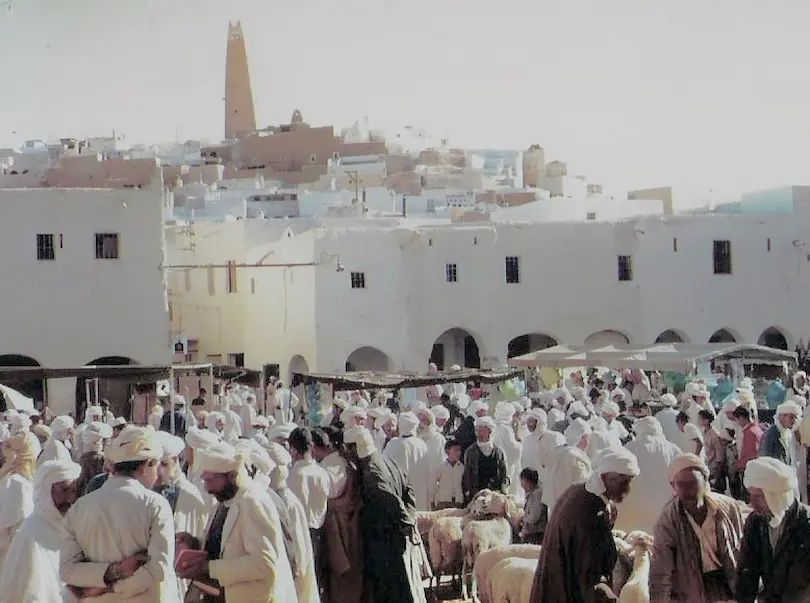 Market on the main square, Ghardaia, Algeria (Wikipedia, Peterfitzgerald)
The French treated the native population as second-class citizens in need of "regeneration" – reeducation to turn them into modern Frenchmen. Until that process was complete, they would not receive French citizenship or full civil rights.
The majority of the native population were Muslim, but there was a significant Jewish minority, especially in Algiers, Oran, and Constantine. The question of what to do with these Jews came under discussion in the French government.
By that time, Jews in France itself had already been emancipated. In 1870, the Cremieux Decree granted French citizenship to the Jews of Algeria, which upset local Muslims who retained their inferior indigenous status. But even after the annexation of M’zab in 1882, its Jews were excluded from the decree. The official reason was the distance from northern Algeria's civil administration; the newly annexed Saharan territory fell under military rule. But private communications between French officials revealed other reasons: some worried about antagonizing local Muslims, while others simply considered the Saharan Jews too primitive to bother with.
Under French military administration, Jews and Ibadites alike received full autonomy over matters of birth, marriage, death, and inheritance. Just as Islamic civil matters were handled by a local qadi (a Muslim judge), Jewish civil matters were handled by a rabbi whose authority the French recognized.
Overall, French rule brought real improvements. The dhimmi restrictions were lifted. The doors of the Mellah opened. Jews were no longer required to wear distinctive clothing, gained greater freedom of movement, and could own land outside the overcrowded quarter. They purchased gardens and wells beyond the town walls.
Jews from M’zab also began traveling to northern Algeria, where they saw firsthand what full French citizenship looked like. They wanted it too. Petitions were filed in 1892, 1919, and again in 1932. All were refused.
Throughout the first half of the 20th century, the Jews of M’zab maintained their traditional lifestyle while trying to appear more French in the eyes of the authorities. They sent their children to French public schools, where they absorbed not only the language but the French ideals of liberty and equality.
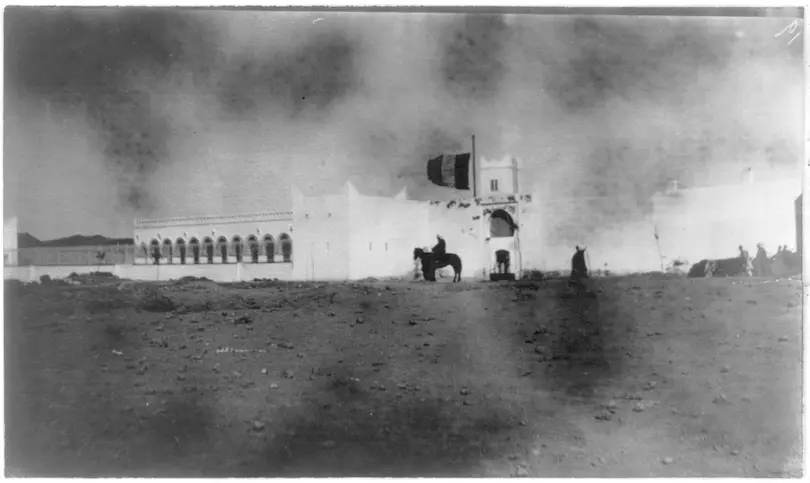 Fort in the Sahara Desert flying a French flag. Library of Congress, Public domain, via Wikimedia Commons
Despite their second-class civil status, most Jews of M’zab felt safe under French rule. Some families had used their newfound freedom of movement to emigrate to the Land of Israel, then under the British Mandate, but most remained.
During World War II, life in M’zab continued largely as normal for its Jewish community, even as Jews in northern Algeria lost their citizenship under the Vichy regime and thousands were deported to labor camps.
After the war, when northern Algerian Jews had their citizenship reinstated, the Jews of M’zab hoped theirs would follow. It didn't. Frustrated, many began leaving for northern Algeria or for the newly established State of Israel.
In the 1950s, the discovery of rich oil and gas reserves in the Sahara brought rapid economic development to the M’zab: new highways, community buildings, a new hospital, and an increased French military and police presence to protect the new assets. The Ibadites and the Jews welcomed the development. As minorities, they generally preferred French rule to that of the mainstream Algerian Muslim majority, as long as the French didn't interfere with their traditional way of life.
The mainstream Muslims felt differently. They wanted independence and were ready to fight for it. In 1954, the Algerian War began. For the next eight years, Algeria was engulfed in conflict.
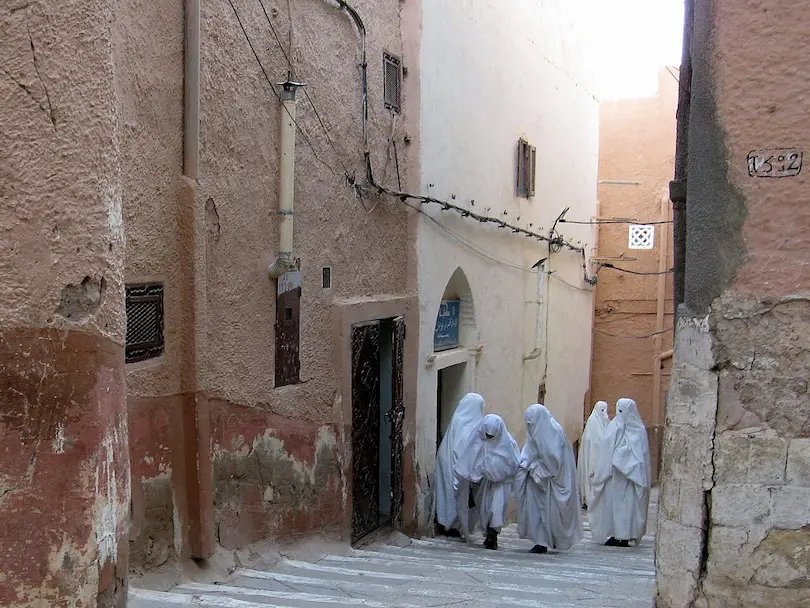 Muslim women in Ghardaia, Algeria (Wikipedia, Stefan Krasowski)
Neither the Jews nor the Ibadites took sides, but that didn't protect them. Some rebels considered Jews to be French collaborators and fair targets. Israel's existence and its conflicts with Arab neighbors deepened the hostility toward local Jews, regardless of any personal connection to Israel. Jews throughout Algeria were targeted in antisemitic attacks. In Ghardaia specifically, Jewish women and young people were harassed in the streets, and a grenade was thrown into a popular Jewish bar.
As the war dragged on, fears grew and the economic situation deteriorated. More and more families left for Israel.
France eventually conceded it could not hold northern Algeria, but hoped to keep the Saharan territory and its natural resources. To tighten its grip, it restructured the administration, bringing M’zab under civil rather than military rule. That move eliminated the last excuse for withholding citizenship from M’zab's Jews. In 1961, they finally received it.
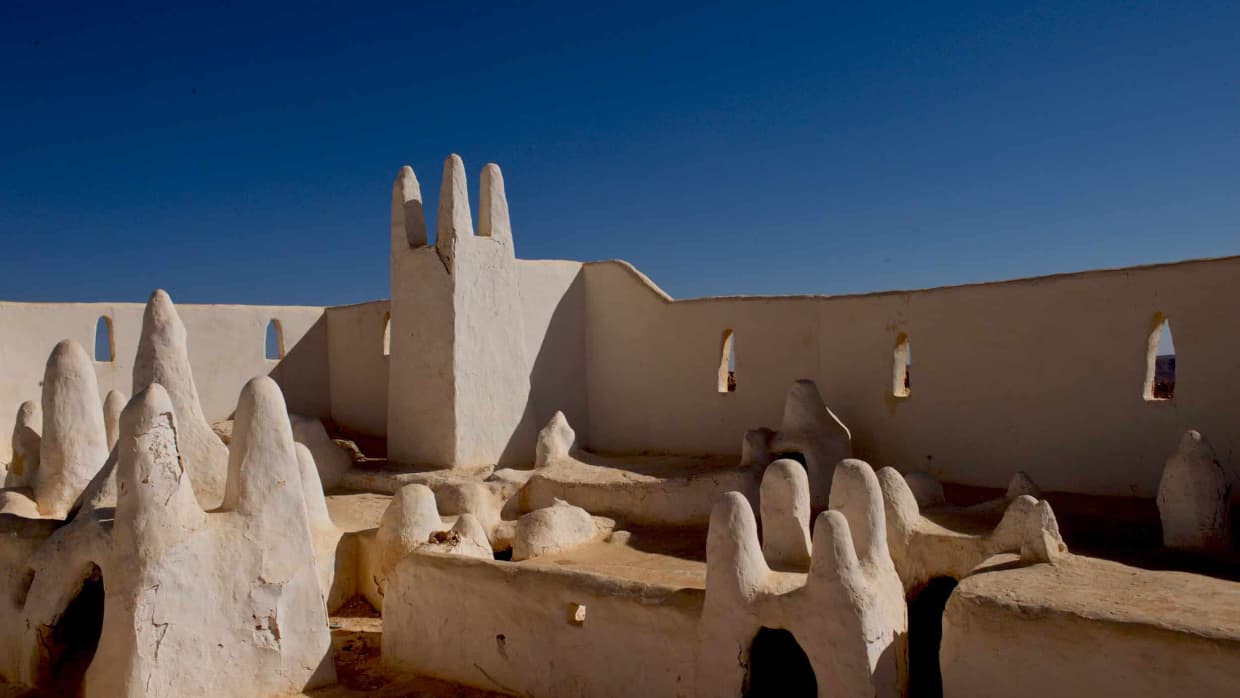
A year later, Algeria declared independence. As French forces prepared to withdraw, the entire Jewish community of Ghardaia used their newly acquired French citizenship to emigrate to France. By the end of June 1962, not a single Jew remained in Ghardaia. All that's left today is a crumbling synagogue and a Jewish cemetery.
Today, descendants of the Jews of M’zab live mostly in Israel and France. A synagogue following M’zab tradition exists in Givat Shmuel, Israel, where the community still observes some of its unique customs. Elsewhere, descendants have integrated into existing Jewish communities, remaining deeply committed to their faith and to keeping their heritage alive.
Sources:









Thank you for writing it out the most obscure and largely unspoken part of the Jewish history. This is where my family and ancestors came from.
Very interesting. Thank you.
Very interesting & sad to hear about all the antisemitism from those poor people