








 Those Shameful Thoughts and What They Really Say about You

8 min read




From Egypt to the Holocaust, Jewish history follows a pattern: the seeds of redemption are planted in the midst of destruction.
Tisha B'Av, the Ninth of Av, the saddest day on the Jewish calendar, has just passed. The sages make a startling claim: the messiah is born on Tisha B'Av (Eicha Rabbah 1:51).
That date carries serious weight. According to the Book of Numbers, it's when the spies sent to scout the Land of Israel returned with a slanderous report that shattered the nation's faith, a moment of national collapse. Ever since, Tisha B'Av has been a magnet for catastrophe: the destruction of the First Temple, then the Second, and a long list of tragedies that cluster around this date across the centuries.
Why would the messiah be born specifically on the darkest day of the year?
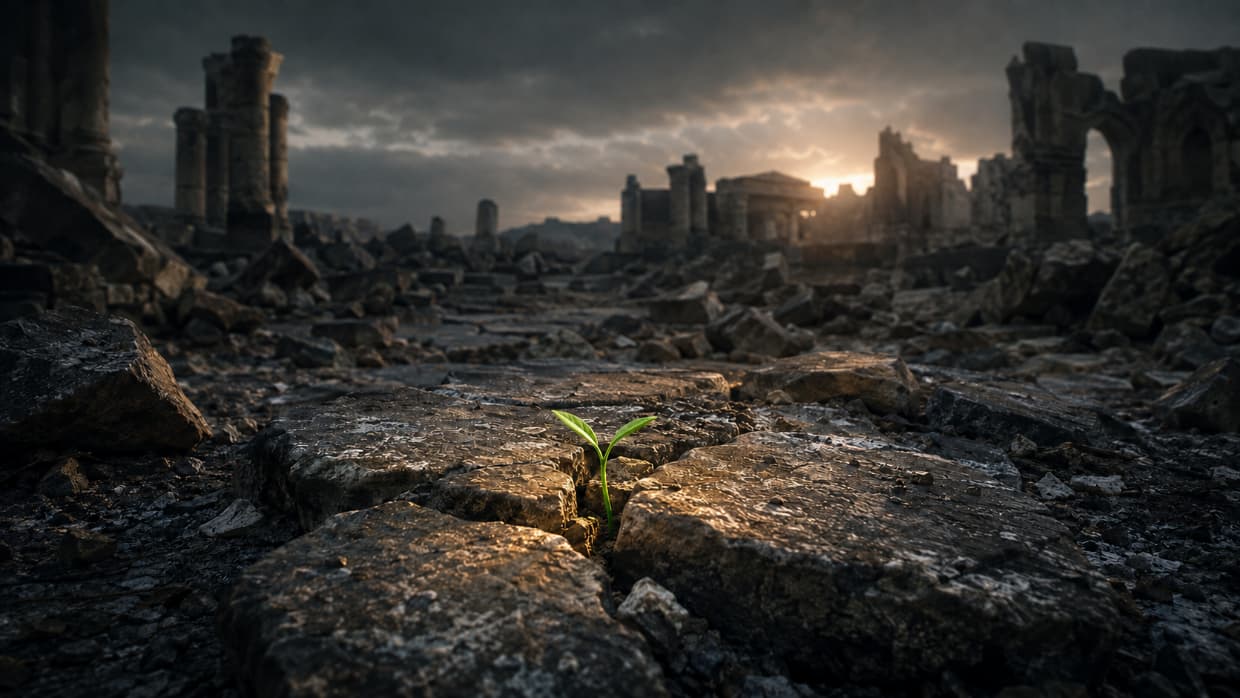
It's teaching us an important lesson about the architecture of Jewish history itself: the seed of redemption is planted inside the moment of destruction. Even though we may not see it, the light is already there, growing quietly, waiting for its moment.
Stand back and look at Jewish history, and you can see that this is a pattern.
Start with the beginning of our national story. The Israelites are enslaved in Egypt: generations of forced labor, infanticide, despair, no way out in sight. Yet out of that exact furnace comes the Exodus, and with it, Mount Sinai, the moment the Jewish people receive the Torah (the Five Books of Moses) and become a nation with a mission. The slavery wasn't a detour from Jewish destiny. It was the road to it. (Even Moses himself, the redeemer of the Jewish People, was raised in the palace of Pharaoh.)
The slavery wasn't a detour from Jewish destiny. It was the road to it.
Centuries later in Persia, Haman, the villain of the Purim story, engineers an attempted genocide: a plan to annihilate every Jew, young and old, in a single day, simply because Mordechai wouldn't bow to him. The Book of Esther reads like a countdown to catastrophe. But it ends with the triumph of the Jewish People, and with the political and spiritual momentum that let the Jewish people return to their land and rebuild the Second Temple. The near-annihilation became the prelude to restoration.
Fast forward to July 31, 1492, the 9th of Av, when the Jews of Spain, the largest and most prosperous Jewish community in the world, are given an ultimatum: convert to Christianity or leave. Families are scattered, an entire golden age extinguished almost overnight.
Three days later, on August 3rd, a fleet sails under the flag of the very kingdom that expelled them, searching for a route to the Far East. Christopher Columbus stumbles, by accident, into a hemisphere no European power yet knew existed. It would take centuries for the connection to unfold, but that accidental discovery eventually opened the door to the United States: the great refuge of the Jewish diaspora, a nation that offered Jews something almost unprecedented in two thousand years of wandering, a place to build and live openly.
As one door slammed shut in Jewish history, another began to open.
And then the darkest chapter of them all. The Holocaust: six million Jewish souls, a third of world Jewry, murdered in a genocide of industrial scale and unimaginable horror. No accounting of "silver linings" can or should explain away that darkness, or suggest it was worth its price. But history records what happened next: the world, confronted with what it had allowed to happen, could no longer look away. On November 29, 1947, the United Nations voted to partition Palestine, paving the way for a Jewish state after two thousand years of exile.
Less than six months later, for the first time in two millennia, Jewish sovereignty returned to the Jewish homeland. The blood of the six million created no justification, nothing could, but it did play a central role in pushing the world toward what Jews had prayed for in every generation: a return home.
These are three examples. There are many more.
What do we make of a pattern like this? Picture a grandmaster playing chess. He sees dozens of moves ahead, allowing sacrifices that look, to an untrained eye, like catastrophic blunders (a queen given away, a position seemingly collapsing) because he already knows where the game is heading.
What looks like defeat may be one move within a much larger strategy, directed by a Higher Power who sees the whole board of history.
We can only see the square we're standing on. What looks like chaos, or even defeat, may be one move within a much larger strategy, directed by a Higher Power who sees the whole board of history.
This isn't fatalism. Jewish theology demands something more active than waiting for God to move the pieces for us. History unfolds through an ongoing interaction between God's power and the genuine free will each of us holds, as individuals and as a nation, to choose our own path.
The destination is never in question. Jewish tradition teaches we're collectively moving toward redemption, toward a repaired world. But the road we take, how long it takes, how much suffering lines the way, is substantially in our hands. All roads lead to the same destination. The speed and difficulty of the journey are up to us.
This is easier to see looking back at history than while living inside it. Enslaved in Egypt, the Jews didn’t know Sinai was coming. When Haman's decree was sealed, the Jews didn’t know the story had a second act. Boarding a ship out of Spain with nothing, one didn’t conceive of a democracy across an ocean not yet drawn on any map. And when six million were being murdered, no words make sense of what redemption could possibly follow.
The tradition that the Messiah is born on Tisha B'Av is a promise that darkness is never the final word.
The greater challenge is to hold onto the possibility of a silver lining while still in the midst of the cloud, while actively choosing again and again to move in the right direction. To build rather than despair, to hold onto faith and responsibility at the same time.
The tradition that the Messiah is born on Tisha B'Av isn't a promise that darkness doesn't hurt, or that catastrophe is secretly good. It's a promise that darkness is never the final word.
Somewhere inside every tragedy, a seed is already planted. Our task isn't to wait for it to grow on its own. It's to tend it, trusting that however hard the road, redemption is already on its way.










Great article!
Wonderful article. We must always remain hopeful
Great!
When society starts with Jews and now Israel, Jews are like the canary in the coalmine, when the canary is in danger everyone else is in danger too, according to history it starts with the Jews and now Israel, but if non Jews don't speak up then western values and Judeo- Christian values will be lost, at this time in America there is Democrat Socialists the people that came from communist countries know where it will lead, how can someone be a socialist and a Muslim, the goal of the Muslims is to make everyone a Muslim, by standing up for Jews/ Israel then the world be saved from this tragedy
Thank you for the article of hope . . . and direction. I am not Jewish but I follow your site because you promote universal truths. In this day and age with the apparent rise of socialism, communism, and a theocracy that seeks to destroy America’s Judeo-Christian basis, your article gives me hope that people of goodness will coalesce to resist this round of attempted destruction. Our country is too valuable to allow this evil to succeed. May God give us strength to save our Constitution and country!
Brilliant article. The light always shines through the darkness.