





 Can a Monk Be a Jew?
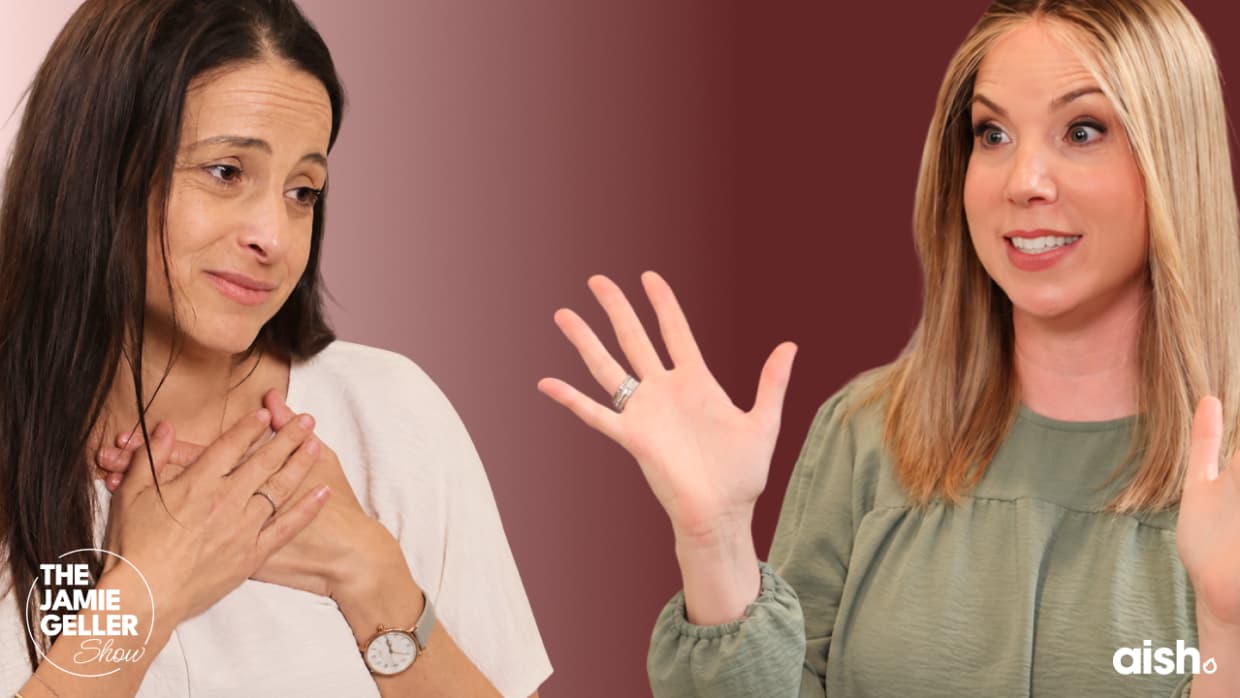






First, you’re ashamed you can’t lose the weight. Then you’re ashamed of how you lost it. Jamie Geller on GLP-1s, food noise and finding your worth beyond the scale.
I have accomplished a lot of hard things in my life. I've built businesses, written cookbooks, raised six children, and reinvented myself professionally more times than I can count.
So when my weight reached close to 200 pounds and I couldn't seem to get it under control, I kept thinking: Why can’t I get a handle on this? Something must be wrong with me!
That's what I really wanted to talk about when I sat down with Dr. Yardena Bauer, who has a PhD in neuroscience and endocrinology and her own complicated, emotionally loaded history with weight.
Because underneath all the talk about GLP-1s, hormones, protein and weight training was something I think so many women understand: shame.
For me, gaining weight wasn't only about a number on a scale. My clothes didn't fit. Getting dressed to go on camera became painful. I didn't want to see people. I could accomplish so much in every other area of my life, yet I couldn't seem to "get this together."
Yardena understood that feeling personally. For years, she did everything she had been told was right and still struggled with her weight. Eventually, she began connecting being thin with being lovable and even worthy of getting married.
We had both absorbed the same message: If you really want to lose weight, all you have to do is eat less, exercise more and exhibit some self-control.
If you can't do it, you're not trying hard enough.
Yardena explained that weight is far more complicated than willpower alone. Genetics, hormones, environment, lifestyle and psychology can all play a role. Struggling with your weight isn't proof that you’re lazy, weak or lacking self-control.
I wish I had understood that distinction earlier.
I eventually started taking a GLP-1 medication. At the time we recorded this conversation, I had been taking it for 22 months and had lost 40 pounds.
I've been open about taking it because I wanted to help remove some of the stigma. But every time I told people, I immediately added that I was also intermittent fasting, eating high protein and low carb, and weight training.
Basically, letting people know: Don't worry, I'm working hard too.
But I always wondered why I felt the need to prove that I hadn't taken the easy way out. And what exactly is so wrong with getting extra help?
There is something strange about the way we moralize weight loss. First, you're ashamed because you can't lose the weight. Then, if medication helps you lose it, you're ashamed because apparently you didn't suffer enough to earn it.
One of the biggest changes for me wasn't even the number on the scale. It was what they call "food noise": the constant chatter about what you're going to eat, what you shouldn't have eaten and what you'll do differently tomorrow. Not to mention the donuts that just keep calling your name.
My food noise was relentless. I even dreamed about food.
When that noise quieted, I described it like cars leaving an overcrowded parking lot. Suddenly there was space in my brain to park other things. Things with more meaning.
But there was another layer to this conversation that was harder for me.
As an observant Jewish woman, I have worked hard to understand that my value doesn't come from my appearance. So why did I still care so much about being thin? Did wanting to lose weight make me vain?
Yardena told me she lives with that tension too. She doesn't want to be shallow or superficial. She also wants to feel good in her body and likes looking good.
Maybe those things don't have to contradict each other.
Judaism doesn't tell us the physical is meaningless. We dress beautifully for Shabbat. We beautify mitzvot. The Beit Hamikdash, the Holy Temple, was magnificent, and the Aron, the Ark, was covered in gold inside and out.
The outside isn't everything, but it isn't nothing.
Losing 40 pounds does not make me more valuable, but it does make me feel better. I have more energy, I'm happier and I want to see people. I feel more comfortable getting dressed and I recognize myself again.
And I've discovered that improving my physical health has helped me grow emotionally and spiritually, too. Judaism teaches us to care for our mind, body and soul, but I don't believe that growth always has to happen in a particular order. Sometimes working on our inner selves gives us the strength to care for our bodies. Other times, making progress physically creates the confidence and space to work on everything else.
For me, this time, the physical came first. And the benefits reached far beyond my weight.
The scale can tell me what I weigh. It doesn't get to tell me what I'm worth.
Watch my full conversation with Dr. Yardena Bauer on The Jamie Geller Show.
Medical note: This article reflects Jamie's personal experience and her conversation with Dr. Yardena Bauer, who holds a PhD in neuroscience and endocrinology but is not a medical doctor. It is for educational purposes only, and does not constitute medical advice. Always consult a licensed healthcare professional before starting, stopping or changing medication.