




 What Two Hebrew Words Reveal About Israeli Democracy
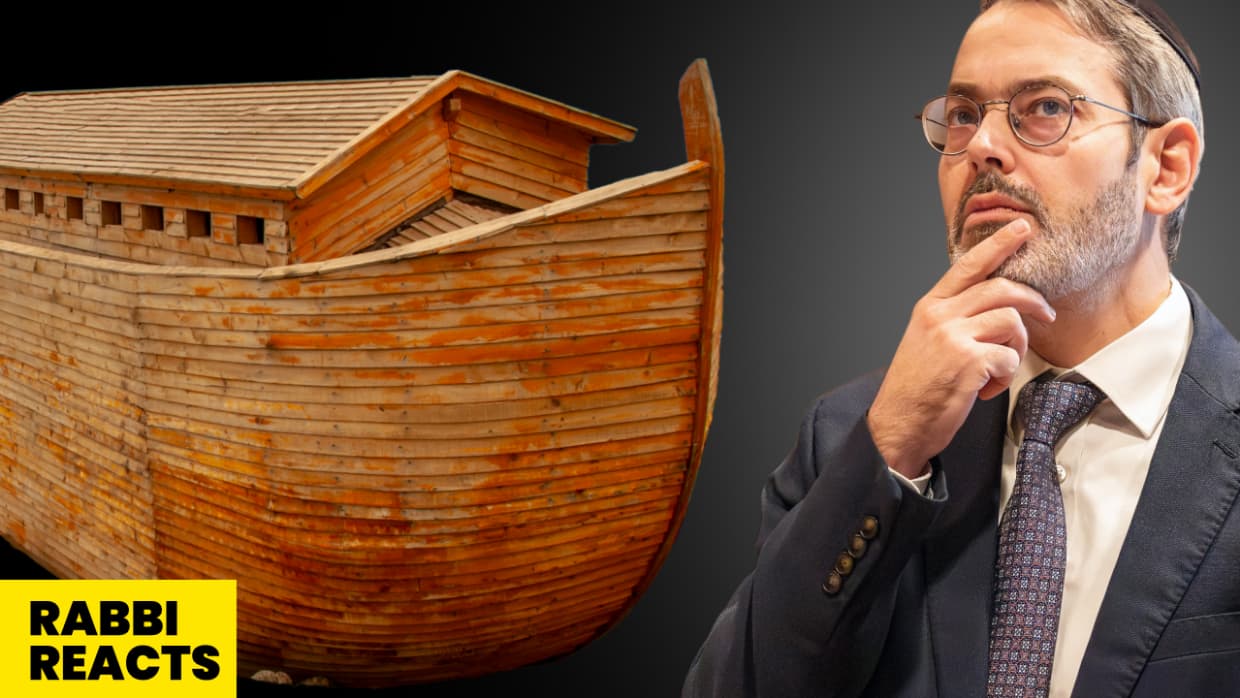






New radar scans claim Noah’s Ark is buried in the mountains of Turkey. A closer look at the evidence, and at the lesson Noah left behind.
There’s been a lot of excitement lately over claims that Noah’s Ark has finally been found. Is this proof that the biblical story is true? Or should we be a little cautious?
A team of researchers says it has proven that a mound in the mountains of eastern Turkey, near Mount Ararat, is Noah’s Ark. The group, Noah’s Ark Scans, was founded by an American researcher named Andrew Jones. They recently announced that a radar survey confirms the site is “not geological” and that “an extraordinary man-made structure lies beneath the surface.” According to the team, the radar shows corridors, compartments, and even several decks. They have drilled up to 18 meters deep and sent a robot camera down the hole. One press release reported that a drill bit shattered on what might be a layer of petrified wood. The headlines wrote themselves: “Noah’s Ark Found.”
It starts with the Torah, the Five Books of Moses. It tells of a massive flood and of Noah’s ark, which saved his family and the animal world so that life and civilization could begin again. When the waters receded, the ark came to rest “on the mountains of Ararat.”
In 1948, near the town of Doğubayazıt, about 29 kilometers south of Mount Ararat’s summit, heavy rains and earthquakes stripped the mud from a hillside. A Kurdish shepherd, [Reşit Sarıhan], noticed something strange. In 1959, a Turkish army captain named İlhan Durupınar spotted the same formation in aerial photographs taken during a NATO mapping mission, and the site still carries his name. Geologically, it looks unusual: a long ridge of earth shaped like a ship’s hull. In 1960, LIFE magazine published the photograph, and people began to wonder whether this could be Noah’s famous boat.
The measurements added to the excitement. The formation came out to about 157 meters (515 feet) long, and some measurements put it at 164 meters. The Torah says the ark was 300 amot, or cubits, long. Scholars still debate the exact length of a cubit, but according to Rabbi Moshe Feinstein, a leading 20th-century authority on Jewish law, a cubit is 21.25 inches, about 54 centimeters. Three hundred of them comes to 162 meters, almost exactly what was found.
Then the debate began. In 1960, an American expedition led by George Vandeman and Arthur Brandenberger spent two days digging, and even used dynamite. They found only soil and rock. Most people concluded it wasn’t Noah’s Ark, and the site was largely forgotten.
In 1977, Ron Wyatt, an American amateur explorer with no training in archaeology, revived interest. He claimed to have found petrified wood, iron brackets, and even the ark’s anchor stones. He was joined by salvage expert David Fasold and geophysicist John Baumgardner, and their radar scans reportedly showed walls and bulkheads. But in 1987, a professional radar operator named Tom Fenner went back to the site and couldn’t reproduce those scans at all.
In 1988, Baumgardner, once a supporter of the site, drilled four holes into the formation with a Turkish geologist. They found mud and bedrock. No wood, and nothing resembling an ark. He concluded it was simply an unusual natural formation.
In 1996, geologist Lorence Collins co-authored a paper with David Fasold, previously one of the site’s biggest champions. They called it “Bogus Noah’s Ark” and exposed the whole thing as a hoax.
Still, the claims kept coming. In 2019, Andrew Jones’s team scanned the site again and reported angular structures beneath the surface, shapes you wouldn’t expect in a natural mound. In 2024, they reported finding about three times more organic matter, material that came from living organisms, in the soil than in the surrounding formations. This June, the Turkish government granted permits for the largest investigation the site has ever seen, led by Professor [name, confirm spelling], an archaeologist at [university] in Sivas. The team began drilling, and a week or two ago came the latest announcement.
Many of you have asked what I think. Here it is: anything connected to the Bible calls for real caution. The same goes for anything connected to Israel, ancient or modern. Very few people come to these subjects neutral. The Bible, Israel, and the Torah stir up deep emotions. They challenge people’s identities in complicated ways, whether they’re religious, atheist, or anything in between. Almost everyone has a stake in the outcome, which means almost everyone is biased.
Almost everyone has a stake in the outcome, which means almost everyone is biased.
That doesn’t mean we can’t investigate. The scientific method can do its job. We just need to wait for the lab results, for peer-reviewed journals to publish the findings, and for the wider archaeological community to examine and critique them. Then we’ll know where things actually stand.
So far, none of this work has been peer reviewed. The lab results aren’t expected until early next year. Andrew Jones is a software developer, not an archaeologist, and he says so openly. He simply believes this is the ark. The radar engineer says he is 100 percent sure the signals come from a single object, but, in his words, “a ship or spacecraft or what, I do not know.” And the university running the dig describes its goals far more modestly: to determine whether the shape is entirely geological, or whether it shows any evidence of human activity.
This pattern isn’t unique to this site. Over the next few weeks, I’m launching a series fact-checking the Torah. One thing I’ll show is how many sensational claims have been made over the last 150 to 200 years. Some people claimed they’d proven the Torah false. Others claimed they’d proven a particular story true. Again and again, on closer inspection, the claim fell apart. Sometimes they were looking at the wrong site. Sometimes a new discovery reversed the verdict entirely. People sincerely believed they had found proof one way or the other, only to see it overturned.
Archaeology is a genuinely difficult science. Unless an inscription turns up that tells you what a place was, you often can’t know for sure.
This could be an incredibly exciting find. If the researchers turn out to be right, if this really is a wooden, man-made structure from the time of Noah, a boat that carried animal life and came to rest on this mountain, it would be one of the most sensational discoveries in history. It would matter enormously to everyone who believes in the truth of the Torah, and to all of humanity, believers or not.
Intellectual honesty requires intellectual caution. I plan to withhold judgment until far more rigorous work is done and the scientific community has had a real chance to study the results.
But intellectual honesty requires intellectual caution. I plan to withhold judgment until far more rigorous work is done and the scientific community has had a real chance to study the results. Whatever the truth turns out to be, it will be contentious. Some will grab any straw to say this is Noah’s Ark. Others will grab any straw to say it can’t be, even if the evidence overwhelmingly points the other way. For me, the best approach is to wait and see.
Extraordinary claims need extraordinary evidence. More importantly, the truth of the Torah doesn’t hinge on any archaeological find. The real message of Noah’s story isn’t sitting on a mountain in Turkey.
The first message is this: humanity can become horribly corrupt, almost beyond saving. But God never gives up. He always finds that last bit of good, saves humanity, and renews it, because God never abandons His creations. According to Kabbalah, Jewish mystical tradition, even the souls who died in the flood returned later in history, reincarnated so they could be repaired. It’s the same principle. Human beings are deeply imperfect, but God never gives up on us and always gives us another chance.
The second message is Noah himself. Noah must have been a social outcast. He refused to join in the depravity and immorality of his time, and everyone mocked him for it. The Talmud, the central text of Jewish law and tradition, records in tractate Sanhedrin that Noah rebuked his generation and they treated him with contempt. “Old man,” they said, “what is this ark for?” The Midrash, the ancient rabbinic commentary on the Bible, says he worked on it for decades. He planted cedar trees, then cut them down, while people called him “the contemptible old man.”
They surely didn’t mock only his piety. They would have found ways to accuse him of being immoral, too. That’s what people do. We’re very good at demonizing those who live godly lives, fixating on every flaw they have. Yet Noah had the strength and courage to say the whole world can be wrong.
Majorities don’t determine what’s true. They don’t determine what’s right or what’s wrong. Murder is wrong. Stealing is wrong. Rape is wrong. Adultery is wrong. Noah was saying: I would rather be mocked and vilified by the entire world, I would rather everyone tell me, “We can’t all be wrong, so it must be you,” than betray the inner voice of my soul, the voice of good that God placed inside each of us.
So the story of Noah is about God’s endless faith in humanity, and about the ability of human beings, sometimes only a small minority, to keep living godly lives from which a whole world can be reborn.
Just a few weeks ago, we celebrated Rosh Hashanah, the Jewish New Year, when God judges the world anew and we ask Him to remember it for good. In those prayers we don’t go back to the beginning of the Jewish people, or even to the patriarchs, Abraham, Isaac, and Jacob. We go back to Noah: “And Noah, too, You remembered with love.” God remembered a human being who could stand against an entire world. In an era of tyranny, where might made right, while everyone mocked him, Noah could say, “I won’t violate what’s right. I won’t give in to social pressure.”
That began the story of humanity anew in an age full of tyrants and oppressors. Noah represented a new way of thinking, one that led to Abraham, Isaac, and Jacob, the fathers and mothers of the nation of Israel, and eventually to the Torah. The Torah taught the value of every human life, justice for every citizen, limits on the power of kings, and peace, not war, as the ideal. To this day, the world wrestles with that vision.
So yes, a discovery here or there might help confirm a story that seems hard to believe. But the truth of the Torah lies in our national memory of the covenant our ancestors made with God. It lies in the way the Torah’s predictions came true: Israel’s exile, the persecution of the Jewish people, and their return to the land. And perhaps most of all, it lies in the meaning of the voice of God that the Torah carries, for the Jewish people and for all humanity, throughout history and especially today.
We’ll wait for the verdict on whether this mound in Turkey turns out to be Noah’s Ark. But the message Noah carried, the meaning of his ark and the voice of good it stood for, lives on in the Torah, in God’s calling, and in the soul of every one of us. In a world that so often feels like it’s drowning in a flood, Noah’s voice lives on in each of us, a beacon of good shining through the torrent. That’s where Noah and his ark truly rest.
May we all carry that voice forward, resist the madness of the world, and shine goodness no matter how unpopular it makes us. We’ll keep watching for more news about the ark and its archaeology. In the meantime, may we be blessed to bring the goodness of this story out into the world.