 Can a Monk Be a Jew?






Critics said “Ur of the Chaldeans” proved the Torah was written a thousand years late. Then a 3,000-year-old tablet turned up in the wrong place.
Judaism, and the religions that grew from it, begin with Abraham’s journey. The Torah says that journey started in a city called Ur Kasdim, Ur of the Chaldeans. That creates a serious problem.
We know who the Chaldeans were. They appear in history about a thousand years after Abraham. So critics argue the Torah uses a name that didn’t exist yet in Abraham’s time, which means these passages could only have been written much, much later.
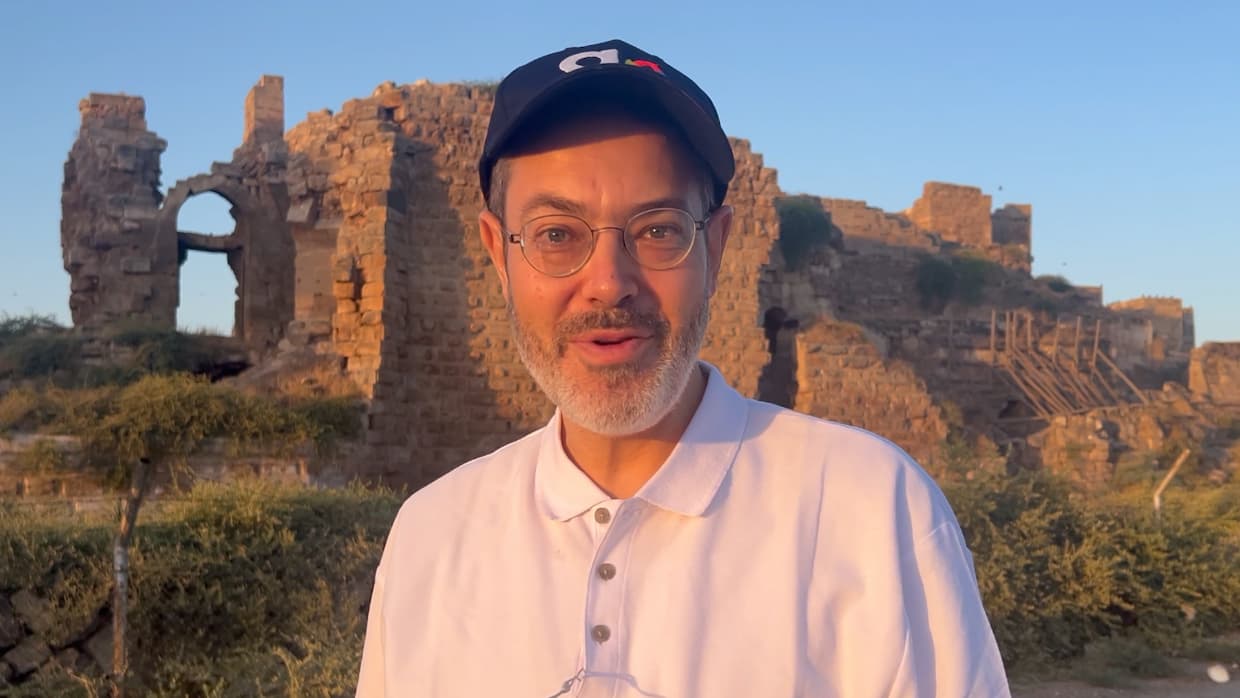
It’s one of a long list of objections Bible critics and archaeologists have raised against the Torah’s historical accuracy. So I went looking for the real Ur: where it was, who lived there, and when. The search took me through international museums and, finally, to Haran, the place where Abraham was born.
This is the first piece in a series called Fact-Checking the Bible. We’ll take claims the Torah makes and test them against what has come out of the ground. We’ll also walk through the fights that have raged for two centuries, which is how long archaeologists and Bible critics have been arguing over one question: is this text accurate? Because it’s the Bible, this field is packed with bias. Religious bias, anti-religious bias, even political bias. I have my own biases too. I’ll do my best to stay factual and fair.
This story starts with Julius Wellhausen, the great German professor often called the father of modern Bible criticism. In 1878 he wrote: “We attain no historical knowledge of the patriarchs, but only of the time when the stories about them arose. The later age is here unconsciously projected into hoary antiquity, and is reflected there like a glorified mirage.”
A mirage. Nothing real behind it. That was the dominant view for at least half a century.
Then people started digging. In 1933, a French team working on the Euphrates River opened a palace at a site called Mari. They found something rare: tablets written in Abraham’s era. Those tablets mention towns listed in Genesis, and names like Avram and Yaakov (Jacob). They describe clans with flocks moving between open grazing land and towns, chiefs, treaties, and disputes over wells. It reads like everyday life in the book of Genesis. Nobody is claiming the Abram in those tablets is our Abraham. But whoever wrote the Torah clearly knew the world of Abraham’s time very well.
The critics hit back. In the late 1960s, a school called biblical minimalism emerged. Through the 1970s and up to 2001’s The Bible Unearthed, its scholars argued that these parallels were forced and the stories were really written centuries later, in the days of the kings of Judah. Others pushed back, and the debate has gone back and forth ever since.
One of the critics’ strongest points is that even if parts of the story fit Abraham’s era, the text contains anachronisms: details that couldn’t belong to his time. Ur Kasdim is one of the great examples.
The city appears four times in the Bible. Twice in Genesis, in the account of Abraham’s father Terah setting out on the journey. Once in the book of Nehemiah, looking back. And once in Genesis 15:7, where God speaks in the first person: “I am God who brought you, Abram, out of Ur Kasdim to give you this land.”
The critics pounced. Norman Gottwald, for example, said nobody could have called Ur a Chaldean city before the 10th century BCE at the earliest. Even the Jewish Publication Society’s commentary on Genesis, written by a scholar much closer to tradition, says the description “would seem to be anachronistic.” And Kenneth Kitchen, one of the greatest archaeologists to defend the Bible’s historical accuracy, a man who spent about 50 years taking apart the minimalists, said Ur of the Chaldeans is a spot where a later scribe updated the text.
To sort this out, we first need to ask: who were the Chaldeans? (Hebrew speakers are probably scratching their heads right now, wondering how “Kasdim” turns into “Chaldeans.” We’ll get to that.)
We actually know quite a lot about them. They were a tribal people living in the marshes of southern Iraq, organized into large family groups called “houses,” like Bit-Yakin and Bit-Dakkuri, each with its own chief. The Assyrians called them Kaldu. They first appear in Assyrian records in 878 BCE, and for two centuries they were Assyria’s most stubborn enemy in the south. A Chaldean chief named Merodach-baladan seized Babylon twice and was thrown out twice. Around 620 BCE, a Chaldean family took Babylon for good. Their son was the king who burned the First Temple in Jerusalem.
The Hebrew name for this people is Kasdim. We know because Jeremiah, Ezekiel and Daniel all use that word for them, the same word as in Ur Kasdim. So the Kasdim were a late, southern people.
What about Ur? In 1922, archaeologists found a city called Ur right in the Chaldeans’ territory.
A British consul named Taylor had discovered the mound back in 1854, along with clay cylinders bearing the name Urim, very close to Ur. Nobody paid much attention until Leonard Woolley came along. Before World War I, Woolley had been digging on the Euphrates with a young assistant named T. E. Lawrence, better known as Lawrence of Arabia. After the war, in 1922, the British Museum and the University of Pennsylvania sent Woolley to Taylor’s mound.
Over 12 years, he uncovered the Royal Cemetery of Ur. He found a queen’s tomb and the famous artifact known as the Standard of Ur. He found a pit holding 74 attendants who had been killed so they could accompany their king into the grave. Agatha Christie came to visit, married the dig’s assistant director, and later set one of her murder mysteries on an archaeological dig. Woolley wrote a book called Ur of the Chaldees. He even picked out a nice house and told visitors it had belonged to Abraham.
He made that last part up. Woolley was a great archaeologist and a bit of a showman. But he himself pointed out that if Ur Kasdim is connected to Abraham, the name is a complete anachronism. The critics seized on this. “Ur of the Chaldeans” is exactly what a writer in the sixth century BCE, a thousand years after Abraham, would call the city, because that’s what it was in his day. That writer looked around, saw the powerful capital of a powerful Chaldean kingdom, and assumed Abraham must have come from there.
For about 50 years, that looked like a knockout. But it rested on two questions nobody had really asked. Where did the Chaldeans come from? And how far back do they go?
In 1958, the story took a sharp turn. Cyrus Gordon, a professor at Brandeis University, said the whole thing was wrong.
Gordon had dug alongside Woolley at Ur in the 1930s. He had stood in the same trenches and seen the same finds, and he disagreed. Gordon was a fascinating scholar, the kind the academic world never quite knows what to do with. A genius, he taught himself half the languages of the ancient world and cracked the ancient language of Ugaritic. He then spent some 40 years promoting bold ideas, such as the claim that Greek and Hebrew civilizations grew from the same roots.
Gordon wrote a paper arguing that Abraham’s Ur was nowhere near Woolley’s Ur in southern Iraq. It was in the north, close to Haran. Some of his arguments were speculative, and many are rejected today. But his strongest case came from the biblical text itself.
Genesis 11:31 says Terah took his family from Ur Kasdim to go to the land of Canaan, and “they came to Haran and settled there.” Picture the route from Woolley’s Ur in the south. The road to Canaan follows the Euphrates northwest, then turns left toward Canaan. Why follow the river instead of taking the straightest path? Because ancient travelers walked, or rode donkeys, often with flocks of sheep in tow. They needed a town to stop at every night for rest and food. Rivers were where civilization was. Rivers meant drinking water and grazing land along the way. So following the southern bank of the Euphrates and then turning toward Canaan makes perfect sense.
But Haran is in the wrong direction. To get there, you’d have to cross the Euphrates and head north, away from Canaan.
Maybe Terah grew old or sick on the road, couldn’t make it to Canaan, and returned to Haran, where his family had originally come from. That’s possible. But the book of Joshua also says Abraham was taken to Canaan from “beyond the river.” Woolley’s Ur sits on the same side of the Euphrates as Canaan. It isn’t beyond anything.
Perhaps the strongest clue is where Abraham himself said he came from. When he sends his servant Eliezer to find a wife for his son Isaac, he tells him, “Go to my land and my birthplace.” The servant goes to Aram Naharaim, to the city of Nahor, right in the area of Haran. Nowhere near the south.
So I decided it was time to go see Abraham’s birthplace for myself.
I packed up and got on the road to Haran.
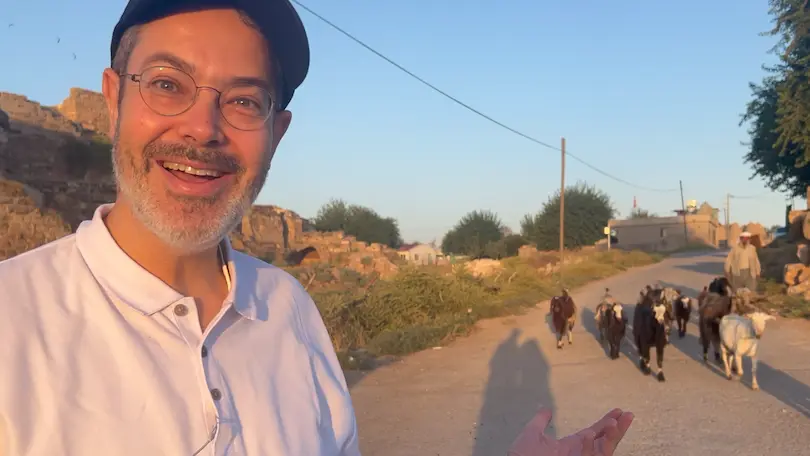
Standing in Haran, I was in the very place where our ancestor Abraham was born. This is where our forefathers grazed their sheep, where Jacob tended the flocks of Lavan (Laban). And right on cue, as I stood there, a shepherd walked his goats across the same ground our ancestors’ flocks once crossed. You can still see one of the city’s ancient gates. The hills behind it hold most of the city, still unexcavated, which gives you a sense of how grand this place once was. This was the homeland of Avram, of Abraham.
But how do we know this is really Haran? Because the city left us writing. Right at the entrance to the east gate, archaeologists found a great stone inscription from the Babylonian king Nabonidus, now displayed in a museum. It’s about as close as a place can get to a birth certificate. Some 2,500 years ago, Nabonidus wrote that this city’s name was Harran. He also recorded its religion: worship of the moon god, Sin. And all of it was found in the paving stones of Harran itself.
So we know with certainty that this is Haran. The Romans called it Carrhae. It’s where the general Crassus lost seven legions to the Parthians in 53 BCE and, according to legend, had molten gold poured down his throat. Arab geographers called it Harran. It’s still called Harran today. For 4,000 years, it has kept one name.
Back to Gordon. Based on the text, he argued, Abraham’s Ur has to be near Haran, in the region called Aram Naharaim, literally “Aram between the rivers.” Archaeology backs this up in a striking way. The region is full of towns that share names with Abraham’s ancestors. Nahor has a town called Nahur. Serug has Sarugi. Even Abraham’s father, Terah, has a town with a very similar name. The verses and the geography all point north.
Gordon had one more major argument. If Abraham’s Ur was the famous Ur, the great capital, why call it “Ur of the Chaldeans” at all? Nobody says “London of the English.” You add a label when there’s more than one city by that name, to specify the lesser-known one.
After Gordon published his article, others wrote rebuttals, and his view remained a minority position.
But if Gordon is right, where exactly was Abraham’s Ur? The ancient world turns out to be full of Ur-like names, so the name alone doesn’t settle it. There’s Uruk, not far from Woolley’s Ur, though that’s probably the city Genesis 10 calls Erech. There’s Urkesh, a real Bronze Age city on the Habur River in the north, but it was Hurrian, its name is Urkesh rather than Ur, and no family tree seems to point there. Gordon mentioned a town called Ura from the ancient tablets, but its location is disputed. As far as the text is concerned, the closer a candidate sits to Haran, the more likely it is to be the right one.
So I asked the locals whether they’d heard of a place called Ur, or anything connected to Abraham. They told me Abraham’s birthplace isn’t some vague district. It’s a city an hour up the road. They know it, they say they’ve always known it, and their ancestors always knew it. It’s called Urfa, today Şanlıurfa. The Greeks called it Edessa. Syriac Christians called it Orhai. And to everyone who lives there, it’s the city of the Prophet Ibrahim.
In Urfa there’s a lake where, by local legend, the tyrant Nimrod tried to burn Abraham alive. The midrash (classic rabbinic tradition) tells that Nimrod threw Abraham into a fire for refusing to bow to him and his idols, and Abraham was miraculously saved. When God says, “I brought you out of Ur Kasdim,” the verse carries a double meaning: I took you out of the place, and, since ur means fire, I rescued you from the flames.
The local version adds that the fire turned into a lake and the burning logs turned into fish. By tradition, this is the very spot. Nobody has excavated here, so we can’t know for sure where things stood. But it’s reasonable to think a palace would have been built close to the water, which makes the tradition entirely plausible.
I met a local woman named Zahra, who told me there’s a custom here: you have to feed the fish. So we did.
There’s also a cave where, they say, Abraham was born. Jews, Christians and Muslims here have told that story for well over a thousand years.
Now for the problem I promised to come back to. Why should Kasdim have anything to do with Chaldeans? The names sound completely different. In fact, another people in the region had a much closer-sounding name: the Kassites. Maybe Genesis is talking about them.
The trouble is that later biblical books, like Jeremiah, Ezekiel and Daniel, clearly use Kasdim for the Chaldeans of Babylon. Still, couldn’t Genesis’s Kasdim be the Kassites, with the word later recycled for a different people? That happens in ancient history. Or maybe the Kassites migrated south and became the Chaldeans.
I reached out to several of the world’s leading experts in reading these tablets, including Professor Yoram Cohen of Tel Aviv University and Professor Paul-Alain Beaulieu of the University of Toronto. Their verdict: the Kassite theory is completely wrong. The Kassites have no connection to the Chaldeans. They called themselves Kashshu, with no “d.” You can’t get Kasdim from Kashshu without inventing a letter. Add the fact that every later biblical writer uses Kasdim for the Chaldeans, never the Kassites, and the theory falls apart.
So how does Kasdim become Chaldeans? The answer lies in pronunciation. In ancient Hebrew, the letter sin wasn’t pronounced as a plain “s” like it is today. It was a sound linguists call a lateral fricative. To make it, put your tongue in position to say “L,” then breathe out as if saying “H.” It lands somewhere between an “L” and an “S.” Try it at home.
Languages without that sound, like ancient Greek and some ancient Semitic languages, had to pick one or the other. Take the Hebrew word bosem (spice), which in ancient Hebrew sounded something like besem or basam. When it passed into Greek and then English, nobody could pronounce that middle sound, and it came out as an L. That’s why we call the spice balsam to this day.
In Akkadian, the language of ancient Mesopotamia, that sound became an “L” when it came before a “d.” So Kashdu became Kaldu. Hebrew preserved the older form.
That’s an important clue. Starting around the eighth century BCE, the old sound was shifting to an “L.” If the critics are right and the Torah was written in the sixth century BCE, its author would have called these people Kaldu, or Kaldim. Instead, the Torah preserves a much older form of the word, one that goes back to the 10th century BCE or earlier. Some Assyriologists are more cautious and suggest the “L” reflects scribal habits more than actual speech. Either way, you end up in the same place: the Hebrew spelling doesn’t look like the work of a late writer, because it isn’t the form anyone in sixth-century Babylon would have used.
Then came a second clue. In 2024, Japanese Assyriologist Daisuke Shibata published two tablets from Middle Assyrian archives that mention the Kaldu, the Chaldeans, as far back as 1110 BCE. That’s hundreds of years before they supposedly existed. And these Chaldeans didn’t live in southern Iraq. They lived in the north, right near Haran.
Gary Rendsburg, a distinguished professor of Jewish studies at Rutgers University who studied under Cyrus Gordon early in his career, recently wrote that with all the evidence now gathered, the case for a northern Ur is overwhelming. He goes further: Ura, the town Gordon spotted in the tablets, is almost certainly Urfa. Just as local tradition says. That’s where the biblical Ur Kasdim was, that’s where the Kasdim almost certainly lived in Abraham’s day, and that’s almost certainly the city the Bible means.
Academic debates are never fully settled, and there are counterarguments. Professor Serge Frolov wrote a response arguing that Ur really was the southern city. But his reasoning is revealing. He agrees that if the Bible was written early, Ur would be in the north. He accepts that the text, the archaeology and the linguistics all make that plausible, and that the Kasdim were certainly northerners at earlier points in history. His argument is that other evidence suggests the Bible was written late, and by then the Kasdim had moved south, so a late author would have meant the southern Ur.
Notice how the argument has flipped. Nobody can now claim that Ur and the Kasdim existed only in the south, and that the Bible must therefore be late. The opposite is true. On the biblical, archaeological and linguistic evidence alone, a northern Ur is at least as likely, and the case may be even stronger. You only end up with a southern Ur if you already have other reasons for believing the Bible was written late. We may look at some of those reasons in future articles in this series.
But taken on its own terms, the evidence from the Torah fits perfectly with a northern Ur, at a time when the Chaldeans lived there. Ur of the Chaldeans was supposed to prove the Torah was written late: a southern city, named for a southern people who didn’t appear until a thousand years after Abraham. Now we have a tablet from 1110 BCE placing the Chaldeans in the north, which matches the natural reading of the Torah far better.
And consider this. By the sixth century BCE, the Ur everyone knew was the southern city. A writer then would have simply said “Ur.” The label “Ur of the Chaldeans” only makes sense when there’s a lesser-known Ur in the north that needs distinguishing from the famous one in the south. If anything, the phrase Ur Kasdim points to a northern city.
When Yehoshua (Joshua) tells the people their ancestors came from beyond the river, that fits too: all of this lies on the far side of the Euphrates. But Joshua says something else that’s fascinating. He says their ancestors worshipped other gods.
Archaeology tells us this region worshipped the moon. From one hilltop near Haran, you can see two ancient pillars standing on the next hill, with the moon shining between them. Picture the ancient mind under these clear skies, watching that bright moon wax and wane. It’s easy to see why this became a center of moon worship.
Up there, I stood inside one of the shrines they built. A circular wall runs all the way around it, and from inside you can see in every direction. It’s a commanding view. On the surrounding hills you can see more shrines, mounds of rock, seven in all. Each corresponded to one of what the ancients called the seven planets: the sun, the moon and the five visible planets.
Nearby, I found a cave. Carved into its walls is a whole row of figures, worn down by time but still visible. More figures, and more after that. This was clearly a central place of worship, most likely for the moon god, Sin.
The names in Abraham’s family tell the same story in their original language. Sarai may mean “princess” in Hebrew, but sharratu, meaning queen, was the title of the moon god’s wife. Milcah, Abraham’s sister-in-law, echoes malkatu, princess, the title of the moon god’s daughter. Lavan, Abraham’s nephew, literally means “the white one,” the color of the moon. Even Terah, Abraham’s father, may be related to the word for moon. This family wasn’t just passing through a moon cult. They were named by it. Whether or not they were local nobility, they were clearly devotees of the local religion.
And that pagan world was anything but gentle. Kings who were gods. Wars fought for the glory of the temple. Seventy-four people killed to keep a dead king company. People here worshipped the sun, moon and planets, the lights they saw moving across the backdrop of stars, and believed them to be divine.
You can understand why. People noticed that when the summer sun was strong, crops grew. They saw that the cycles of day and night tracked these lights. They didn’t understand energy or how sunlight fuels growth on Earth, but they grasped that these things were somehow linked to power. And to the ancient mind, power and control were everything. If the sun governs the crops, then getting close to it on a hilltop and offering it gifts, appeasing the divine force inside it, would make you powerful. It’s essentially a bribe to the entity in charge, paid in exchange for a good harvest.
Over time, that instinct grew into something bigger: you became a mighty emperor who could subdue other peoples. The worship of powerful things became the worship of power itself. It’s a deeply human instinct, it dominated ancient civilizations, and it led to the mass oppression of whole populations.
So when Abraham, living in this world, hears God call him to leave and go to a land that will be shown to him, and is told that through him all the families of the earth will be blessed, that would have sounded like open rebellion against the power structures of his day.
The moon cult of Haran outlasted Rome. This was one of the oldest, most settled regions on Earth. It’s where Abraham came from, and he left it. He walked away from all of it.
Every day in our prayers we say Elokei Avraham, Elokei Yitzchak, v’Elokei Yaakov: the God of Abraham, the God of Isaac and the God of Jacob. Are we appealing to God through family connections, as if to say, “Our great-great-grandparents were so good, please look after us”? No. As Rabbi Eliyahu Dessler, a great 20th-century rabbi, wrote, what we’re really saying is that Abraham never fully died. Neither did Isaac or Jacob. Our mothers and fathers live on in us. We are their living continuation.
What we’re saying is that our ancestors had the courage to stand up to the entire world when the entire world mocked them and told them they were wrong. When enough people insist that wrong is right and right is wrong, that the moral is immoral and the immoral is moral, it’s incredibly hard for a human being to stand against the crowd, the experts and the great moral thinkers of the day.
Abraham’s power was in saying: I’m going on a journey. I don’t know where it leads, but it’s worth leaving everything behind. It’s worth standing up to the world. And we say that journey continues.
Abraham set out with no guarantee he’d arrive anywhere, no guarantee of success. Only the certainty that he’d be the odd one out, the one people laughed at, the one told he was always in the wrong, attacked and demonized in his own lifetime.
To everyone in town, he must have looked like a total failure. Here was a man who walked away from the temple, the family business, perhaps even a place among the nobility. A man who turned his back on one of the most ancient civilizations the world had ever known and wandered into the desert with his wife, his nephew and a few sheep.
History sees him differently. Every great civilization on earth now bears the stamp of this one man who left this one place.
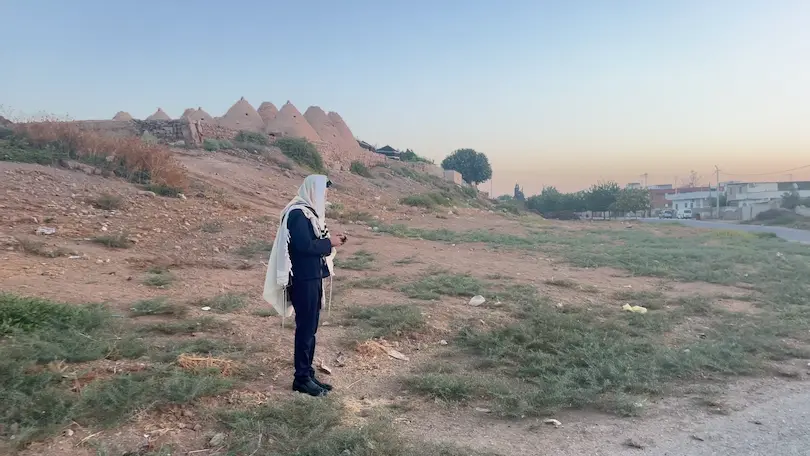
Up on that hill, before anyone else was awake, I said the morning prayers. They were the same words I’ve said all my life. But I had never said them standing in the place where Abraham first heard God, where that journey began.
One line in those prayers hit differently there: Atah hu Hashem ha’Elokim asher bacharta b’Avram, v’hotzeito me’Ur Kasdim, v’samta shemo Avraham. “You are God, who chose Avram, brought him out of Ur Kasdim, and named him Avraham.” Avram was his name back then, before God added the letter hei (H) to make it Avraham. And here I was. These are the steps he walked. This is where he heard God’s call.
So whether Ur was in the south or, as I’ve argued, much more likely in the north, the biblical story stands. Abraham left one of the most established and powerful civilizations of his time to begin a journey that would transform all of history. A journey that began with his departure from Haran, in the north, and continues to this day.
Next in this series: Abraham in the land of Israel. The Torah says he camped between two towns, Bethel and Ai. Many archaeologists claim that when they dug up Ai, there was nothing there in Abraham’s time. We’ll see what the evidence really says.