 Minimizing Attacks on French Jews
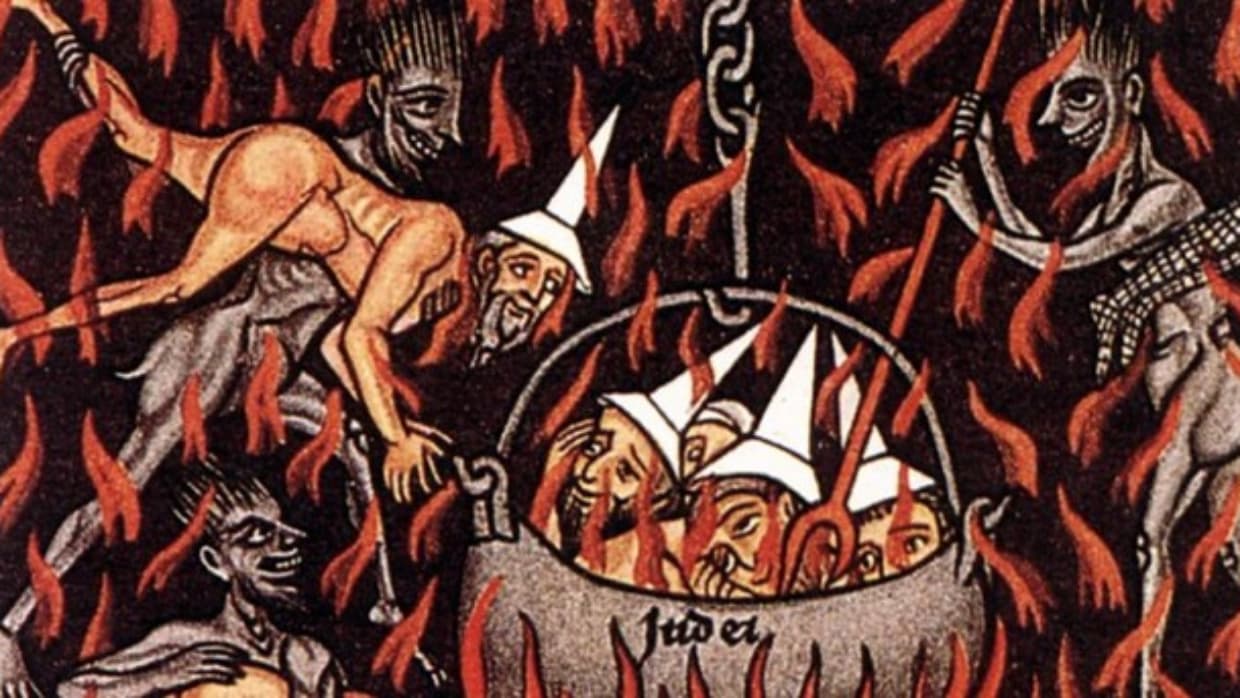






Pointy hats, hooked noses, child-snatching and midnight “Sabbaths.” Many classic witch stereotypes began as slurs against Jews, and some are still hurled at Jews today.
This Halloween, millions of kids will put on pointy black hats, paint warts on their noses and stir pretend cauldrons. That costume has a dark history.
“The common image of a witch in the Western tradition is a woman who is usually older, ugly, who wears a pointy hat, flies on a broomstick, cooks over a cauldron, and lures children into her house in order to eat them,” says Prof. Magda Teter, a history professor and Shvidler Chair in Judaic Studies at Fordham University in New York. Teter has studied how Europe and North America imagined witches and found that many of those images grew out of antisemitic depictions of Jews.
For centuries, the same slurs were used against Jews, and some still are. Here’s how hatred of Jews shaped the witch we all know.
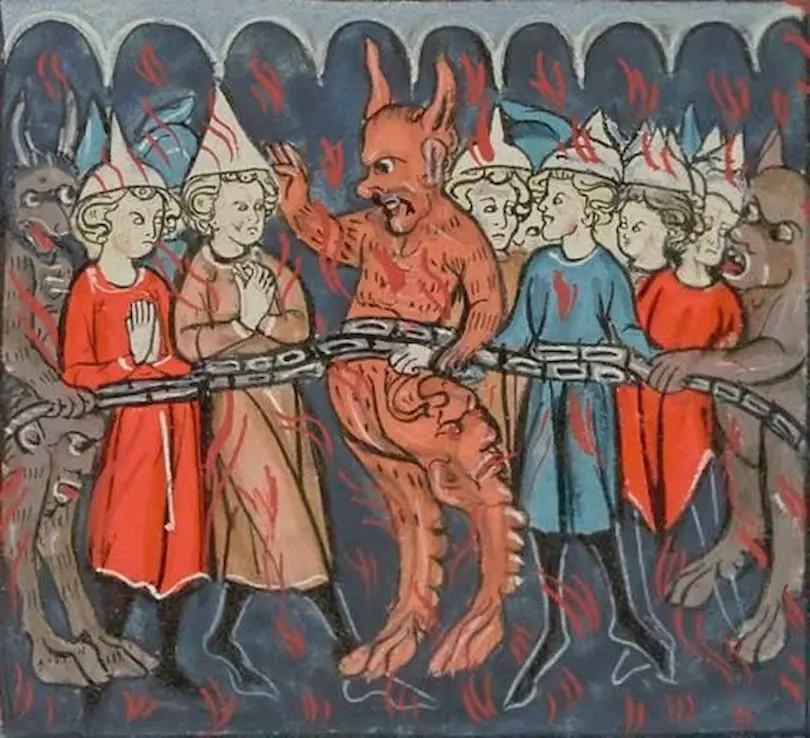
Take the tall, pointy hat. It began in 13th-century Europe as a Jewish head covering. In 1215, Pope Innocent III convened the Fourth Lateran Council, which ordered Jews to wear clothing that set them apart from Christians. Each town chose its own marker. Some forced Jews to wear a yellow patch. Many others forced them to wear tall, pointed hats called Judenhuts, German for “Jews’ hats.”
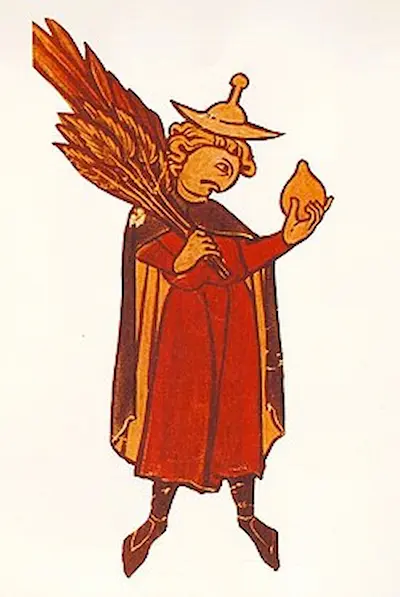 Figure in a Jewish hat holding an etrog
Medieval artists soon began painting demons in Judenhuts, and the hat came to stand for everything sinister, frightening and evil. By the 15th century, it was a short leap to witchcraft. In 1431, a Hungarian decree forced Christian men and women accused of witchcraft to wear the Judenhut, even though they weren’t Jewish. Illustrations of accused and convicted witches began showing them in the tall, conical hats we still picture today.
The witch’s grotesque looks came from Jews too. Early European art portrayed Jews as ordinary people. That changed in the Middle Ages, when “Jews began to be depicted (in art) with hooked noses,” Dr. Teter notes, to stress how foreign they were. Jews were also said to have warts and to smell bad, traits later pinned on witches. (In some witchcraft trials, a wart was eventually treated as “proof” that a woman was a witch.)
Around the year 1000 CE, European artists began portraying Jews as monstrous: huge noses (sometimes snouts), dark skin, tall Judenhuts, warts and occasionally cloven feet. “Four centuries of seeing pointy-hatted, big-nosed, bearded Jews in art had conditioned Christians to regard Jews as different and socially distant,” notes Dr. Sara Lipton, a history professor at the State University of New York at Stony Brook. Jews came to be seen as disgusting and impure, both ritually and physically.
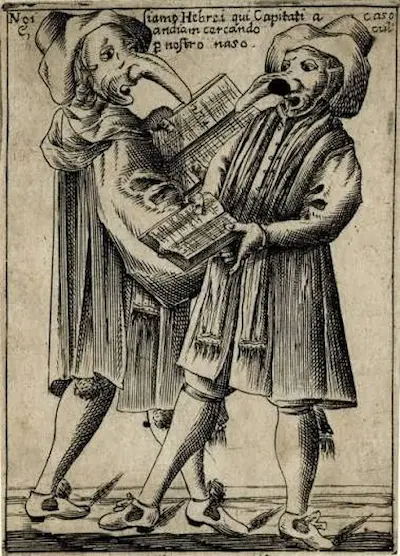
Over time, these ugly “Jewish” stereotypes were transferred to witches, who were also seen as strange, frightening outsiders threatening the old European order. Dr. Penny Roberts, a history professor at the University of Warwick in England, notes that both Jews and single women embodied “certain types of behaviour, appearance or lifestyle which differ(ed) from the prevailing norms” and were “marginalised, ostracised or actively persecuted” as a result. Exaggerating their features in art and literature drove home that they didn’t belong. (See “Marginals and Deviants” by Penny Roberts, in The European World 1500-1800: An Introduction to Early Modern History, ed. Beat Kumin, 2014.)
Cauldrons became associated with witches in the early 1600s thanks to a spate of plays - the most famous of which is Shakespeare's Macbeth - which feature creepy scenes of witches making spells over smoking cooking cauldrons. Historian Clare Merrick notes that the first play to set off this craze was Christopher Marlowe's 1590 work The Jew of Malta. Though it doesn't feature witches, this odiously antisemitic play does depict a murderous, bloodthirsty Jew named Barabas who plans to trick and kill a local governor and his army by dropping them into a large boiling cauldron. (Barabas is foiled and dies in agony in his own cauldron instead.) Merrick observes that this anti-Jewish play established cauldrons as potent symbols of evil in the Renaissance imagination - and that they were soon adopted as markers of evil associated with witches as well.
The fear these images stirred up ended in tragedy. Over the centuries countless of Jews across Europe were massacred, many of them tortured and burned at the stake. Tens of thousands of accused witches (75% to 85% of them women) met the same fate in Europe and North America.
Think of the Wicked Witch of the West imprisoning Dorothy in The Wizard of Oz, or evil Mother Gothel targeting Rapunzel in Tangled. Pop culture is full of grotesque women, often with big noses and dark hair, luring children into their homes for sinister purposes. “This trope in folklore is based on real stories brought against thousands of accused witches,” Prof. Teter notes.
Historian Yvonne Owens traces the charge that witches harmed or kidnapped children back to the blood libel: the lie that Jews killed Christian children to use their blood in religious rituals, especially in baking matzah, the unleavened bread eaten on Passover.
Europe’s first blood libel struck the Jews of Norwich, England, in 1144, after the body of a young boy named William was found stabbed to death in the woods outside town. Locals blamed the Jews. A chronicler of the time claimed they “tortured him with all the tortures wherewith our Lord was tortured” and then hanged him out of “hatred of our Lord.” Jews were accused of killing the boy in a frenzy of cruelty and hatred of Christianity. Blood libels soon spread across England, France, Spain, Germany, Italy and beyond, accusing Jews of murdering Christian children out of pure spite, or to consume their blood or body parts.
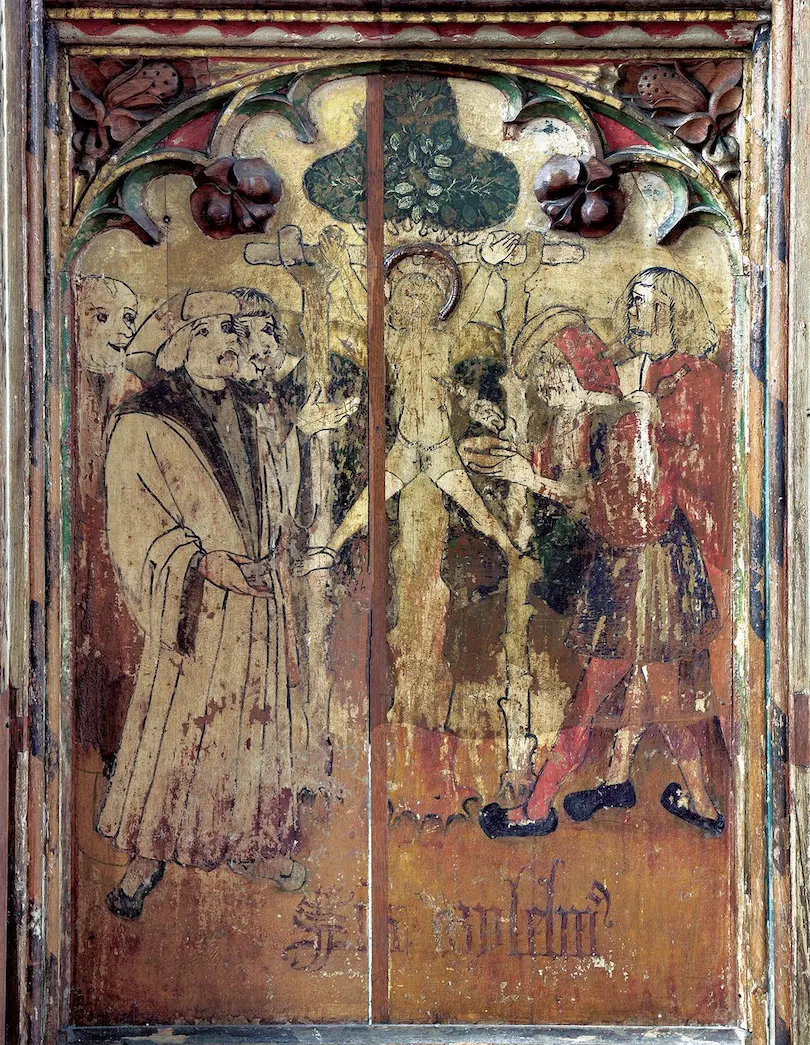 A 15th-century depiction of the death of William of Norwich
The 1475 case of Simon of Trent was especially influential. After a Christian toddler was found dead in the Italian town of Trento, his father accused local Jews of killing him to use his blood in their Passover matzah. Authorities arrested the town’s prominent Jews and tortured them into confessing. Fifteen were burned at the stake; five more took their own lives in prison. Church authorities then credited two-year-old Simon with hundreds of miracles and honored him as a saint. (The Church officially ended his veneration in 1965.) St. Simon of Trent became one of the best-known figures in Catholicism, cementing the lie that Jews need children’s blood to make matzah.
It sounds far-fetched, but the blood libel is still alive. On the last day of Passover in 2019, a gunman stormed the Chabad synagogue in Poway, California, and murdered 60-year-old congregant Lori Gilbert Kaye. His manifesto declared: “You are not forgotten, Simon of Trent. The horror that you and countless children have endured at the hands of the Jews will never be forgiven.”
In 2014, Hamas spokesman Osama Hamdan said on Arabic TV, “We will remember how the Jews used to slaughter Christians in order to mix their blood with their holy matzos,” and CNN’s Wolf Blitzer challenged him on the remark on air. In November 2025, pro-Palestinian activists staged an “Israel’s Friendsgiving Dinner” outside Washington DC’s Union Station. Actors wearing masks of Israeli Prime Minister Benjamin Netanyahu and American politicians drank blood-like liquid from wine glasses, ate fake baby limbs and wiped their bloody-looking mouths with Israeli flags.
Only Jews and witches were considered capable of the atrocities of cannibalistic infanticide.
The myth of Jewish bloodlust, especially the supposed urge to kill children, was applied to witches as well. “To the late Medieval perspective, the Jews’ cannibalistic tendencies arose from a craving for the salvific (saving) benefits to be gained from consuming Christian blood,” notes Dr. Yvonne Owens. “Indeed, only Jews and witches were considered capable of the atrocities of cannibalistic infanticide…”
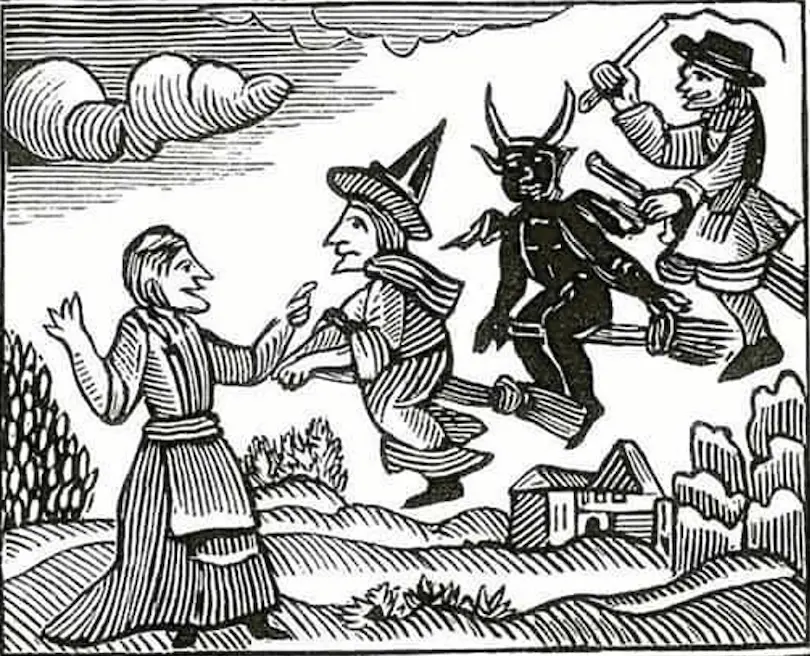
Like Jews, witches were accused above all of wanting to murder children, explains Dr. Teter. She points to Hansel and Gretel, lured into the home of a witch who plans to kill and eat them. Generations of believing that Jews were hunting for children to kill and eat primed Europeans to fear the same from witches.
Individuals had been accused of witchcraft in Europe for centuries, but in the 15th century accusations soared, driven largely by the Dominican order, which had pledged to root out heresy in the Catholic Church. The resulting “witch craze” lasted about two hundred years, peaking between roughly 1450 and 1650. Up to 100,000 people were accused, and about 60,000 executed. Catholics and Protestants alike held witch trials. In the early Middle Ages, accused witches were often seen as simply misguided. By the late Middle Ages, they were described as thoroughly evil and in league with the Devil.
As tales of witchcraft grew darker, Christian authorities began dressing them in Jewish vocabulary. Church authorities called gatherings of so-called witches “Synagogues of Witches.” Some Christian writers borrowed the phrase “Synagogue of Satan” from the Christian Bible to describe supposed nighttime witch gatherings.
In the 1400s, the Medieval Inquisition, the Catholic Church’s tribunal for investigating heresy, began calling these gatherings the “Witches’ Sabbath,” a reference to Shabbat, the Jewish Sabbath. Church officials described wild, debauched nights where witches celebrated with the Devil, swore loyalty to him and welcomed new witches into the fold. These “Witches’ Sabbaths,” officials claimed, took place on Friday night, when the Jewish Sabbath begins, and featured digging up the dead, desecrating Christian holy objects, unnatural relations and eating babies.
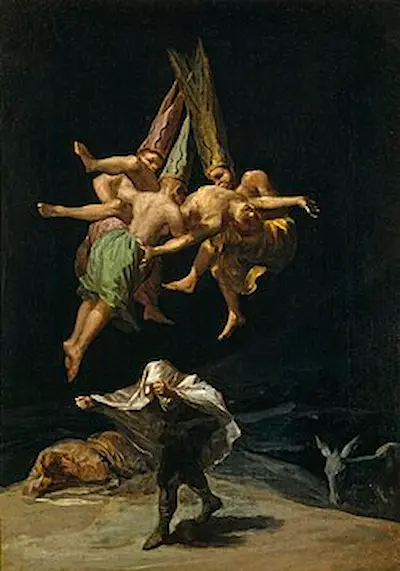 Witches' Flight, 1797–98, Francisco Goya, Museo del Prado, Madrid.
Witches weren’t the only ones accused of working with the Devil. In the mid-14th century, the bubonic plague, known as the Black Death, swept Europe and killed an estimated 25 to 50 million people. Jews were accused of spreading it by poisoning wells, with a new twist: they did it not just because they were evil, but because they were acting on the Devil’s behalf. It was a massive shift. Jews were no longer seen as merely misguided or bad. Like witches, they were now partners of the Devil, the source of all evil in Christian teaching. Europeans came to believe that “all Jews everywhere form(ed) a conspiratorial body set on ruining and then dominating the rest of mankind” through supernatural means, observed historian Robert Ian Moore, a former professor at Newcastle University in England.
Few people believe in witches anymore, but the lie that Jews serve the Devil lives on. In 2024, pro-Palestinian activists protesting outside a New York synagogue called the Jews inside “Devil worshippers.” The Palestinian Authority has called Jews “the ally of Satan,” and the pro-Palestinian group Palestine Action refers to “Satanic Zionism.” Popular influencers such as Candace Owens routinely use “Synagogue of Satan” as a slur against Jews.
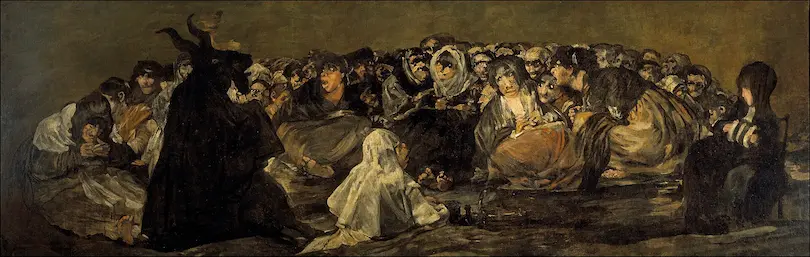 Witches' Sabbath 1821–1823, by Francisco Goya
In 2025, the CEO of the social media site Gab published an essay called “Naming the Synagogue of Satan,” accusing Jews of undermining the United States. And in 2026, Beth Israel Congregation, Mississippi’s oldest synagogue, was firebombed by a Christian fitness influencer who said he wanted to destroy the “Synagogue of Satan.”
The persecution of witches and Jews in the past can teach us to spot the same patterns of discrimination and othering today. It’s up to each of us to remember where the witch stereotypes came from, and to stand guard against the antisemitism that created them.