



 Minimizing Attacks on French Jews

8 min read




When a gunman killed a 12-year-old Muslim girl, President Macron called it unprecedented. French Jews have a long, painful list that proves otherwise.
When a terrorist opened fire on Black and Arab people frequenting a medical center, a gas station, and a playground in the town of Trappes, near Paris, on October 23, 2026, he wounded five people and murdered a 12-year-old girl. French President Emmanuel Macron acted quickly to calm the nation but got some key facts very wrong. He called the mass shooting “a turning point, because it is the first time we have had a terrorist act that was planned to kill our compatriots, our children, based on the color of their skin or their religion.”
French Jews were left scratching their heads in puzzlement. (Macron later acknowledged that he was mistaken.) This tragic murder is hardly the first time that people have been targeted and murdered because of their religion in France.
Violent attacks on French Jews are almost too numerous to list.
These violent attacks pale in comparison to the Holocaust, during which about 75,000 French Jews were rounded up and arrested by French police and sent to their deaths in Nazi camps.
A Familiar Pattern
Pres. Macron has been in office since 2017. He personally has witnessed and responded to many of the deadly attacks against Jews listed above. It might seem odd that his first instinct in responding to the tragic death of a 12-year-old Muslim girl last week was to declare that her murder was unprecedented, when it so clearly is one of a long, long line of religiously motivated terror attacks on French soil. Yet his response is hardly unique. When Jews are killed and targeted for terror attacks, public responses are often to downplay, minimize or even justify violence against Jews.
In 1980, when terrorists affiliated with the Popular Front for the Liberation of Palestine bombed a synagogue on Rue Copernic in Paris, wounding 46 people and killing four, French Prime Minister Raymond Barre said on television that the attack was “aimed at Jews worshipping in a synagogue, but struck…innocent Frenchmen” too. His not-too-subtle take was that Jews are not like other French people: they deserve hatred, violence, and even death.
US President Barack Obama indulged in a similar rhetorical sleight of hand in 2015, a few weeks after the attack on the Hypercacher kosher supermarket in Paris killed 4 Jews. In an interview with Vox magazine, he described the terrorists as “violent, vicious zealots who behead people or randomly shoot a bunch of folks in a deli in Paris.” Barely a month after the attack, the Jewishness of the supermarket victims was already being erased.
Jews Don’t Count
British comedian David Baddiel has a term for this: Jews don’t count. He’s turned it into a book and a documentary, and his thesis is simple: “This one minority doesn’t seem to be considered, by the people who care most about minorities, quite a proper one.” In France and elsewhere, anti-Jewish violence is all too often treated as not as real, not as threatening, as other forms of racism. All too often, it is even justified.
After Palestinian terrorists murdered 11 Israeli Olympic athletes at the 1972 Munich Olympics, the famed French philosopher Jean Paul Sartre wrote a piece excusing the attack, shrugging his Gallic shoulders and saying “the principle of terrorism is that one must kill” and that there is no point in condemning terrorism.
This sentiment was echoed in 2024 in France when American philosopher Judith Butler declared that Hamas’ October 7, 2023 attack on Israeli civilians, children, and partygoers constituted “armed resistance” and was legitimate.
No other group is treated this way: France’s most recent attack on Muslims has been rightly condemned, not justified or minimized or distorted, as attacks on Jews are.
A Song That Celebrates Murder
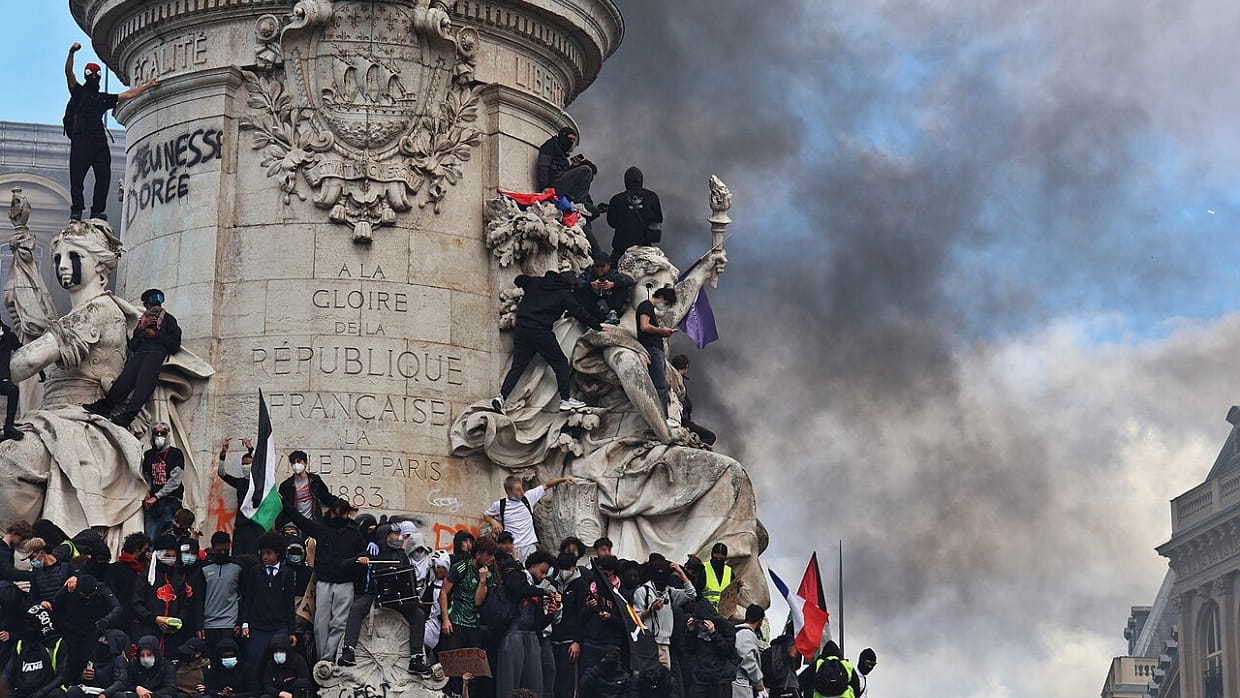
Perhaps the most chilling display of insouciance in the face of antisemitism has been instances of French students singing a provocative French rap song that glorifies some of these terrorist attacks as part of the current wave of protests sweeping France. MRH, by the French rapper known as BORO700, glamorizes the terrorist who murdered a Jewish teacher and three students at Ozar Hatorah school in Toulouse in 2012. It also romanticizes one of the terrorists who took part in the 2015 attack on the Bataclan concert hall in Paris in which 90 people died. Students protesting for more school funding have been filmed singing MRH in the towns of Nice, Brive-la-Gaillarde, Soullans, and Beaugency.
Many French people are horrified to hear students singing a song that glorifies attacks on Jews and others; the Orleans prosecutor’s office has opened an investigation into the song’s support for terrorism. Yet MRH continues to trend, used as a background anthem on some videos showing protests in France.
When it comes to attacks on Jews, in France and elsewhere, it’s all too easy to pretend that deadly anti-Jewish violence isn’t as real as other forms of hate.