




 Visiting Auschwitz with Holocaust Survivors and a Nova Survivor

10 min read
5 min read
12 min read




One survivor walked out of a gas chamber. Another escaped the Nova festival on October 7. Crossing Poland together, they taught me four lessons I’ll carry for life.
I spent last week crossing Poland with the Aish Living Legacy Experience, from the Warsaw Ghetto to Treblinka, Majdanek, Auschwitz-Birkenau, and finally Shabbat in Kraków. Two Holocaust survivors and one survivor from the Nova festival walked every step with us, and I fell in love with all of them.
Marion Weinzweig was just eighteen months old when her parents made the unthinkable choice to hand her to a Polish landowner so she might live. She was later left on the doorstep of a convent, baptized, and raised under a Polish name. Her mother was murdered at Treblinka. She was 25.
Tova Friedman, author of The Daughter of Auschwitz, was marched into a gas chamber as a little girl. She stood there, undressed and freezing, for hours. And then, for reasons no one can explain, she walked out alive. Tova is fierce, and she is funny. Even in Auschwitz, telling us about the selections where being sent left meant death, she couldn't resist: "I still don't go to the left, by the way."
Raz Moshe Ravid was at the Nova festival with his brother on October 7. With no reception and terrorists on every road, he somehow pulled up Google Maps, found a way out through the fields, and shouted to every car around him to follow. In the middle of all that chaos, he and his brother were sharing their water with strangers.
These three gave me four lessons I will carry for the rest of my life.
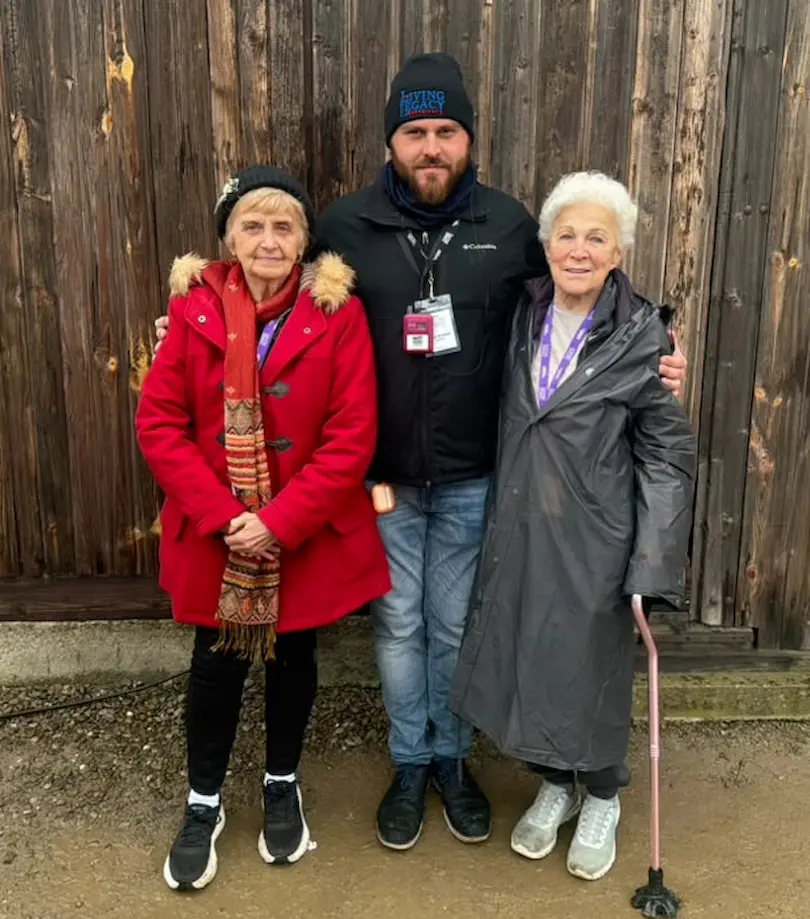 Raz Moshe Ravid with survivors at Auschwitz
Tova was angry. Really angry. When she talked about October 7, the fire in her was unmistakable. It wasn't supposed to happen again.
For me, "Never Again" had become something I said without thinking about it, reduced to a hashtag. For Tova, it was a promise the world made to a little girl in Auschwitz, and to every child who never got to grow up. Hearing her say it, I felt how badly that promise had been broken.
When I asked Raz what he was feeling as we walked through Birkenau, he didn't talk about himself. He talked about us. He wanted every single Jew on the trip to be safe. He couldn't bear the thought of one more of us falling on that ground. "No more," he said. "Please God, keep us safe."
These people are survivors; they have survived the worst that antisemitism has thrown at us, and they know just how dire an emergency it is. We need to learn from them, follow their lead, and start acting like it.
"I'm telling my story so people will never, ever say it didn't happen," Tova said that to me at Majdanek, and she said it like a vow. She keeps coming back to Poland, with her children, her grandchildren, and groups like ours, because she made a promise to the people who died there. "As long as I'm alive," she told me, "I won't forget them."
The generation that can say "I was there" about the Holocaust is nearly gone. Meanwhile, denial of October 7 began on October 8, before our dead were even buried, even though the terrorists proudly filmed their own crimes. Raz told us that telling his story is part of how he survives it.
Watching the two of them, it hit me. Testimony doesn't end when a survivor stops speaking. It passes to whoever was listening. On this trip, that was us, and now, reading this, it's you.
Tova said something to me that I want every person to hear: "You can't walk around in pain."
The mind, she told me, is our best computer, and life is training in positive experiences. Here was a woman who survived Auschwitz telling us that we have the power to train our own minds. It's the only way she can stand in that place and talk about what happened to her there. I told her how much I loved that she gave the power back to us.
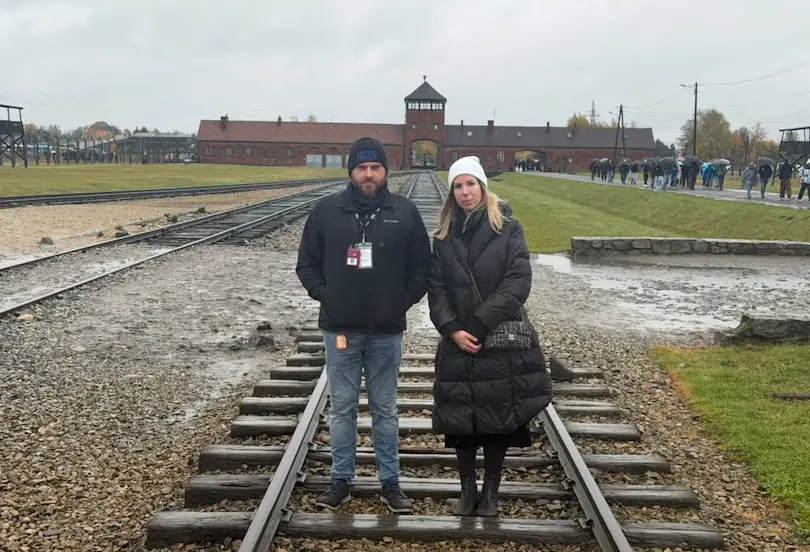 Raz with Jamie Geller at Auschwitz
Raz said the very same thing in his own words. Let it be. Hug it. Talk about it. Process it. He told me the tears don't usually come when he's with people. They come when he's alone. All week I kept glancing back at him, nervous for him, the way a mother does, then he told me this journey was making him stronger.
So many of our kids, in Israel and all over the world, are carrying wounds that are still fresh. Our oldest survivors are handing them the tools to carry that weight without being crushed by it. We need to make sure they're listening.
When Tova was not yet five, the Nazis emptied her ghetto in Tomaszów Mazowiecki and sent eight thousand Jews, including much of her family, to Treblinka. She and her parents were kept behind on a cleanup squad. They had to gather the remains of the people who had been shot, some of them neighbors and friends. Tova clung to her mother's dress the entire time. And her father quietly said words she didn't understand.
Years later, he told her it was Kaddish. She asked him how he could possibly praise God while picking up pieces of people. Telling us this, Tova smiled, with so much love for her people, and said, "Jews are weird. When other people would curse, we praise."
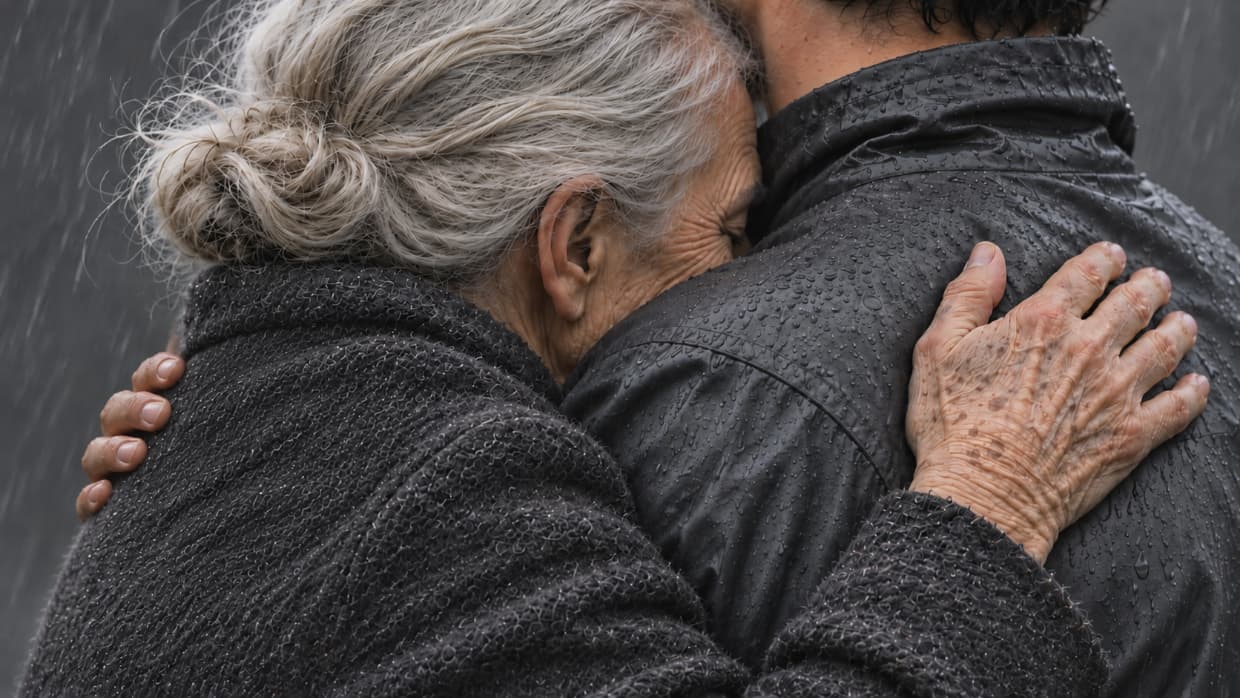
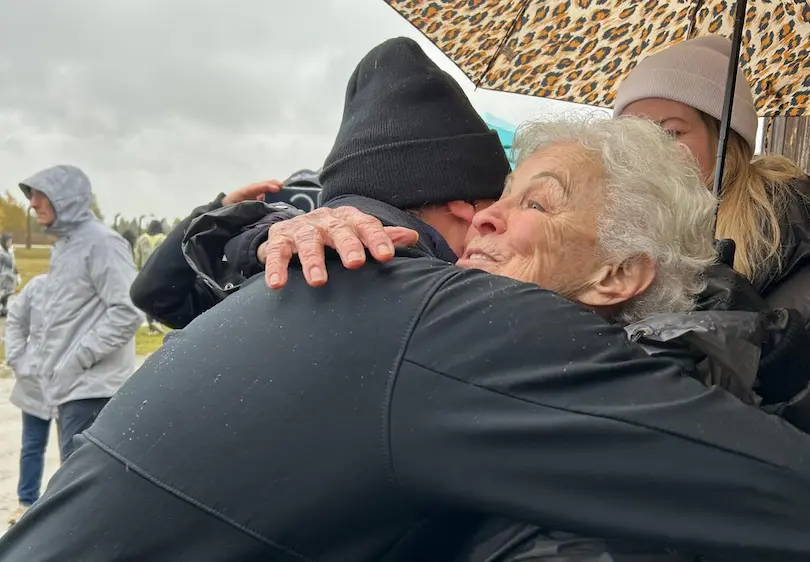 Holocaust survivor hugs Nova survivor
There were 140 of us on this trip, spread across three buses, and the first time we all came together was at Auschwitz-Birkenau.
I had the honor of introducing Marion, who had flown in from the United States, and Raz from Israel, on this holy ground, soaked in the blood of our people. Two survivors from worlds apart.
When I told Marion who Raz was, her face lit up, her arms were already open, and she asked, "Can I hug you?"
There was so much genuine joy in that hug, so much love and heart, and it was the last thing in the world you'd expect to see in that place. The day was dark and freezing, and it had been pouring since morning. We were all soaked to the bone. But standing there watching them hold each other, I stopped feeling the cold and the wet. The warmth of that hug reached every single one of us.
Marion had brought her daughter along to lean on. Raz had brought his mother. Two families, the generations flipped, each one holding the other up, and in that moment, Marion and Raz were holding each other up too.
Eighty years apart, different enemies, but the same hatred.
We won't just survive.
That Friday night, we welcomed Shabbat in the ancient synagogue of Kazimierz, in a city where Jewish life was supposed to be wiped out, and we danced.
All through the Kabbalat Shabbat prayers, people kept spontaneously breaking out into dance, and nobody could stop us.
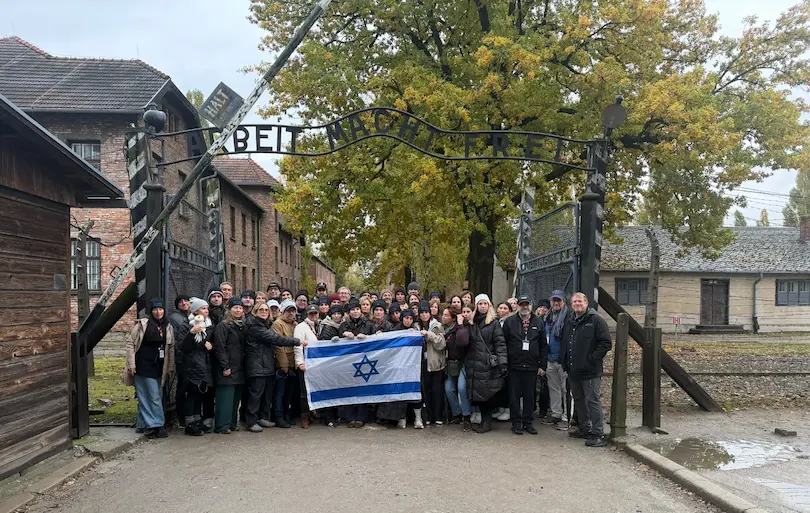 Aish Living Legacy Experience group at the gates of Auschwitz
After Nova, the survivors made "We will dance again" their promise to the world. In Kraków, I watched Raz keep it. There he was, and there were Tova and Marion, each one in the middle of a circle of Jews dancing around them.
We are dancing again. We are celebrating again. We got this.