 Muslim Heroes of the Holocaust






In 2014, The New York Times declared that camels proved Genesis was written centuries too late. A closer look at the text and the bones tells a different story.
In February 2014, The New York Times ran a headline declaring that camels had no business in the Book of Genesis.
The story came out of Tel Aviv University, where two archaeologists studying ancient camel bones found in Israel had dated the earliest ones to around 930 BCE. That’s roughly the time of King Solomon, eight or nine centuries after Abraham.
Genesis, though, is full of camels. So the conclusion seemed obvious: whoever wrote Genesis either didn’t know when camels arrived, or was writing many centuries later, looked around, saw camels everywhere, and assumed Abraham and Isaac must have ridden them too.
The best-known camel story appears in Genesis 24, the Torah portion called Chayei Sarah. Abraham is getting old and wants to find a wife for his son Isaac. He sends his most trusted servant, known in Jewish tradition as Eliezer, back to Haran, the town his family came from, in what is now southeastern Turkey. The servant takes his master’s camels and sets out. He arrives outside Haran in the evening, at the well, just as the young women come out to draw water. That’s where he meets Rebekah.
As I mentioned a few episodes ago, I recently traveled to Haran, retracing the route of Abraham and the patriarchs and matriarchs. The timing couldn’t have been better for this episode.
I was walking through the old village a little before 7 a.m. The streets were empty. Suddenly a shepherd walked right past me with his flock, dressed exactly the way you’d picture someone from the Bible. A few minutes later I turned a corner and there they were: camels.
I couldn’t believe it. One of them was standing over what looked like a well, drinking. Nearby, a woman was watering the ground. This was the scene of Eliezer watering his camels, still playing out thousands of years later.
Eliezer reaches the well in Haran with ten camels. In verse 14 he prays: How will I know the right woman for my master’s son? Let it be the girl who, when I ask for a drink, says, “Drink, and I’ll water your camels too.”
Before he even finishes praying, Rebekah appears with a jar on her shoulder. He asks for a drink. She gives it to him, and in verse 19 she says, “I’ll draw water for your camels too, until they’ve had enough.” Then she runs back and forth until she has watered ten thirsty camels at the end of a long journey.
According to the critics, this scene could never have happened. Why?
The critics point out that this isn’t a single scene. Camels appear throughout Genesis: with Abraham, with Eliezer, with Jacob, and with the traders who buy and sell Joseph. The author clearly assumed camels were common in Canaan during the era of the patriarchs, the 18th to 16th centuries BCE. The archaeology, they say, shows camels weren’t domesticated and put to work until centuries later.
Israel Finkelstein, one of Israel’s most famous archaeologists, co-wrote The Bible Unearthed with Neil Asher Silberman. Both are biblical minimalists who believe very little of the Bible is historical. They write that camels weren’t domesticated as beasts of burden until the late second millennium BCE, and weren’t widely used until well after 1000 BCE.
The Tel Aviv University archaeologists quoted in the Times reached the same conclusion, and they called it proof that the text was written long after the events it describes. Picture a film about ancient Rome where one of the actors is wearing a wristwatch. That’s an anachronism, something that clearly belongs to a later time.
Before turning to the archaeology, let’s look at the Torah itself. On a quick read, Genesis seems packed with camels. Read it carefully and the picture changes completely.
When Abraham arrives in Canaan in Genesis 12:5, the text lists his wife, his nephew, his possessions and his people. It mentions no animals at all. Then a famine strikes, he goes down to Egypt, and in verse 16 Pharaoh gives him gifts: sheep, cattle, donkeys, servants and camels.
So what is the Torah claiming here? Only that the king of Egypt owned some camels. Pharaohs kept collections of exotic animals nobody else had; it was part of being Pharaoh. Abraham’s camels were a royal gift, a small private herd brought into Canaan from outside.
The next camels we meet are those same animals, or their offspring: the ten Eliezer takes up to Haran. They tell us nothing about large numbers of camels in the land.
When Abraham makes his painful journey to Jerusalem with Isaac, believing he’s about to offer up his son, he takes a donkey. And in the next generation, when Jacob travels to Haran in Genesis 28, he goes without camels. His parents were wealthy. If camels were available, they would have owned some or bought some. The likeliest explanation is that Abraham’s camels had died and there was simply nowhere to get more. Either way, camels clearly weren’t common in Canaan, or Jacob would never have made that long journey on foot.
In Haran, Jacob tends his uncle Laban’s sheep and grows rich from the flocks. In Genesis 30:43 he trades some of that wealth, perhaps with international merchants, and acquires camels. Once again, this says nothing about camels being native to Canaan or even Haran. It tells us that people there could buy animals that arrived along trade routes from much farther away. When Jacob returns to Canaan, he gives some of these camels to his brother Esau as a gift (Genesis 32:15).
Later, when Jacob’s sons travel to Egypt to buy grain, and when Joseph, Egypt’s second-in-command, sends them back and forth, they ride donkeys. Every single time. Nobody would cross the Sinai desert on donkeys if camels were an option. Donkeys need lots of food and water and can’t travel nearly as far. Camels are built for the desert. If Canaan or Egypt had camels in any real numbers, the brothers would have used them.
The author of Genesis clearly understood that camels weren’t domesticated in Canaan at the time. A later writer, surrounded by camels, would have put the brothers on camels without a second thought. In Genesis, camels always come from outside the land: Pharaoh’s collection, which Abraham’s servant takes to Haran and back; the camels Jacob acquires abroad and gives to Esau; and the international traders who buy Joseph, arriving from outside Canaan and leaving it again. The land itself had almost no domesticated camels at all.
Now to the archaeology. The Tel Aviv study is excellent work. The ancient copper mines in the Arava, the desert valley south of the Dead Sea, are full of animal bones. The miners had to eat, and they needed animals to haul loads. Archaeologist Lidar Sapir-Hen went through the remains layer by layer: donkeys, donkeys, donkeys, donkeys. Then, in the layer from the end of the 10th century BCE, camels. That tells us camels became everyday pack animals for the copper trade in southern Israel only in the 10th century BCE.
The Torah never claimed otherwise. What it does describe is a handful of camels arriving from outside the region around the 18th century BCE. Is that plausible?
Here’s the crucial point: two different species of camel are relevant to this story.
The first is the one-humped Arabian camel, the dromedary. That’s the one we all picture, and it was domesticated late. The second is the two-humped Bactrian camel, from beyond the Zagros Mountains between Iraq and Iran. It was domesticated much earlier, by about 2500 BCE, and from then on it carried goods along the long trade routes into Mesopotamia. The Sumerians, who invented writing in that part of the world, called it “the elephant of the caravan.”
In 2021, two German scholars, Martin Heide, a specialist in ancient texts, and Joris Peters, an expert in ancient animal bones, published a 400-page study of every known camel bone, image and written reference from the ancient Near East. Their central finding: the dromedary isn’t the only camel.
A museum in Baltimore holds a cylinder seal from Syria dating to around 1800 BCE. Cylinder seals were small carved stones rolled across wet clay, a kind of ancient signature. This one shows two people riding a two-humped camel. A clay tablet from Alalakh in northern Syria, from around the same period, lists animal feed, and one line reads “feed for a camel.” Scholars debate it, but that’s the natural reading. Babylonian word lists, the dictionaries of their day, include camels among the farm animals.
None of this means camels were everywhere. Heide and Peters conclude that in Abraham’s time the camel was rare, expensive and prized. It existed, and it was used to carry heavy loads over long distances, while donkeys did everything else. That’s almost exactly the picture the Torah paints.
The evidence from Egypt is thinner: a few early figurines and rock drawings that scholars still argue over. But the Torah claims only that the king owned a few.
Put it all together and the biblical picture matches the archaeological one almost exactly. Camels were uncommon. They came mostly from outside the land, especially via the northern trade routes, and long-distance travelers used them. Pharaoh owns a few in Egypt. Jacob trades for some, probably from merchants up north. Long-distance traders take Joseph down to Egypt. Everyone else walks or rides donkeys, because camels weren’t yet widely domesticated.
Eliezer does bring his camels to Haran, and watering them is exactly what shows him that the young woman in front of him is the right bride for Isaac. Camels drink a lot. Rebekah turns out to be part of Abraham’s extended family, which makes her an even better match and fulfills Abraham’s request that Isaac’s wife come from his own family.
The heart of the story is the extraordinary kindness she shows. A woman destined to become a matriarch of the Jewish people needed exactly that quality.
I want to go back to that morning in Haran, because something remarkable happened.
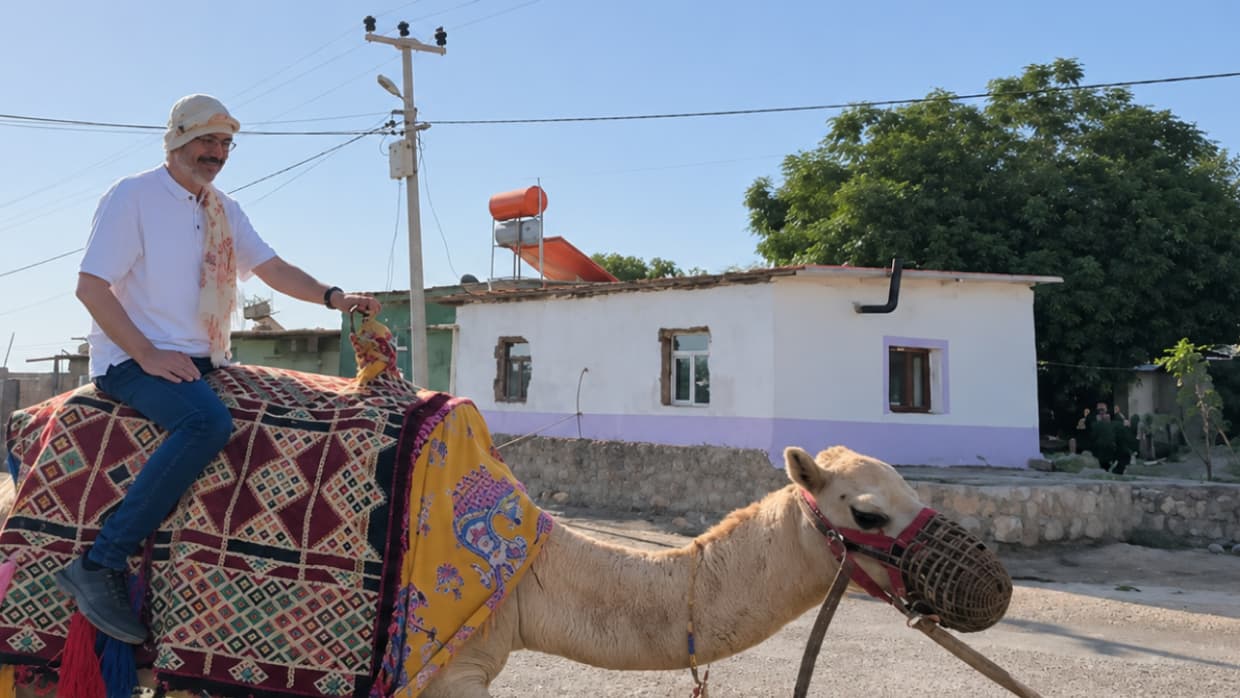
We were wandering around on our own at what looked like a tourist site when the family who runs it showed up and started talking with us. Once again it felt like stepping into Abraham’s world. Perhaps their families really have lived there for thousands of years. Like the families of Abraham and Rebekah, they overflowed with kindness. They kept pressing food and tea on us and refused to take any money. Then they decided we had to become part of the family. They placed one of those grand, biblical-looking head coverings on my head and insisted I ride their camel. So there I was, riding around Haran, on the receiving end of the hospitality of the modern-day neighbors of Rebekah’s ancient family.
I like to imagine that this same spirit of hospitality, of caring for camels and guests, is what launched the first marriage in Abraham’s family, the family that would become the Jewish people. It’s God’s message to humanity: care for the stranger, for every human being and for every animal, must be the foundation of the family and the nation that will carry God’s voice to the world. The goal is a day when all humanity hears God’s word, worships the one God of all people, and recognizes the God of loving kindness, who wants us to excel in loving kindness too.
The critics may be a little disappointed. The biblical text fits the archaeological record so precisely that it becomes hard to believe a later author simply described the world around him. A later author would have gotten it wrong. The author of Genesis got it exactly right.
That settles the camels. In the next episode we’ll tackle another supposed mistake: the claim that the Philistines appear in the wrong era. Abraham meets them, Isaac meets them, and according to the critics, they didn’t exist yet. We’ll travel to their homeland, to the very place where the Torah says Abraham and Isaac went to meet the Philistine king.
Until next time, may God bless you all.