





 The Blood Libel Machine






Abraham camped there. Joshua fought there. Archaeologists said nobody lived there. A northern gate, a fire and a beheaded idol are reopening the case.
There’s a spot in the hills north of Jerusalem where you can stand between two ancient towns and know, with reasonable confidence, that Abraham stood there too.
In the Torah portion of Lech Lecha (“Go Forth”), Abraham enters the land of Canaan. He passes through Shechem, then heads to the hill country and pitches his tent with Bet El (“House of God”) to the west and Ai to the east. He builds an altar there and calls out to God. Later, he returns to the exact same spot. His grandson Jacob comes back to it too, and dreams of a ladder stretching up to heaven. Centuries after that, Joshua fights his most famous battle after Jericho: the battle of Ai.
That makes this one of the rare places where you can check the Torah’s account against the ground itself. And for about a hundred years, archaeologists said the Torah failed the test. Ai wasn’t there. Nobody lived there in Abraham’s time, Jacob’s time or Joshua’s time. The man who excavated it called it an embarrassment to anyone who takes the Bible and archaeology seriously.
In recent decades, much of that has changed, though plenty remains hotly debated. So for the second episode of our series Fact Checking the Bible, I decided to go see for myself. Today’s two leading candidates for Ai are Khirbet el-Maqatir and et-Tell. As I often do, I wrote to an archaeologist who worked the sites: Dr. Scott Stripling, one of the leading figures in the region, who directed the digs at Khirbet el-Maqatir for years. I expected some advice on what to look for. Instead, he wrote back that he’d be there himself in October and offered to take me.
How did anyone figure out where these places were to begin with?
In 1838, an American professor named Edward Robinson rode through the hill country on horseback with an Arabic-speaking missionary, asking villagers the names of their villages. His idea was simple and brilliant: the Arabic names had preserved the Hebrew ones. Beit Lahm was Bet Lechem (Bethlehem, “House of Bread”). Anata was Anatot. And Beitin, a village twelve miles north of Jerusalem, sounded a lot like Bet El.
Ai was trickier. The name means “the ruin,” and the hill country is full of ruins. But about a mile east of Beitin sits a large mound the locals call et-Tell, Arabic for “the mound.” The Torah places Ai east of Bet El. In 1924, William Albright, the greatest biblical archaeologist of his day, declared it a match. He dug Beitin himself and found a Middle Bronze Age town, walls and all. Bet El checked out.
Then someone went to dig Ai. Judith Marquet-Krause was a young Jewish archaeologist, born in Palestine and trained in Paris, and Baron Rothschild funded her excavation. She was 27 when she began at et-Tell in 1933. In three seasons she uncovered a large city with a temple, a palace and a wall, all from the Early Bronze Age, roughly 3000 to 2400 BCE. Then came a burn layer. Then nothing. She died in 1936 at just 30, before she could publish. Her husband released her notes after her death.
Thirty years later, an American named Joseph Callaway returned to et-Tell and dug there from 1964 to 1972 to see if she’d missed anything. She hadn’t. The city was destroyed around 2400 BCE and then sat empty for 1,200 years. Around 1200 BCE, a small village of a few hundred people appeared, lasted about a century and vanished.
Now line that up against the Torah. Abraham arrives in the early second millennium BCE. Joshua doesn’t fit either, wherever you date him. No walled city to burn, no king of Ai, no gate. Just a mound with a name that means “ruin.”
Stripling told me how the problem looked from the inside. Callaway, a Christian, concluded there was simply nobody there when the Bible says the conquest happened. “He said this is an embarrassment, nothing’s here.” The timing made it worse. In the 1950s, Kathleen Kenyon had published her excavations at Jericho, which also seemed to contradict the biblical date. Then in the sixties came the same story at Ai.
“If you lose Ai,” I said, “you’ve lost the conquest.”
“You’ve lost the conquest,” he agreed. “You don’t have a historical narrative.”
Amihai Mazar, one of Israel’s most careful archaeologists, wrote that there was no second-millennium Canaanite city at et-Tell “or at any other site in the region.”
Critics seized on this. The German scholar Martin Noth argued the story was invented backward: the Israelites came across a huge ruin named “the ruin” and made up a battle to explain how it got that way. Albright, the man who had put Ai at et-Tell in the first place, suggested the battle was real but probably happened at Bet El, and the story drifted to Ai through later editors. The modern version, found in books like The Bible Unearthed, is the simplest of all: whoever wrote the account had never seen a Bronze Age Ai, because there wasn’t one. We’ll come back to that.
In 1970, a man named David Livingston published a paper that turned the question on its head. Livingston wasn’t an archaeologist. He ran a small Christian research group, the Associates for Biblical Research, which he’d founded in the 1960s largely because the problem of Ai bothered him so much. His paper argued that everyone had been wrong about where Bet El was, and therefore wrong about Ai.
The professionals laughed. He was an amateur, after all. But his argument was interesting. Around the year 300, the bishop Eusebius compiled a guide to biblical places with distances. He put Bet El at the twelfth milestone from Jerusalem on the road to Shechem. Measure it today and Beitin sits at the fourteenth. The town at the twelfth is el-Bireh, a large modern town on the ridge. Robinson, Livingston said, got the name right and the distance wrong. Bet El was el-Bireh, which would put Ai at a ruin east of it called Khirbet Nisya.
Standing on the ridge, Stripling pointed it out for me. Beitin, which has been excavated, was in one direction. El-Bireh was in the other, and within it sits Ras et-Tahuna, the town’s high point, which has never been excavated. “If you wanted to settle that, you’d excavate there,” he said. “Not an easy dig, though.”
Anson Rainey, who knew the geography of this land better than anyone alive, wrote a reply that was, let’s say, less than gentle. Beitin preserves the name, he argued, and Roman milestones weren’t that precise.
Livingston believed the site of Ai, and its name, might have migrated to a nearby hill. He went to Khirbet Nisya, which we passed on the drive in, and as far as Stripling knows, he went to his grave believing it might be Ai. But the idea never caught on with other scholars. There was no fortification, and even a ruined wall leaves stones lying around.
Still, Livingston had accomplished something. He got people looking at the ridge again. And on that ridge was a mound nobody had dug.
Khirbet el-Maqatir (khirbet is Arabic for “ruin”) lies about a kilometer west of et-Tell, on the road up from Jericho, at the head of a valley. In 1995, Bryant Wood, an American archaeologist who had already built a career arguing against the consensus, began digging there. Stripling later took over and dug until 2016.
Wood and his colleague Gary Byers had worked with Livingston at Khirbet Nisya and concluded it couldn’t be Ai without fortifications, so they went looking elsewhere. Early explorers had left a clue. Locals told Ernst Sellin, famous for his work at Jericho, and other excavators in the early 1900s that Khirbet el-Maqatir was Ai. It was the local tradition.
“I thought it was et-Tell,” I said.
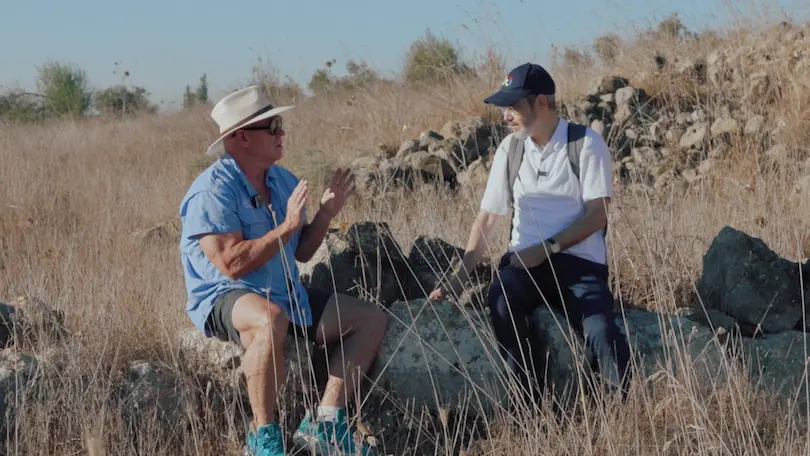
“No, they never pointed to that hill,” Stripling said. Locals sometimes mentioned a nearby site called Khirbet Haiyan, later dismissed because it only dated to the Second Temple period. But others pointed here. Following up on Sellin’s lead, Wood found Bronze Age pottery on the surface. And the site was small, which is exactly what you want for Ai. The biblical text says it was smaller than Gibeon and smaller than Jericho. That was the beginning. A license followed, and in 1995 the excavation began.
“So what makes you think this is Ai?” I asked.
To keep things objective, a researcher named Peter Briggs drew up a screen of fifteen criteria at the start of the excavation. If the Bible is giving us straight information, the site has to pass archaeologically and topographically.
Some criteria were geographic. The site had to be in the hill country of Benjamin, west of Jericho and east of Bet El, and within sight of Bet El. The landscape had to match the battle scene in the Book of Joshua: a hill to the north, and a large valley to the west where an army could hide, invisible from both Ai and Bet El. The city itself had to be fortified, occupied in the Late Bronze Age, with a gate facing north. It had to be smaller than Gibeon. Other criteria were possible indicators: signs that women lived there, since the biblical text clearly suggests they did, even though many fortresses and citadels had none. And broken idols, which would point to the arrival of a people commanded to destroy them.
Before the digging started, the team already knew a few things. The site roughly matched the geography, and it was smaller than Gibeon. That was a few boxes ticked. There were many more to go.
Stripling had me sit down in a stone chamber on the north side of the site.
“This is where the investigation really picked up,” he said, “because the gate was on the north.” That matters, because Joshua 8:11 places the gate of Ai on the north. Had it been on any other side, the expedition wouldn’t have lasted long. They would have tested the hypothesis, watched it fail and moved on.
In 1995, Byers and Wood found the first socket stone, still in place, right beside what looked like a gate complex.
“Explain what a socket stone is,” I said.
A gate’s heavy doors pivot on posts, he explained, and each post sits in an upper and a lower socket stone. This gate had four chambers with a road running between them, and doorways with sockets. An attacker breaks through the first door, then faces another, and another. Altogether the team found eight socket stones in this area. “Why would you have eight socket stones in this spot if it’s not a gate?”
The chamber we were sitting in, he said, is the only one of the Late Bronze Age gate that survives. Why did later builders leave it when they scavenged the rest? Because they turned it into a wine press. The bedrock floor is tiled with tesserae, small mosaic tiles. Workers filled it with grapes, trod on them, and the juice drained into a vat. Every village had olive presses and wine presses, so why build one from scratch when a perfectly good chamber was sitting right there? The chamber was used into the Late Bronze Age and repurposed as a wine press in the Second Temple period.
I was getting very excited at this point, and here’s why. There’s a long-running debate over this site. Supporters point to this gate as key evidence. Critics say it was a wine press. That was exactly what I’d come to ask him about, and he’d just brought it up himself.
I’d seen a video by Joel Kramer, who once dug here with Stripling. Kramer explains that he believed for years this was the Late Bronze Age gate of Ai, until he brought three experts to the site, a geologist and two archaeologists. Each of them, independently, immediately identified it as a Byzantine wine press. Two plastered vats for collecting grape juice were later found in front of it, and the excavation report itself calls the structure a wine press. For Kramer and his colleague Titus Kennedy, that was reason to reject the gate theory.
“I saw that too, and I pushed back,” Stripling said. “I understand it’s a wine press. I published it in 2023, in the final volume on Maqatir, as a wine press from the late Second Temple period. But that doesn’t mean it isn’t also a Late Bronze Age gate chamber. Why else do we have a socket stone right there? You don’t have socket stones in wine presses.” Kramer and Kennedy’s explanation, he said, is an oversimplification. “It’s not either/or. It’s both.”
“So it’s a wine press repurposed from a gate?”
“That’s right.”
Next, Stripling showed me the Bronze Age wall. Early Roman builders built right on top of the ruins, and later farmers plowing the fields piled stones on top of it, which is why it looks the way it does today. When the team excavated, they reached the original face of the wall. It encircles the whole site and runs three to four meters wide where it connects to the gate.
Inside are about two and a half acres. It’s a small fortress, but a heavily fortified one, home to maybe a couple of hundred people. In wartime you might cram in double that.
Which raises an obvious question. Joshua 8:25 says twelve thousand people of Ai fell that day. How does that square with a fortress that holds a few hundred? And what about the women the text describes?
On the second point, Stripling had an answer. The team found infant burials inside storage jars just a few meters from where we stood. Clearly, women lived here. One by one, the boxes were getting ticked. This was looking like a strong candidate.
Just above bedrock, the team found a scarab of Amenhotep II, the pharaoh of the Exodus in Stripling’s view, which places the site in the right window.
They also found a beheaded idol: a bronze ram’s head of Khnum, the Egyptian god of creation. You can see where it was hacked off. It took four or five blows. The Israelites, unlike the Canaanites, were commanded to destroy idols. “If that doesn’t date to the time of Joshua,” Stripling said, “then I suppose there’s some other explanation for why we’ve got decapitated idols like that.” Both finds date to the fifteenth century BCE, which fits what scholars call the “high chronology” for the Exodus and conquest.
The Bible says Ai was burned. Stripling, who has examined over a million pieces of pottery in his career, says something about the Late Bronze Age pottery here is abnormal. Thousands of fragments are rock hard, so hard you can barely cut them with a diamond-bladed saw. His explanation: the pottery was fired once in a kiln, and then fired again in the blaze that destroyed the fortress.
Right where we were sitting, the bedrock itself showed signs of fire. Archaeologists call it “calcined.”
“In less academic words?” I asked.
The limestone is cracked and has turned red, he said, the marks of having been burned. When they first exposed it, there was charcoal too, though it’s gone now.
The battle in Joshua chapter 8 needs a specific landscape: an ambush force hidden west of the city between Ai and Bet El, and a main army north of the city with a valley in between. Stand at the gate and look. The valley is to the north. The ambush ridge is to the west. And Bet El, whichever Bet El is the right one, lies beyond it.
To the west is a deep wadi, Wadi Sheban (a valley or dry riverbed), about a five-minute walk away, big enough to hide a large force. Joshua puts about 75 percent of his army there and keeps about 25 percent with himself. And there’s a hill to the north, Jebel Abu Ammar. “We didn’t put it there,” Stripling joked.
He sketched out the battle. Joshua shows his army on the northern hill. The men of Ai, who had just beaten the Israelites in chapter 7, assume this will be easy. It’s a trap. They’re lured out of the fortress, right outside this gate, while a signal goes out to the ambush. Once they’re engaged with Joshua, they’re caught from behind. From the top of the hill there’s a line of sight to Bet El, whose men join the fight and are defeated alongside Ai.
Because the wadi drops so steeply, the ambush force would have been invisible from Bet El. Stripling even tested the timing. He dropped off a group of young adults in their mid-twenties, roughly soldier age, with backpacks and gear, and timed how long it took them to get from the wadi to the gate. A little over five minutes.
Much of this lines up with what you’d expect at Ai. But it’s far from settled, and the biggest fight is over pottery. Late Bronze Age pottery is notoriously hard to date to a precise century.
The team excavated a lot of Middle Bronze III pottery and what they believe is Late Bronze I pottery. The question is whether it comes from the beginning of that period, around 1550 BCE, or the end, around 1400. Wood is certain it’s from the 1400 horizon, the destruction of the fortress. Wood was also involved in a similar dating debate over Jericho, and his critics have pushed back hard here too, arguing this is actually Middle Bronze III pottery, an earlier period. Stripling expects the fight to heat up in 2027, when volume one of the Khirbet el-Maqatir publication finally comes out.
Then there are the critics I mentioned earlier, Joel Kramer and Titus Kennedy. After much of the Maqatir work had been done and published, they went back to the original site, et-Tell, the one Albright had identified and later archaeologists had abandoned. They claim to have found exactly what everyone said wasn’t there: pottery from the right period and a burn layer.
In his video, Kramer describes the dig, directed by Kennedy after he earned his PhD. They opened a first square on the acropolis, just inside the ancient city wall line, then a second, and a third just north of the western city gate, inside the fortification wall. As they dug, he says, it was obvious. They hit layers full of Late Bronze I pottery, then a destruction layer of black ash.
So now there are two sites that seem to have the evidence. Before I could even raise it, Stripling did. “Many of these things are true also for et-Tell,” he said. “The same hill is to the north of et-Tell.”
I couldn’t see et-Tell from where we stood. It was hidden behind a row of five- and six-story houses in a village called Deir Dibwan, which Stripling called “the Beverly Hills of the West Bank.” The northern hill is the same one, just closer to et-Tell. Its gate faces north too.
“So the two candidates for Ai are about a kilometer apart?”
“Exactly.” Wadi el-Gayeh, between them, forms the dividing line.
I asked Stripling to put numbers on it. How likely is it here, how likely there, how likely neither?
“I’m going to lose all my friends on both sides,” he said. “I’m not sure whether it’s here or there, or both.”
“Both? How could it be both?”
He came back to that. First, the camps: Wood is close to 100 percent certain it’s Maqatir. Kennedy and Kramer are close to 100 percent certain it’s et-Tell. Most other scholars land somewhere lower. Stripling has spent 360 days of his life on this site, and in the new chapter he’s writing for his book on the conquest, he lays out two leading possibilities. Either Khirbet el-Maqatir is Ai and Wood is right about the pottery, or people were living among the old ruins of et-Tell at that time, camped there rather than living in a real city, which might explain why more hasn’t turned up. Once Kennedy publishes his pottery, everyone will reassess. For now, he considers them about equally likely.
And the “both” option? Et-Tell, which sits beside a spring, could have been the residential area, while Maqatir, small but heavily fortified, served as the military fortress. The two might have worked together. So it comes down to three possibilities: Maqatir is Ai, et-Tell is Ai, or the two were part of one system.
Most of the Maqatir findings have been published, with the rest due in the summer of 2027. Stripling has shown how much of it aligns with the biblical story of Ai and Joshua’s entry into the land, down to a scarab from the right pharaoh. The et-Tell findings haven’t been published yet. Kennedy and Kramer are credible archaeologists, but until their data is out, there’s room for skepticism.
Suppose both sites turn out to have pottery and a burn layer from the right time. Which one did Joshua fight?
Here it helps to go back to the question of numbers. How can Ai be a small fortress holding a few hundred people when twelve thousand people of Ai fall? Some argue that the Hebrew word elef, usually “thousand,” often means a military unit in the Bible. But twelve units still adds up to more than 200 people in a fortress.
There’s another puzzle in the story itself. Why does the army of Ai keep coming out to fight? Normally it’s safer to stay behind your walls and let attackers wear themselves out against them.
The answer lies in what a “city” meant in ancient Canaan. When we hear “city,” we picture something massive. The Hebrew word ir means nothing of the kind. It’s an urban center that controls the land around it. It might house a royal family, priests or a garrison. It’s an elite hub that dominates a large population living nearby.
This part of the country was fertile. A small stream once ran through it, and there were wells, which means many people could live across the hills for miles around. In wartime, the capital, the royal and military citadel, was Ai: the fortress at Maqatir. Its defenders came from all around, quite possibly including people living at et-Tell. Et-Tell was no longer a walled city, but people may well have lived on that hill and on others nearby. As the Israelites approached, the king of Ai could rally farmers and townspeople from the whole area. Thousands of them could never fit inside the fortress, so they massed on the surrounding hills.
The Israelites approach from the northern hill and charge. In chapter 8, the king comes out with his 200 or 400 men, his elite command unit, leaving the citadel empty. That’s when the ambush force strikes from behind and burns it. They may well have burned et-Tell across the wadi in the same assault, so that the local elite no longer had a center of power.
Mazar wrote that there was no second-millennium city at et-Tell or anywhere else in the region. That was true in 1990. It isn’t true today.
Before we left, we stood on the ridge again. Whichever site turns out to be Ai, there are only one or two hills between it and Bet El.
“So it’s the only hills between Bet El and Ai,” Stripling said. “If you want to get goosebumps, this is a good place to get it. Abraham was here.”
“And this is where he built an altar and called out to God.”
“That happened here. Probably right on this hill.”
There’s a lesson in humility here. Archaeology can’t give us everything. It’s like a 100,000-piece puzzle where you’re holding 50 pieces. You can make intelligent guesses and say some things with confidence. We can say Bet El is that way and Ai is this way. And unlike in the fifties and sixties, we now have Bronze Age occupation, or very likely Bronze Age occupation, along with a fiery destruction.
Stripling agreed. The conquest begins at Jericho and ends at Shiloh, and we know where both are. Not everything is a mystery. But there are points where we have to be honest about what we have. One thing we can know, he said, is that Abraham was on this hill. The altar was within about 100 meters of where we stood. Abraham called out to God here and consecrated this place.
Four thousand years later, we stood on the same spot and reflected on it: when we call out to God, He answers.
As we said our goodbyes, Stripling had one last piece of advice for anyone who wants to visit. “Now you know how to get here. Just come with me. That’s the best way.”