 The BBC Broke Her Because She’s a Jew






Exploring the most detailed land deal in the bible.
Where did Abraham stand when he negotiated for his wife’s burial plot? The Torah tells us: at the city gate.
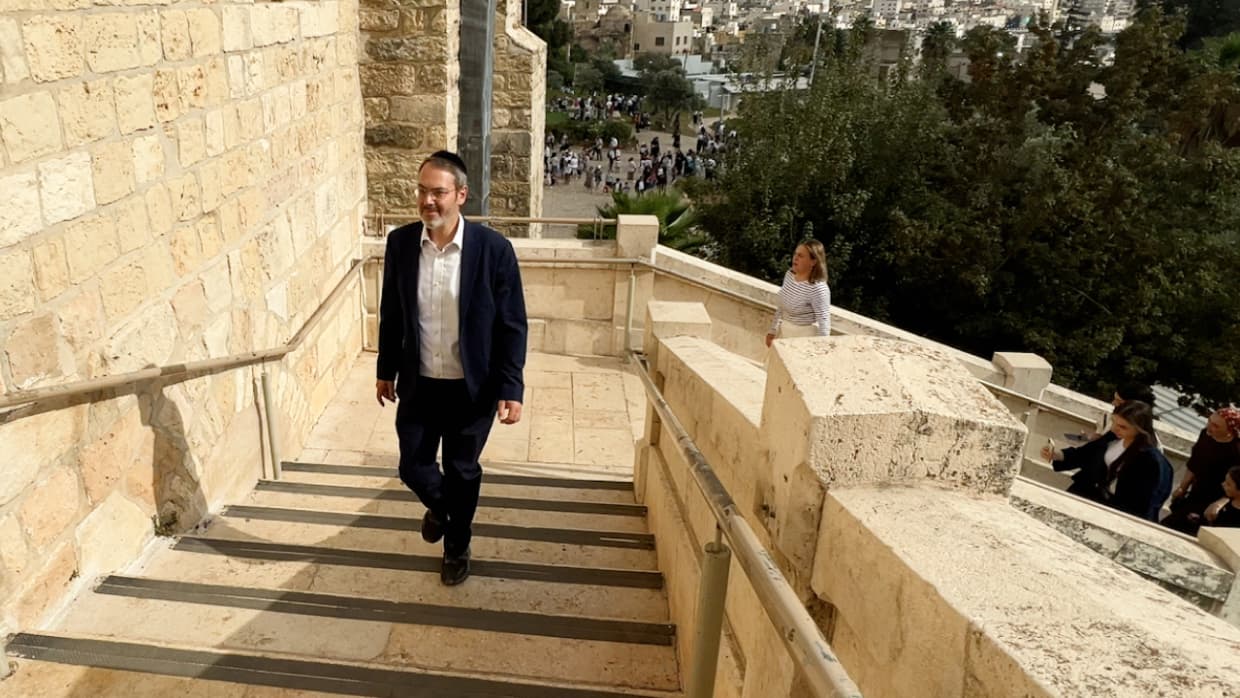
I’m standing at that gate right now, in Hebron. In front of me is an ancient staircase leading up to the entrance of the city, a gateway that goes back to well before Abraham’s time. This is very likely the spot where the Cave of Machpelah was negotiated and bought.
In this series, we take the weekly Torah portion read in synagogue and check it against the archaeology and the debates around it. This week is Genesis chapter 23, one of the most intriguing chapters in the Bible.
Sarah, Abraham’s wife, dies in Hebron, and Abraham needs somewhere to bury her. He owns no land, so he goes to the locals. After a long back-and-forth, he buys a field with a cave from a man named Ephron.
The Torah records the entire transaction: who sold it, who witnessed it, where the deal was done, exactly what was included (down to the trees), the price of 400 shekels of silver, and how the money changed hands. It was weighed, not counted. The whole thing runs 20 verses, from verse 1 to verse 20. It’s the only piece of land in the Torah that comes with full paperwork.
Believers, skeptics and commentators have all asked the same question: why so much detail? Why not just say Abraham bought a plot and buried his wife?
Skeptics have raised three challenges. First, some argued the deal bears the marks of a Babylonian land purchase from the sixth century BCE, which would mean the story was written much later. Babylonian contracts of that era were written as dialogue: the seller offers this, the buyer replies that. The skeptics claimed the conversation in Genesis 23 is meant to be the contract itself. A plain reading of the text shows that’s clearly wrong. The dialogue is not the contract. Still, it shows us which details mattered to the people involved.
Second, some argued that earlier land sales didn’t include these kinds of details.
Third, and most dramatically, skeptics claimed the story was impossible because the seller belonged to a people who never existed: the Hittites, supposedly invented by the Bible’s authors.
So we’ll look at the evidence for the Hittites, and whether this kind of negotiation fits the contracts people actually made in Abraham’s day.
First, one point even the critics don’t dispute: there was a Bronze Age town of Hebron in Abraham’s time.
The Book of Numbers (13:22) makes a very specific claim about Hebron: it was built seven years before Zoan in Egypt. Zoan was a city in the Nile Delta that served as Egypt’s capital in the 17th century BCE. So the Torah itself dates Hebron’s founding to roughly that period.
When archaeologists dug at Tel Rumeida, the site of ancient Hebron, in the 1960s, 1980s and 1990s, that’s what they found: a town from what they call the Middle Bronze Age, roughly 2000 to 1550 BCE, surrounded by a wall built of stones so massive that excavators called it “cyclopean,” as if giants had built it.
The Torah’s date and the archaeologists’ date agree.
Standing at that ancient wall, you’re looking at a structure from the era of the patriarchs. Abraham lived near this city. At its gates he negotiated for the field of Machpelah, where he buried his wife and where he himself was later buried.
Hebron is also where King David ruled for seven years after becoming king, before moving to Jerusalem for the rest of his reign. From the top of the hill, where David’s palace likely stood, you can see straight across to the Cave of Machpelah. It sits outside the old city walls, as you’d expect, since people didn’t bury their dead inside the city. Abraham would have stood at the gate negotiating for a field directly in view.
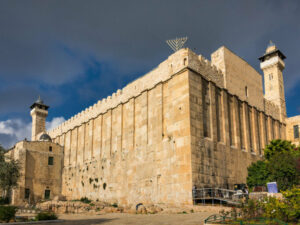
Today a massive structure stands over the cave, known as Herod’s Enclosure. Herod, the great builder of the late Second Temple period, built it with enormous stones much like those at the Western Wall. Just moving one of those stones took incredible manpower. Herod was relentless and had some of the finest engineers in the Roman Empire at his disposal.
That wall, built over the cave described in Genesis 23, has never fallen. That makes it one of the oldest buildings on earth still used for its original purpose.
Let’s start with the seller. The Torah says Ephron was a Hittite.
The Bible mentions the Hittites, the “sons of Heth,” about 50 times. One of them sells Abraham the field. King David has a soldier named Uriah the Hittite. King Solomon sells chariots to the kings of the Hittites. In the Book of Kings, an enemy army flees because it believes Israel has hired Hittite kings against them.
In the Bible, the Hittites are a major power with kings, armies and people scattered across the region. Yet until about 150 years ago, nobody had found a trace of them. The Greeks never mentioned them. Neither did the Romans. Archaeology had turned up nothing.
In 1853, an Oxford scholar named Francis Newman put into words what many believed: a people that powerful would have left some trace in other records. Since they hadn’t, they couldn’t have been that powerful, and probably never existed at all. The Bible had invented them, or at least inflated them. That was the mainstream, respectable view. The Hittites were the Bible’s phantom nation.
What happened next is remarkable.
Step one: Egypt. In the 1820s, a Frenchman named Champollion cracked Egyptian hieroglyphs. For the first time, scholars could read the inscriptions on temple walls. At Luxor, Pharaoh Ramses II had carved the story of a huge battle he fought around 1274 BCE at Kadesh, in Syria, against an empire called Kheta. It was the same word as the biblical Heth. So the Egyptians knew of a great northern empire, but nobody knew where it was, and nobody had found anything it left behind.
Step two: Turkey. In central Turkey there’s a village called Boğazköy, where farmers kept plowing up clay tablets covered in wedge-shaped writing. In 1906, a German named Hugo Winckler arrived. By all accounts he was a difficult man and not a particularly good excavator. But he dug into the citadel on the hill above the village and uncovered a royal archive of 10,000 clay tablets. It was the capital of an empire, a city called Hattusa. The empire called itself Hatti: the Great Hittites. Among those tablets, Winckler found something astonishing: a peace treaty, written in Babylonian, between the great king of Hatti and Ramses II of Egypt. It was the same treaty Ramses had carved at Luxor. There was an Egyptian copy and a Hittite copy of the same document, found 800 miles apart. That’s how we know Boğazköy was the Hittite capital. The phantom nation suddenly had its foreign ministry back. A few years later, a Czech scholar deciphered the Hittites’ own language, which turned out to be Indo-European, a distant cousin of English. Nobody saw that coming either. The Hittites were real. They ran an actual empire, and the people who mocked the Bible for inventing them were wrong.
That doesn’t automatically mean the man who sold Abraham his field belonged to the same people who fought Ramses. The Hittite capital is about 800 kilometers north of Hebron. And the names of the people Abraham deals with, Ephron son of Zohar, aren’t Hittite names. They’re local Semitic names. Elsewhere, the Bible seems to describe a group called Heth as Canaanites.
So were they connected to the great empire up north? We don’t know. As we’ll see in future episodes, the same name often gets applied to different peoples across the region, and Hatti is one of the best examples. It began as the name of the original people of central Turkey, then became the name of the whole empire, then of small kingdoms in Syria after the empire fell. Eventually, Assyrian documents used it for everyone from Turkey to the Egyptian border, Israelites included.
So a clan called Heth living in Hebron in the 17th century BCE fits the history perfectly. There definitely was a Hittite empire, and when the Bible describes Hittites, it’s referring to a real one. Plenty of smaller groups and clans seem to have carried a similar name, perhaps because they originated there or migrated south. Abraham dealing with a member of a family or clan called Heth is something we now know was entirely realistic in the ancient world.
Then there’s one small object. In 1986, in the Bronze Age layers at Hebron, excavators found a broken clay tablet written in cuneiform, the wedge-shaped script of Mesopotamia. It’s the only one ever found in Hebron, and its content seems pretty dull: a list of sheep and goats being delivered. But it mentions a king.
So in Abraham’s era, Hebron was a town with a king, with flocks, and with a scribe keeping accounts on clay in the international language of the day, just like scribes in Babylon. It was exactly the kind of town where a stranger with flocks could stand at the gate, make a deal in front of the elders, and have someone write it down.
To check the deal itself, we need to know what a contract looked like in Abraham’s world. And we do. The people of Mesopotamia, in modern-day Iraq, wrote their contracts on clay. Unlike paper, clay doesn’t rot, so tens of thousands of these tablets have survived.
At the Bible Lands Museum in Jerusalem, there’s a collection of ancient documents written in Akkadian, the common language of the time, dating to the 14th and 13th centuries BCE. Several are Hittite. They’re yet more evidence of how widespread, sophisticated and powerful Hittite culture was. These tablets turn up at digs all over the region, and they show an empire deeply governed by legal tradition in purchases, sales and nearly everything else.
One tablet is about 4,000 years old, from what archaeologists call the Old Babylonian period, the age of the famous King Hammurabi, around 1800 BCE. By traditional Torah dating, that’s right at the start of the era of the patriarchs.
Read it slowly, because every line matters. It describes the property: a field of a certain size. It gives the boundaries: next to so-and-so’s field on one side, the road on the other. It names the seller and the buyer. It states the price in shekels of silver. Then comes a phrase found on nearly every one of these documents: “He has weighed out its full price.” The transaction is complete, and “his heart is satisfied,” the legal formula meaning the seller has no complaints. Next comes a promise that the seller will never come back and claim the land. At the bottom: a list of five or ten witnesses, and the date.
Property, boundaries, parties, price, silver weighed, full price, transfer, witnesses. That was a deed in those days.
Now go back to Genesis 23, and the whole back-and-forth makes sense. These are exactly the elements anyone in Abraham’s time would have considered essential, especially people involved in international trade with roots going back to the Hittites.
Where does the deal happen? Verse 10: in the hearing of the children of Heth, “all who came in at the gate of his city.” In the ancient world, the gate was far more than a door in the wall. It was the marketplace and the courthouse rolled into one, where elders and judges sat and where legal documents were signed. If you needed witnesses, you did your business at the gate.
Who’s named? The seller: Ephron son of Zohar. The buyer: Abraham. The witnesses: the children of Heth.
What’s transferred? Verse 17: the field, the cave in it, and all the trees in the field, within all its surrounding borders. There’s the property and its boundaries, even the trees counted in, just like the tablets from that era.
What’s the price? Four hundred shekels of silver, “current with the merchant.” In verse 9, Abraham asks for the cave “for the full price.” That exact phrase appears on those tablets. In verse 16, he weighs out the silver, again just like the tablets. Verse 17 uses the legal verb: the field “was made over” to Abraham. That’s the transfer clause.
Property, boundaries, parties, price, silver weighed, full price, transfer, witnesses. Every element of the ancient deed appears in this chapter, in the same order a scribe would have written them.
One more detail: why is the silver weighed? Because there were no coins. Coins weren’t invented until around 600 BCE, more than a thousand years after Abraham. Before that, money meant lumps and rings of silver, and you paid by putting them on a scale. A shekel wasn’t a coin. It was a weight, about 11 grams.
Then there’s Ephron’s line: “A piece of land worth 400 shekels of silver, what is that between me and you?” It’s the oldest trick in the book: name a high price while pretending money doesn’t matter.
But Abraham doesn’t haggle. He’s a stranger in town, burying his wife. He doesn’t want an argument, and he doesn’t want anyone coming back later to dispute his claim. So he pays full price in front of everyone. Ephron may have politely gouged him at the gate, but the price is right, and so is the procedure.
Which brings us back to the cave.
Inside the building in Hebron today stand six large monuments, one each for Abraham and Sarah, Isaac and Rebecca, Jacob and Leah. They’re cenotaphs, empty markers. Nobody is buried in them. The graves are believed to lie in the cave below, and in the floor there’s a narrow shaft, covered by a grate, leading down into it.
No one has ever conducted an archaeological excavation beneath Herod’s building, and nobody is likely to anytime soon. But people have been down there.
In 1968, a year after Israel took Hebron in the Six-Day War, Defense Minister Moshe Dayan had a 12-year-old girl named Michal lowered by rope through that shaft with a camera, because no adult could fit. She came back with photographs of steps and a passageway.
In 1981, a small group went down at night and found a corridor, a chamber and broken pottery. They brought some of the pottery up and dated it to the First Temple period, roughly 2,700 years ago.
That’s all we know. There is a cave, and it’s double, matching the name Machpelah, which comes from the Hebrew word for “double.” That suggests it was used as a tomb long before Herod built over it. When Herod built, there was already an ancient tradition that Abraham, Sarah and the other ancestors were buried here.
What we can say is that the name never changed. The tradition runs unbroken through Judaism, Christianity and Islam. And the building, 2,000 years old, was deliberately placed on a site that locals already knew as the Cave of Abraham and Sarah.
So what do we know?
We know Hebron existed in Abraham’s time. We know it had a king and scribes who wrote in the international language and handled financial records. We know the Hittites were a vast civilization to the north, and Hittite families were spread farther south. It’s entirely plausible that a Hittite family in Hebron would want the kind of contract Hittites themselves used, and would have scribes who knew the international legal formulas.
Then there’s the negotiation itself. Contrary to the critics, this isn’t a contract written as “the seller says, the buyer says.” It’s a back-and-forth that sets up the legal terms that will go into the contract. That’s not how it was done in sixth-century Babylon. It’s exactly how it would have been done in the 18th century BCE, in Abraham’s time. All the details fit.
And the site of the cave has been known for thousands of years. To this day, it’s one of the most important places of prayer on earth.
But verification isn’t the point of the story. The Torah didn’t record this purchase in such detail so that someone, thousands of years later, could check it against archaeology. It carries something far more profound.
Abraham refused to accept a gift. Ephron offered him the land for nothing, and Abraham said no. He insisted on buying it and paying the full price, because he didn’t want this place to depend on anyone’s generosity. He wanted it to be entirely his: the place where he would rest forever, belonging to him, his children and his grandchildren, always.
Here’s something fascinating about land. When you buy an object, anything from a pen to a football, it belongs to you. When you buy land, the land doesn’t belong to you. You belong to the land.
Abraham wanted to belong to the land, and he wanted his children to belong to it too. So he turned down the gift and paid a price so high that no one could ever claim he underpaid. He bought the entire surrounding field too, so no one could ever say he held it only by their kindness. The whole area was his.
Abraham had been a shepherd all his life, always on the move. In death, he wanted permanence. His message was that he, his children and their children after them would always be here and always belong here. The land doesn’t belong to the Jewish people. The Jewish people belong to the land. And just as the land is permanent, so is God’s promise to Abraham here: that he and his descendants would shine a light to bring the world to perfection. “Through your seed,” God says, “all the families of the earth will be blessed.”
The burial place isn’t only for Abraham and Sarah. Their son Isaac lived his life here and is buried here with his wife, Rebecca. When Jacob lies dying in Egypt, he doesn’t just ask to be buried somewhere in Canaan. He gives the exact location: Bury me with my fathers in the cave in the field of Ephron the Hittite. There they buried Abraham and Sarah his wife. There they buried Isaac and Rebecca his wife. And there I buried Leah. His grandparents, his parents, his wife.
That was his message to the Israelites about to go down into slavery: I know you’re headed into a long, dark exile, and terrible things will happen. But know that we are here in this land, and you will come back to us. More importantly, if you keep us alive, you will never die.
Keep our values alive, he was saying. The values of Abraham and Sarah, of Isaac and Rebecca, of Jacob and Leah. Those values will never die. If you live by them, you will come back to them.
The Zohar, the classic work of Jewish mysticism, teaches that the cave is the entrance to the Garden of Eden, meaning those who lie there never die. Their souls live on through their descendants. When we return to this burial place, we touch a very deep part of who we are, the part that unites all of us: the dreams and visions of Israel’s ancestors.
We don’t belong only to a physical place. It’s not just that the Jewish people belong to the Land of Israel or to the city of Hebron. We belong to the ideas, the values and the dream of bringing God’s blessing to the world through Abraham’s children. That was the promise to Abraham, Isaac and Jacob: through your descendants, all the families of the earth will be blessed.
Later, when Moses sends spies into the land, Caleb knows they’ll lose their nerve and the people will be afraid to enter. The Torah says Caleb went to Hebron, alone, without the other spies. The Sages explain that he went to pray at the graves of his ancestors.
Whenever the Jewish people are lost, unsure, confused or living through dark times, we can always go back. Today we can visit the physical place. And every day, in our prayers, we return to our ancestors.
Because of that, Caleb received that land, and that’s why his descendant David began his reign over Israel from Hebron. David, the king who unified the people, becomes the ancestor of the Messiah. Hebron holds all of Jewish history, from our ancestors to our messianic future. One soul unites us all, one dream, one vision, and by living it, we keep our ancestors alive.
That’s why the Torah portion describing Sarah’s death is called Chayei Sarah, “the Life of Sarah.” At that moment, she went from being one individual to being the soul of millions of descendants, and the soul of the light that will one day illuminate the whole world.
Right after Abraham buries Sarah, he decides it’s time to find a wife for Isaac. He sends his servant Eliezer back to his homeland, on camels. Critics say there were no domesticated camels at that time, and they use those very camels to attack the Torah’s credibility. In the next episode, we’ll travel to Haran, where Eliezer went, to explore that claim.