




 Assimilation Disguised as Jewish Authenticity





I crossed into Jordan to find the river where Jacob wrestled an angel and got the name Israel. The Bible and archaeology point to one spot.
This is where Jacob was alone. This is where he met the man and wrestled with him until dawn, and where he was given the name Israel. This is where we were born.
Few words in the world carry as much weight as "Israel." Ancient Israel, modern Israel, religious, political: the name means struggle, tension and conflict, and at the same time it holds humanity's highest dreams and hopes. The biblical story of where the name comes from contains both. There's a battle in the dark of night, and then a triumphant dawn that vindicates the good in humankind.
That story, near the end of Genesis chapter 32, takes us to a river crossing in what is now Jordan. So I want to ask a simple question. Does this place really exist? Can we still find it on a map? And what does archaeology tell us about it?
Jacob, Yaakov in Hebrew, has been away for 20 years, working for his uncle Lavan in Charan. He left home single. He's coming back with wives, children and wealth. And he's about to face his brother Esav, who last time they met wanted to kill him. Esav is now heading toward him with 400 men.
That night, Jacob brings his family across a shallow ford in a river called the Jabbok, Yabbok in Hebrew. Then the Torah says something strange: Vayivater Yaakov levado, "Jacob was left alone." A man, some kind of being, wrestled with him until daybreak.
The Hebrew here is worth noticing. The river's name, Yabbok, the word for wrestling, vaye'avek, and Jacob's own name, Yaakov, all echo each other. The name of the place is woven into the story itself.
The being can't overpower Jacob, so it wrenches his hip and asks to be released before dawn. Jacob refuses: "I won't let you go until you bless me." The being answers, "Your name will no longer be Jacob, but Israel, because you have struggled with the divine and with people, and you have prevailed."
Jacob names the place Peniel, "the face of God," saying, "I have seen God face to face, and my life was spared." The sun rises as he passes the place, now called Penuel, and he walks away limping.
Then he meets Esav. Instead of a battle, Esav runs to him, hugs him, falls on his neck and kisses him, and the two brothers weep. And Jacob tells him something remarkable: "Seeing your face is like seeing the face of God." This is part of why the ancient rabbis taught that the being Jacob wrestled was an angel representing Esav himself.
Setting that aside for now, is this anything more than a nice story? It turns out that the Bible, read across several books, together with modern archaeology, actually helps us locate the place. It also sparks a debate among archaeologists.
Today the Jabbok is called the Zarqa River. At one bend, two hills face each other across the water. Together they're known as Tulul adh-Dhahab, "the hills of gold." Both rise about 120 meters above the riverbed. The larger western hill sits slightly north and west; the smaller eastern hill sits slightly south.
Nearly everyone agrees this is the place. The argument is over which hill is which.
Some, like archaeologist Joel Kramer of Expedition Bible, identify the western hill as Penuel. Others, like Israeli archaeologist Israel Finkelstein, say the western hill is Mahanaim and the eastern hill is Penuel. Yehuda Holtzman, on the channel Historical Sites in Israel, follows Finkelstein's view.
So why do these two names keep appearing together? Are Mahanaim and Penuel the same place, or two hills at the same river crossing? I went there myself to find out.
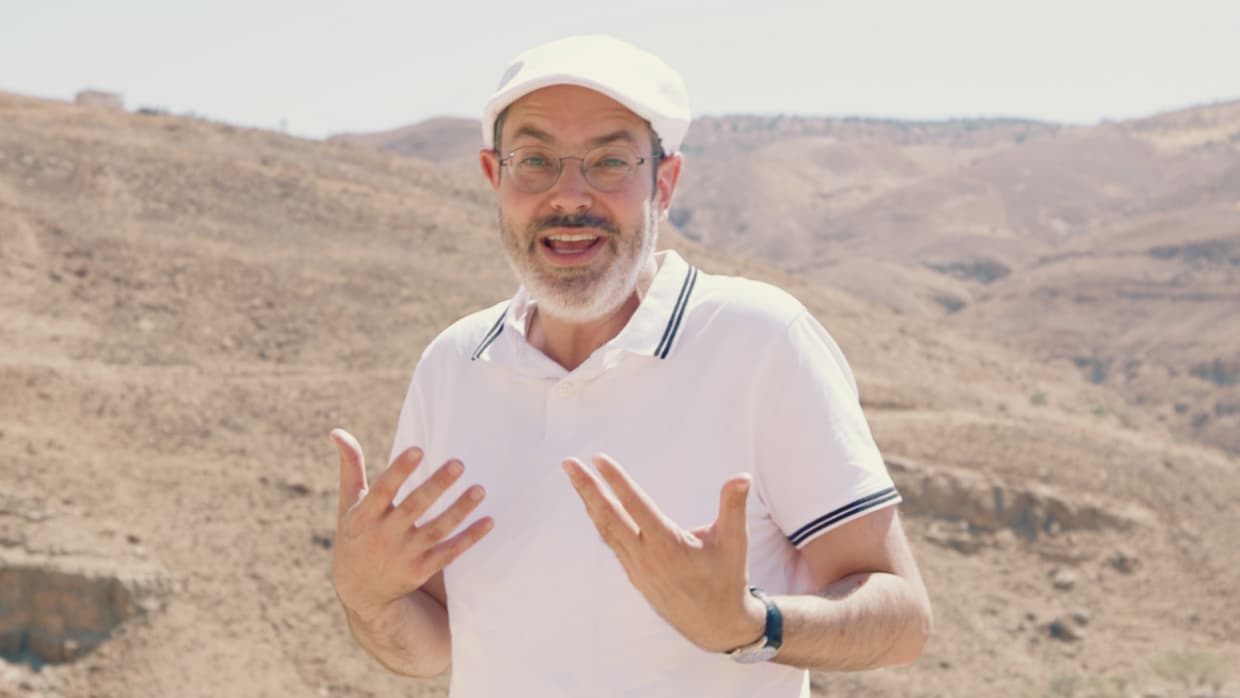
We crossed into Jordan at the Sheikh Hussein border crossing. From there, we were essentially driving on the ancient highway that once linked Shechem in the west, Sukkot in the middle, and Mahanaim and Penuel, where we were headed.
Standing on the hill above the Jabbok is incredible. You can see the river flowing down into the valley and curving around the big hill known as Penuel. We were standing on the opposite hill. The two are twin peaks, and whoever held them controlled the valley route below, which means they controlled the trade route. This was a very important place.
The books of the Bible give us two names for this spot. In Genesis, a single night produces both.
When Jacob arrives, angels of God meet him. He says, "This is God's camp," and calls the place Mahanaim, which means "two camps." The next morning, after wrestling one of these beings, he names the place Penuel, "the face of God." Evening, Mahanaim; morning, Penuel. Not much time passes between the two names.
In between, Jacob splits his own people into shnei machanot, "two camps," reasoning that if Esav attacks one camp, the other can escape. It sounds like a play on the name Mahanaim. It's as if he saw the two camps of angels and took them as a cue to create two camps of his own. He hasn't gone anywhere. He's still in the world of Mahanaim when he wrestles the angel and calls the place Penuel.
The classic commentators debate exactly how he divided his camp, since by the time he meets Esav everyone seems to be together again. But on the simplest reading, he split his people at the start of the night and reunited them before facing his brother.
Once you see the two hills with a river between them, the geography makes perfect sense.
In the ancient world, Esav could have come by different routes. This spot is a crossroads. A north-south road comes up from the south, and an east-west road runs across toward Shechem. At first, Jacob wouldn't have known which way Esav was coming.
Picture Jacob putting half his camp on one hill and half on the other. The bend in the river shields one hill from anyone coming up the south-north route, and the other hill from anyone coming along the east-west route. Whichever road Esav took, he could reach only one of the two hills. It's the ideal setup for keeping at least one camp safe.
There's also a biblical tradition that the two camps of angels represent the area outside the land of Israel and the area inside it, and this spot later becomes a marker on the borders of biblical Israel. For all these reasons, it's the perfect place for two camps. Seeing it with your own eyes, you understand why.
Joshua. The next mention comes in the book of Joshua, where Mahanaim marks the boundary between the tribes of Gad and Menashe (Joshua 13:26, 30). A river makes a natural border. Mahanaim also appears as one of the cities given to the Levites, the priestly tribe (Joshua 21).
Judges. The book of Judges, Shoftim in Hebrew, never mentions Mahanaim, but it does mention Penuel. Gideon is chasing the kings of Midian across the Jordan. At Sukkot, the locals refuse to give his men bread. At Penuel, they refuse too. When he comes back victorious, he tears down the tower of Penuel (Judges 8:8-9, 17). So we find a Penuel with some kind of fortification, and no Mahanaim.
Sukkot. Driving along, we passed Tell Deir Alla, which the Jerusalem Talmud calls Tar'ala, almost the same word. In the Bible it's Sukkot. It appears in two stories. Right after Jacob wrestles the angel and becomes Israel, he settles in Sukkot, builds a house, and makes sukkot, shelters, for his animals, which is how the place got its name. There's another Sukkot in the Bible, too, so the name seems to have meant a kind of transit point, a campsite where people might stay for months or even more than a year.
In ancient times, this road was exactly where a defeated army would flee and where the victors would chase it. Just like Gideon did.
Samuel. After King Saul dies, the tribe of Judah accepts David as king in Hebron. Much of the rest of Israel follows Saul's son Ish-boshet, who sets up his kingdom in Mahanaim (2 Samuel 2:8-9). When Ish-boshet's forces are defeated, his general Avner comes to David to make peace, and David demands the return of his wife Michal, who had been taken from him. Later, when David's own son Absalom rebels, David flees here, and the great battle that wins back his kingdom happens in this area too.
If you're following along: in the Torah, Mahanaim and Penuel seem to be the same place, or very close together. Joshua mentions only Mahanaim. Judges mentions only Penuel. Samuel mentions only Mahanaim.
Then the plot thickens. In the book of Kings, after King Solomon dies and the kingdom splits in two, Jeroboam, Yeravam in Hebrew, takes the northern kingdom. He builds up Shechem and then fortifies Penuel (1 Kings 12:25). Again Penuel, no Mahanaim. You start to think they might be two different places.
The southern kingdom of Judah generally followed the prophets and teachers. The northern kingdom often didn't, with more golden calves and worse. Jeroboam was its first king, and part of the massive wall still visible at the base of the hill was probably his work.
Then we get an outside witness. Around 925 BCE, just a few years after Jeroboam fortified Penuel, the Egyptian pharaoh Shishak (Shoshenq I) invaded the region. On the walls of the temple at Karnak in Egypt, he listed the places he conquered. Both Mahanaim and Penuel are on the list, apparently right next to each other. So by Shishak's time, at least, there were two names for two places, right across the river from each other or very close by.
Some archaeologists, like Israel Finkelstein, who generally doubt the Bible's historical accuracy, argue that the Jacob story was written much later, in the 8th century BCE, during the later kings. On their reading, Shishak makes it clear: the big western hill was the main town, Mahanaim, and the eastern hill had a small religious site. Locals then invented a folk tale linking both places to Jacob.
In 2024, Finkelstein published carved stone blocks from the western hill showing lions and a banquet scene. He dates them to the first half of the 8th century BCE and suggests they came from a palace or grand gate of Jeroboam's northern kingdom. He proposes that the eastern hill may have been a temple compound.
So in his view, there was a large city called Mahanaim on the west and a religious site on the east, and the biblical writers projected back a story about Jacob naming the place Penuel after some religious experience.
The big problem with this theory is Gideon. If a later writer were simply looking around at the Mahanaim of his own day, he would have had Gideon destroy the wall of Mahanaim. Instead, Gideon tears down a walled place called Penuel. The best explanation is that in Gideon's time, there really was a fortified place called Penuel, and no Mahanaim.
Since 2005, a German team from the Technical University of Dortmund, led by Professor Thomas Pola, has been excavating the western hill. People lived there for a long time, going back at least to the Late Bronze Age, with the settlement expanding in the early Iron Age. Radiocarbon dates run from 1300 to 970 BCE, the period of the Judges, and there's evidence of an early wall from that time.
The eastern hill is much smaller and has never been properly excavated. What's visible on top is one large building that looks more like a fort or temple than a town.
Lining the hills up with the Bible, then: in Gideon's day, the place with a tower worth tearing down was the western hill, so the western hill must have been called Penuel then. By Shishak's day, Finkelstein may be right that the western hill was the large town of Mahanaim and Penuel was its smaller neighbor. That's why archaeologists disagree.
Here's my own understanding. What most likely happened is what archaeologists call a name shift: over time, names can move from one hill to the other.
Start with the biblical story. Jacob sees two camps of angels and names the place Mahanaim, the two hills of the two camps. He very plausibly divides his own camp between the two hills. Then he meets the angel, but on neither hill. He meets it at the ford, the ma'avar Yabbok, "the crossing of the Jabbok," which is exactly what the verse says. That crossing is still there. Modern roads often follow ancient routes and cross rivers at the same old points, and the road here still uses it. So Jacob wrestles the angel down in the valley and names it Penuel. Mahanaim for the hills; Penuel for the valley.
A river crossing like this one wouldn't have been a random spot to wade across. It would have been a natural crossing point. As we drove closer, I watched to see whether the road crossed near the midpoint between the two hills, which would suggest this could be the very spot where Jacob crossed.
Even as we filmed, a herd of sheep passed by, grazing along the riverbank. It's fertile land with a natural water source. This is how people traveled in the ancient world: along the river, so both they and their flocks always had water to drink and grass to eat. These became the natural routes.
Those names would have stayed in the Israelites' memory for generations. In Joshua's time, there were most likely two camps. Archaeologically, there isn't much to see, since many settlements then were tent camps rather than stone towns. There's a little on the western side. But Joshua would have had people living on both hills. It was a Levite city and a boundary between Gad and Menashe. When he refers to Mahanaim, he means both hills.
By Gideon's time, a few centuries later, the archaeology shows the western side heavily built up and fortified, with a tower and a wall. The twin hills are still called Mahanaim. So what do they call the fortress? They have another name connected to this spot: Penuel. The hills remain Mahanaim, but when Gideon tears down the tower and wall, he's destroying Penuel, the fortress within the twin-peaked area of Mahanaim.
Later, under Ish-boshet and King David, the name Mahanaim returns for the whole site, since a king would want to control both sides of the river. That's where Ish-boshet sets up his kingdom, and where David later flees during his son's rebellion. By then it seems plausible that both hills were occupied, and the archaeology fits this model.
After the kingdom splits and Jeroboam fortifies Penuel, there may be towns on both sides of the river. He strengthens one, called Penuel, and the other is called Mahanaim. The two names have now settled, one on each hill, because there's now a settlement on each.
Finkelstein may well be right that by this point the western hill, the larger of the two, is called Mahanaim and the building on the eastern hill is Penuel. We can't know for sure until archaeology turns up something with a name on it. When Shishak arrives, he finds two neighboring settlements, Mahanaim and Penuel. The archaeology and the biblical model line up precisely.
So on which hill did Jacob become Israel? Which one was Penuel?
Neither. The hills took the name Penuel later. In Jacob's time, the two hills together were Mahanaim, the camps, and Penuel was the low crossing between them, the valley where Jacob named the river ford. I could hardly believe I got to stand there.
We were at a low point at the foot of one hill, where the slope of the other, the Penuel hill, runs down to flat ground. The Jabbok was right behind me. Almost certainly, the ancient crossing was right there.
This is where Jacob came, alone, after bringing his family across. This is where he met the ish, the man, the being, the angel. This is where he wrestled until dawn, and where the angel blessed him: "Your name will no longer be Jacob. You will be called Israel." This is where we were born.
So what light does all this shed on Jacob's story?
The commentators disagree on how exactly he split his household. Some say the family was mostly on one side and the flocks on the other; others say the family itself was divided. Either way, Jacob's family really did split in two over the course of history. Leah's sons and Rachel's sons were often rivals. Leah's sons sold Joseph, Rachel's son, into slavery. Later the kingdom itself divided: the southern kingdom led by Judah, one of Leah's sons, and the northern kingdom by Joseph's descendants.
It's almost symbolic. The family is split across two hills, and Jacob is down in the valley between them, holding it all together, wrestling with a being, struggling in a sense with the idea of brotherhood itself. His own brother wants to kill him. Can he find enough strength and inner peace to unite his family, and the different sides of himself, so he can face that threat? According to rabbinic tradition, the angel was Esav's own angel (Bereishit Rabbah 77, the ancient midrash on Genesis, cited by the commentator Rashi on Genesis 32:25).
In the morning, after the angel blesses him, Jacob brings his family together and goes out to face Esav. Esav may have come to kill him, but something in Esav changes. He softens, becomes his brother again, and embraces him. That's a metaphor for the whole history of the Jewish people. Jacob receives the name Israel right there.
As long as Jacob stays true to himself and builds a family and nation that's united, the whole family can come together. That's what he's struggling for in the valley. When we're divided, the nations around us see the worst in us. When we see the divine in one another, and understand that embracing God means embracing each other, we become whole. And when we're whole, the nations that once wanted to destroy or condemn us find that the night has passed and dawn has come. Suddenly they want to join us and stand with us.
Jacob says it perfectly when he finally meets his brother: "Seeing your face is like seeing the face of God." Penuel, the face of God, found in the face of a brother. To embrace God, I have to see you. On one level, it means the angel I wrestled in the night was you, Esav. But the harmony I found within myself created harmony between us.
Jacob's struggle is the story of how we become Israel: by seeing the divine in one another, and from there, by uniting with all of humanity. That's the insight you get standing in that valley and imagining what it took to bring together the two halves of a family on the two hills of the Jabbok. Because of this, Jacob became Israel. He embraced the people who could have been his enemies, made them his allies, and went back into the land of Israel.
May we see the same in our day: may we see the divine in one another, first within the Jewish people and ultimately in all of humankind, and may the whole world come together with Israel, to the land of Israel and to the holy Temple in Jerusalem, as the prophets promised.
The Torah says that as Jacob left that place, "the sun shone for him." May that light shine through Israel to all of humanity, and may Jacob's struggle be vindicated in our time, as we see the good and the divine in one another and light up the world.