



 Muslim Heroes of the Holocaust


6 min read
9 min read




After losing their only son, a Boston couple adopted two struggling Ukrainian orphans. What followed was an extraordinary journey of patience and love.
The boy sat alone in a corner. At 15, he did math at roughly a first-grade level. He rarely spoke, avoided eye contact, and almost never smiled. When someone told a joke, a twinkle might flash in his eyes before he turned away.
Boris and Irina Guralnik looked at him and saw their son.
Years earlier, the Boston couple had buried their only child, Igor. It was a loss no parent should ever have to endure, the kind that can close a heart for good. Instead, they opened their home to two orphaned brothers from Ukraine, both facing serious developmental and emotional challenges.
The teenager, who happened to share his future adoptive father’s name, was Boris. His younger brother, Pasha, faced similar struggles, along with muscle weakness and poor coordination.
The Guralniks knew that raising these boys would take extraordinary patience and commitment. They also understood something about the human spirit: a broken heart still has an incredible capacity to love.
Boris Guralnik was born in 1954 in Chukotka, in the far northeast of the Soviet Union, to a Jewish father from Ukraine and a non-Jewish Russian mother. Irina was born in Moscow in 1963. They met at Moscow Engineering University, married in 1988, and welcomed their son, Igor, that same year.
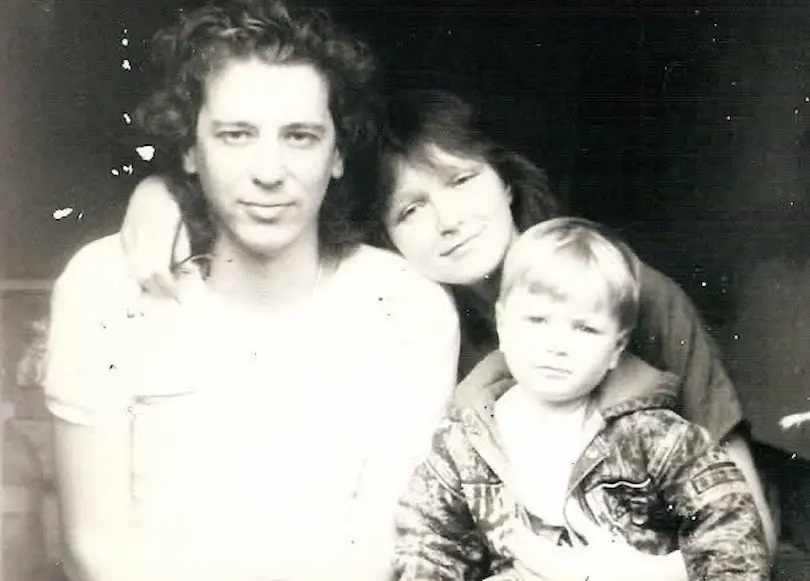 The Guralniks with their son Igor in the Soviet Union
In 1997, the family moved to Boston. Igor got involved with Shaloh House, a Chabad center serving the city’s Russian-speaking Jewish community. Friendly and outgoing, he earned the nickname “Sunny.” He loved sports and music and dreamed of becoming an architect.
In 2006, Igor was killed in a car accident while riding with a friend. Both young men died.
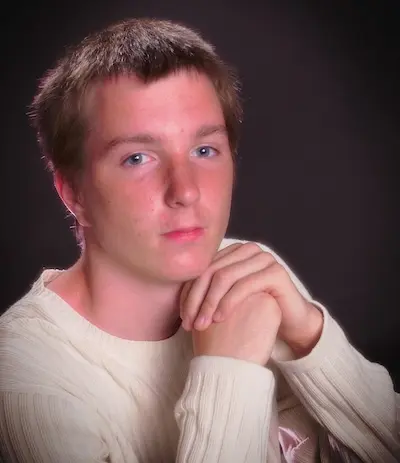 Their son Igor
“My wife and I went to support groups for parents who had lost children,” Boris recalls. “The first year was unbearable. But I needed something else. I wanted to talk about God and about faith.”
That search led them toward Jewish observance. Boris studied at Shaloh House under Rabbi Zan Rodkin and his wife, Sara, and eventually completed his conversion according to Jewish law. Irina completed her conversion in 2020, taking the Jewish name Chana Reena. That same day, Boris and Irina were married under a chuppah, the Jewish wedding canopy.
“We felt we had so much love to give, and we knew Igor would want us to give it,” Boris says. “I felt instinctively that our family wasn’t complete, and that we could make a home for children who needed one.”
Through a program that brings Ukrainian orphans to visit American families, the couple met 15-year-old Boris from the Mykolaiv region.
During his monthlong stay, his struggles became clear. He liked being near people but often sat alone in a corner. He seldom made eye contact and almost never smiled.
When they tried introducing him to kids his own age, he became so anxious that it sometimes showed up physically. He was more comfortable with younger children. Years in the orphanage system had made trust and affection especially hard for him.
The Guralniks saw a boy who needed security, encouragement, and love. By the end of the visit, they wanted to adopt him.
Then they learned he had a younger brother, Pasha, living in a different orphanage. The two boys didn’t even know about each other.
Adopting a teenager with significant needs was already a huge commitment. Taking on a second child would make everything harder. But Boris and Irina couldn’t bear to leave Pasha behind.
They adopted both brothers.
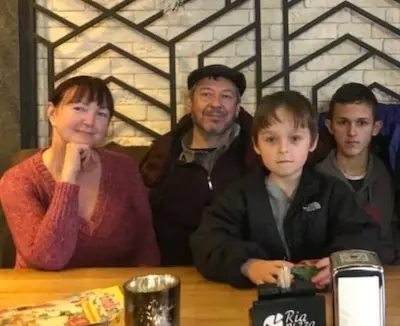 In Ukraine before returning to the United States as a family
After working through international regulations and Covid delays, they brought the boys home to Boston in January 2022. Boris was 16. Pasha was 7. One month later, Russia invaded Ukraine.
“This was meant to be. It was a gift from our son Igor,” Boris says. “I feel he was guiding us and watching over the boys.”
The adoption was only the beginning.
Young Boris needed specialized education. Math and writing were especially difficult, and English came slowly.
Pasha had more to overcome. Little physical activity in the orphanage had left him with muscle atrophy and poor coordination. He often fell on the stairs.
Both boys get physical, occupational, and speech therapy, plus reading support. Pasha started in public school and later moved to a Jewish day school, while still receiving special education services through a nearby public school. His parents worked through Massachusetts requirements to coordinate the two.
The Guralniks signed the boys up for swimming, using the water to help them heal physically and emotionally. They encouraged biking, skiing, and skating to build balance and coordination. Pasha tried martial arts.
The hardest part, though, was helping the boys form emotional bonds.
The family took countless day trips, played games, ate meals together, and tried new things. Slowly, the boys began to trust and open up. Kids who once flinched at physical affection learned to welcome hugs and cuddles.
For their parents, those small moments were huge milestones.
Sara Rodkin, the rabbi’s wife, describes their devotion: “Looking at the boys today, it’s hard to imagine these two children came out of the orphanage system. They are unconditionally loved and have traveled the world with their parents. Every imaginable after-school activity is offered to them. They are encouraged in every way, loved, and cherished.”
Boris, now 19, has graduated from high school and works as a counselor at a Jewish summer camp.
“I like working with kids and helping them,” he says proudly.
For someone who once struggled to connect with anyone, that’s real progress. He continues in a special education program to build more skills.
Pasha has made remarkable strides too. He loves Shaloh House and has developed a strong interest in Judaism. He asked for a brit milah, the ritual circumcision, and took the Hebrew name Pesach, meaning Passover. He loves synagogue, Jewish traditions, sports, and chess.
“I really like coming to Shaloh House,” he says.
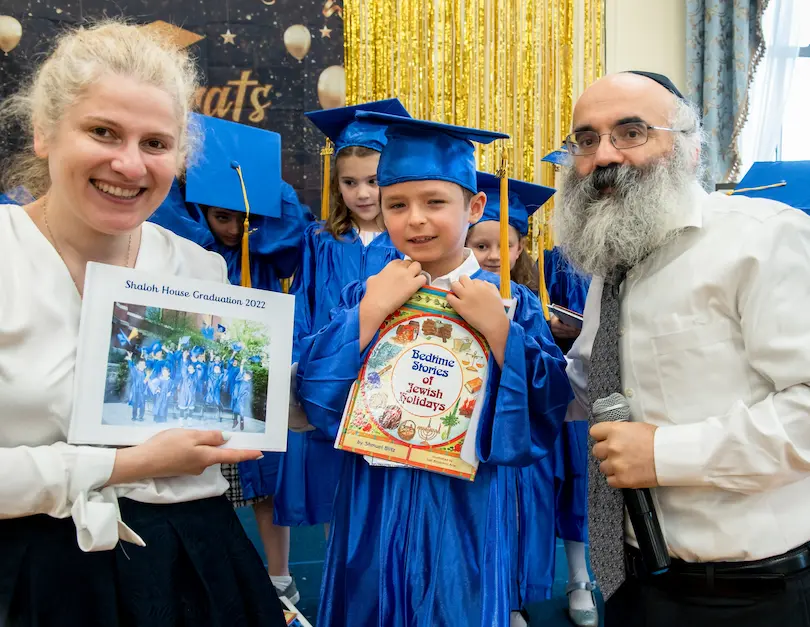 Pasha with his teacher and Rabbi Rodkin at the Shaloh House.
The Guralniks often host guests for Shabbat, the Jewish Sabbath, and for holidays.
Both boys love hearing stories about Igor, whose memory is still very much part of the family.
The boys brought joy and purpose back into the Guralnik home.
“We’ve been privileged to watch this inspiring couple turn darkness into light,” Rabbi Rodkin says.
Boris hopes their story will encourage others. “I strongly believe that someone who has lost a child still has a lot of love to give. If having biological children is no longer possible, consider adoption or foster care.”
The Guralniks chose a hard road. Their days are filled with therapy appointments, lessons, tutoring, family meals, outings, and the quiet patience it takes to help each son reach his own potential.
For Boris, the greatest reward is watching his son’s transformation. The boy who once sat silently in a corner, unable to look anyone in the eye or smile, now talks proudly about helping other children.
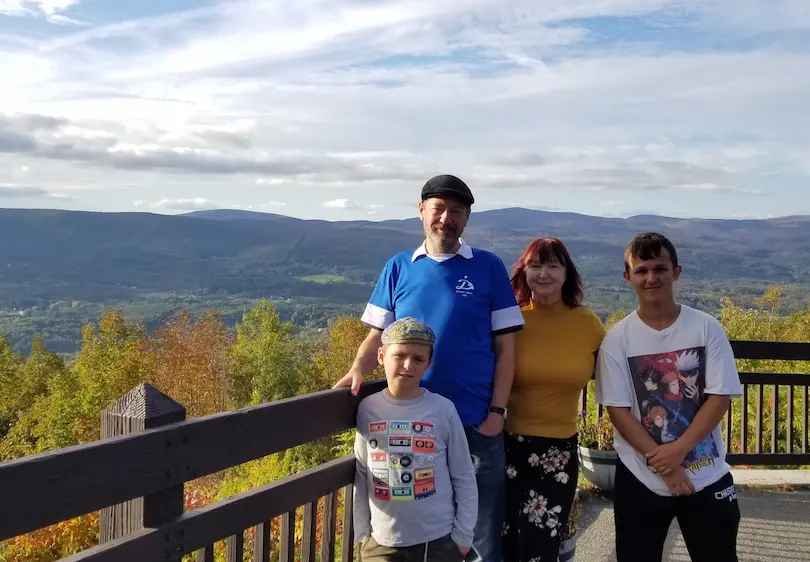 The happy family of four
Jewish tradition teaches that a little light can push away a great deal of darkness. Sometimes that light comes from people who have known darkness themselves and choose to bring kindness to others.
Boris and Irina are giants of inner strength and unconditional love. In honor of their son Igor, they drew on a seemingly endless well of love and opened their hearts and home to give two boys the family they so desperately needed.
May Igor’s memory forever be a blessing, and may the Guralnik family continue to be blessed with strength, joy, and love.