



 When Did Thin Become the Measure of a Woman’s Worth?

8 min read
7 min read
< 1 min read
< 1 min read




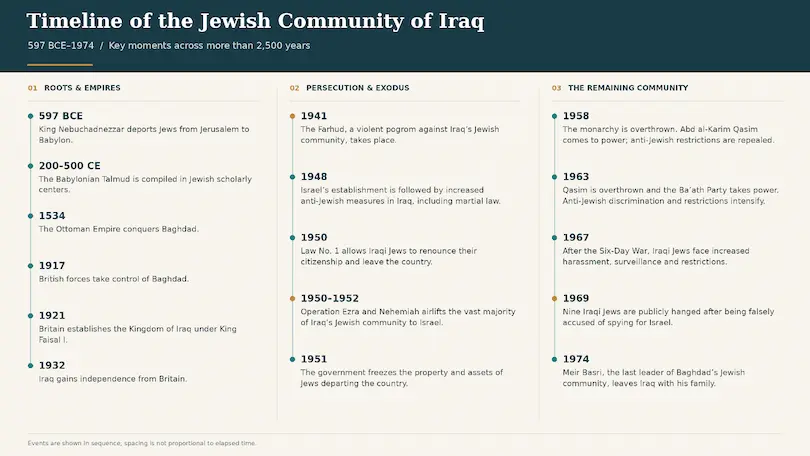
For 2,500 years, Jews thrived in Iraq, the birthplace of the Babylonian Talmud. A new documentary traces how this ancient community vanished in a single generation.
It’s no wonder “The Long Journey Home: The Untold Story of Iraq’s Jews” opens with a question. “Where are your Jews?” asked Hillel Neuer, executive director of UN Watch, in a 2017 speech to the United Nations that went viral.
“How many Jews live in your countries?” he asked the delegates. “How many Jews lived in Egypt, Iraq, Jordan, Kuwait, Lebanon, Libya, Morocco? Once upon a time, the Middle East was full of Jews. Algeria had 140,000 Jews. Algeria, where are your Jews? Egypt used to have 75,000 Jews. Where are your Jews? Syria had tens of thousands of Jews. Where are your Jews? Iraq had over 135,000 Jews. Where are your Jews?”
By the middle of the 20th century, about 800,000 Jews lived in Arab countries like Algeria, Syria and Egypt. Today, only about 5,000 remain in the entire Middle East. So what happened?
Filmmaker David Kahtan, the son of an Iraqi Jew, set out to understand how his father’s community vanished. “One of the most striking revelations in my research was just how deeply rooted Jewish life was in Iraq, spanning more than 2,500 years, and how rapidly this ancient community was uprooted,” he told Aish.com.
The result, after more than 20 years of research, is “The Long Journey Home,” which Kahtan directed and produced. The film chronicles the history, culture, devastating hardships and extraordinary tenacity of Iraqi Jews.
It tells the story of a vibrant community that thrived in Mesopotamia for more than two millennia, until politics, persecution and exile nearly wiped it out. Iraq’s Jewish community, the oldest diaspora community in the world, traces its roots to the Babylonian exile. It numbered 180,000 at its peak in the 1940s and had all but disappeared by the 2000s.
That’s why Kahtan has been working tirelessly to record the testimonies of survivors before they pass away.
“I felt that the plight of Iraq’s Jews, and the broader story of Jewish refugees from the Middle East, had been overlooked for too long,” Kahtan said. “Their stories deserved to be heard and remembered.”
The film features many experts who share insights into Iraqi Jewish history, including English historian Sir Martin Gilbert; Esther Meir-Glitzenstein, professor of history at Ben-Gurion University in Israel; Israeli author Eli Amir; Meir Basri, president of the Jewish community in Baghdad in the early 1970s; and Kahtan’s father.
“The Jews were brought to Iraq in 597 BC to Babylon, as it was known then,” the elder Kahtan noted. “They were brought in as slaves from Jerusalem by Nebuchadnezzar…. In Babylon, the most magnificent cultural works of the Jewish people were created. The Babylonian Talmud, the Geonic literature and the Responsa.” (The Talmud is the central text of Jewish law and debate; the Geonim were the heads of Babylon’s great Torah academies; and the Responsa are rabbis’ written answers to questions of Jewish law.)
Added Amir: “Huge libraries with questions on religion were sent to the rabbis of Iraq, which was the spiritual center of world Jewry. If a Jew in England or India had a question, he sent it to Baghdad and got an answer.”
Some of Judaism’s holiest shrines are in Iraq, Kahtan said.
“The prophet Ezekiel is buried in Al-Kifl. Ezra the Scribe is buried in Al-Uzayr. The prophet Jonah’s tomb can be found in Mosul. The tomb of the prophet Daniel is in Kirkuk, and Joshua, the high priest, is in Baghdad.”
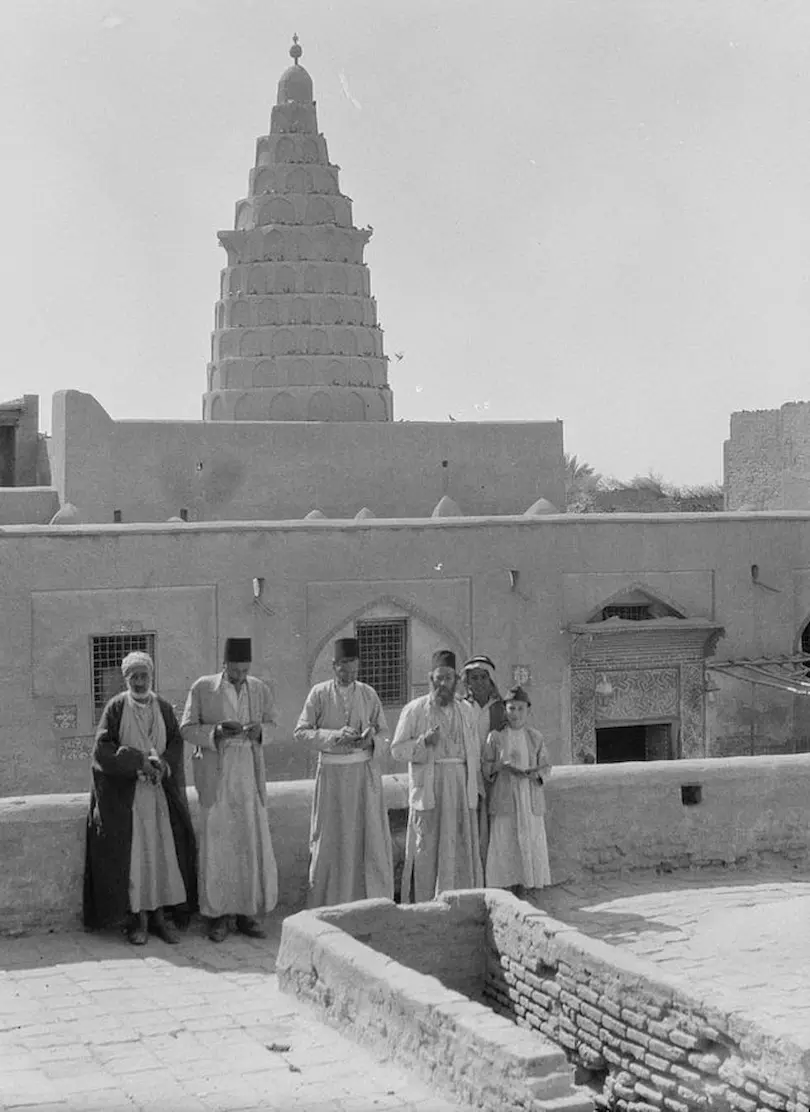 The Prophet Ezekiel’s Tomb al-Kifl, Iraq, build between the 12-14th centuries
(image source: Wikipedia)
Centuries later, with the Islamic conquests of the 7th century, Muslim Arabs arrived in Iraq. They did not accept foreigners and wanted to convert the Iraqi Jews to Islam.
For more than 1,000 years, Jews lived under dhimmi laws, which treated non-Muslims as inferior, and the Shia majority considered their Jewish neighbors unclean, Kahtan said.
“You couldn’t ride a horse if a Muslim was walking, because it would be as if you are sitting above him,” said Amir. “You pay a head tax, they called it jizya; it meant that if you went along with the laws of Islam, that you were a second-class citizen.”
Under Ottoman rule, which began in 1534, the treatment of Jews ranged from tolerance to persecution. Eventually the community began to prosper, but harsh measures in the 18th and 19th centuries drove many Jews to leave, especially for India.
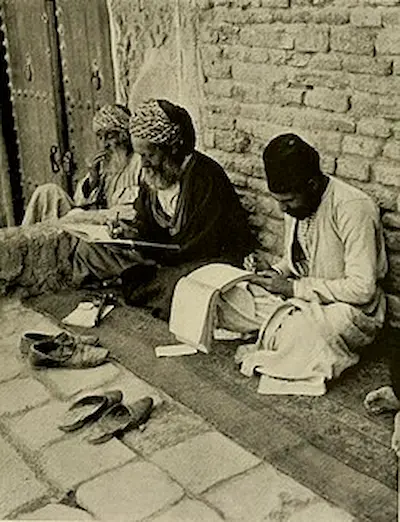 Jewish scribes at Ezekiel's Tomb, 1914
Meir-Glitzenstein described these “Baghdadi Jews” as Iraqi Jews who immigrated to India and became part of British international trade.
“But they maintained ties with the community in Baghdad. It was clear that for any child who wanted to integrate into this commercial system, they had to be able to read and write.”
In the 19th century, Baghdad’s Jews nearly outnumbered its Sunni Muslims and exceeded the Christian, Turkish and Persian communities combined, said Kahtan.
“The urban Jewish middle class was relatively prosperous, having generated wealth from trading and banking. The Alliance Israélite School for Boys was founded in Baghdad in 1864, followed by the Girls School in 1893, which offered the best education in the country. Some of the well-to-do Muslim families used to send their children to the Jewish school, so that they could get a good education.”
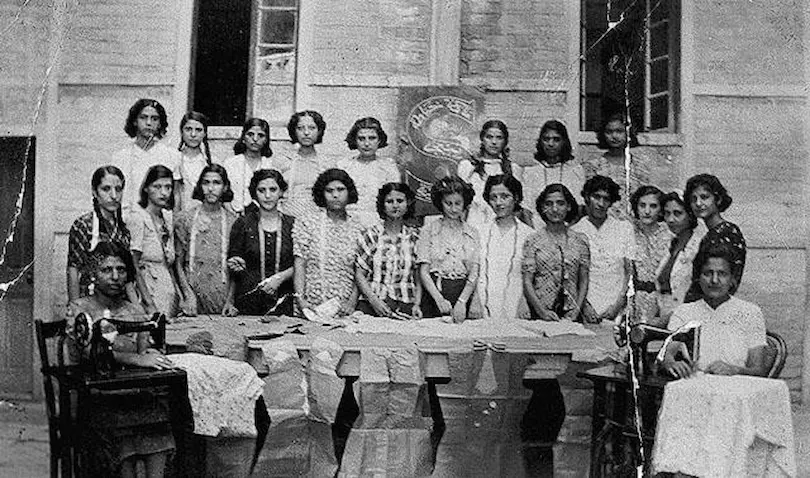 Girls learning to sew in the workshop at the Alliance School in Basra, Iraq, 1939
When World War I broke out in 1914, Britain and France declared war on the Ottoman Empire and sent troops across the Middle East and Mesopotamia.
“One cannot ignore that the discovery of oil was a growing factor in the Allies’ interest in the region,” said Kahtan.
“Following two years of fierce fighting, the British needed assistance to defeat the Turks. The Arab Sharif Hussein, governor of Hijaz, located in modern-day Saudi Arabia, agreed to assist Britain in return for their support to create a single independent Arab state in the region.”
He continued: “The Arab Revolt, assisted by British gold and arms, together with the support of Colonel T.E. Lawrence, whose character was depicted in David Lean’s classic film ‘Lawrence of Arabia,’ helped the British defeat the Turks and capture Baghdad in March 1917. But the secret Sykes-Picot Agreement between Britain and France one year before reneged on the British promise to Hussein by dividing the Middle East into British and French spheres of influence.”
France would control the new states of Lebanon and Syria, while Britain would control Iraq and Palestine, both through a mandate system.
Meir-Glitzenstein pointed out that the whole region was carved up in an office, with rulers, pencils and straight lines drawn on maps. “But of course, they didn’t meet the geopolitical needs. The Middle East is still paying the price for these sins to this day.”
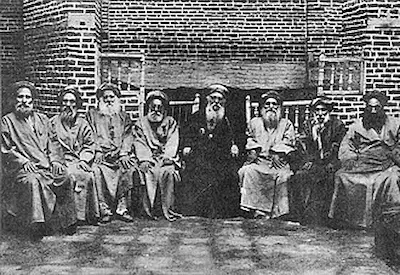 Rabbis of Iraq at the beginning of the twentieth century
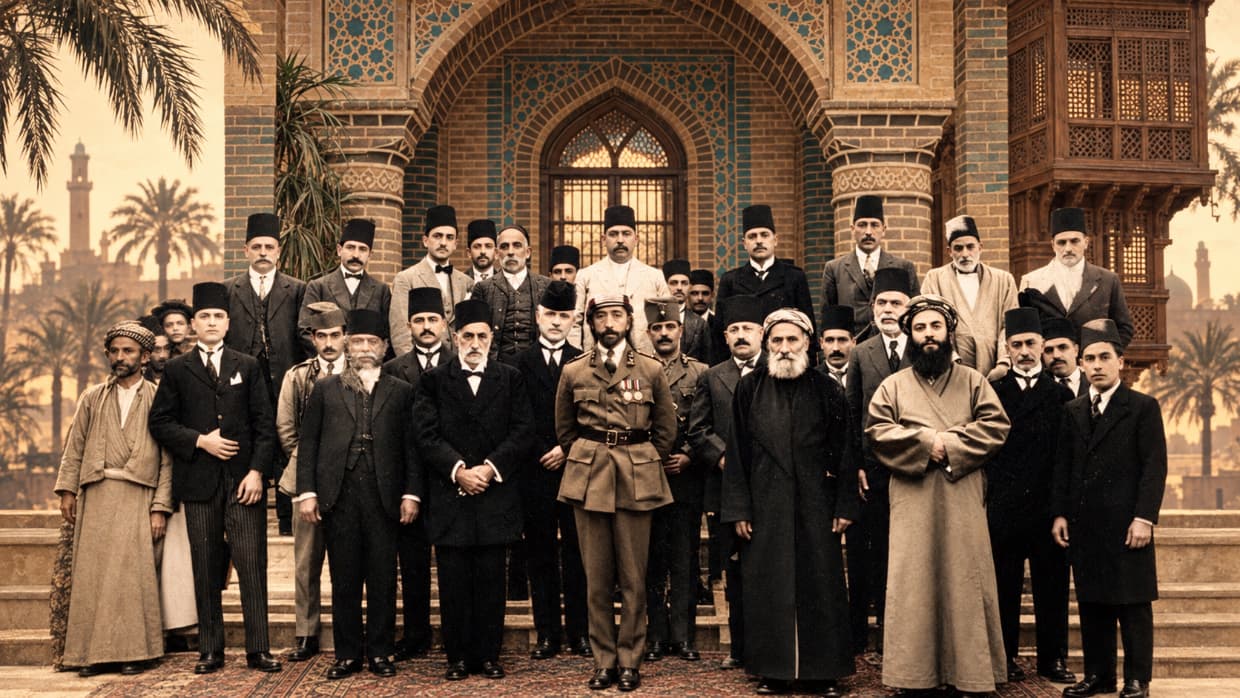
In 1921, the British installed Hussein’s son, Emir Faisal, as King of Iraq. The Jewish community held a banquet in his honor, where he told them: “I thank my Jewish citizens, who are the mainspring of the life of the people of Iraq. I beg the citizens of this country not to make any distinction between Jew, Christian, and Mohammedan. We call ourselves citizens of Iraq.”
Jews entered public life and government, largely in service of the British. The community played a major role in building and running modern Iraq and in the country’s political and economic development.
“There were many strategic ministries where the Jews made up 60 percent of the administration,” said Meir-Glitzenstein. “In the 1920s, Jews loved Iraq. They identified with Iraq. They saw themselves as Iraqis, no less loyal than anyone else. They were Iraqi patriots. The 1920s were the golden age of the Jewish community.”
But the rising tide of Arab nationalism swept that golden age away, and a dark chapter began, Kahtan said.
The number of Jews in Arab countries dropped sharply in the mid-20th century because of political conflict, persecution, discrimination and violence, Kahtan said. “As conditions became increasingly hostile, many Jewish communities were forced to flee their homes and countries, leading to the dramatic decline in their populations.”
With footage of Hitler’s speeches, the documentary turns to the Nazi era, exploring the rise of antisemitism, the Holocaust and “the far-reaching impact of World War II on the Middle East.” During a period of political instability in Iraq, the Farhud (Arabic for “violent dispossession”) erupted: a devastating two-day pogrom against Iraq’s Jews in 1941, on Shavuot, the holiday celebrating the giving of the Torah.
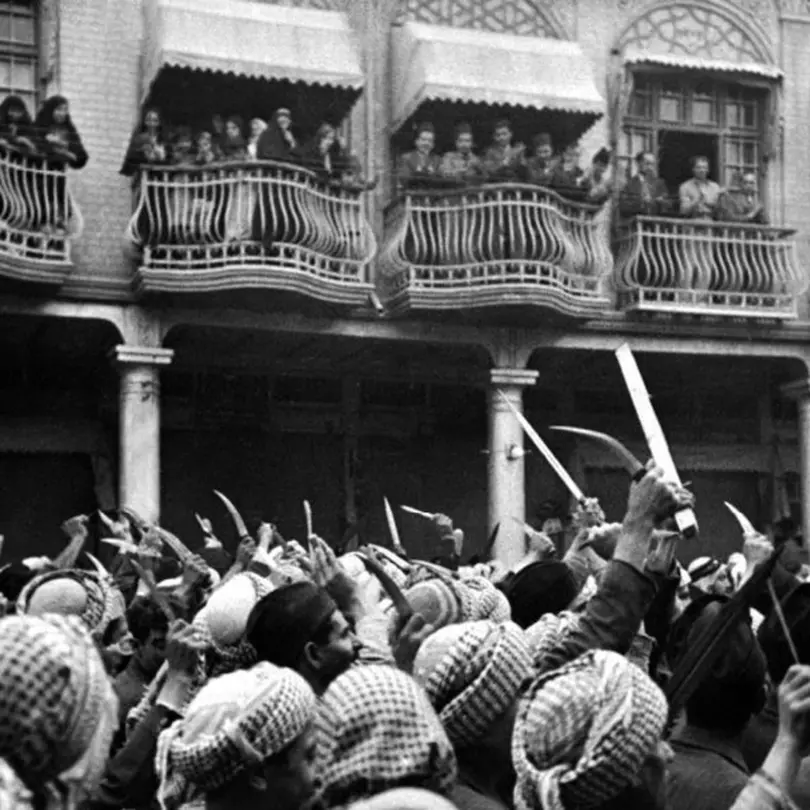 The Farhud, during the Jewish holiday of Shavuot, June 1st-2nd, 1941 (image source: Pictures Archive of Yad Ben Zvi & Beit Hatfutsot)
“The Farhud of 1941 was a pivotal turning point, shattering the sense of security many Iraqi Jews had known, while the mass exodus a decade later marked the end of an extraordinary chapter in Jewish history…. Hundreds were raped, maimed, and murdered, while homes, businesses, and synagogues were looted and destroyed,” said Kahtan.
Earlier this year, Kahtan led the creation of a memorial ceremony marking the anniversary of the Farhud at the President’s Residence in Jerusalem.
“These atrocities, compounded by ongoing persecution and accusations of treason as Zionists, ultimately forced the majority of Iraqi Jews to flee to Israel during Operation ‘Ezra and Nehemiah’ in the early 1950s, leaving behind their homes, possessions and centuries of heritage.
“Operation Ezra and Nehemiah was one of the largest airlifts of its time, transporting approximately 105,000 Iraqi Jews and a further 20,000 from Kurdistan to Israel between 1950 and 1952.”
The film then follows Iraqi Jews as they arrived in the young State of Israel, tracing their struggle to integrate into Israeli society and rebuild their lives in a new homeland.
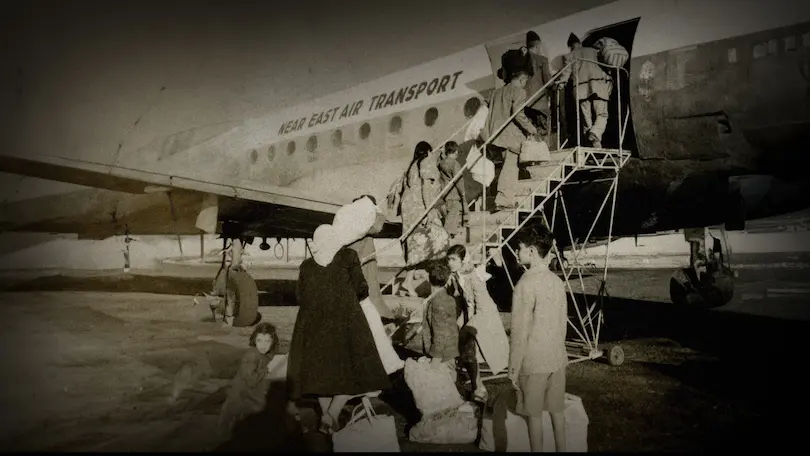 They are boarding planes in Iraq to go to Israel, in the 1950s. (ELAL Israel Airlines)
“At the same time, thousands of Jews remained in Iraq, navigating their complex lives amid the country’s frequent government coups and political instability,” said Kahtan.
The film’s final chapter covers the end of this once-thriving community, beginning with the rise of the Ba’ath Party in 1968 and the early years of Saddam Hussein’s rule.
“Over six years, dozens of Jews were kidnapped, imprisoned, tortured, and murdered, many under false accusations of spying for Israel,” said Kahtan. “Hundreds were smuggled out and escaped through perilous routes via Kurdistan and Iran, while the last remaining Jews managed to obtain visas to England in 1974, leaving Iraq behind for good. Scattered around the world, they rebuilt their lives from scratch. To this day, the vast Jewish assets seized have not been returned.”
As much as the film is about the past, it is also about the future of Iraq’s Jewish community.
“It is about memory, identity, and what it means to belong. It’s an educational and advocacy project, created to preserve this history, raise awareness of the experiences of Iraq’s Jews, and ensure that their story is understood by future generations. I hope viewers see the film not simply as a story of persecution and displacement, but of a rich culture, a deep connection to a homeland, and a people whose history, contributions, and memories deserve to be remembered and preserved.”
Kahtan is adamant that the world has largely overlooked the plight of Iraq’s Jews.
“Their history of persecution, displacement, and forced exile has not received the attention or recognition it deserves. That needs to change now, so their stories and experiences are remembered and included in the broader history of the region.”
For the Jews of Iraq and their descendants, the future lies in the places where they have built new lives, in Israel and in communities around the world, Kahtan said.
“What we can preserve is the heritage, culture, traditions, and memories of the Jewish community that once flourished in Iraq. That’s my mission: to make sure this history is not forgotten.”
“The Long Journey Home: The Untold Story of Iraq’s Jews” will be screened in November at the Santa Barbara Jewish Film Festival, the Santa Fe Jewish Film Festival and the UK Jewish Film Festival.