



 What Jensen Huang’s Downfall Teaches Us About Human Nature

6 min read
5 min read




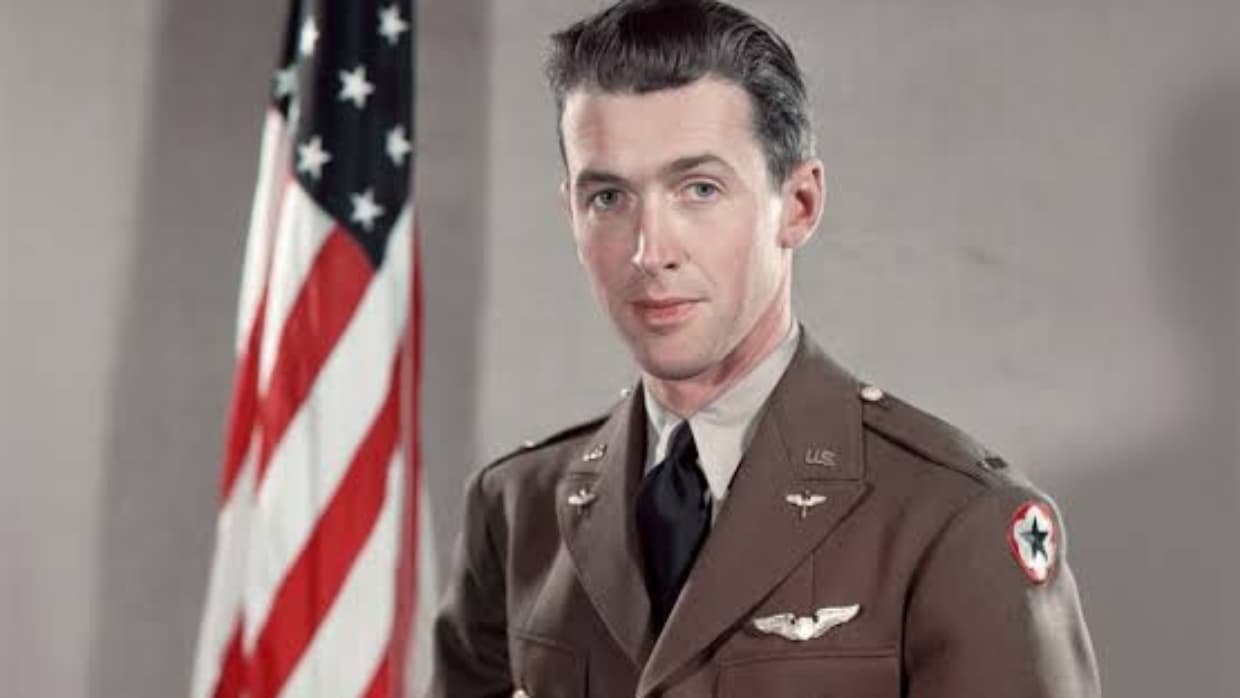
Fresh off an Oscar win, Jimmy Stewart could have taken a safe celebrity post in WWII. The new film, Jimmy, based on his hidden diary, shows why he chose combat instead.
In the new drama, Jimmy, a biography about the legendary actor, Jimmy Stewart, audiences get an intimate look at the man who left Hollywood to become the first major American movie star to enlist in the United States military during World War II, shortly after he won the Academy Award for Best Actor for The Philadelphia Story.
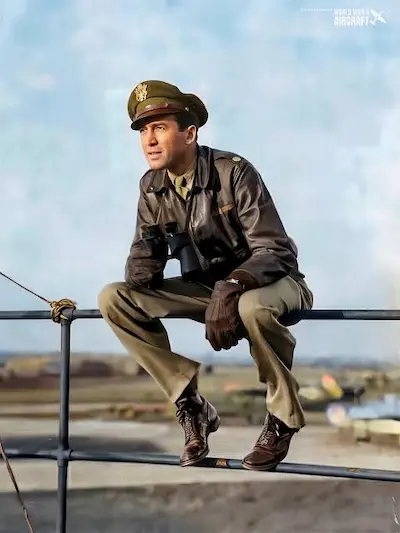
Refusing a safe, “honorary” position as a celebrity, Stewart was eager to fight the Nazis, and pushed to become a skilled military aviator, flying in 20 combat missions. He released hundreds of bombs over Germany and Nazi-occupied France, and rose to the rank of colonel by the end of the war.
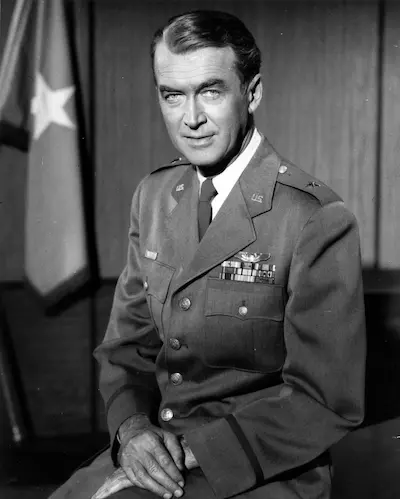 Brig. Gen. James M. Stewart
The film, starring KJ Apa, is based on a hidden diary Stewart kept. No one knew about it until his daughter, Kelly Stewart-Harcourt, an executive producer of the film, found it by chance.
In a pivotal scene, famed filmmaker Frank Capra, who would later direct Stewart in It’s a Wonderful Life, shows him extended footage of Hitler and Nazi soldiers. In real life, Capra supported the United States War Department in their propaganda efforts for WWII.
According to The Tenement Museum, “When Capra first saw Leni Rienfenstahl’s Nazi propaganda film, The Triumph of the Will at the Museum of Modern Art in 1942, he was horrified. The film was so powerful and so captured the myth of German Nazism that Capra remembers thinking, ‘We’re dead. We’re gone. We can’t win this war.’
“To fight back, Capra joined the War Department and in collaboration with several prominent directors, including John Huston and John Ford, began to direct and develop the war propaganda films. He quit his Hollywood job to commit solely to this project. The result was the arresting seven-part series, Why We Fight.”
 When asked in 1941 why Stewart wanted to leave his acting career to fly combat missions over Nazi Germany, he said, “This country’s conscience is bigger than all the studios in Hollywood put together, and the time will come when we’ll have to fight.”
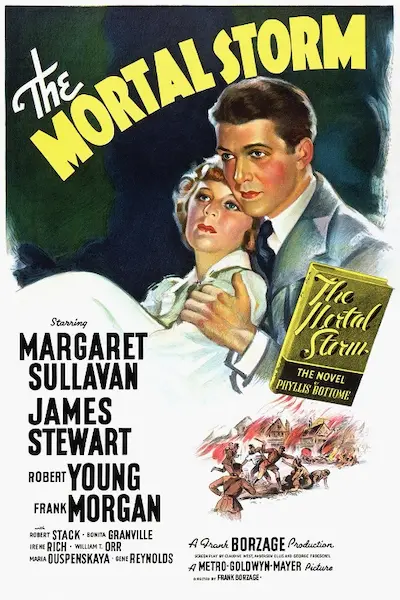
Prior to joining the military, Stewart starred in the very first blatantly anti-Nazi film, The Mortal Storm. The movie is based on the 1937 book by the British writer Phyllis Bottome, which focuses on Hitler's rise to power. Both Stewart’s nephew, David Perry, and Stewart’s daughter, Kelly, agree that the film had a major impact on him, which could have propelled his desire to fight Nazis.
“The Mortal Storm was the first Hollywood movie to show a concentration camp and inform the American public about the Holocaust,” said Perry, who has done extensive research into his uncle’s history.
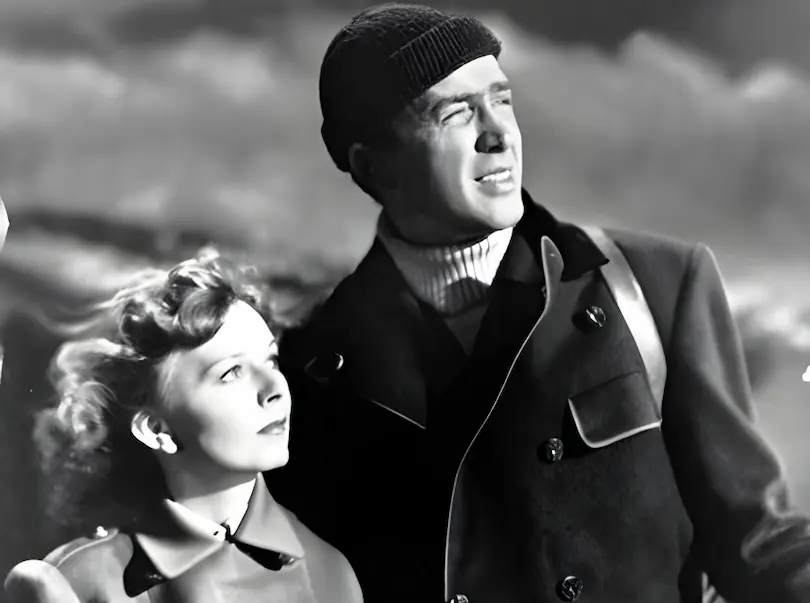 Jimmy Stewart and Margaret Sullavan in The Mortal Storm
Released just a year before the United States entered WWII, the film’s second unit director, Richard Rosson, had been interned for a month in an Austrian Nazi camp.
“Rosson escaped to the United States; the filmmakers built the concentration camp for the movie based on his recollections,” Perry said.
“My uncle and all the cast and crew were aware that ‘Mortal Storm’ would be highly controversial, but everyone felt strongly that it should come out.”
Jason Alexander plays the Jewish studio head, Louis Mayer in the film, Jimmy. In real life, movie studio executives like Mayer, who greenlit The Mortal Storm, were worried that explicitly anti-Nazi or pro-Jewish films would provoke antisemitic backlashes in the U.S. or ruin lucrative foreign box-office markets.
According to the book, Pieces of Time: The Life of James Stewart, written by Gary Fishgall, the words "Jew" and "Jewish" were not used, scrubbed from the film by Mayer. The book also noted that Stewart did not remember the making of The Mortal Storm with fondness.
Wrote Fishgall: "I'd read the papers, the horrifying headlines,” Stewart said shortly after the picture wrapped, “go on the set, and walk right into the headlines. Same thing. The emotional and nervous strain was terrific.’ Moreover, in February, March, and April of 1940, while the company was filming, Hitler was enjoying victory after victory on the battlefields of Europe. According to (his co-star) Robert Stack, the Nazis were fully aware of The Mortal Storm. When the war was won, a Swiss diplomat informed (producer) Victor Saville, everyone involved with the film and Confessions of a Nazi Spy, another unflattering picture, would be ‘taken care of.’ The atmosphere on the set was, to quote Stack, ‘tense.’”
Because of The Mortal Storm, Perry said there was a story going around that Hitler put a huge bounty on Stewart and Clark Gable, who also flew missions.
“My uncle was aware of what was happening in Europe and knew his first priority was to fight the atrocities that were happening there,” said Perry. “Members of the German Embassy arrived in Robert Stack's dressing room unannounced and tried to get him to quit the film. They told him something to the effect of ‘when we win the war, you'll be sorry.’ The cast and crew were not cowed.”
Added Jennifer Buckles, president-executive director at The Jimmy Stewart Museum: “The Mortal Storm had such a strong anti-Nazi stance that it was responsible for all MGM films being banned in Germany until the end of the war.”
Perry’s mom, Mary – Jimmy Stewart’s sister – was also anti-Nazi and influenced by the work of Käthe Kollwitz, an anti-Nazi German artist whose paintings were repressed under National Socialism.
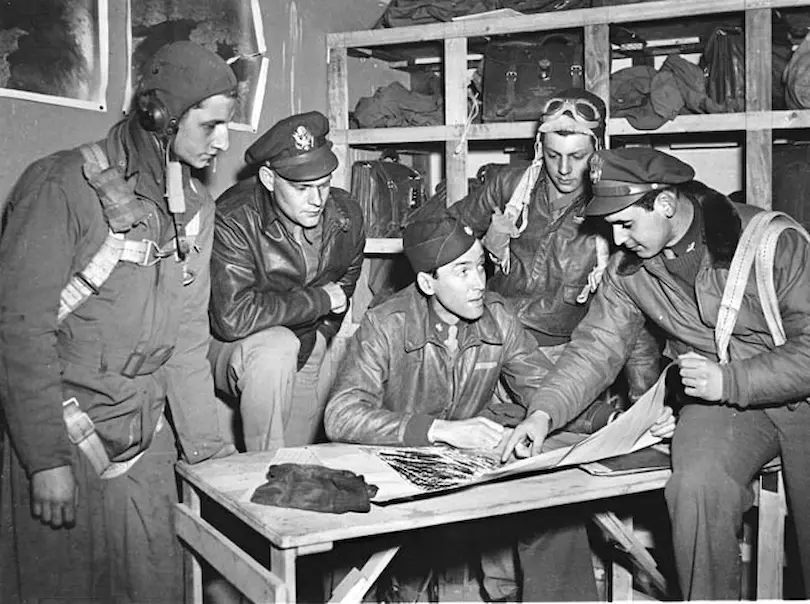 While serving as a squadron operations officer, Major Jimmy Stewart discusses a mission with pilots in the spring of 1944.
“Being a Stewart, my mother tried to get herself stationed in Europe to minister the wounded troops,” Perry noted. “She had training as a nurse's aide. After getting turned down for that role, she began a series of artworks she called War Orphans, depicting the horrors happening to the children in Europe.”
Mary Stewart also joined Artists for Victory, whose members created posters to raise awareness about Nazism and money for War Bonds.
“She was very proud to be part of that organization,” said Perry. “Her poster, Little Nazi won first prize in a juried show at The Metropolitan Museum of Art in New York, beating out other anti-Nazi posters by luminaries like Saul Steinberg, Charles Addams, Peter Arno, and others.”
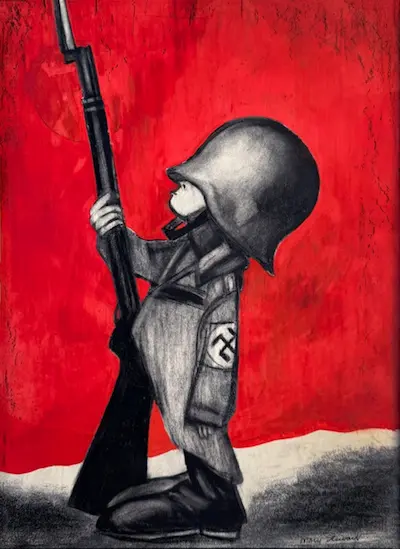 Mary Stewart’s poster Little Nazi
Perry is currently producing a film/art event that incorporates Jimmy Stewart’s military service and his mother's War Orphans art, along with a showing of The Mortal Storm. “We've had several successful events, including a sold-out show at the Sag Harbor Cinema. As Kelly has said, ‘Every American today should see ‘The Mortal Storm.’’”
Jimmy also touches on how Stewart’s intense, harrowing experiences fighting the Nazis left him with severe combat fatigue (PTSD), which heavily influenced his deeper, post-war acting performances—most notably in It's a Wonderful Life. That film has a beautiful Jewish message about the value of each human life.