




 Those Shameful Thoughts and What They Really Say about You

8 min read
10 min read




A mural in a small Polish town was meant to honor Irena Sendler. Without meaning to, it also tells a story about the children it leaves out.
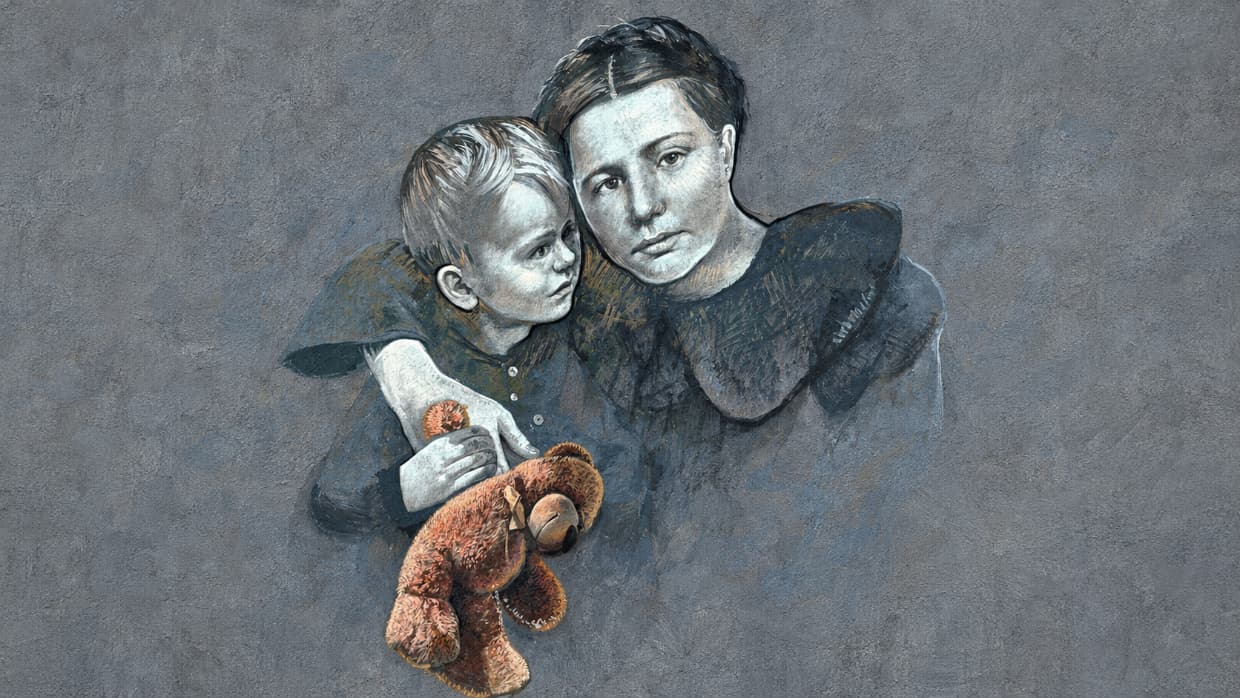
Step off the train at Świdnica Miasto, a station in a small town in Poland's Lower Silesia, turn right, and you can't miss her. A larger-than-life portrait of a Irena Sendler, painted in shades of gray, covers the side of the building at 3 Dworcowa Street, a name that simply means Station Street. She is holding a boy with light, almost white hair. She looks straight at the passersby; he looks up at her. A teddy bear dangles from his hand, the only thing in color on the entire wall.
At the bottom are her name, the dates “1910–2008,” and the logo of the Year of Irena Sendler. Nothing about the ghetto, nothing about who the child might be.
I stood there longer than I had planned. Something didn't fit. The boy looked as if he had stepped out of a First Communion photograph. I might have seen him playing outside anywhere in Poland. I started to wonder what the artist actually knew about the children Sendler saved.
Irena Sendler was a Catholic social worker in Warsaw. During the German occupation, she and her colleagues, later working with Żegota, the Polish underground’s Council to Aid Jews, smuggled some 2,500 Jewish children out of the Warsaw Ghetto and hid them with Polish families, in convents and in orphanages.
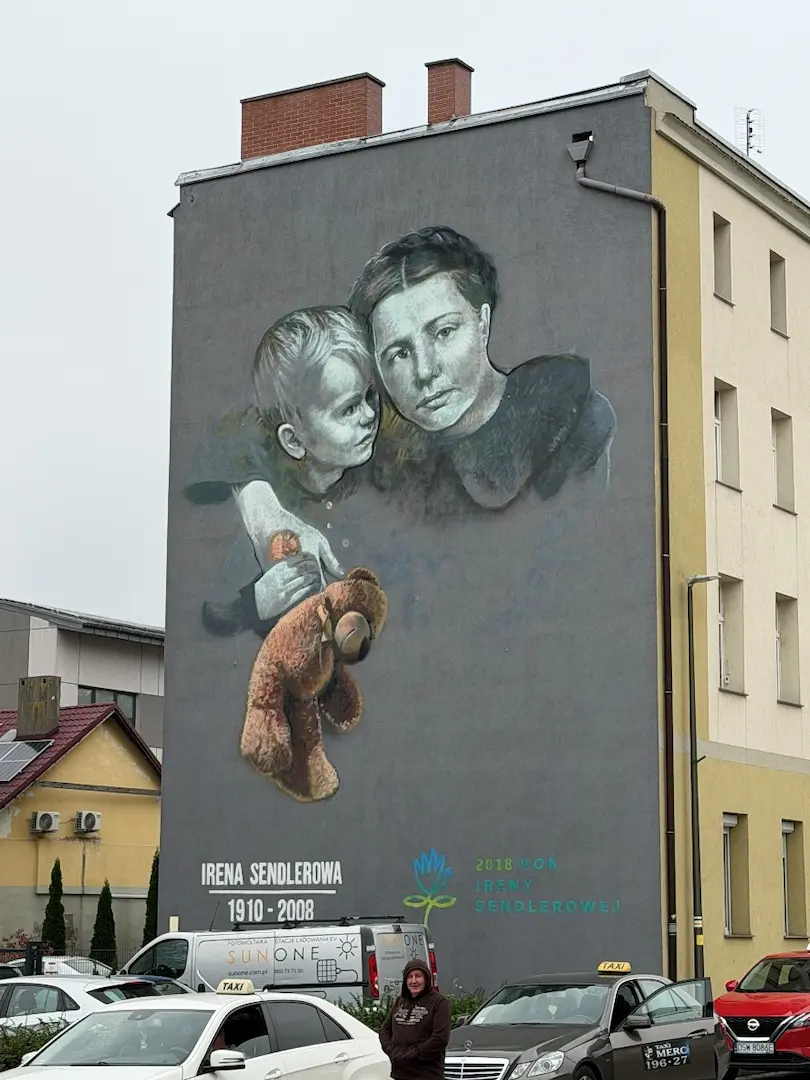
The mural was painted in May 2018 by Robert Kukla, a local painter behind most of the murals in town. His trademark is chubby baroque cherubs modeled on the putti in Świdnica's Church of Peace. He even painted a few of them on Heroes of the Ghetto Street.
Poland had declared 2018 the Year of Irena Sendler, marking ten years since her death. On June 11, 2018, her daughter, Janina Zgrzembska, unveiled the mural.
Kukla works from photographs, and this time his own family posed for him. The woman on the wall is his wife. The child is his son. The teddy bear was his son's too. Speaking to Radio Wrocław, the artist put it plainly: as a painter, he turned his wife's face into Irena Sendler's.
So the model for the blond angel on Station Street was not a child from the ghetto. He is a boy from Świdnica who posed for his dad in the 21st century.
And that, it seems to me, is an act of deep empathy. There is hardly a stronger way to feel someone else's tragedy than to imagine losing your own child. Kukla didn't paint a textbook heroine. He put his own wife and son on that wall, as if asking himself what it would mean to give up his own child.
For parents in the ghetto, this was not an exercise of the imagination. Sendler recalled that the hardest part of her work was persuading them to hand their children to a stranger. A mural that at first glance shows a rescue can also be read as a portrait of a parting.
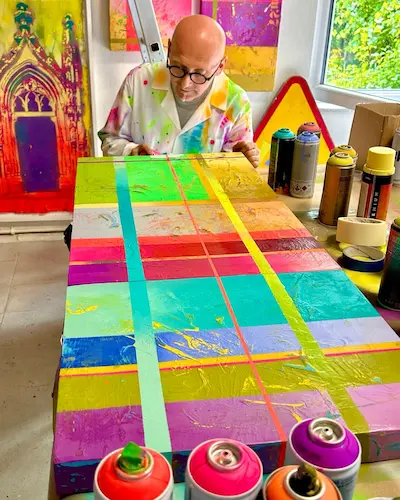 Robert Kukla
Not much in Świdnica reminds you that Jews once lived here.
Jewish life here dates back to the Middle Ages. Until 1945 the town was part of Germany and was known as Schweidnitz, and its Jews were German Jews. In 1877 they opened a Romanesque Revival synagogue with two towers, on what is now Independence Avenue. On the night of November 9–10, 1938, Kristallnacht, German Nazis from the SA and SS set it on fire. The ruins were cleared before the war even began. Today a block of apartments and shops stands on the site.
During the war, the Germans deported those Jews who had been unable to emigrate, sending them to camps and ghettos, some of them through Lower Silesian transit camps to Theresienstadt. The Nazi authorities used gravestones from the Jewish cemetery to pave the streets. The cemetery itself survives. It has a monument from 1963, but it commemorates the Warsaw Ghetto Uprising.
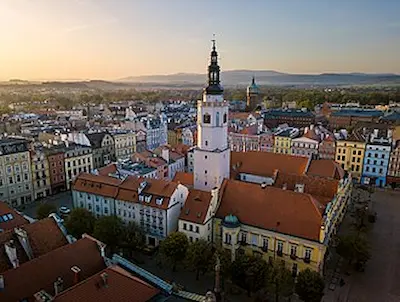 Town hall and market place of Świdnica (Photo by By Kateryna Baiduzha, Wikipedia)
After the war, Świdnica became part of Poland, and Holocaust survivors were resettled here, many of them Polish Jews returning from the Soviet Union, where they had survived the war. By 1946 about 2,400 Jews lived here. Most of them eventually moved on, and another wave left after 1968.
For anyone stepping off the train, the most visible reminder of the Holocaust today is the mural by the station. Like the monument in the cemetery and Heroes of the Ghetto Street, it tells a story from Warsaw, not from Świdnica. And the model for the child in it was a Polish boy.
The children whom Sendler and her couriers smuggled out of the Warsaw Ghetto could not afford to leave their appearance to chance.
On the so-called “Aryan side” of occupied Warsaw, how you looked decided whether you lived. People spoke of dobry wygląd, literally “a good appearance”: features that others were unlikely to identify as Jewish. A child who was to live openly as a Polish Catholic also had to speak fluent Polish and know Catholic prayers. Some of the children from the ghetto spoke only Yiddish.
Those who “looked wrong” often had to remain out of sight: in convent orphanages, in the countryside, behind closed doors. Małgorzata Mirska-Acher, who was led out of the ghetto, later wrote to Mother Matylda Getter that she had been terrified because she had a “bad face.” Her younger sister Irena was thought able to pass as non-Jewish. Same parents, same home. And yet it was Irena whom a neighbor recognized, and the little girl had to flee her hiding place. Both sisters survived with the Franciscan nuns in Płudy.
Michał Głowiński, one of “Sendler's children,” who grew up to become a renowned literary scholar, survived in a convent orphanage in Turkowice. Only decades later did he learn that the nuns there had hidden more than 30 Jewish children.
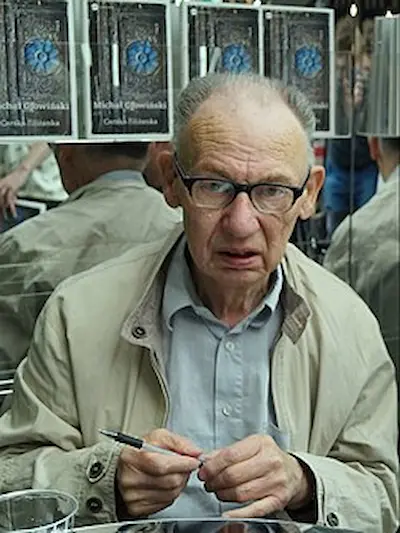 Michał Głowiński, one of “Sendler's children”
Fair hair did not make a child any less Jewish, and a “good appearance” guaranteed nothing; it only improved the odds. So the fair-haired boy on the mural is, paradoxically, a child who might have been able to “pass.” A child with a “bad face,” who spoke only Yiddish, could not be hidden in plain sight. And that child is missing from the wall.
The crowd is missing too. The mural shows one woman and one child. During the celebrations in Świdnica that day, Sendler's daughter reminded the audience that saving a single child could require the help of ten adults. Behind every embrace like this one stood a network of people, mostly women, whose names almost nobody knows.
These children received new names, new birth certificates, new mothers. For many, the disguise became their life. Of the roughly 2,500 children rescued, between 400 and 500 were never found, despite Sendler's years of searching. Some may not have survived. But some grew up, raised families and grew old without ever knowing they were born Jewish.
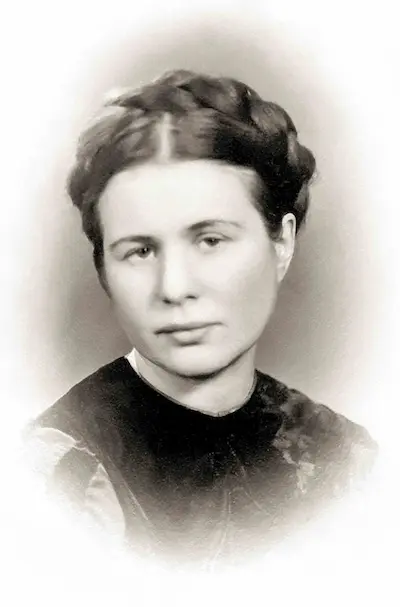 Irena Sendler
Some Polish Jews survived the war on forged baptismal certificates and kept the borrowed names afterward. Their grandchildren are only now noticing that something in the family story doesn't add up: a photograph in which no one can be named, a grandmother who would not say where she came from, a surname that stops somewhere. Many of them will never know for sure. Their grandparents covered their tracks as well as they had to, in order to survive.
The stories of Sendler's children belong here too. I sometimes wonder whether their grandchildren walk past the mural on Station Street today, not knowing they are looking at their own family's history.
That is why Sendler and her co-workers recorded the children's real names and where they were hidden. According to postwar accounts, some of the lists survived the war buried in jars under an apple tree in the garden of a courier, Jadwiga Piotrowska. When the Gestapo came for Sendler in October 1943, her colleague Janina Grabowska hid the lists under her clothes. Sendler was tortured and betrayed no one. Saving a child's life is one thing. Giving the child back their name is another.
Yad Vashem, which honored Sendler in 1965, takes its name from the Book of Isaiah (56:5). There God promises those who cannot have children “a memorial and a name” in His house and within His walls, yad vashem: better than sons and daughters, “an everlasting name that shall not be cut off.”
“Within His walls.” I think of those words when I look at the wall on Station Street, in a town that no longer has a synagogue. Kukla did the most important thing: he made us think, “this could have been my child.” But during the war, to the Germans and to too many neighbors, these children were not “ours.” They were Jewish, and that is exactly why they were marked for death. When we paint our own fair-haired children in their place, we risk completing the very disguise they were forced to wear. The mural lets us see our own child in that boy.
But I would like to see one real name added beside it: the name of a child who left the ghetto in a toolbox or a sack, and who spent the whole war pretending to be someone else.
This October marks 83 years since Irena Sendler's arrest. The next time I get off the train at Świdnica Miasto, I will see two children on that wall. The one who was painted. And the one who isn't there.