







 Why Hating Jews Feels So Good

7 min read
11 min read
5 min read





A way out of Nazi Germany came with a catch: work on the Sabbath. A rabbi approved, on one condition, sealed with a handshake my grandfather would never forget.
In a world that celebrates flexibility and going with the flow, it’s surprising how often the Torah describes the Jewish people as an am k’shei oref, a stiff-necked people. It hardly sounds like a compliment. Yet throughout Jewish history, that same stubborn determination is often what kept our people faithful to the Torah and its commandments, despite immense pressure to abandon them.
The life of my Opa (German for “grandpa”), Aharon (Arnold) Goldsmith, vividly demonstrates the power of that holy stubbornness.
Opa was born in Fulda, Germany, a city renowned for its Torah scholarship, distinguished rabbis, and deep-rooted commitment to Jewish life.
Yet hardship entered his life even before the Nazis came to power. His father died when he was still a young boy, leaving a widow and three children. As the oldest, Opa had to grow up fast. While his devoted mother struggled to hold the family together, he took on responsibilities far beyond his years, helping care for his younger brother and sister and becoming, in many ways, the man of the house.
Then came the darkness that engulfed European Jewry.
In November 1938, when Opa was 16, Kristallnacht, the “Night of Broken Glass,” shattered whatever sense of security Germany’s Jews had left. Across the country, Jewish men and boys were being rounded up and sent to concentration camps. In Fulda, the Nazis had a quota to fill. Opa was technically too young to be taken, but when a man designated for arrest fled, the Nazis simply moved to the next name on the list.
That name was Aharon Goldsmith.
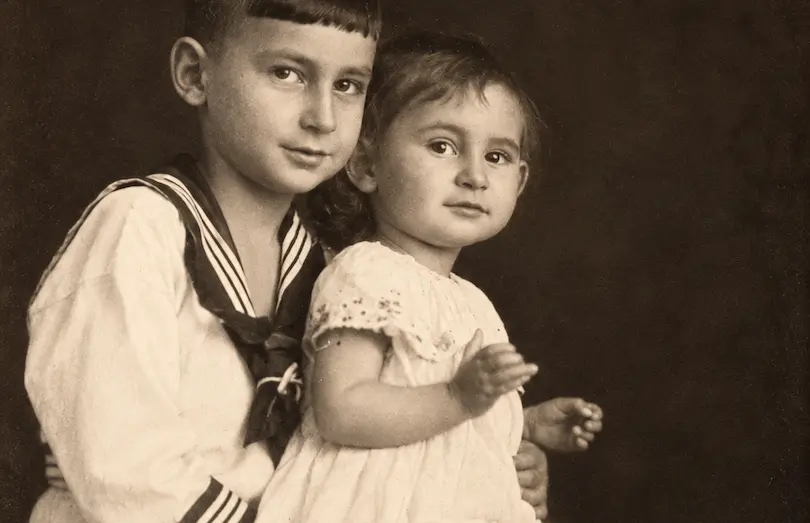 Opa with his sister Baila
He was deported to Buchenwald where he spent six harrowing weeks enduring conditions and witnessing brutality no teenager should ever experience.
When he finally came home, exhausted and filthy, all he wanted was to wash away the grime and degradation of the camp. He headed for the bath, but his mother stopped him. Word had spread that someone had returned from Buchenwald, and a line of women was waiting outside their home. Their husbands, sons, brothers, and fathers had disappeared into the camps, and they were desperate for any news.
Before he could even clean himself, 16-year-old Aharon Goldsmith was answering impossible questions and carrying the weight of a community’s anguish.
Soon after, a possible path to safety appeared. Distant relatives in America were willing to provide an affidavit that could eventually bring him to the United States to work for them. But the offer came with a condition: before they would sponsor him, he had to agree to work on Shabbat.
To grasp the magnitude of this dilemma, remember the moment in history. This was a Jewish teenager trapped in Nazi Germany, being offered what might be his only way out.
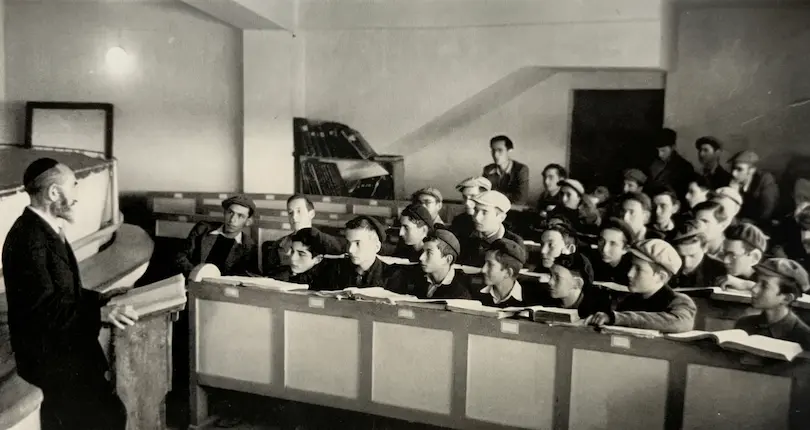
Rather than decide on his own, Opa turned to Rabbi Baruch Kunstadt, the revered Dayan, rabbinical judge, of Fulda.
The Dayan understood this was no ordinary job negotiation. It was a matter of pikuach nefesh, the Jewish legal principle that saving a life overrides almost every other commandment. With a young Jew’s life at stake, he ruled that Opa was permitted, even obligated, to do whatever was necessary to escape Germany.
Then Rabbi Kunstadt extended his hand.
“When you reach safety,” he told him, “when the danger has passed and the test is no longer one of survival but of conviction, promise me that you will never willingly desecrate Shabbat.”
My Opa gave his word.
The document would get him out of Germany. The handshake would guide how he lived once he was out.
Soon afterward, Opa and his younger brother and sister were sent to Holland on a Kindertransport, the rescue effort that carried Jewish children out of Nazi territory. Their mother stayed behind in Germany. The hope was that Holland would be a temporary stop on the way to safety.
Eventually the affidavit came through, but only one child could go on to America. Opa was the oldest, old enough to work, and therefore the one who qualified.
The opportunity that offered him a future also forced him to leave behind the only close family he had left.
He boarded a ship for America while his brother and sister stayed in Holland, hoping to follow soon.
They never did.
The Nazis occupied Holland, and his younger brother and sister were deported and murdered. His beloved mother, whom he adored all his life, was later murdered in the Riga Ghetto. Within just a few years, Opa had lost his father, mother, brother, sister, grandparents, and nearly every trace of the world he was born into.
He was the sole survivor of his immediate family.
Like so many survivors, he carried that reality for the rest of his life. The questions never fully went away. Why was I spared? Could I have done more? Why did I survive when so many others did not?
He arrived in America carrying far more than a suitcase. He carried grief, loneliness, responsibility, and memories that would never leave him. He had no parents, no siblings, and no one waiting to greet him.
He was a teenage refugee, utterly alone in the world.
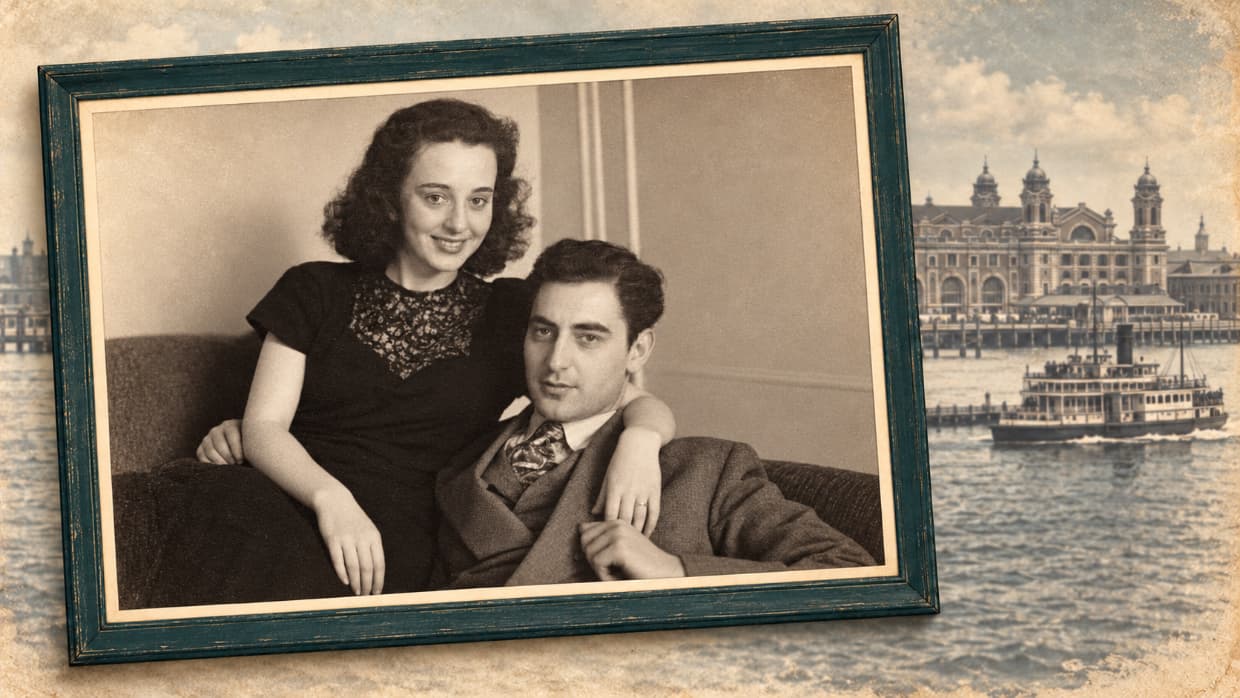
It only got harder once the ship docked. At Ellis Island, he was detained and nearly sent back because no one came to claim him. His sponsors were eventually reached and secured his release. They placed him in school for several months to learn American culture and history before preparing him for work.
Then came the day the handshake was put to the test.
His sponsors told him they were sending him to Minnesota, where he would be expected to work Saturdays, the busiest day of the week. The situation could not have been more daunting. He had no family beside him, no safety net, and no community to embrace him. He was a teenage refugee in a strange country, carrying wounds most people cannot begin to imagine.
With great difficulty, he told his sponsors he could not work on Shabbat.
They reminded him of the commitment he had made to secure his passage out of Nazi Germany. My Opa understood what that document represented. It was how he had escaped Europe, and he would always be grateful for it. He thanked them for everything they had done for him.
But this was no longer a decision about physical survival. He remembered Rabbi Kunstadt’s outstretched hand. He remembered the promise he made before leaving Fulda. And he held on to it firmly.
The sponsors’ response was immediate. The support vanished, the relationship ended, and the people who had brought him to America wanted nothing more to do with him.
Once again, my Opa was completely alone.
This is where the Torah’s description of a stiff-necked people comes alive.
The Piaseczno Rebbe, Rabbi Kalonymus Kalman Shapira, the Hasidic leader who led and taught Jews in the Warsaw Ghetto, explains that stubbornness is neither inherently good nor bad. Everything depends on what a person is stubborn about. The same quality that makes someone difficult can also make him unbreakable. The same determination that makes a person resist change can also help him resist assimilation, pressure, temptation, and despair.
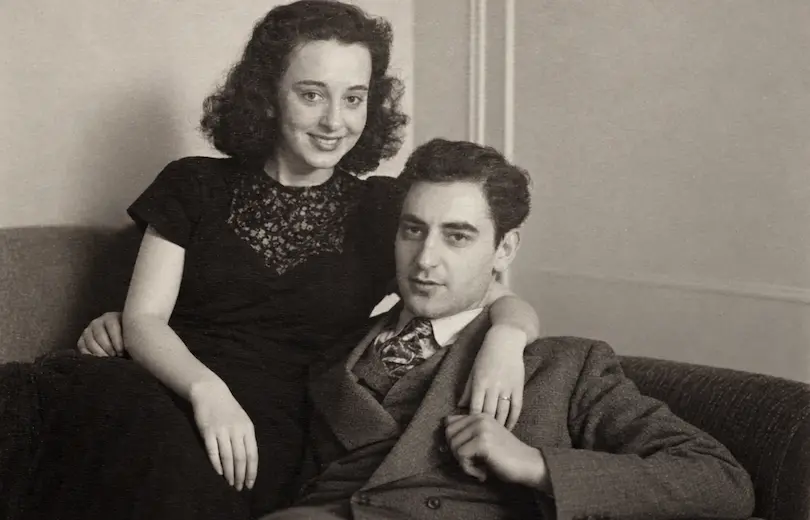 Opa with my grandmother Edith
My Opa was deeply stubborn. But that stubbornness became his greatness.
He didn’t bend when bending would have made life easier. He didn’t compromise when compromise would have been understandable. He didn’t let loneliness, fear, or loss pull him away from God.
Instead, he held on tighter.
And from that refusal came his entire future.
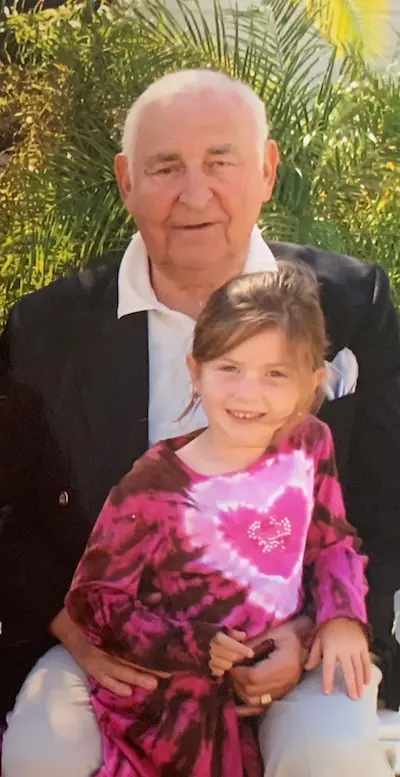 Opa with my daughter Leora
He eventually found his way to the Torah community of Washington Heights and to Rabbi Joseph Breuer, leader of its German-Jewish congregation, who helped him rebuild a life from nothing. Some time later he met and married my Oma (grandma), raised children committed to Torah and its commandments, helped build Jewish institutions, and created generations of proud Jews.
That’s the part we often forget when we tell stories of mesirus nefesh, self-sacrifice for one’s faith. The greatness lies not only in what was sacrificed, but in what was built afterward.
Today, we live in a world that often celebrates compromise as sophistication. We’re taught that convictions should be flexible and that principles should bend to convenience and pressure.
But stubbornness isn’t merely a description of an ancient people. It’s one of the secrets of Jewish survival.
When the winds of history demanded surrender, Jews endured because there were moments when they refused to bend.
The world calls it stubbornness. The Torah calls it loyalty.
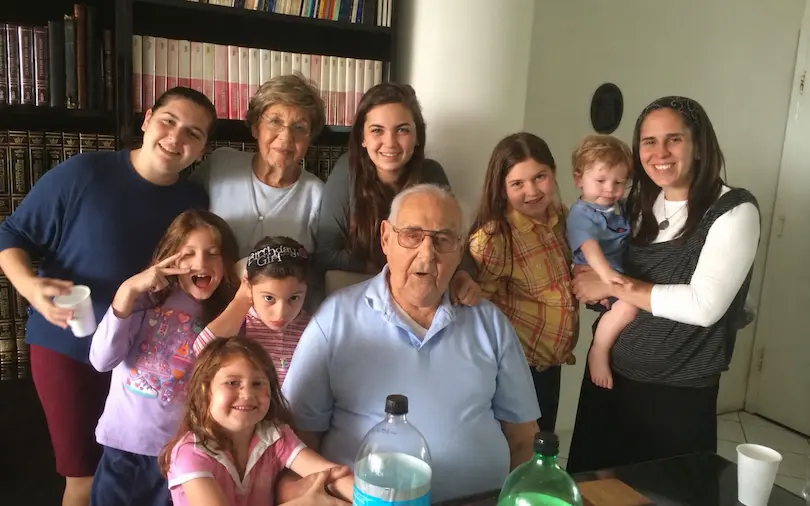 Opa with my family
Every Jewish home, every Jewish child, every synagogue, every study hall, and every mitzvah performed today is part of a chain preserved by men and women who quietly held firm to their Judaism.
My Opa was one of those Jews. His promise, sealed with a handshake, echoed across generations.
The family he built, the Torah values he preserved, and the descendants who carry on that legacy are living testimony to the power of “a stiff-necked nation” at its best.
The Nazis sought to erase a people. Instead, because Jews like my grandfather refused to surrender what mattered most, the Jewish future would outlive those who tried to destroy it.
That handshake became a legacy that built generations. Now it’s our responsibility to carry it forward.









This was a wonderful story. I wish it had included an explanation of how the writer’s grandfather was permitted to remain in the US when he refused to work on Shabbat.
Thank you for the moving and inspiring account of your Opa.
My father fled Nazi Germany a few days after Kristal Nacht, the Night of Broken Glass.
His parents put him along with two of his older brothers and two cousins on a train to Holland telling them to keep quiet, keep their heads down, don’t get noticed, while praying and hoping for the best. There they met a cousin who guided them to relative safety, and after 15 months with G-d’s help, arrived in America to reunite with their parents and youngest brother.
88 years ago beginning tonight on the Hebrew calendar 16 Cheshvan Parashat Vayera, marks that terrible pogrom that tore sons apart from their parents.
They acted through faith and conviction to preserve generations BH.
Avraham Avinu set the example.
Beautiful story and beautiful family!
He was an unbelievable hero.
There are really no words to describe how he survived and thrived as did others.
May he continue to to have a lot of Nachas from his family.
I've never liked those words, stiff neck people.. What's the alternative, lay down and die? The Jewish people have a strong will to survive.. Because their will is to survive us non Jewish people have found HaShem and life.. Can you imagine if the beautiful Jewish people didn't survive their history? This world would have killed one another off a very long time ago!
To keep this world spinning and the people on it surviving, we need HaShem.. We NEED HaShem.. This beautiful man is a light unto the nations..
The Jewish people aren't stiff necked, they are determined.. They inspire and teach us to follow their example.. Should we live or lay down and die? Jewish people are leaders!
That description is in Jewish scripture. I think the alternative is that others would bend and assimilate.
i am not sure how he was able to return six weeks after he was taken?
On Kristalnacht only adult men were taken and were sent home several weeks later. If they could not leave the country they were taken later with round-ups of the entire community.
My Opa was also rounded up and arrested on Kristalnacht. He was sent to Dachau, but was released sometime later. In 1939, he was very fortunately given a Visa to the U.K.
The grandfather of a friend of mine was taken also for some time. When he came back he was a changed person. He and his wife managed to get their son out of Germany through Portugal to New York. I knew the son as an old man and studied with him. He was tough also and a great person to know. He was unshakable in doing the right thing no matter what people thought of him.
An excellent denouement and beautiful story. I don’t want to be a party pooper, but one small thing bothers me a bit. Opa knowingly reneged on his promise to the family that sponsored him. What would he have done if he were returned to Germany?
One could argue that the sponsors had no right to demand such a thing of a religious Jew. I imagine they were expecting a payoff for delivering a low-cost worker to some company.
Regardless of what the ’payoff’ was in their minds, the sponsors ‘gave’ him their condition(s). He could have very well not accepted this specific condition, but he did. There is no ‘lashon hora’ intended against this man, nor his reputation, nor his family. I am merely pointing out that was not honest with them.
What a heart-wrenching and touching story of horrors, survival and later successes. Thank you for sharing this moving tribute to your Opa. Please let everyone of conscience help to insure that such hatred can be met preemptively with strong defense of Jews and Israel!
Am Yisrael Chai
עַם יִשְׂרָאֵל חַי
Thank you for sharing your Opa's journey. It's a wonderful story of commitment, faith, loyalty, and love. My father was also a survivor who lost his entire family in the Holocaust. He not only survived but thrived, found the love of his life, and together raised a beautiful family who proudly live by the laws of the Torah.
An inspiration to all of us.
Thank you for this wonderful story of loyalty and resilience.
Debora
Very nice story.
My family was also from Fulda. They were cousins of my father who was born in a small town called Dieburg, which was near Darmstadt. His mother’s family was from Dieburg. Her maiden name was Heil.
if you’d like to make contact, please ask Aish for my email address.