





 What Mamdani Gets Wrong



13 min read
4 min read
12 min read



5 min read


A powerful true story of Jewish heroism.
Rabbi Yosef Wallis, director of Arachim of Israel, talks to Project Witness about his father, Judah Wallis, who was born and raised in Pavenitz, Poland.
While he was in Dachau, a Jew who was being taken to his death suddenly flung a small bag at my father, Judah Wallis. He caught it, thinking it might contain a piece of bread. Upon opening it, however, he was disturbed to discover a pair of tefillin. Judah was very frightened because he knew that were he to be caught carrying tefillin, he would be put to death instantly. So he hid the tefillin under his shirt and headed for his bunkhouse.
In the morning, just before the appel [roll call], while still in his bunkhouse, he put on the tefillin. Unexpectedly, a German officer appeared. He ordered him to remove the tefillin, noted the number on Judah’s arm.
At the appel, in front of thousands of silent Jews, the officer called out Judah’s number and he had no choice but to step forward. The German officer waved the tefillin in the air and said, "Dog! I sentence you to death by public hanging for wearing these."
Judah was placed on a stool and a noose was placed around his neck. Before he was hanged, the officer said in a mocking tone, "Dog, what is your last wish?"
“To wear my tefillin one last time," Judah replied.
“The officer was dumbfounded. He handed Judah the tefillin. As Judah put them on, he recited the verse that is said while the tefillin are being wound around the fingers: "Ve’eirastich li le’olam, ve’eirastich li b’tzedek uvemishpat, ub’chessed, uv’rachamim, ve’eirastich li b’emunah, v’yodaat es Hashem – I will betroth you to me forever and I will betroth you to me with righteousness and with justice and with kindness and with mercy and I will betroth you to me with fidelity, and you shall know God."
It is hard for us to picture this Jew with a noose around his neck, wearing tefillin on his head and arm – but that was the scene that the entire camp was forced to watch, as they awaited the impending hanging of the Jew who had dared to break the rule against wearing tefillin.
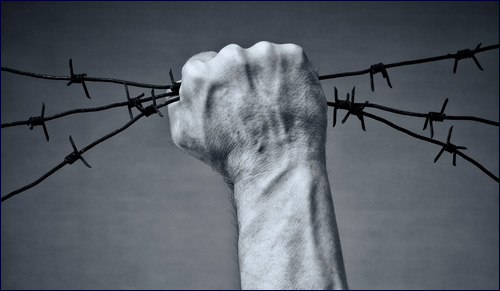
Even women from the adjoining camp were lined up at the barbed wire fence that separated them from the men’s camp, forced to watch this horrible sight.
"Yidden, I am the victor. Don’t you understand, I am the winner!"
As Judah turned to watch the silent crowd, he saw tears in many people’s eyes. Even at that moment, as he was about to be hanged, he was shocked. Jews were crying! How was it possible that they still had tears left to shed? And for a stranger? Where were those tears coming from? Impulsively, in Yiddish, he called out, "Yidden, I am the victor. Don’t you understand, I am the winner!"
The German officer understood the Yiddish and was infuriated. He said to Judah, "You dog, you think you are the winner? Hanging is too good for you. You are going to get another kind of death."
“Judah, my father, was taken from the stool and the noose was removed from his neck. He was forced into a squatting position and two huge rocks were placed under his arms. Then he was told that he would be receiving 25 lashes to his head – the head on which he had dared to position his tefillin. The officer told him that if he dropped even one of the rocks, he would be shot immediately. In fact, because this was such an extremely painful form of death, the officer advised him, "Drop the rocks now. You will never survive the 25 lashes to the head. Nobody ever does."
Judah’s response was, "No, I won’t give you the pleasure."
At the 25th lash, Judah lost consciousness and was left for dead. He was about to be dragged to a pile of corpses , after which he would have been burned in a ditch, when another Jew saw him, shoved him to the side, and covered his head with a rag so people didn’t realize he was alive. Eventually, after he recovered consciousness fully, he crawled to the nearest bunkhouse that was on raised piles and hid under it until he was strong enough to come out under his own power. Two months later he was liberated.
"I saw what you did that day when the officer wanted to hang you. Will you marry me?”
During the hanging and beating episode, a 17-year-old girl had been watching the events from the women’s side of the fence. After liberation, she made her way to Judah. She walked over to him and said, "I’ve lost everyone. I don’t want to be alone any more. I saw what you did that day when the officer wanted to hang you. Will you marry me?”
My parents walked over to the Klausenberger Rebbe and requested that he perform the marriage ceremony. The Klausenberger Rebbe, whose Kiddush Hashem is legendary, wrote out a kesubah [marriage contract] by hand from memory and married the couple. I have that handwritten kesubah in my possession to this day.
Join Aish for a powerful, once-in-a-lifetime experience in Poland with a Holocaust Survivor.
This subsidized trip is open to all adults ages 20+ throughout North America.
For details and registration, visit:
livinglegacy.aish.com












Exquisite story of love
I am sitting in a Drs surgery waiting room.
The tears and emotions are joined to you and your family. Yet the huge Simcha of Life. How precious. Thank you for sharing this love story
Beautiful example of a true Jewish soul! It's a miracle anyone survived those camps.. And yet to survive such horrid cruelty as this is so awesomely amazing! Bless him and his family xxx
S
Wow, just amazing story of Jewish people. Blessings 💞 to you family and every Jewish person
is this story really True ? did anyone ever try to find out the name of the German guard ?
Lewis Regenstein
In the book "Incredible", about Rabbi Wallis, you can read the full story. It names the guard, I recall his first name was Otto.
THE GERMAN NAZI YM"S, was Otto Tybet.
Otto Tybet, look at Aish's article about him. Truly fascinating.
Most excellent article, brings hope again to all us Yiddisher menshen and wibber.
Beautiful. What heroes Holocaust survivors are/were.
B"H he did win and went on to rebuild Jewish life.
Love this!!
Isn't the prayer quoted the prayer from a marriage ceremony? Why would he say that when putting on the Tefillin?
That prayer is recited every day by Jews putting on tefillin, when wrapping the retzuah around the fingers. You will find it in every siddur in the early morning prayers. It is also part of the kesubah.
the idea is that we are "betrothing ourselves" to Hashem and His will in a similar way that a groom betroths his bride to him in loyalty