







 What Repentance Really Means in Judaism




13 min read
12 min read
9 min read
5 min read




How one family’s superhuman response to tragedy galvanized a movement.
Charlotte Herzberg, an 8-year-old girl in Monsey, New York, was riding her bicycle when she was hit by a car and killed. The driver of the car was not texting, drunk, nor speeding. He was a respected member of the local Orthodox Jewish community and a dedicated volunteer for the Hatzalah emergency medical service.
He was also Charlotte’s father’s best friend and study partner.
Two lives could have been destroyed—one by death and the other by guilt, recrimination, and rejection by his community. But that’s not what happened.
At the funeral of his daughter, Yudi Herzberg, Charlotte’s father, spoke about the potentially unbearable feelings and division such a tragedy could create among neighbors and friends. Rather than allowing such resentment and blame to take root, at the grave of his daughter, he publicly committed himself to promoting unity and shalom, and he called upon the community to do the same.
Rather than allowing such resentment and blame to take root, at the grave of his daughter, he publicly committed himself to promoting unity and shalom
In response, a campaign “Shalom for Charlotte” was born.
The next night, Rabbi Benyamin Eisenberger, a prominent New York rabbi, came to pay a shiva call to Charlotte’s parents. The scene that greeted him was as if from another world. In the kitchen, he saw Charlotte’s father and the driver of the car embracing, crying, and literally holding each other up. A few feet away were Charlotte’s mother and the driver’s wife, also hugging each other and sobbing.
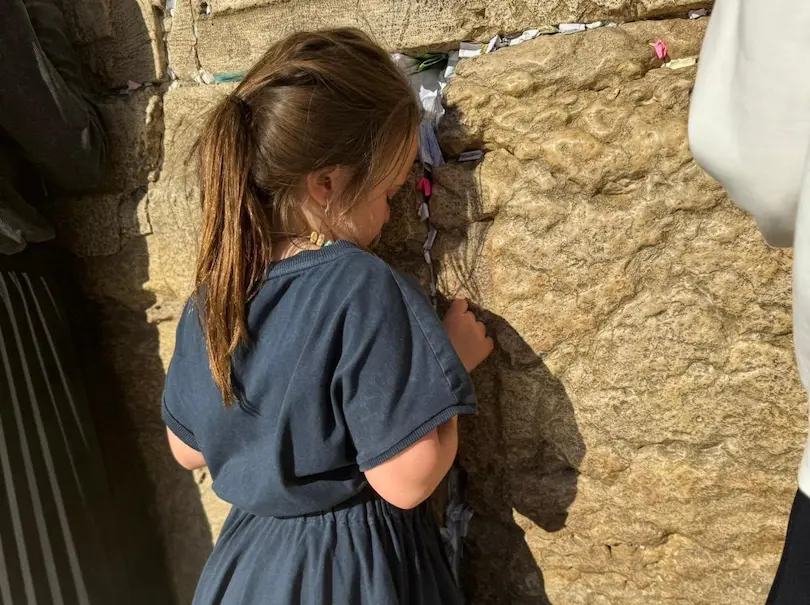 Charlotte praying at the Western Wall
This was not about forgiveness. The driver had not been guilty of negligence or any crime. It was an accident, in the pristine meaning of the word—an unfortunate loss that just happened. But Charlotte’s parents don’t believe that anything “just happens.” They believe that God is the sole operative force in the universe, and although human beings have free choice to choose between good and evil, where no moral choice is involved, everything is determined by God—whether or not they understand why.
The Torah speaks about deaths caused by someone who had no intention to cause harm. When faced with loss, human beings naturally look for someone to blame. They channel their grief into anger and revenge. The “avenger of blood” is still a widespread phenomenon in many Middle Eastern societies.
To forestall such vengeance killings, the Torah stipulates Cities of Refuge where an accidental murderer can flee and be protected. This was a concession to human nature. It is too much to expect the bereaved family to admit the innocence of the accidental murderer and let go of their anger and resentment.
However, this is exactly what happened in Monsey a few weeks ago. Charlotte’s parents could disavow resentment and blame because they acknowledge the Divine will behind their tragedy.
Recently my good friend Barbara called me, crying. She had just read Rachel Goldberg-Polin’s memoir about the death of her son Hersh, an Israeli hostage murdered by Hamas in Gaza. Thirty-two years ago, Barbara’s 12-year-old son, spending the summer in a wilderness camp, was killed, struck by lightning while sitting on a tree root holding a frying pan. Barbara, a Jew estranged from belief in God, has been mourning ever since.
Reading about Rachel Goldberg-Polin’s endless suffering and mourning, Barbara wanted to know what difference did it make that Rachel is a believing, religious Jew? Their grief and pain at losing a child is the same.
Yes, their grief is equally deep, equally inconsolable, but it is not the same. Early in her book, When We See You Again, Rachel relates the tale, told in many renditions, including in the Talmud, of a king and his loyal servant in the garden of the palace. The servant, panicked, runs up to the king and tells him that he has just seen the Angel of Death. He begs to borrow the king’s fastest steed so he can escape to Tehran. The king agrees and the servant gallops off. Shortly afterwards, the king sees the Angel of Death and asks him why he frightened his servant. The Angel of Death replies that he was surprised to see the servant here since he has an appointment with him tonight in Tehran.
Rachel writes: “The final line of the passage in the Talmud’s narrative says, ‘A person’s feet will always take them where they are supposed to be.’ I tell myself that story again and again throughout the day.”
Throughout Rachel’s memoir of unremitting suffering, anger and blame are conspicuously absent.
The difference between Rachel Goldberg-Polin and my friend is that throughout Rachel’s memoir of unremitting suffering, anger and blame are conspicuously absent. She barely mentions Hamas. Barbara, with no sense of Divine direction, lives in a random universe and is forever haunted by “what if’s”—if only the counsellors had herded the campers into their tents when they heard the thunder storm, still miles away, her son would still be alive. Her anger and blame were not relieved by suing and closing the camp.
In a God-written script, there are indeed tragedies, but they are not random. As one of my rabbis says, “Everyone comes into this world with a round-trip ticket.”
Charlotte’s parents certainly do not understand why their child was taken from them. But they do understand that everything comes from a loving God, who alone sees the whole picture of the soul’s journeys into and out of this world.
Rachel Goldberg-Polin writes about her father-in-law’s experience of a seemingly unrelated series of events that ended up saving a person’s life. She ends the chapter with: “How we live with the never-known decides everything.”
Charlotte’s parents have chosen to live with “the never-known” in a spirit of acceptance, love, and letting go of all resentment. That is what has fueled the “Shalom for Charlotte” campaign.
Is there a grudge you’ve been carrying that you can drop today?
Hearing of it, I wondered, “What grudge am I carrying that I can let go of?” Although I have persistently worked on choosing connection and seeing God’s Providence in my daily life, I realized that I was indeed carrying a grudge against someone who had publicly embarrassed me years ago. I rarely thought of this man, but when I did, negative feelings of recrimination clouded my mind and heart.
I decided that in the merit of Charlotte (Sheindel bat Chaim Yehudah Leib), I would let go of my grudge, just let it drop like a dead weight. I had heard that my former foe was ill, so I sent him an email wishing him a speedy recovery and asking for his Hebrew name so I could pray for him.
Is there a grudge you’ve been carrying that you can drop today?
Click here to join the “Shalom for Charlotte” campaign.
Click here to order Sara Rigler’s new book 8 Seconds to Connect with Hashem: Mitzvah Mindfulness for Women









Reading this article, I am right now davening for a former sister-in-law who was hit by a car a few days ago in Netivot, Israel, and is lying sedated and on a breathing machine with no brain activity in soroka hospital Beer sheva- the name for tefila, Dorit bat Ester Tira.
Very touching article. But we cannot ignore how much car are a danger, especially the larger vehicles that have become commonplace these days where it's very difficult to see children or short people. People get very comfortable driving in and out of driveways and consequently lose sight of the risk that results in such tragedy.
There is no such thing as a "random, accidental death" without cause; every sudden passing is the result of a combination of the soul's pre-planning, karmic balancing, and the interplay between free will and environmental factors.
1. The "life-end milestone" pre-set by the soul (most common)
1. Lessons completed: The character cultivation, karmic repayment, and soul-level lessons regarding family members set for this lifetime have all been concluded; the physical body naturally ends its journey through an accident. Rather than remaining bedridden with a long-term illness and draining their family, many souls choose a swift departure.
2. Voluntary termination of the contract: The soul realizes that remaining in the physical body would cause it to lose sight of its true self
Yes everything happens for a reason. That is why in Law there is a distinction between an "accident" and "negligence" and "intent". Rightly or wrongly the law punish one for their acts, it punishes people for the motivation of their acts. This was not always so, however it was considered a better solution to punish people for motivations and not acts. That is the way the law in the USA and other developed countries works and I agree with that.
Wonderful!
Nice article, but -----as someone who easily forgives others, there are certain grudges that should not be let go.
The is also the saying that "one can forgive, but one should never Forget!"
.....and somewhere in the Heavens Charlotte is smiling....(at her parents) Difficult to fathom their loss and beautiful to see both of their responses....
I am not well-versed in such things, but I do understand the concept of Divine Plan. However, I was also given to understand that (per a discussion I had years ago with a rabbi), there was also a concept in Judaism that accepts such a thing as, basically, dumb luck. Does this contradict Divine Plan, or are they the same thing. Can anyone please explain?
"Coincidence is Hashem's way of staying anonymous."
Author responds: Although there are different opinions in Judaism of exactly how much a person's destiny can be impacted by another person's free will, in general we believe that there is only one operative force in the universe: God. The spurious concept of "luck" is based on randomness. We do believe in "mazel," a soul's predetermined fate, e.g. whether the soul will be born into a life where he/she will be rich or poor, healthy or sickly, etc. This is not random. According to Kabalah, the soul, before coming down into this physical world, chooses the life circumstances that will most conduce to her tikkun (rectification).
Another beautiful, meaningful essay written by the incomparable Mrs. Rigler. Her words are always rich in thought. This particular essay ‘spoke to me’ her message that ‘letting go of a grudge’ is one way that Hashem helps us to navigate our way on our troubled planet.