






 Biblical Imagery in Dolly Parton’s Music

4 min read
10 min read



14 min read


A Yale-trained anthropologist, Adam Louis-Klein emerged from the Amazon to find his academic world celebrating a hate movement. He is using his background in anthropology to fight antizionism.
Adam Louis-Klein was a left-wing Yale philosophy grad, conducting fieldwork among indigenous Amazonians for his PhD in anthropology. Completely cut off from the world, he finally got online, and the horrors of October 7th hit him like a freight train -- and what he saw in his own academic circles shook him even more. Today he runs one of the most effective anti-antizionism organizations in the Jewish world. This is how he got there.
Adam was born in London and grew up in Seattle. He had a Bar Mitzvah, visited Israel, and was involved in Jewish life at Yale, but after college he drifted away from Judaism entirely.
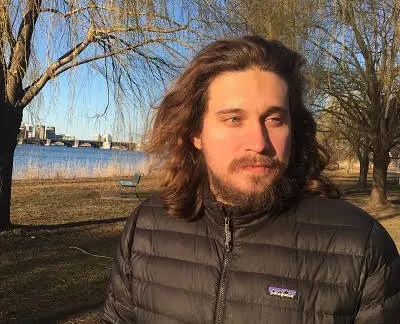 Adam in college
"I joined a far-left group called Socialist Alternative," he says. "I was very into communism." His undergraduate degree was in philosophy, and he became obsessed with Alain Badiou, a French Maoist philosopher. After Yale, he pursued a Master's in philosophy, then another in anthropology. Along the way, he discovered The Amazonian Cosmos by anthropologist Gerardo Reichel-Dolmatoff, a dense, metaphysical account of an ancient indigenous cosmology. He was hooked.
When Adam began his Ph.D. at McGill University in Montreal, he decided to dedicate his dissertation to the Desano people described in Reichel-Dolmatoff's book. Through American Christian missionaries active in the region, he found his way to a small Desano village deep in the Amazon.
 Adam in the Amazon
Life there was stark. "I drank rainwater out of a huge bucket. I bathed in the river every single day." He stayed in a ramshackle health post meant for visiting medical professionals, with windows that wouldn't close and bats in the rafters. He was an outsider in every sense. "It was probably the loneliest experience of my life," he says. "I was seen as a completely alien being." Every day, he walked to the village pavilion and listened to the elders tell the stories of their people.
The Desano, it turned out, consider themselves a chosen people with a special affinity for Jews. Some indigenous tribes even claim descent from the Ten Lost Tribes of Israel. "When I told the Chief I was Jewish, that was how we connected," Adam says.
Spending time with the Desano gave Adam a new lens on indigeneity itself.
Spending time with the Desano gave Adam a new lens on indigeneity itself. The Desano trace their origins to a sacred homeland where they once lived under a single chief. Eventually there was conflict, dispersal, diaspora – and they even displaced another tribe in the process. "There's immigration, war, displacement," Adam says, "but no one's going to call the Desano settler colonists because immigration, displacement, and war are just history."
What defines an indigenous people, he came to understand, isn't that they never moved. It's that a sacred territory anchors their identity, history, and culture. That insight would soon become central to everything.
On October 9th, 2023, Adam connected to the internet for the first time in months. "The first thing I saw was the news of the massacre," he says. "And the second thing was how people in my left-wing academic environments were reacting. What I saw was so shocking and so immoral. I saw that this was a hate movement. It was unlike anything I'd ever witnessed in my life."
 He was watching it from the inside of academia. Shortly after October 7th, his anthropology department began organizing a series of talks about genocide in Gaza, seemingly before Israel had even mounted a significant military response. Outside academia, no one was using that word yet. "Little by little, this eventually made its way to the New York Times," Adam says.
His training as an anthropologist gave him an immediate clarity that others lacked. The entire antizionist narrative, he saw, rested on a single claim: that Jews are foreign colonizers in the Land of Israel. "It's not a fringe belief," he says. "It's the foundational element of antizionist ideology."
And to someone who had spent months studying indigenous peoples, that claim made no sense. "The settler colonial reading was erasing Jewish indigeneity. Jews have migrated around the world, but Israel is their homeland – the sacred site through which Jews have defined their identity throughout history. Jews are an ethno-religious people, not simply a faith disconnected from peoplehood."
Even though his social circles dismissed anything that challenged their ideology, Adam decided to speak out. "I thought it was important to use the critical skills I had learned in the academy – post-colonialism, anthropology, indigeneity – to speak back against this hate movement."
He approached antizionism the way he would any cultural system: as a trained anthropologist analyzing an ideology. That's how he began identifying what he calls the foundational erasures and inversions on which antizionism is built.
When Adam shared his writing on social media, he was bombarded with hate mail. "Some people told me they didn't want to speak to me anymore. Some harassed me and screamed at me. Some of my mentors and intellectual heroes publicly humiliated me. Little by little, I was purged by my whole community. I don't speak to anyone in the academy anymore."
What kept him going was knowing exactly how the narrative had been constructed. "It wasn't the way the war progressed that made it inevitable that people would conclude genocide was happening. The narrative was already there. Academia granted it authority, and mainstream media picked it up and exploited it."
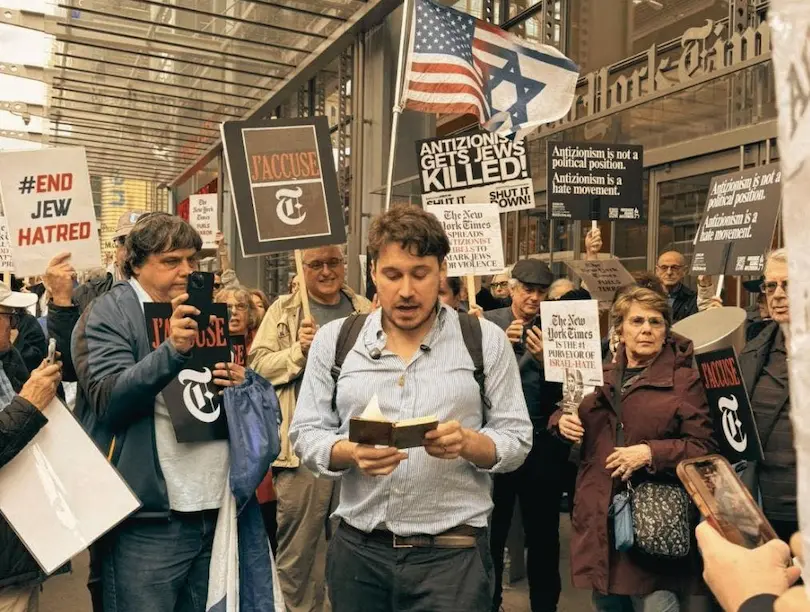 Adam speaking outside of the New York Times at the protest MAAZ helped organize after the Kristof dog rape libel
At first he felt like he was speaking into the void. Then he reconnected with the broader Jewish community, and his writing started spreading. It resonated because it used the language of the antizionist academy to dismantle antizionism from within. Some pieces went viral.
When I was marked as an evil Zionist, which I knew was a way of targeting my Jewish identity… I returned to a much more active and observant Judaism.
At the same time, Adam was reconnecting with Judaism. “My Jewish identity was really forced on me,” he says. “I felt a lot of solidarity with Israelis in the wake of October 7th, and my support for Israel became more explicit. But when I was marked as an evil Zionist, which I knew was a way of targeting my Jewish identity, it was a reckoning and return, which I ended up embracing. I returned to a much more active and observant Judaism.”
Back in Montreal, he started attending synagogue regularly. Today he studies Torah daily. “I find it important to root myself in Torah, and the moral and ethical values, and the mystical and Kabbalistic dimension, which also helps me understand what I'm doing, and what is the purpose of all of this. Why was I called by God to do this work? I'm trying to understand that through studying Torah. The religious element is actually the center of it all, and then one has to bring that outward and try to improve and fix the world on the basis of that firm grounding in the Torah.”
As his following grew, he began publishing in larger outlets like the Free Press and The Atlantic. A group of activists who had been reading his work reached out. They saw in Adam's framework something they hadn't found elsewhere: a direct, coherent focus on antizionism – not classical antisemitism – as the dominant form of Jew hatred today. They wanted to build a movement that incorporated Adam’s deconstruction of antizionism.
In October 2025, Adam and other activists founded the Movement Against Antizionism (MAAZ). "We want to build a language that ordinary people can use," says Adam. "We really try to educate the public, the Jewish community and beyond, on what antizionism really is."
Until recently, the Jewish community has focused its energy on fighting classical antisemitism, which comes primarily from the right – and has largely succeeded. Antizionism is a different beast. "It comes from the Nazi-Islamist axis, but was truly crystallized in the Soviet Union and Arab nationalism, and then in Western settler colonial theory. It has its own lineage, its own aesthetics, its own tropes. It is now the hegemonic form of Jew hatred – the systemic problem. Classical antisemitism is not really systemic. It is coming back, but antizionism has created the permission structure on the right for it to return."
MAAZ is laser-focused on combating antizionism: "the normalized bigotry, the permanent accusation and criticism of Israel." Their goal is to get the Jewish community to shift its fight –from classical antisemitism to exposing antizionism as a hate movement. "The Jewish community needs to put all hands on deck and make antizionism the central focus," says Adam.
Behind MAAZ is a grassroots network of academics, lawyers, teachers, and activists working to make that cultural shift happen. They conduct trainings for people on college campuses, in the corporate world, and anyone else who wants to know how to push back. "When people take the training, they suddenly see the whole issue in a new way and feel empowered to speak directly back to antizionism."
Six months in, he's seeing results. Major Jewish influencers have started adopting the language. Ordinary Jews are speaking more directly and effectively. Antizionists are getting back-footed. "Our next stage is institutional," he says. Major Jewish organizations need to get on board for the culture shift to take hold. "We're in discussions with the Jewish legacy organizations, encouraging them to name antizionism explicitly and allow it to stand as its own category."
Antizionism, Adam explains, rests on three core libels: colonizer, apartheid, and genocide.
"They form a simple narrative," he says. "The colonizer libel says Jews were foreign Europeans who arrived in a land that wasn't their own. Since they had no claim to it, they had to be racists to justify displacing the native population. That leads to the apartheid libel – that Jews built a racist state to subjugate that population. And when the population resisted, the colonizers had to eliminate them completely. That's the genocide libel. Each one leads logically to the next, and they escalate in intensity."
The libels spread deliberately, but they also fit naturally into the moral framework of the progressive left.
What made the colonizer libel so devious when applied to Israel is that Zionism looked nothing like actual colonialism. "It wasn't about extracting resources. No slaves, no gold mining, no missionizing, as happened everywhere else colonialism occurred. It was just people immigrating and building a community. So they changed the meaning of colonialism. It became really just xenophobic sentiment: these people are foreign and don't belong."
The libels spread deliberately, but they also fit naturally into the moral framework of the progressive left. "When you tell someone there's a white colonial apartheid state committing genocide of indigenous people, anyone on a college campus is immediately going to say, I'm against that, I need to show up to this protest. There are deliberate propaganda agents, but there's also a larger cultural current carrying it forward."
Once you see the libel structure, the entire narrative unravels. "Every major iteration of the genocide libel since October 7th, from Francesca Albanese, Human Rights Watch, Amnesty International, the Journal of Genocide Research, they all depend on settler colonial theory and the colonizer libel. It's not a factual claim. It's built on the erasure of Jews."
View this post on Instagram
Antizionism is not new. It began, Adam explains, with the alliance between the Muslim Brotherhood, the Mufti of Jerusalem, and the Nazis.
The Nazis had portrayed Jews as invaders on European soil – foreign Orientals, Asiatic hordes from the East. When that ideology traveled to the Middle East, it got inverted. Now the Jews were foreign Europeans colonizing Arab land. Same libel, flipped direction. The historian Jeffrey Herf documented Nazi Arab propaganda radio broadcasts across the Middle East during World War II that repeated these exact claims – Jews planning to eliminate and commit genocide against the Arabs. The libels were seeded early.
Antizionism as an organized ideology crystallized with the alliance between the Soviet Union and Arab nationalism. By 1956, the Soviets had thrown their weight behind Nasserism and Arab nationalism, framing it as a socialist fight against the imperialist West. Zionism was cast as the spearhead of that imperialism. "The Arab nationalists were not truly communist," Adam notes. "It was really about opposition to the West, and the Soviet Union took on antizionist ideology as part of its agitation against the United States."
The critical turning point came in 1965, when Fayez Sayegh, a PLO operative working with the Soviets, founded the Palestine Research Center and coined the term "settler colonial theory." In his writing, he argued that Jews are inherently foreign to the land, that Zionism is racist because Jews believe they are a chosen people, and that Zionism intends to annihilate the Arabs. The three libels, fully formed.
The secular left picked them up readily. Sayegh himself drafted the 1975 UN resolution declaring "Zionism is racism", the crystallization of Soviet-Arab antizionism repackaged as left-wing human rights ideology.
The Oslo Accords brought a lull. Antizionism lost steam when peace seemed possible. But when the peace process collapsed and the Second Intifada erupted, it came roaring back. The 2001 Durban Conference re-injected Soviet-era antizionist libels into the West with more force than ever. The BDS movement followed, embedding antizionism into progressive culture. Then came October 7th. "The antizionist complex detonated," Adam says. "Now it's part of mainstream Western culture. It's the dominant ambience in which we live."
Through all of it, the Jewish community was caught off guard. There was no organized response, no counter-language, no framework. "The public was never really taught what antizionism was," Adam says. "So that's what we need to do now."
Adam's tips for fighting back are practical and direct. Say the word "antizionism" and write it without a hyphen. Don't get pulled into debates about Israeli history. "It is not a factual debate," he says. "Recognize it as abuse, as libel intended to harm you. Shut it down. If someone starts in on you, just say: antizionism is a hate movement."
Don't justify yourself. Keep the focus on them. "Their power comes from always placing Israel on trial. Ignore what they say about Israel and flip the attention back onto antizionism."
The goal, he says, is to morally shame them because that's exactly what they're trying to do to Jews. "They're trying to put the moral status of Jews into question. Our goal is to question their moral status. Don't be afraid to call them out directly, because they can't process guilt and shame very well. It takes away the entire incentive structure."
"They would just rant: this is a white, racist Zionist, he supports killing Palestinian children, why is he a student at McGill?" Despite the pressure, the McGill administration stood by him.
Adam is still a Ph.D. student finishing his dissertation, and the fact that he wasn't expelled is, in his words, "a miracle." People called his advisor and wrote to his department chair, sometimes copying Adam directly so he'd see it. "They would just rant: this is a white, racist Zionist, he supports killing Palestinian children, why is he a student at McGill?"
What struck him most was their confidence. "They really thought they were on the high ground. Within certain spaces, their position is legitimized by experts, so they feel emboldened to do things that are unimaginable."
Despite the pressure, the McGill administration stood by him. He expects to finish his dissertation in early 2027. He knows he was lucky – many others weren't. "There are Israelis who were straightforwardly boycotted and couldn't finish their PhDs, lost their advisors. I was fortunate."
He looks ahead with a clear vision. Antizionism, he believes, will eventually be stigmatized the way other hate movements have been, through public education, cultural pressure, and institutional change. He wants to see museums built to the victims of antizionism: Jews expelled from Arab countries, Jews persecuted in the Soviet Union, victims of terror attacks around the world. "That's where I would want to see the Jewish community in 10 years," he says.














Thanks for this article. Shuvua Tov 😀
If the 1948 Arabs, or the 1967 Arabs, or the 1985 Oslo Peace process Arabs, or the year 2000 Arafat Arabs had accepted the very fair offers of statehood, we wouldn't be having this conversation.
Since not a single one of them ever accepted the statehood that was offered to them multiple times, the right of full settlement upon all except privately owned lands, that has existed since the time of Lord Balfour, and "The League of Nations Mandate For Palestine", continues to exist until this very day.
And therefore any argument condemning continued Jewish settlement does not hold water.
After all, it is not a Zionist conspiracy that those who start wars and lose the Wars they started should lose territory!
THAT has happened repeatedly throughout all of history!
Anti zionist is another name for hating Jews , so anti zionism is anti semitism/ hating Jews in disguise, these characters in my view are no better than Nazis ( Y"S) they have the same goal to make the world and Israel " Judenrein " ( free of Jews) , the word zion is written Jewish holy books, and another for Jerusalem is zion
Ecclesiastes Chapter: 12 Verses: 12-14
I define an antizionist this way: someone who believes that all people/religions are entitled to their ancestral land/holy places, except for the Jews. Pure racism. I would add that the "white European colonizer" crowd labels Jewish immigrants to mandate Palestine during the 1920s-1930s as "colonizers" or "invaders," while calling Muslims who emigrated there during the same period merely "immigrants." So racism AND hypocrisy.
I think it is important to define what we are talking about. The Zionism of 100 years ago is nothing like the Zionism we see today. The early Zionists never talked about entitlement. Both sides seem to be conflating these two movements to support their own positions.
If we are talking about 21st century Jewish immigrants settling in the occupied West Bank, then the argument is very different from the European immigrants who settled in the British mandate 100 years ago.
If the 1948 Arabs, or the 1967 Arabs, or the 1985 Oslo Peace process Arabs, or the year 2000 Arafat Arabs had accepted the very fair offers of statehood, we wouldn't be having this conversation.
Since not a single one of them ever accepted the statehood that was offered to them multiple times, the right of full settlement upon all except privately owned lands, that has existed since the time of Lord Balfour, and "The League of Nations Mandate For Palestine", continues to exist until this very day.
And therefore your argument condemning continued Jewish settlement does not hold water. After all, it is not a Zionist conspiracy that those who start wars and lose the Wars they started should lose territory!
THAT has happened repeatedly throughout all of history!
Excellent article. Thank you!
I came across one of Adam's posts on Substack and I suspected immediately that he was a leftist intellectual who had seen the light and defected. It was nice to read a bit about Adam's personal history. He is every woke antizionist's nightmare: he understands exactly how the mind-forged manacles are constructed, and he deftly deconstructs the accusations and uses the value system against itself.
The accusation that the Jews stole another people's land is the rock upon which the entire antizionist church has been built. It's tragic that the Jewish community has been so inept at learning how to defend itself against libels and smears. "Free, free Palestine" is a hate campaign designed to demonize the Jewish people. Nothing more than that. It's a web of lies supported by bullhorns.
Thank you for framing this for us studiously, clearly and with such coherancy. Truth - Antizionism is a hate movement! I will help to spread the word.
anti- zionisim
what is zionism?
Good! You started to reverse engineer the Hamas public relations effort that has been going on for longer than since October 7.
Two questions arise: first, why did Hamas attack on October 7? They attacked because Israel left the border wall undefended. Bennett & Ganz withdrew one battalion to protect settlers on the West Bank. Netanyahu & Ganz withdrew the other battalion for the same reason and then was foolish enough to try to bribe Hamas (through Qatar) to stay quiet.
Second, why do so many hate the government of Israel? Too often, they can point to the failure of the Israeli government and judiciary to apply the rule of law evenly. Also, this government of Israel has prioritized assassinating enemies over children’s lives. Israel is not innocent.
I don’t think Adam or anyone else who knows the facts is seriously claiming that Israel has never done anything wrong. That’s not the point. The point is that antizionists will try to criticize and delegitimize Israel *regardless* of what it does, because it perceives the mere existence of a sovereign Jewish state in the Land of Israel as a crime.
You need to regard antizionism as you would any other hate movement: it says nothing about the object of the hate - neither its culpability nor its innocence.
Take a typical racist claim: people who think all Blacks are either degenerate criminals or on the verge of turning into them. Does that say anything about Blacks? No.
Is opposing it the same as saying that no Black person is a criminal? No. To quote Adam, it’s not a factual debate.
Great read. Concise and clear. I come from a large Jewish family and have been shocked at the anti Zionist comments of the 30-40 year olds. When I asked for their factual support I was only referred to social media posts.
I appreciate so much what Adam is doing and am appalled by this sudden consensus of parts of society to attack Jews. The one piece in this article i take issue with - and please don't burn me at the stake for this, I've certainly read it elsewhere as well - is saying that anti- semitism is largely right wing. I grew up in what is considered right wing, I was in my 30s before I learned that antisemitism existed outside of the Nazis or Arabs. I never heard it in the churches i grew up in and quite the opposite - they believe they are Jews by adoption and love the Jewish people. It was always wonderful to meet a Jewish person as we also believe they are God's chosen people.
We moved and traveled a lot, I attended many different churches, mostly west coast & TX, and in the middle east.
It used to be assumed that antisemitism came from the right, but not the left. It began working its way into the left, as radical leftists, influenced by the Soviets and Third World Marxists from former European colonies in Africa, joined together to fight the U.S., deemed the irredeemably racist colonizer of the world, and Israel which, as Adam explains, was targeted by the antizionist ideology, partly due to Arab and Islamist colonial ambitions of their own, and partly due to Israel being a valuable ally of the U.S., making it a target for anti-capitalists, as well.
A big part of the reason antisemitism is considered right wing is the narrative pushed by leftist intelligentsia and academicians for the past 80 years that Nazism and Fascism are right-wing movements.
But they’re not. The primary characteristic of left-wing movements is that power must reside primarily in the state rather than in individuals, and Nazism was certainly that. The only thing “right wing” about Nazism is that it is economically on the right wing of left-wing ideologies because instead of demanding that the state actually own the “means of production,” it demands only that the state completely control the means of production through regulation and state dictate. But it’s firmly a left-wing ideology in that it demands that power must derive from the state, the collective.
You would be correct if you replaced "the state" with "the people". Right-wing politics is about, and always has been about, wealth and power being controlled by the wealthy; the left is about fair distribution.
There is nothing inherently "left" or "right" about antisemitism. In the West, antisemitic neo-fascists have aligned with the right. The questions I would ask are "why do we call these people fascists" and "why have they aligned with the right"?
Adam did not write his article for the purpose of defining the left or the right or who controls all the money or worker vs. management power struggles.
Adam wrote this article for the purpose of clarifying the nature of the hate movement targeting Jewish existence.
He is trying to explain the method He suggests that can be effective in countering that hate movement.
I'm sure that you mean well but I do believe that you are off topic and are adding to the confusion by discussing anything else.
I was responding to Eric, not Adam. Adam is making a clear distinction between "classical antisemitism" and "antizionism". Eric is trying to conflate the two and erase that distinction, thereby adding to the confusion.
There are some, like Eric, who are attempting to explain antizionism through the lens of the American culture war. That is a mistake.
Adam did not say that anti-zionism is right wing. He characterized it as coming predominantly from the intellectual left and having found its origin in the Nazi Islamic Nexus of the 1930s and 1940s. He credits classical anti-Semitism to the right wing, the so-called right wing I should say, and he says that that has largely been Tamed.
Thank you for this article.
There are multiple organizations which are pro-Israel such as IAC and JNF which have college-campus level activists. I hope that they have been reached out to.
Also, I would suggest that working with high school students is a necessity - such as BBYO, USY, NFTY, etc. I don't know what groups are orthodox affiliated.
Adam is an absolute genius and a very brave young man. History will remember him!
When other nations were in the land of Israel, Israel didn't bloom when Jews came back to their homeland the dessert bloomed, the land of Israel knows it belongs to the Jews just like Hashem says it does
The Holocaust Survivors( obm) that were victims of the Nazis ( Y"S) , what did they do they build a homeland of Israel, or they went to different countries to rebuild their lives, got married had children a lot of the descendants are fighting in Israel against our enemies, some minorities feel like victims but Jews are different Jews rise up from the ashes and are reborn, after the Holocaust my mother( obm) got smuggled into Israel, which was at night going on a narrow wooden plank, some people survived the Holocaust but drowned by getting smuggled into Israel, the brother was waiting for his sister unfortunately she drowned trying to smuggle into Israel under the British at the time, this is a true story it happened to my mother( obm )
Recently the comedian Jerry Seinfeld was asked by the Muslim terrorists say " free Palestine " his answer was " Palestine never existed" because what existed was a Jewish land called " Judea" also why does the Torah start with Genesis because the Rashi commentary said" when the other nations will say Jews are thieves, for stealing other people's land say Hashem ( G _ d) made the heavens and the earth do Has5 can give the land to whomever Hashem chose, Hashem chose the Jews, with the condition we keep the Torah, in the prophets before Moshiach comes it says Ishmael will try go claim the Jewish people's land for themselves, unfortunately it is happening in our day and age, I hope we don't have wait for Moshiach to come to solve the big problem we have on our hands
A most useful and clear statement. May many more hear it.
This was an eye-opening article, though unfortunately not too surprising because we can recognize the progenitors of today's antisemites during pre- and post-Holocaust times.
Paton's hateful and ugly remarks were unique only in that they were overt, which was unusual at that time (not so today!) for a person in his position. His good buddy FDR was wily enough to be careful and not sound like a hooligan, though his low behavior revealed who he really was.
Hatred breeds hatred, and Jew hatred is the world's oldest story. Napoleon had a point when he said that history is bunk. Hateful, jealous fools have never learned that those who cause trouble to the Jews generally live to regret it.
Wow! This is SPOT ON. One of the most insightful pieces I’ve read in a long time. He really gets it. I hope people in positions of influence are listening and strategizing accordingly.
This story says, "The entire antizionist narrative, he saw, rested on a single claim: that Jews are foreign colonizers in the Land of Israel." What Louis-Klein doesn't mention is that the claim of Jewish indigeniety is always accompanied by the claim the Palestinians are NOT indigenous. Indeed, you can see that claim in the comments on this very story. If you were a Palestinian who had never known any other home, give me one reason why you shouldn't see that as hatred.
What's your insight?
Of course if Jews are the indigenous ones, the (so-called) Palestinians are not, and that's a historical fact: the Arabs living in the territorial Land of Israel migrated there from neighboring Arab nations — though of course antizionists (along with their close kin, the antisemites) don't care about the truth because their hatred of Jews and the Jewish State overrides their logic.
And don't forget that Arab citizens of Israel prefer to live there rather than in their indigenous lands, which shows the ludicrousness of the false claim that Israel is an apartheid state!
Mostly because the “Palestinians” have only existed as a people since 1964. At which point the people in question were either Israeli or Jordanian citizens.
Individual Arabs lived under the British Mandate for Palestine - where the name “Palestinian” comes from - but they were never a separate nationality from other Arabs in the Middle-East.
These Arabs were given many opportunities to establish a state of their own (separate from other Arab states in the ME), but always refused. That is their decision, not Israel’s,
The claim of “indegineity” depends on origin, not mere residence. Thus both claims are correct.
I hate when I see a cherry-picked date to make a point. If you go back just a little further, few of the Middle East nationalities existed. These people lived in provinces of the Ottoman empire and had lived in the Ottoman empire for many generations.
I agree with Philip that attempts to delegitimize Palestinians are as offensive as attempts to delegitimize Israelis. It isn't their fault that they fell into a crack when the Ottoman empire was broken up by the European powers.
There are plenty of strong arguments to support the legitimacy of the State of Israel without going down a rabbit hole of what indigenous means in a region at a world crossroads which has been subsidiary to whatever power was strongest at any particular time.
The British didn’t coin the term Palestine. The Romans did!
Well actually the Palestinians are not indigenous. They are descendants of the Arabs who invaded the lands in the 7th Century after Christ. Jews were there 3,000 years prior to that.
Are you saying that anywhere that there has been an invasion by a foreign army, the people there are no longer indigenous? Or, rather, is it: the only way to become an indigenous people is by wiping out the indigenous population and replacing them?
It should be easy to see how outrageous arguments relying on definitions of indigeneity quickly fall apart.
To volley the non-sense;
1) Between the Romans and the British the biggest imperialists and settler colonialists are the Arabs and all Moslems.
2) The entire Moslem/ Sharia apartheid outfit treats Christians and Jews as second class: tolerated NOT equal DHIMMI who have to pay JIZYA for their own protection. A racket is a racket, is a racket.
3) As to genocide why is the destruction of all Jews - NOT just Israeli Jews but all Jews written into the Hizbollah and Hamas charters in Hadith quotes?
4) All the states of the World are ethno states of their majorities BUT in Europe and the Americas minorities and freedom of worship are equal citizens. In Arab countries Jews have been ethnically cleansed and the Christians' are being so as shops and churches burnt across the Sahel...
This comment reads like an whataboutism. It is necessary to look deeper and understand why these points are true... so answer this:
The book “Zionism and Anti-Zionism” by Greg Rosenberg is also an excellent step-by-step analysis of the how, who, what, where, when and why of anti-zionism - with go to links to the sources.
1. Let go of the victim mentality; understand that suffering is a lesson for aligning with one’s spiritual mission, rather than a source of vengeful hatred;
2. Return to the original intention of bearing witness to the truth through one’s own being; replace confrontation with service and acts of kindness;
3. Make a distinction: worldly ties of blood and lineage do not define the entirety of the soul’s identity; there is no need to be bound by labels associated with a specific group.
2. For ordinary people harboring antisemitic prejudices
1. Engage in inward self-reflection: Is the underlying sentiment behind the aversion to Jewish people rooted in envy, fear, or the influence of public opinion? Acknowledge the sense of inner lack within yourself;
Eva, Just because we state the facts of what happening to 'us' jews does not mean we have victim mentality. One definition of victim mentality is where you blame external forces or other people for their problems. What, do you think we jews should blame ourselves? For the holocaust, for anti-semitism, for the land od Israel that belongs to us?
All of us needs to fight back and not just look inwards and self reflect.
Yes, I know, but I read a book stating that other people haven't developed as far as the Jews have—they are like kindergarteners. It’s not their fault; that’s just how they were born. Even though Jews are also underdeveloped in the grand scheme of the universe, they shouldn't hold it against others; instead, they should be tolerant and patient. The book says that violence only leads to more violence.
here's more information
1.The Jewish people have endured—and continue to endure—immense hardship.
2.Being the "Chosen People" is not a matter of privilege, but a mission of responsibility and service: to bear witness to the Light. .
3.The Exodus: More than a historical event, it symbolizes the collective soul breaking free from material bondage and returning to spiritual consciousness.
4.Jewish "Wandering": Stemming from a past-life refusal to share spiritual light and an attachment to the sense of superiority inherent in being "Chosen," this resulted in a collective karma—a mandate to learn tolerance, service, and unity through suffering.
5.Antisemitism: A projection of humanity's collective fear of "pure spirituality"; the Jewish mission is to transform hatred through patience and love, serving as a spiritual mirror for humanity.
6. Keys to transforming the Jewish destiny: Letting go of the "victim" identity, relinquishing attachment to the superiority of lineage, turning toward service and unity, and practicing daily meditation to connect with the Inner Christ.
7.At a time of Earth’s transformation and the elevation of consciousness, the Jewish spiritual tradition (the Essene core) will be revived, becoming a key force in global awakening.
Wow. A great summary. To be shared widely.