




 Toy Story Lets Its Characters Grow Up
5 min read
4 min read
15 min read



9 min read


A non-Jewish educator spent 20 years bringing Muslim and Jewish students together. Here are eight things he learned about one of the world's most misunderstood conflicts.
As non-Jewish Canadian, I had no real opinions about Israel and Palestine. For most of my life, it felt like a distant regional conflict between Jews and Muslims — and honestly, I was completely detached from it.
That all changed after 9/11. The attacks on the United States somehow inflamed the Muslim student population at my school. I watched students cheering and celebrating. I asked myself: why are kids in Ottawa, Canada thrilled about harm coming to our neighbors to the south?
Suddenly, geopolitics, immigration, and social media had turned a distant conflict into a daily classroom conversation. I started hearing and witnessing attitudes I had never encountered before. I heard that 9/11 was either committed by Jews or provoked by them — which made no sense, especially once it became clear the attack was carried out by followers of radical Islam.
Through those classroom conversations, I learned just how fragile the relationship was — not just between Jews and Palestinians, but between Jews and Muslims broadly.
Even some of my sweetest Muslim students told me that Jewish people were their enemy. When I asked if they had ever actually met a Jewish person, the answer was no. "How can you dislike someone you've never met?" I saw a problem that needed to be addressed.
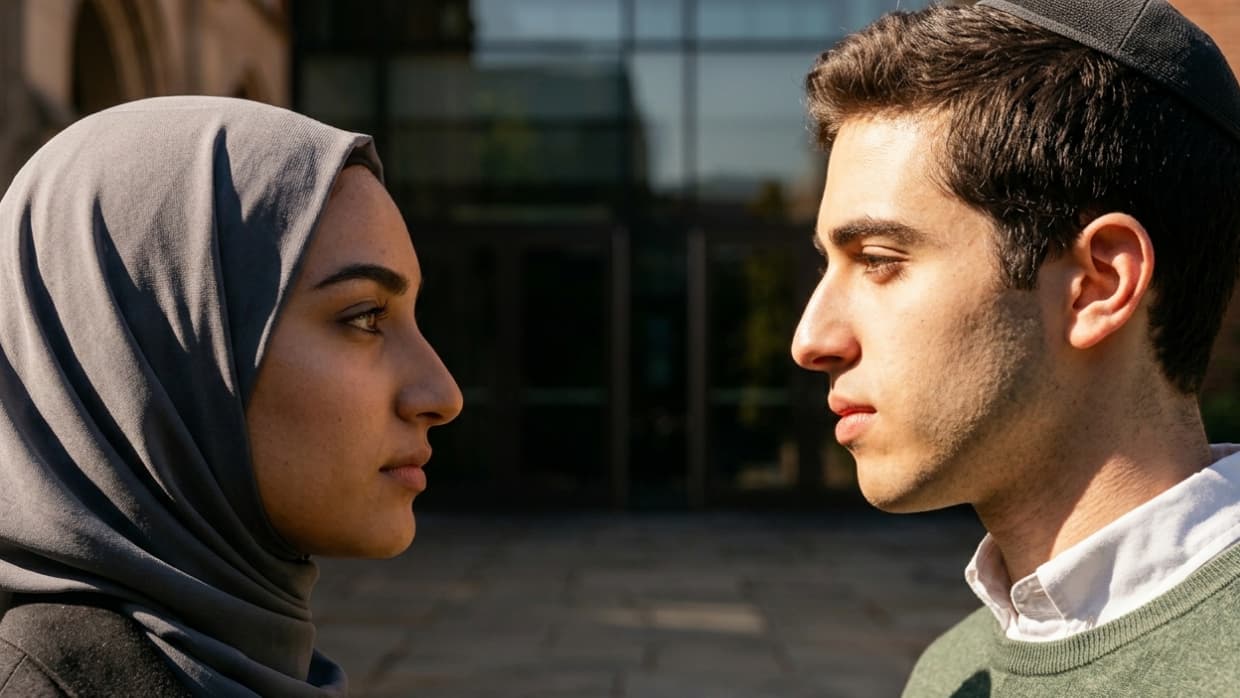
That's how "Building Bridges" was born — a grassroots program that brought Muslim and Jewish students together. It ran for 20 years and earned both national and international recognition.
Though I'm neither Jewish nor Muslim, the program gave me deep friendships and real learning from both communities. I was invited to speak at a conference in Jerusalem and had the rare opportunity to enter the West Bank. I don't claim to be a Middle East expert, but I've learned a great deal over the years. Here are eight things I've discovered:
About 2,000 years after Judaism began, an Arab man named Muhammad claimed to be a prophet of God and invited Jewish tribes to join his new religion, Islam. The Jewish communities in Medina said no. Things went downhill from there.
Once it was clear the Jews weren't joining, tensions grew. Muslims had originally prayed toward Jerusalem, but after the rejection they shifted toward Mecca. Muhammad eventually gained power in Medina and removed all Jewish opposition.
According to Islamic belief, Muhammad received the Quran through divine revelation over 23 years. As time went on, its tone toward Jews grew increasingly hostile. The Quran and the Hadiths (sayings and rulings attributed to Muhammad) contain passages rebuking Jews for rejecting him. The most extreme Hadith states that the Day of Judgment will not come until Muslims fight and kill the Jews.
Conclusion: After 1,400 years, the animosity hasn't changed. Some Muslims and Jews work to find common ground. Others continue to promote division.
According to the Bible, the land some now call Palestine was originally called Canaan, later divided into two Jewish kingdoms: Israel and Judea. The name "Palestine" appears nowhere in the Bible or the Quran.
So where did it come from? After Rome suppressed a Jewish revolt, Emperor Hadrian deliberately renamed the land "Palaestina" — derived from the Philistines, ancient enemies of the Jews. It was an intentional insult, designed to erase the Jewish connection to the land.
Conclusion: Many assume Palestinians have always lived in "Palestine," but the term "Palestinian" wasn't used to describe Arab people of that region until 1964. Today's Palestinians and the ancient Philistines are two entirely distinct groups with no direct lineage.
The Hebrew Bible describes God's covenant with Abraham, promising the land of Israel to the Jewish people. That claim is backed by extensive archaeological evidence of continuous Jewish presence there.
One clear example: the City of David in East Jerusalem. King David captured and established it as his capital roughly 1,600 years before Islam existed. The city has stood for over 3,000 years. And in 1949, the UN General Assembly recognized Israel as a legitimate, independent nation.
Conclusion: No other people have a stronger ancestral claim to this land than the Jews.
This is where things get complicated. Islam offers a different narrative. The Quran also traces a covenant back to Abraham, but Muslims view history through the Quran's lens alone — anything predating it is essentially considered obsolete.
The first Islamic rule in the region began around 636 CE, when Muslim armies conquered Jerusalem from the Byzantine Empire. Some Islamic scholars hold that once a territory comes under Islamic rule, it retains that status permanently — a concept called Dar al-Islam (territory of Islam). The idea of "once Muslim, always Muslim" is frequently cited by extremist groups today, though notably the principle isn't applied to the Jews who ruled the land first.
Arabs also claim entitlement based on British promises made in exchange for their support against the Ottoman Empire during WWI. Land was promised, but never specifically defined. Arabs believe it included Palestine and that the British broke their word.
Conclusion: Not everyone views history through the same lens, and the rules don't seem to apply equally to everyone. That explains the enormous gap between the two narratives.
Jerusalem has always sat at the center of Jewish life. It's where King Solomon built the First Temple. Jews around the world face Jerusalem when they pray. The phrase "Next Year in Jerusalem" has been recited at the end of every Passover Seder (the ritual meal commemorating the Exodus) for a thousand years. Jerusalem is mentioned 669 times in the Hebrew Bible.
Conclusion: Jerusalem is the heart of the Jewish world.
The al-Aqsa Mosque in Jerusalem is considered the third holiest site in Islam. Muslims believe Muhammad ascended to heaven from there. Jerusalem is regarded as holy Islamic territory.
Yet historically, that reverence hasn't always been consistent. Jerusalem is never mentioned by name in the Quran and was never designated a capital under Jordanian rule (1948-1967). During that period, Jerusalem was largely neglected. Jewish and Christian residents complained it was being deliberately ignored. Muslim holy sites were renovated while the Jewish Quarter was largely destroyed. The ancient Jewish cemetery on the Mount of Olives was ransacked, graves desecrated, and tombstones used as construction material.
Conclusion: While Palestinians feel a genuine connection to Jerusalem, the historical record suggests its importance was secondary to erasing its Jewish heritage.
The numbers here are deeply contested. In 1948, UN Mediator Ralph Bunche estimated approximately 472,000 Palestinian refugees. Today, the Palestinian Central Bureau of Statistics puts that number at roughly six million — a striking figure given that Israel's entire population in 1967 was only 2.75 million.
The gap comes down to definitions. The Palestinian count includes all Arabs in the West Bank and Gaza, Palestinians living abroad, and all their descendants. While some Arabs were genuinely forced from their homes, many left voluntarily. Wealthy Palestinians relocated to neighboring Arab countries. Others sold their land to Jewish immigrants. Thousands were encouraged by Arab leaders to leave temporarily and return after Israel was defeated. When that defeat didn't happen, no Arab nation rushed to absorb them.
The refugee crisis that rarely gets discussed is the 820,000 Jews expelled from Arab countries after Israel's founding. Their property was seized without compensation. Israel absorbed them at its own expense.
As for the Arabs who stayed in Israel in 1948 — they were granted full citizenship, with the right to live, work, and vote, along with access to national healthcare and education.
Conclusion: Israel absorbed Jewish refugees expelled from Arab lands. Palestinians remain in exile. Arabs who stayed in Israel in 1948 received citizenship. Jews were driven out of Arab countries and told to go live in the Jewish state — the same state many of those Arab countries now want destroyed.
In 1896, Theodor Herzl, the father of Zionism, argued that the Jewish people needed their own territory. Herzl felt that Jews would never be safe in any country as long as they were a minority population. Jewish leaders lobbied for decades to make it happen. After WWII, it was apparent that Herzl was right, and lobbying efforts intensified. Zionist organizations targeted the British government, the United States, and the United Nations. Their efforts paid off.
The UN decided to partition the land into two independent states, one Jewish and one Arab. Jewish leadership accepted the plan and moved forward. The Arab League rejected it. They had no desire to share the land and felt all of it should be theirs. They have continually rejected any type of mediation or compromise ever since.
What I find difficult to understand is that during the years Jordan controlled the West Bank, there was never a demand for an independent Palestinian state. And today, the Hamas charter still does not call for a sovereign Palestinian state.
Conclusion: Under Jordanian rule, no one demanded Palestinian independence. Under Hamas, the charter still doesn't ask for it. Their sole focus is the destruction of Israel. That keeps bringing me back to the same question: is this conflict really about Palestinian independence, or is it about Israel's right to exist?
After years of conversations, friendships, and firsthand experience with both communities, I remain hopeful. The vast majority of people on both sides want the same things: safety, dignity, and a future for their children. The loudest voices are rarely the most representative ones. Change doesn't come from governments or charters — it comes from people willing to sit across from someone different and actually listen. That's what "Building Bridges" taught me, and it's a lesson I haven't forgotten.












Impressive effort
Wonderful article! I am keeping this one to preserve the information shared by the author. Any time we (Jews) can have the support of educated, informed non-Jews, it is a victory against the misinformation spewed by those who wish us to "disappear".
Thank you for being an independent thinker in search of the truth instead of following what appears to be the majority of largely ignorant hotheads seeking justification for their illogical antisemitism.
As the adage goes, "Money talks" (yes, these days in Arabic especially) – so loudly that it can cover truth with even preposterous lies.
Thus, your willingness to dig deeper than the rot in today's media restores one's faith that there are still people who don't shoot off their mouths without knowing what they're talking about!
Thank you for sharing this clear information!
What about the Samaritan populations spread around the Holy Land a number of Christians and Muslims (Palestinians)can actually trace their lineage to both Jewish and Samaritan origins, including via dna testing.
The first president of Israel moved the Samaritans up out of Nablus/Shekhem to Mount Gerizim because they were being harassed & attacked by Arab Muslims. A large number became Muslims & are actually part of today's pro-Hamas government in Nablus/Shekhem. A few years ago our school went on a trip to their mountain top village & I got to talk with some of them. They said a number of Muslims lived in their tiny village because they had married their daughters. That's the beginning of their end. The Talmud details the complication of their halakhic status which includes Cohanim who married into them. Because of so much endogamy which has lead to unfortunate genetic defects, they've taken to marrying non-Jewish women from Ukraine, another nail in their coffin.
"Muhammad eventually gained power in Medina and removed all Jewish opposition." He actually beheaded all the men and raped the women, or took them as 'wives'.
This is the reason why Israel should not do anything that evolves American troops. I know Israel has said numerous times it does not want this, but it should be repeated.
what does that have to do with anything? yes they want to be independent and soon they will be. But they are the best ally America has and Israel is always threatened. The Palestians still want to destroy the Jews , and not for land. Shouldn't America help them? America's enemies are Israel enemies and visa versa!