






 In Poland, Even Winnie-the-Pooh Has a Holocaust Story




18 min read


The story of the Jewish orphans of Poland who found refuge in Iran.
The history of the Holocaust is often mapped along a familiar grim landscape: yellow Stars of David sewn onto coats, families separated on arrival platforms, and smoke rising from crematoria in Nazi-occupied Poland. While 90% of Polish Jews were trapped behind the walls of ghettos and the barbed wire of Auschwitz, Treblinka, and Belzec, more than a quarter of a million Jews found a way out.
A narrow window of escape opened during the German invasion of Poland in September 1939, when hundreds of thousands of Jews fled in the only direction they could -- east, toward the Soviet Union. Their survival path took them on a dizzying geographic route. While most Jewish refugees in the USSR ended up in slave labor camps in Siberia or faced starvation in Central Asia, a small group of roughly 1000 Jewish youth from Poland -- mostly orphans -- managed to exit Soviet territory during the war and found refuge in a strange new world: the capital of Shah-era Iran.
This is the true historical account of the "Tehran Children."
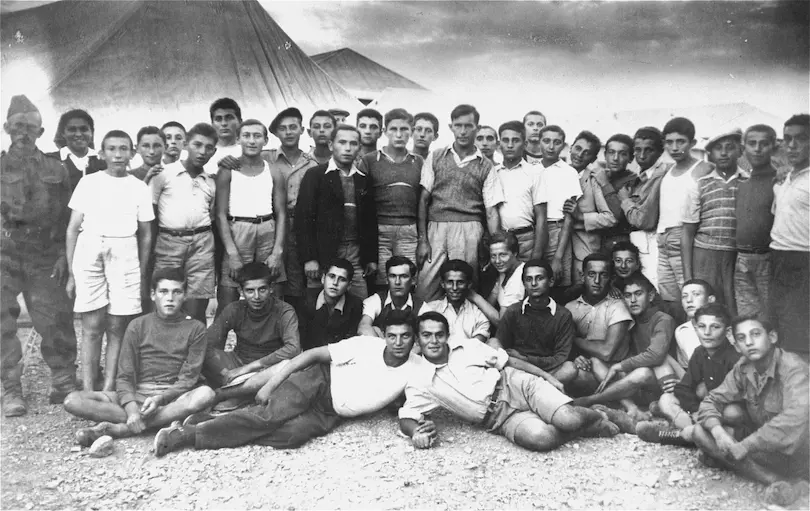 “The Tehran Children,” in Iran, circa 1942.
The children who came to be known as the "Tehran Children" were not gathered from a single orphanage in Warsaw or Lodz. Before the war, they didn't know each other, and they were not orphans. They were normal Jewish kids with normal, comfortable lives: parents, brothers, and sisters. Separated by geography, social class, and religious observance, they only came together during the war.
In the northeastern Polish town of Ostrów Mazowiecka, nine-year-old Hannan Teitel lived a life cushioned by his father's brewery, a world of sweet grain and malt, anchored by the rhythm of a traditional Jewish home. In another corner of Poland, five-year-old Natan Fuchs played in the parks of Katowice, a protected younger brother in a cultured European city.
Their world ended on September 1, 1939, when Nazi Germany invaded Poland. The Luftwaffe (German Air Force) used deliberate terror-bombing tactics to flatten urban centers, specifically targeting Jewish neighborhoods. Survivors recalled German pilots flying at tree-top altitudes, 50 to 100 feet, machine-gunning Jewish civilians in the streets, close enough that victims could see the pilots' faces and goggles.
Most Jewish families grabbed what they could carry and fled east into the forests. The Teitel family loaded a commercial truck with winter coats, food, jewelry, and cash, and frantically drove toward eastern Poland.
Why east? Nazi Germany surrounded Western Poland on its western and northern borders in 1939. Slovakia in the south was a de-facto puppet state of Nazi Germany with German troops stationed on its soil. The only direction to escape was east, deeper into the Polish interior. The point was to get out of harm’s way and in the case of the Jewish population, to also avoid persecution by a foreign antisemitic regime.
At the time, it was not yet known how fast German forces would advance across the country. The general public assumed that Polish armed forces would gather in Eastern Poland and push back the Germans from there. They were caught off guard when on September 17, Soviet forces entered Eastern Poland and systematically took over the area, in line with a secret clause in the Molotov-Ribbentrop Pact, which was a non-aggression pact made between the USSR and Nazi Germany just one week prior to the Nazi invasion. For many Jews, however, the Soviets were the lesser of two evils.
Between 250,000 and 300,000 Jewish refugees successfully crossed into the Soviet-occupied zone of Eastern Poland, settling in border towns like Kovel, Lvov, and Bialystok. My grandparents were among them. For nine months, they lived in crowded, makeshift apartments, suffered severe food shortages, and were constantly surveilled by the NKVD (Soviet secret police). Polish Jewish refugees faced a brutal catch-22: accept Soviet citizenship and be trapped forever in the USSR, or sign up to return to Nazi-occupied Poland. Most chose to wait in terrified limbo, hoping for a third way out.
It never came.
To Stalin, anyone who rejected Soviet citizenship or refused to return behind German lines was a counter-revolutionary or potential spy. In the dead of night on June 29, 1940, military boots echoed in the stairwells of Kovel and Lvov. The NKVD gave families less than an hour to pack. In a single night, 75,000 to 90,000 Jewish refugees were rounded up and packed into teplushki, wooden freight cars fitted with rough bunks and a hole in the floor for a toilet. Over the following months, another 40,000 to 50,000 Jews were arrested and deported to the east.
The trains rolled deep into the Soviet interior. For weeks, refugees watched through slatted windows as the European landscape gave way to remote regions of the USSR, like the dark forests of Arkhangelsk in the far north and the jagged peaks of the Ural Mountains. Most of the Jewish refugees, however, ended up in the frozen expanse of Siberia. They were dumped into "Special Settlements", slave labor camps surrounded by subarctic forest.
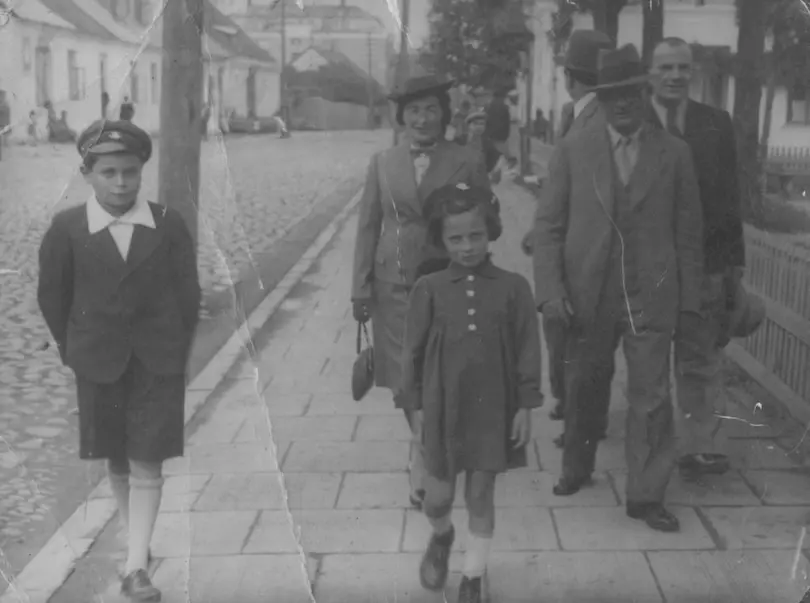 Hannan Teitel with his family in Ostrów Mazowiecka, Poland, circa 1938.
Hannan Teitel, barely ten years old, watched his parents grow gaunt as they were forced to chop massive trees in sub-zero temperatures. Natan's family was crammed into a single freezing barrack room alongside 17 others. Food was tied strictly to work quotas. If a worker fell short, their child's bread ration was cut in half. People began dying of exhaustion.
As grim as the conditions were, in retrospect, Siberia was better than the killing pits of Ukraine or the death camps of Poland. By deporting them thousands of miles east, Stalin inadvertently saved between 120,000-140,000 Jewish refugees, including Hannan Teitel and Natan Fuchs, from the Nazi invasion that would come one year later.
On June 22, 1941, Hitler betrayed Stalin and launched a massive invasion of the Soviet Union. Those Jewish refugees in Eastern Poland who managed to avoid deportation by the Soviets fled from the advancing German army deeper into the Soviet interior, following the path of their brethren the previous summer.
Panic-stricken and desperate for Western allies, Stalin signed a treaty with the Polish Government-in-Exile granting an immediate "amnesty" to all Polish citizens trapped in Soviet labor camps, giving them freedom of movement within the USSR. Masses of skeletal human beings were suddenly "free," but stranded thousands of miles from home with no money, no food, and no winter clothes. Poland was still under Nazi occupation. The NKVD therefore issued travel documents to hundreds of thousands of Polish refugees, Jewish and non-Jewish alike, and put them on trains. Destination: Central Asia.
The region offered warmer climate and higher food supply. It was also where the newly forming Polish Army-in-exile was recruiting, offering a potential exit from the USSR. For the Soviets, it was a convenient dumping ground far from the front lines that desperately needed laborers to harvest cotton and grain for the war effort.
Refugees flooded the Soviet railway system, riding on rooftops, clinging to the buffers between cars, or walking on foot. The route south from Siberia and other remote parts of the USSR to Uzbekistan, Kazakhstan, and Tajikistan was a path of pure attrition. When they finally arrived, expectations of food quickly evaporated. The German invasion had already devastated the Soviet supply chain, plunging the region into a catastrophic wartime famine. Jews, Poles, and other refugees died by the thousands from starvation, typhus, and malaria.
In ancient Islamic trading cities like Samarkand and Tashkent, the sidewalks were literally lined with dying Jewish refugees from Poland. Although many of the children had already lost family members during the German bombardment of Poland or in the Siberian labor camps, it was here in Central Asia, between 1941 and 1942, that most of them became orphans. Natan Fuchs's father, Karol, withered away from starvation in a mud hut in Samarkand. Before the end, Natan and his sister Ziva were brought to see him one last time. Karol was an unrecognizably thin, ghostly shadow of the father they knew. He died hours later.
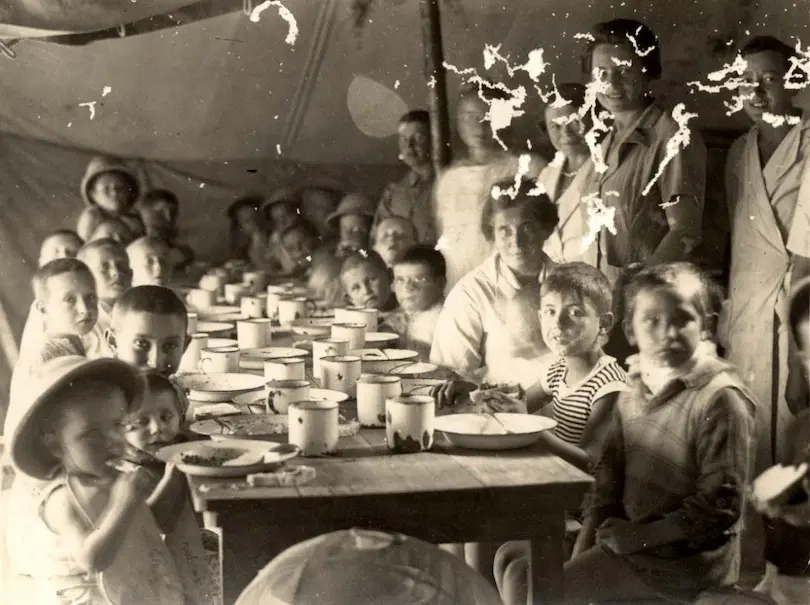 Dining room in a camp for the Tehran Children (Yad Vashem)
That same suffocating Uzbek summer, Zindel and Ruchela Teitel looked at their children, Hannan and Regina, and faced a terrifying truth: if the children stayed, they would all starve to death. With breaking hearts, thousands of Jewish parents made the ultimate sacrifice. They walked to the gates of orphanages being established by the Polish Government-in-Exile and local Soviet authorities, handed their children over, and walked away. They knew that registered orphanages received priority diplomatic rations from the American Jewish Joint Distribution Committee (JDC) and the Red Cross.
Reflecting on this, Hannan Teitel later said: "My parents wanted to save us. It was the right thing to do."
The Polish-run orphanages, however, were a mixed blessing. Many were rife with virulent antisemitism. Jewish children were beaten by Polish staff and other orphans, called “Christ-killers”, forbidden from speaking Yiddish, and forced to kneel and recite Catholic prayers to receive their daily bowl of thin broth.
To survive, the Jewish children developed an intense, pack-like loyalty to one another. Older kids became surrogate parents. Ten-year-olds held the hands of four-year-olds, whispering Yiddish lullabies at night to ensure they didn't forget who they were.
Recognizing this horror, Zionist activists within the refugee community, alongside emissaries from the Jewish Agency who had managed to enter the USSR, launched a covert operation. They rented mud-brick houses in Samarkand and Ashgabat, creating underground Jewish orphan units to keep the children together, re-teach them Hebrew songs, and shield them from abuse.
By early 1942, the Soviet Union, facing a brutal German advance at Stalingrad, refused to continue feeding the civilian Polish population, including the orphanages. General Anders was organizing the Anders Army, a Polish military force formed from released labor camp prisoners, in Central Asia to fight the Axis powers. A diplomatic agreement was struck to evacuate his forces, along with a strictly limited quota of civilian dependents, across the Caspian Sea to British-occupied Iran. A fierce bureaucratic battle broke out over the evacuation lists. The Polish authorities systematically prioritized Catholic Poles over Jewish refugees. Out of more than 100,000 slots, only a tiny fraction went to Jews.
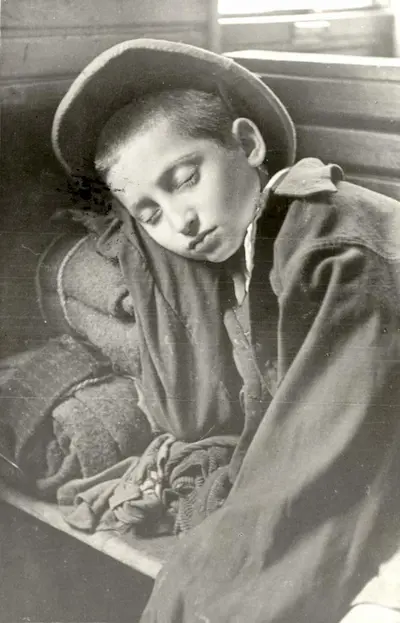 One of the Tehran Children sleeping on the train at one of the stops on the journey
David Ben-Gurion and Eliahu Dobkin of the Jewish Agency in Jerusalem launched an intense diplomatic offensive, negotiating directly with Stanislaw Kott, the Polish Cabinet Minister in exile, and British officials, arguing that the starving Jewish orphans must be prioritized on humanitarian grounds.
The strategy worked. The Jewish Agency, funded by emergency grants of hundreds of thousands of dollars from the JDC, secured the inclusion of the Jewish orphan units in the Anders Army evacuation.
The children were crammed into trains and sent to the Soviet port of Krasnovodsk, then packed into the filthy cargo holds of Soviet oil tankers and coal ships. For days they sweltered, floating across the Caspian Sea toward freedom, terrified that Soviet reversals would drag them back. When the ships finally docked at the Iranian port of Pahlavi (now Anzali), the scene was overwhelming. Thousands of emaciated refugees stepped onto the beach. Their heads were shaved to control typhus and lice. Their bodies were covered in scabies, open sores, and the bloating of severe malnutrition.
As they walked off the gangplanks, Jewish Agency representatives stood on the docks frantically identifying the Jewish children among the sea of Polish refugees, pulling them into separate groups before they could be lost in the general military transport system.
From the shores of the Caspian Sea, the children were transported by military trucks over the winding Alborz Mountains into the valley of Tehran. The Iranian government, under the young Shah Mohammad Reza Pahlavi, opened its borders to the influx. The British military cleared a former Iranian Air Force training base called Doshan Tappeh on the eastern outskirts of the capital and this tent city rapidly became known across the Jewish world as the Tehran Home for Jewish Children.
After being cleaned and sanitized, the children encountered food they hadn't seen in years. Survivor Henryk Grynberg, who later became a prominent author, recalled the sensory overload:
"We saw mountains of white bread, mountains of sugar, and real butter. We didn't know what to do first. Some children choked because they ate too fast, while others buried bread in the dirt because they were terrified it would be taken away." They could not comprehend that there would be food tomorrow as well.
“Medical staff had to ration meals strictly -- digestive systems so atrophied from starvation that eating a full meal could, and sometimes did, prove fatal.
"We had to teach them how to sit at a table again," recalled one Jewish Agency emissary sent to run the camp. "They slept with crusts of bread tucked under their pillows for months. The fear of hunger never truly left their eyes."
Instructors noted that the children didn't know how to play normal games. Instead they played "NKVD," mock-arresting each other, or "Funeral," digging small graves in the camp dust -- a direct reflection of the thousands of unburied bodies they had witnessed in Uzbekistan.
It was here that an incredible cross-cultural encounter took place. Tehran was home to a deeply rooted ancient Persian Jewish community, descendants of Judean exiles from the destruction of the First Temple. They spoke Persian, wore traditional Eastern attire, and practiced distinctly Mizrahi (Middle Eastern Jewish) customs. The orphans were pale, Yiddish- and Polish-speaking Ashkenazi children from the shtetls (small towns) of Eastern Europe.
Yet the moment news of the orphans' arrival reached the Mahalleh (the Jewish quarter of Tehran), cultural barriers vanished. The Persian Jewish community adopted these children as their own. Wealthy families drove to the camp gates with truckloads of fresh pomegranates, oranges, cucumbers, and traditional Persian flatbread (nan), delivered daily. Because the children shared no common language with the local Jewish population, communication was entirely physical and emotional.
Survivor Tzipora Tscherniak recalled a moment that brought the entire camp to tears:
"Local Jewish women came into the barracks. They didn't say a word. They just looked at our shaved heads and our skeletal frames, fell to their knees, and began to wail and beat their chests. They took us in their arms and kissed us as if we were their own dead children come back to life."
Persian Jewish women who visited regularly took the youngest children -- those who had lost their mothers in the fields of Uzbekistan -- sat them on their laps, washed their sores, combed through their newly growing hair, and mended their oversized clothing.
During the major Jewish holidays of late 1942, the integration was complete. The Persian Jewish community organized massive celebrations, brought traditional sweets, and ensured the children marked Sukkot and Chanukah surrounded by communal love. Local synagogues held special prayer services for the orphans, and community leaders used political connections in the Iranian parliament to maintain the camp's security against local Axis-sympathizing elements.
As the months passed, Doshan Tappeh became a vibrant youth village. The children were taught Hebrew songs, introduced to agriculture, and gradually re-socialized. The madrichim (guides) from British Mandatory Palestine deliberately used the promise of Eretz Yisrael (the Land of Israel) as a therapeutic tool, telling the children they were going to a place where no one would ever lock them in cattle cars again.
Tehran was always meant to be a temporary stop. Under the British 1939 White Paper, however, Jewish immigration to Palestine was strictly limited out of fear of inflaming tensions with the Arab population, leaving the Tehran Children trapped in political red tape.
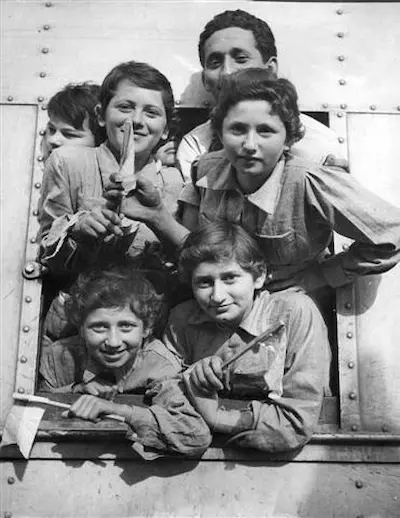 The “Tehran Children" on a train bound for Mandatory Palestine, 1943, photo courtesy of the Central Zionist Archives
This changed when a bread crisis erupted in Iran in late 1942. The presence of over 100,000 Allied troops and 116,000 Polish refugees had created a food shortage that triggered violent riots. A desperate British military finally cut through the bureaucracy and decided to evacuate the orphans.
The natural overland route home, west through Iraq, into Transjordan (present-day Jordan), and across the border into Mandatory Palestine, was blocked. The Iraqi government refused transit, viewing the orphans as future Zionist settlers who would alter the demographic balance of Palestine. In the fragile aftermath of the 1941 Farhud (an anti-Jewish pogrom), the regime also feared that a visible Jewish convoy crossing Iraq would trigger nationalist revolts. Faced with this blockade, the Jewish Agency and the British military designed a complex circular maritime route.
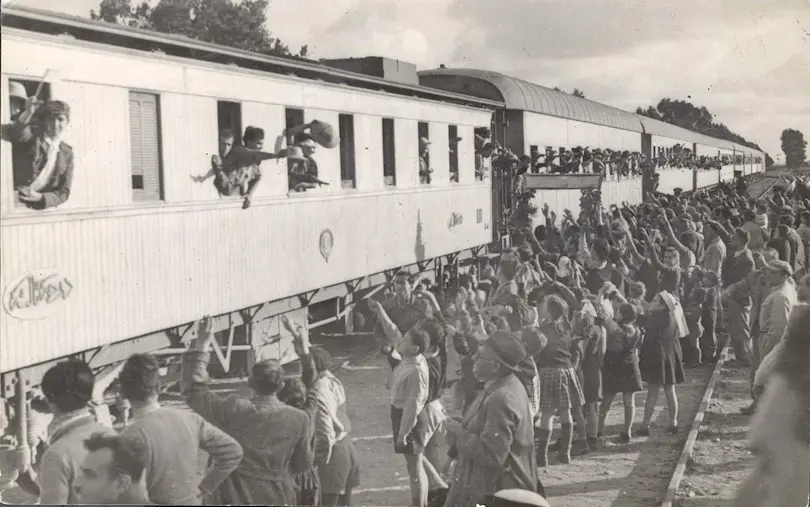 A crowd awaits the arrival of the Tehran Children at the railway station, Hadera, Israel
On January 3, 1943, the gates of Doshan Tappeh officially closed. The children, now physically recovered, clothed, and vibrant, were loaded into trucks and traveled south through the rugged Iranian interior to the port of Bandar Shahpour on the Persian Gulf. There they boarded the British military transport HMT Dunera, which carried them 1,500 miles east, in the opposite direction, to Karachi (present-day Pakistan), then a massive Allied logistics hub in British India. The Persian Gulf ports had no passenger vessels heading west; Karachi did. Before continuing, the children spent a few weeks in a transit camp where Karachi's small local Jewish community brought them hot meals, fresh clothes, and toys. They then boarded a second vessel, the SS Noralea, which carried them west across the Arabian Sea, through the Bab-el-Mandeb strait, and up the Red Sea to Port Said in Egypt.
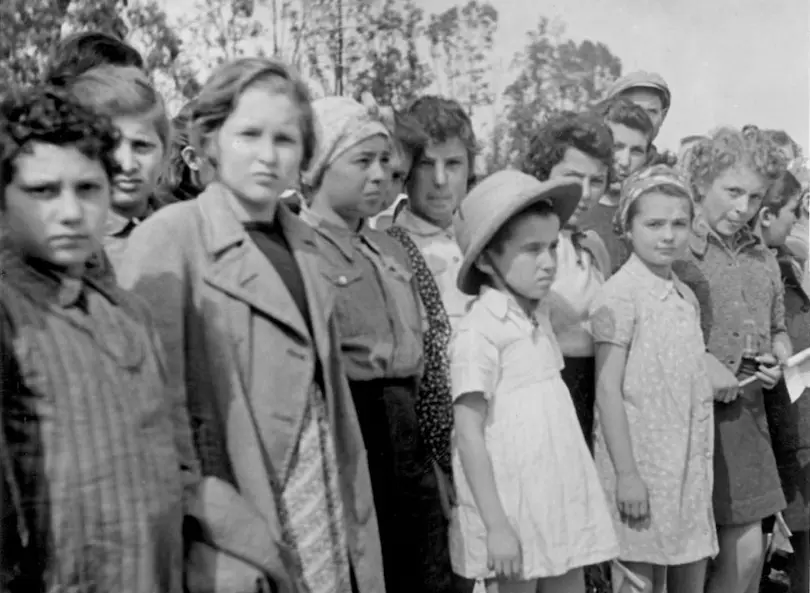 Group of Tehran Children at the railway station in Atlit, February 1943
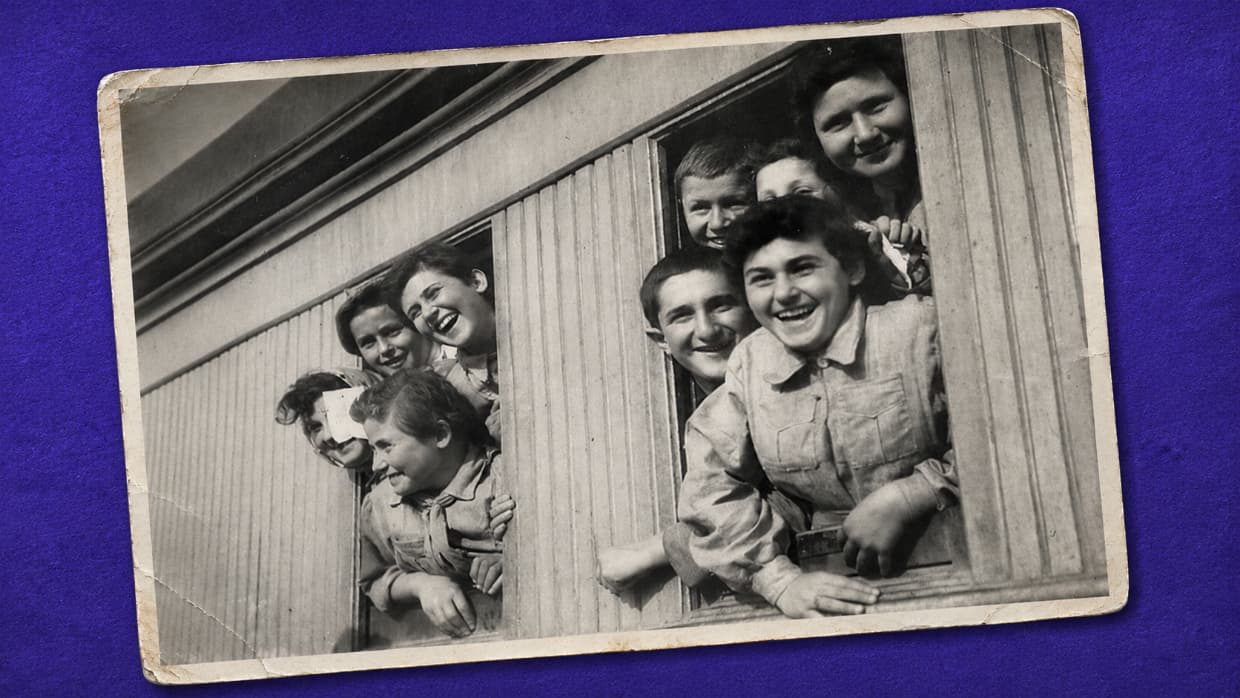
On February 18, 1943, the final leg began. 870 children accompanied by 300 adults (guides/caregivers) boarded a British military train whose tracks cut through the sands of the Sinai Desert. When the train crossed the border into the Land of Israel, the tracks were lined with people. The pre-state Jewish community had brought its economy to a virtual standstill.
As the train pulled into stations at Rechovot, Lod, Hadera, and Binyamina, tens of thousands crowded the platforms. Old men in long black coats, young kibbutz members in khaki shorts, and women holding babies stood side by side, weeping openly. People reached through the open windows, handing the children boxes of fresh oranges, chocolates, and handmade toys.
David Ben-Gurion and other Jewish Agency leaders boarded the train or stood at platform windows at Rehovot to officially greet the children. For a community receiving daily reports of the systematic annihilation of their families in Europe, the arrival of the Tehran Children was a jolt of hope, proof that the Jewish future could not be extinguished.
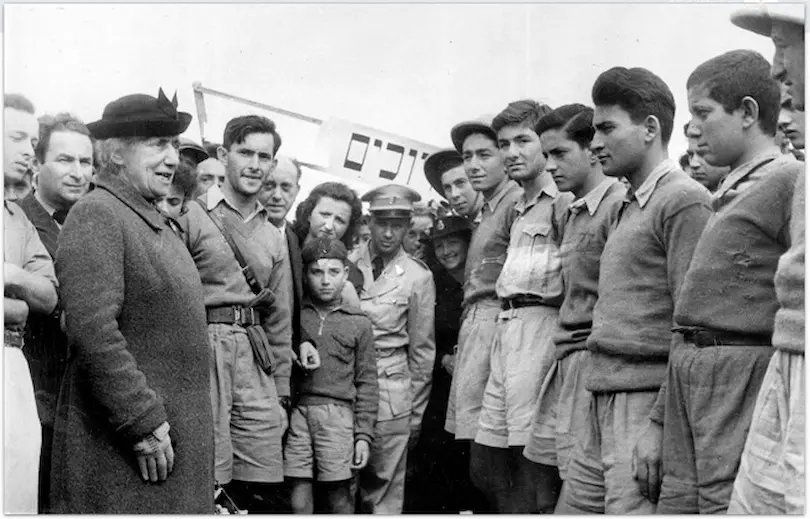 Henrietta Szold welcoming the Tehran Children. Photo: Nadav Mann, Bitmuna, from Hadassah
When the train reached its final destination at Atlit, the reception was led by Henrietta Szold, founder of Hadassah and head of Youth Aliyah. Szold had spent months organizing the logistics of the children's arrival and stood on the Atlit platform to personally oversee their disembarkation, medical screening, and transfer into the transit camp.
In 1949, six years after the Tehran Children first arrived in British Mandatory Palestine, a bittersweet reunion took place when Hannan Teitel's mother, Ruchela, arrived alone in the newly established State of Israel. His father, Zindel, who had survived Siberia and Central Asia, had succumbed to tuberculosis in a displaced persons camp in Germany that very same year.
When Ruchela stepped off the ship at the Port of Haifa, Hannan faced the heartbreaking shock shared by so many of his peers. The robust parents of their Polish childhoods had been replaced by fragile, hollow-cheeked strangers carrying the silent weight of the war years. The emotional gap, caused by years of separation and the children's transformation into Hebrew-speaking Israelis, laid itself bare.
Fellow Tehran child Ben-Zion Tomer captured the collective numbness of these emotionally charged reunions when he recalled looking into his own surviving mother's weeping face and whispering, in a mix of grief and guilt: "Mother, I don't feel anything... I want to cry and I can't."
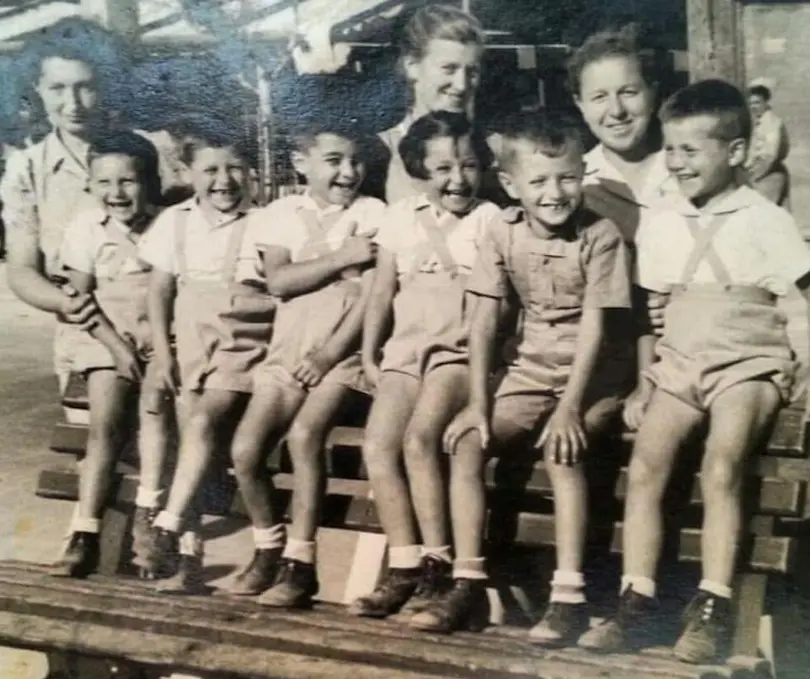
The vast majority of the parents of the Tehran Children did not survive the war. The children were distributed among kibbutzim and youth villages across Israel, such as Ein Harod and Ben Shemen. They learned Hebrew and became integral citizens of the emerging Jewish state.
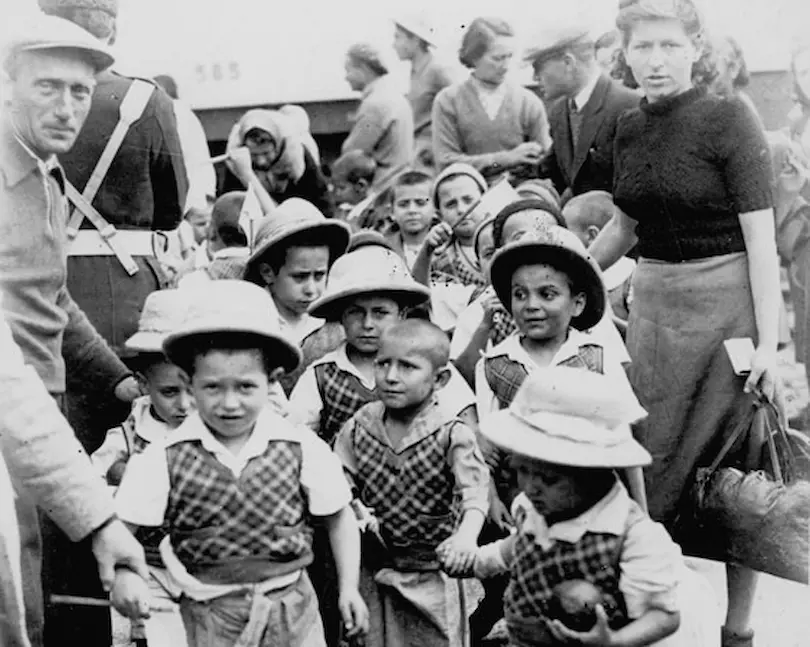 The Tehran Children arriving in the Land of Israel, 1943
Out of the trauma of their 13,000-mile odyssey emerged some of Israel's greatest leaders. General Yanush Ben Gal, who saved the Golan Heights during the desperate early hours of the 1973 Yom Kippur War, was one of the Tehran Children. General Haim Erez, head of the IDF's Southern Command, was another.
Hannan Teitel went on to serve a 48-year career in the Israeli Air Force. Alex Giladi became a pioneer in Israeli broadcasting and sports media, serving as a long-standing member of the International Olympic Committee (IOC). Ben-Zion Tomer became an influential author, poet, and playwright. His landmark 1962 play, Children of the Shadows (Yaldei HaTzel), was one of the first major Israeli theatrical works to directly explore the psychological rift, survivor's guilt, and identity struggles faced by the Tehran Children and other Holocaust survivors integrating into Israeli society.
In the end, children of the cattle cars became the builders of a nation.
Sources:










some of the children ended up in religious orphanes and grew up to raise religious families
it would be interesting to interview them and find out exactly what happened
A touching article on the trauma & suffering of the Tehran children. That several of the children survived and contributed to the new state of Israel shows the hand of God.
Amazingly written article!
We as Jews born after the Shoa have to be positive and celebrate the fact that these holy neshomas found their way HOME!
Many may not have been frum but they became ISRAELIS and part of our Nation and each and everyone of them contributed to by building families, an economy, a military and whatever Hashem deemed for them to do for Klal Yisroel!
Let’s look forward to a strong State of Israel, the Galus’ loss when each of us makes Aliyah and strengthens and builds our beloved Nation!
Am Yisroel Chai
My uncle, Emanuel Harari (b. 1920), who died a few years ago, was older than these children, but I recognise much of the account of the Tehran children in his story. He was made to work in these bitterly cold forests. Every morning they awoke to dead people around them who had frozen to death overnight. He also wrote of the beautiful scent of the citrus groves as the train pulled in to Rehovot. He married my father's sister, who was widowed with a child. Her first husband was killed in the war of independence.
I am crying my eyes out as I read this article.
I'm wondering whether you might be able to obtain names of the Jewish-Polish children that were on the Tehran Transport, or directives as to whom we should connect with.
Thank you in advance for your time.
Has anyone seen a genealogy of Ben-Zion Tomer?
As a New Zealander, born in 1946, so far from the Holocaust, it is a delight to read of your history of escapees who helped establish modern Israel. It is heart rending to hear of such widespread trauma with so few survivors. It is a a priviledge to say Am Israel Chai.
Well written article! 🙂
Thank u for discussing this important topic. However, you omittted the vimp. topic of how the Teheran children were socialized. The Zionist leftist groups took numerous children who came from traditional orthodox homes and placed them in leftist kibutzim in an effort to erase Judaism
from their hearts and minds.
This i s topic that needs to be explored fully. Thx, Mrs. Spira
Exactly. The elephant in the room is completely ignored. A very large percentage if not the majority of these children were from observant homes, and they were deliberately (and sometimes forcibly) distanced from Jewish practice. By the orders of some of the people who get "honorable mention" in this article...
You are right, it happened to others too, trying to make children from religious homes, it was left labor government that did that to immigrant children, I think in the end their descendants or they went back to being religious
I agree. I wonder why that part was omitted. It is definitely part of the secular Zionist scheme....Awesome chessed on one hand together with ripping them from their heritage on the other. 60% truth is 100% sheker