







 Those Shameful Thoughts and What They Really Say about You
Jewish Geography
Jewish Geography





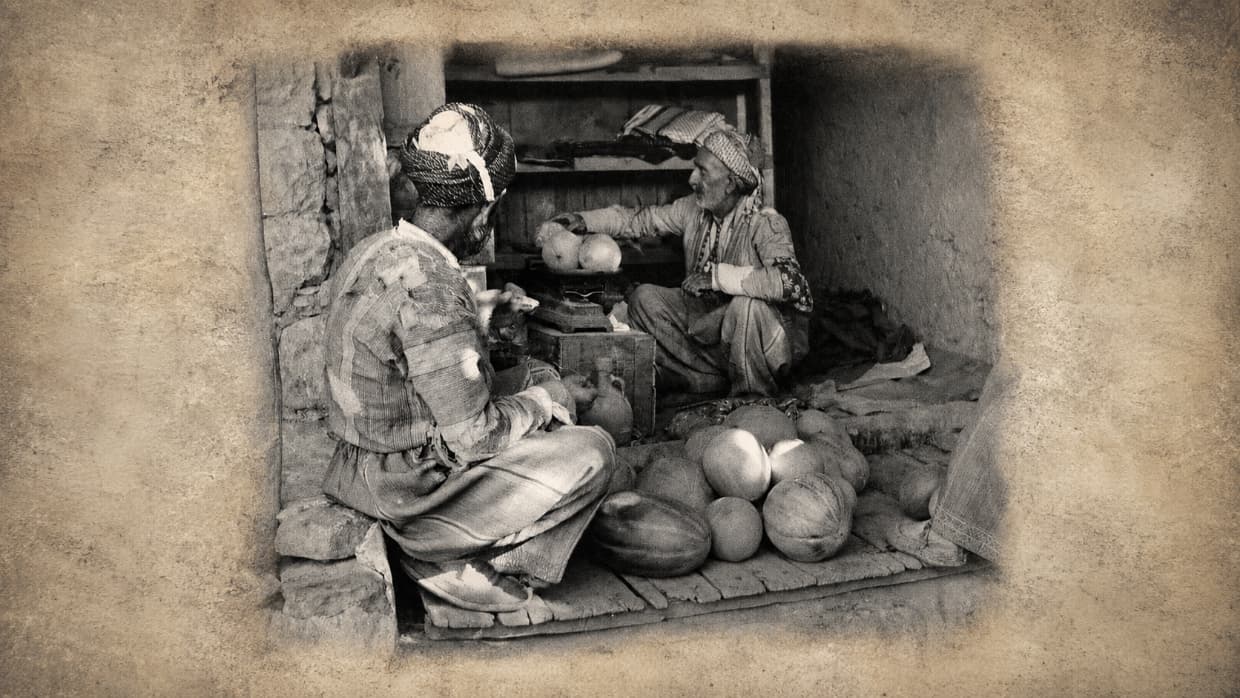
Aramaic, the language of the Talmud and the Kaddish, was supposed to have died out centuries ago. One community in the mountains of Kurdistan never got the memo.
For most Jews today, Aramaic is a language locked behind the gates of ancient Judaism. It's the dense, scholarly text of the Talmud, the mystical language of the Zohar, the legal phrasing of the Ketubah (marriage contract), the solemn declaration of Kol Nidre, and the comforting cadences of the Kaddish. It serves as a linguistic snapshot from an era when the Sanhedrin sat in Jerusalem and the sages debated Jewish law in Babylonia.
As a living, breathing mother tongue, many assume Aramaic drew its last breath millennia ago. But history has a way of defying expectations.
In the rugged mountains of Kurdistan that span the isolated border zones of present-day Iraq, Iran, and Turkey, an ancient Jewish community managed the impossible. For roughly 2,500 years, through the rise and fall of empires, Islamic conquests, and brutal persecutions, this community kept the Judeo-Aramaic language of the Talmud alive, in the marketplace, around the dinner table, and in the lullabies sung to their infants. They were the only Jewish community in the world to preserve the oldest Jewish Diaspora language all the way into the 21st century.
To understand how this linguistic miracle happened, we need to trace how the Jewish people fell in love with Aramaic in the first place, how the rest of the Diaspora lost it, and how one indomitable community carried it home to the modern State of Israel.
The language originally recorded in the Torah and spoken by the Jewish patriarchs, prophets, kings, and common people in ancient Israel during Biblical times was Hebrew. The books of the Prophets and Writings (Tanach) are also written in a vibrant, classical Hebrew that reflected the daily vernacular of the kingdoms of Israel and Judah. Hebrew's dominance in the First Temple period is confirmed by discoveries like the Siloam Inscription (commemorating King Hezekiah's water tunnel), the Ketef Hinnom silver scrolls (containing the oldest known fragments of the Priestly Blessing), thousands of "LEMELECH" (for the king) royal storage seals, and personal bullae, clay seal impressions bearing Judean names mentioned in the Bible, found throughout the land.
Not only was Hebrew the native language of Jews in ancient Israel, but most Jews during the First Temple period didn't even understand Aramaic, which was fast becoming a regional language across the ancient Near East. In the Book of Kings (2 Kings 18:26), when the army of the Assyrian king Sannacherib besieges Jerusalem, the royal envoys mock the city's defenders in Hebrew. King Hezekiah's officials panic and beg the envoys to switch to Aramaic when addressing them personally, so the common Jews on the wall won't understand the terrifying threats being hurled at them. At that moment, Aramaic was understood only by elite Judean diplomats. The average Jew on the streets of Jerusalem spoke Hebrew, and only Hebrew.
So when did Aramaic enter the picture?
Everything changed in 586 BCE. The Babylonian Empire destroyed the First Temple and exiled masses of Jews from the Land of Israel to the rivers of Babylon. There, in the heart of the Babylonian empire (present-day Iraq), the Jews underwent a profound cultural shift.
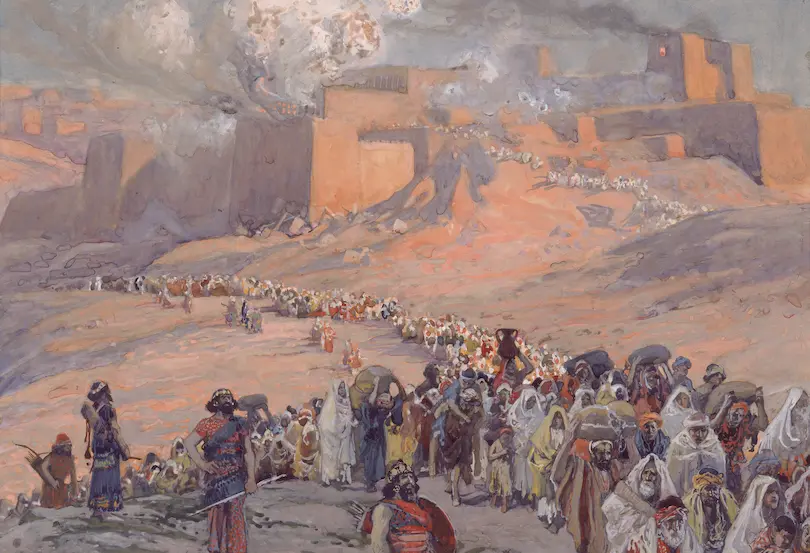 The Flight of the Prisoners (1896) by James Tissot, Jewish Museum, New York
Babylon ran its bureaucracy in Imperial Aramaic. Over the 70 years of exile, displaced Jews absorbed the new language of their surroundings into daily life, social interaction, and business, while keeping Hebrew for liturgy and prayer. In southern Iraq, archaeologists found roughly 200 cuneiform clay tablets dating to 572 BCE, over a decade after the Temple's destruction, recording the financial, agricultural, and daily dealings of exiled Judean families (identified by distinctive Judean names like Ahiqam and Shelemiah) living in settlements such as Al-Yahudu, "Town of Judah."
This kind of rapid linguistic shift within a generation is something we can all relate to. In the 20th century, Yiddish-speaking Jews from Europe became fluent in English within a generation of settling in North America, while Arabic-speaking Jews from the Middle East and North Africa became fluent in Hebrew after moving to Israel.
Wherever Jews settled, they typically adopted the local language while folding in elements of Hebrew, giving us Yiddish (Judeo-German), Ladino (Judeo-Spanish), Judeo-Arabic, and others. In Babylonia, Jews developed a Hebraic variety of Aramaic known as Judeo-Aramaic, which quickly became the mother tongue of the generation born in exile.
When Cyrus the Great, king of Persia, allowed the Jews to return to the Land of Israel and rebuild the Temple, only a small wave of Jews actually went back. Most Jews stayed in Babylonia. But the roughly 50,000 who returned brought Aramaic with them, and it remained their primary language in the Land of Israel for centuries.
Later books of the Biblical canon written during the early Second Temple period, such as Ezra and Daniel, contain large sections in Aramaic rather than Hebrew, recording royal decrees and prophetic visions in the language of the masses. When Ezra the Scribe read the Torah aloud to the returning exiles, Nehemiah 8:8 notes that the Levites translated the reading (from Hebrew into Aramaic) so the people could actually understand it.
Throughout the Second Temple period, Aramaic was the most widely spoken language among the Jews of Judea, and many customs, prayers, and liturgy still in use today were composed during this time. The Ketubah, early versions of which have been found in Judean Desert caves, was written in Aramaic rather than Hebrew, so ordinary people would fully understand their binding legal and financial obligations.
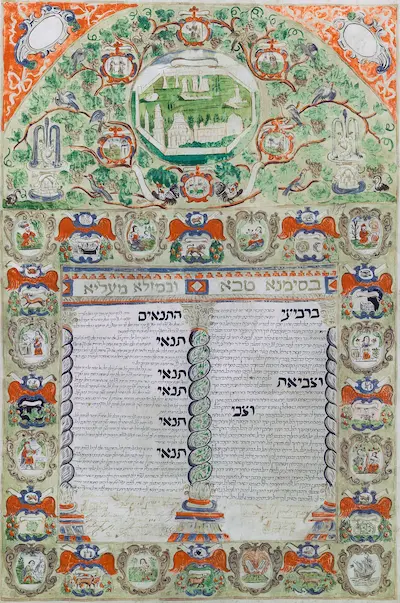 Decorated Ketubbah, Livorno, 1698.
The first-century sage Yonatan ben Uziel, Hillel the Elder's greatest disciple, composed his Targum (Aramaic translation) of the Prophets during that period. About a century later, the sage Onkelos translated the Torah into Aramaic. The Kaddish prayer, woven throughout the prayer service, also emerged during this era.
Aramaic wasn't the only language ancient Jews spoke, even though it dominated in both Babylonia and the Land of Israel. Rural pockets of Judea that had escaped Babylonian exile kept speaking late Biblical Hebrew, which eventually evolved into Mishnaic Hebrew. And the largest Jewish population of this era actually lived outside both Judea and Babylonia, thriving in Mediterranean cities under Roman rule such as Alexandria, Damascus, Antioch, Cyrene, and Rome, where daily life ran in Greek. Of the 5 to 8 million Jews alive in the late Second Temple period, roughly half spoke Aramaic (in the Near East) and half spoke Greek (in the Western Diaspora).
Those large Greek-speaking Jewish populations of the Roman Mediterranean were decimated by violent massacres during the Kitos War (115-117 CE). Greek-Jewish hubs in Egypt, Cyrenaica, and Cyprus were wiped out not only by ethnic cleansing but by plagues that thinned Mediterranean Jewish communities over the following centuries. Later Byzantine Christian laws further restricted Jewish life and pushed conversion and assimilation, shrinking what remained of the Greek-Jewish world even further.
In the Land of Israel, the Romans crushed the Bar Kochva Revolt (132-135 CE), destroying 985 villages in rural Judea where Hebrew was still spoken, killing hundreds of thousands of Jews in the process. The last native Hebrew speakers migrated to the Aramaic-speaking Galilee, where the Mishnah (the compiled Oral Torah) was being assembled in the late 2nd century. Rabbi Yehuda HaNassi, who wrote the Mishnah in Hebrew, famously employed domestic workers from Judea who may have been the last native Hebrew speakers alive. The Talmud records his students, native Aramaic speakers themselves, asking his maidservants what certain Hebrew words meant.
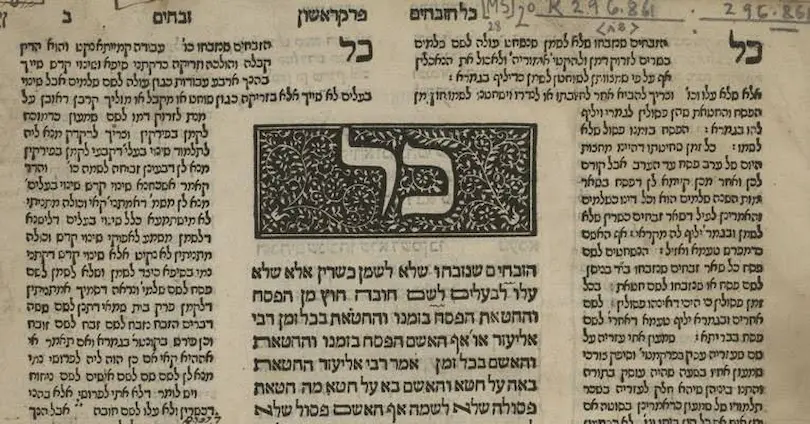
When the sages later compiled the legal debates, stories, and rulings that became the Talmud (4th-6th centuries), they wrote them in Aramaic, their native tongue, so it would remain accessible to the majority of world Jewry, most of whom by then lived in Aramaic-speaking regions.
As the Greco-Roman Jewish world shrank and spoken Hebrew faded, the center of gravity for world Jewry shifted east to Babylonia, a stable, thriving environment where Aramaic was the native tongue of Jews and non-Jews alike. This cemented Aramaic as the primary vernacular and literary language of most of world Jewry for centuries.
Given how deeply Aramaic was embedded in Jewish life, it's striking that it vanished as a mother tongue from nearly every Jewish community within a relatively short span of time.
Jews who migrated or were forced across the Roman Empire picked up Greek, Latin, or Punic, and dropped Aramaic within a generation. But Jews who stayed in the East -- the Land of Israel, parts of Syria, Babylonia, western Persia (Iran), and eastern Turkey -- kept speaking Aramaic for centuries longer.
That changed with the seventh-century Islamic conquests. Within a few decades, Arab armies swept out of the Arabian Peninsula and conquered the Levant, North Africa, and Mesopotamia, the historic heartlands of Jewish life. The new rulers brought with them a new language: Arabic. Over the following two to three centuries, Jews across the Middle East and North Africa gradually abandoned Aramaic and embraced Arabic, the new language of trade and government across a vast empire. Most communities in the region developed Judeo-Arabic, a Hebrew-Aramaic variety of Arabic, between the 8th and 10th centuries -- the language in which giants like Rabbeinu Saadia Gaon and the Rambam (Maimonides) wrote their most influential works of Jewish philosophy and halacha (Jewish law).
By the late Middle Ages, spoken Aramaic had been wiped out across the Middle East, replaced almost entirely by Arabic, Persian, and European languages. Except in one impossible geographic fortress.
While the rest of the Jewish world moved on, one community in a corner of the Middle East kept speaking Aramaic all the way into the 20th century. What enabled the Jews of Kurdistan to hold onto the old Jewish language of the Talmud against all odds?
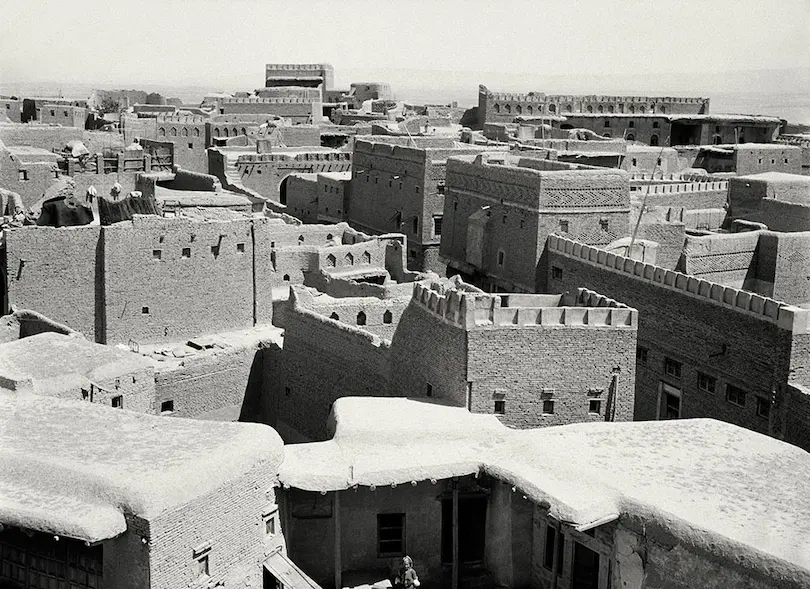 by British photographer Anthony Kersting, Courtauld Institute of Art, London.
The answer starts with geography. Kurdistan is defined by the Zagros and Taurus mountain ranges, a maze of steep ridges, deep gorges, and isolated valleys. The Jewish presence there predates even the destruction of the First Temple, tracing back to the earliest Israelite exiles.
According to local tradition, Kurdish Jewry's roots lie with the Ten Northern Tribes deported by the Assyrian Empire in 722 BCE. The Book of Kings notes the Assyrians settled them in the cities of the Medes, which lines up with the geography of historical Kurdistan.
 While the rest of the Jewish world shifted to Arabic after the Islamic conquests, Kurdistan's terrain acted like a time capsule. The conquering Arab armies built their administrative centers on flat plains and in river valleys -- Baghdad, Basra, Mosul -- with little interest in pushing into the rugged mountain peaks where fierce Kurdish tribes and isolated minorities lived on their own terms.
Cut off from the main currents of global trade and empire, the region's language simply stayed put. The local Jews kept speaking what they'd always spoken. While the surrounding Muslim majority spoke Kurdish, Arabic, Persian, and Turkish, the Jews held onto their Aramaic mother tongue.
Beyond isolation, having a language only Jews understood was a serious practical advantage. It served as a secure internal channel for business, courtship, communal decisions, and travel across borders without outsiders following along. It also drew a sharp line around Jewish identity, acting as a natural barrier to assimilation into the surrounding Muslim culture.
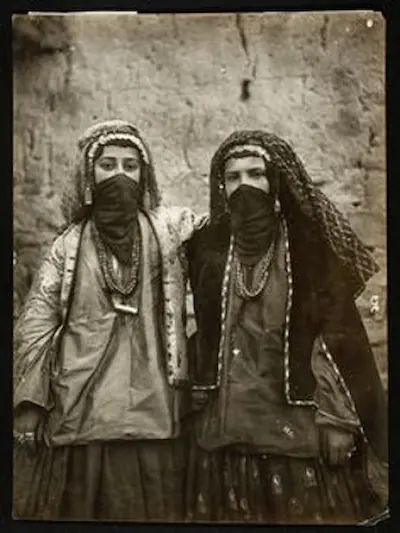
 Kurdish Jews in Rawanduz, northern Iraq, 1905
Because they studied the Talmud, recited the Kaddish, and read the Targum alongside the Hebrew text every week in synagogue, speaking Aramaic in daily life felt like maintaining a living chain back to the Temple in Jerusalem.
The Judeo-Aramaic spoken by Kurdish Jews wasn't identical to the Talmud's text. Over 1,500 years, the language evolved, as all languages do, into a distinct dialect known natively as Lishan Didan, "Our Language." Judeo-Aramaic shifted from an ancient, synthetic structure into modern Jewish Neo-Aramaic, trading old verb conjugations for participle-based tenses and absorbing heavy doses of Kurdish, Persian, and Arabic vocabulary.
Because the community lived in rural isolation, Hebrew literacy was often limited to the local rabbis. To bridge the gap, the community built a rich oral culture around the Tafsir, an oral Aramaic translation of the Torah. On Shabbat, the rabbi would read the Hebrew text and the community would recite the Tafsir aloud in Aramaic, echoing the same translation practice used back in the Second Temple period.
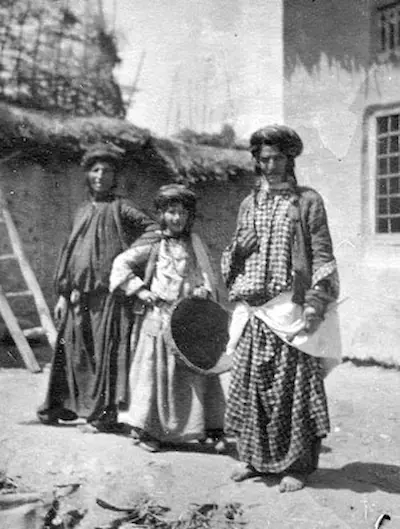
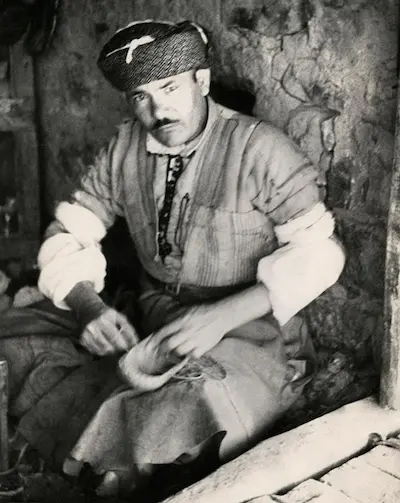 by British photographer Anthony Kersting, Courtauld Institute of Art, London.
Aramaic-speaking Kurdish Jews were unusual in that many worked as farmers, shepherds, and weavers, staying closely tied to the land, unlike their European counterparts who were often barred from agriculture. They were deeply spiritual, known for making long pilgrimages to the tombs of Biblical figures like Jonah, Nahum, Daniel, Mordechai, and Esther in and around Kurdistan.
Surrounding populations saw the language itself as spiritually powerful. Kurdish Jewish chachamim (sages) were respected by local Muslims and Christians alike for writing protective amulets (kameot) in Aramaic script to ward off illness, trusting the ancient resonance of the language to bring healing. This may even be the origin of "abracadabra" -- literally "I create as I speak" in Aramaic.
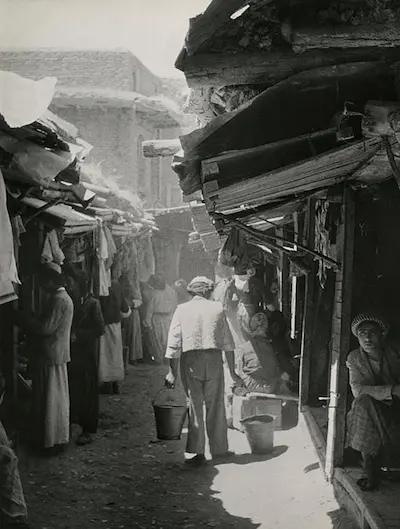 by British photographer Anthony Kersting, Courtauld Institute of Art, London.
For centuries, the Jews of Kurdistan lived in a delicate balance with their Muslim neighbors. Despite intermittent violence and heavy taxation under Ottoman and local tribal rule, they were generally respected as a distinct, honorable ancient community. The 20th century shattered that balance.
The collapse of the Ottoman Empire, the rise of Arab nationalism in Iraq, and the founding of the State of Israel in 1948 made Jewish life in the region unsustainable. Antisemitic riots, economic boycotts, and political targeting surged across Iraq, forcing families to abandon their ancestral mountain homes.
Between 1950 and 1952, Israel launched Operation Ezra and Nehemiah, a massive airlift that rescued over 120,000 Iraqi and Kurdish Jews. Entire mountain villages packed up what they could carry, trekked down to transit points, and flew home to the newborn Jewish state. Prominent Israelis born in Kurdistan -- like former Defense Minister and Chief of Staff Yitzhak Mordechai -- grew up in native Aramaic-speaking households before emigrating to Israel during the operation.
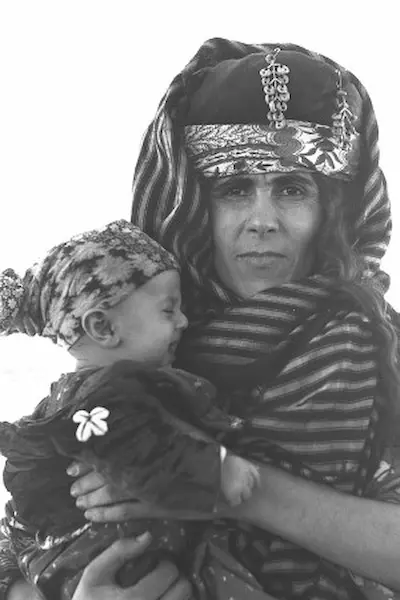 An immigrant from Kurdistan arrives in Israel with her son, 1951. (Photo: Israel Government Press Office)
Aramaic-speaking Jews across the border in Iran stayed in place for a few more decades. Sanandaj was historic Persia's main center for Aramaic-speaking Jews, and through the mid-to-late 20th century, prominent families from the Sanandaji and Kermanshahi Jewish communities ran key trade hubs, schools, and medical facilities across western Iran.
But after the 1979 Islamic Revolution, virtually the entire remaining Jewish intelligentsia and business leadership of Sanandaj and Kermanshah left, mostly via Turkey or Pakistan, resettling in Great Neck (New York), Los Angeles, and Israel, carrying their regional traditions and Aramaic heritage with them. I've met a number of second-generation Persian-American Jews and asked how much Farsi they'd picked up from their parents. To my surprise, several told me their parents didn't speak Persian at all growing up -- they spoke Aramaic. That conversation is what sparked this article.
Are there still Jews who speak Aramaic today? Yes, but the language is facing an existential crisis. When Kurdish Jews arrived in Israel in the 1950s, they landed in a society fiercely committed to the melting pot. The young state pushed all immigrants toward modern Hebrew as their sole language to build a unified Israeli identity, and Judeo-Aramaic was sidelined right alongside Yiddish, Judeo-Arabic, and other Diaspora languages.
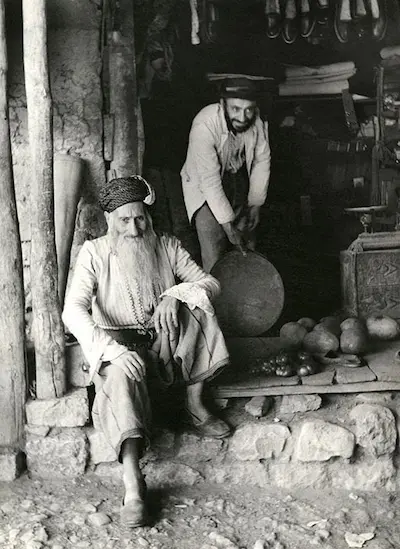 by British photographer Anthony Kersting, Courtauld Institute of Art, London.
Today, only a few thousand fluent Judeo-Aramaic speakers remain, most of them elderly Israelis living in Jerusalem neighborhoods like Mahane Yehuda, or in agricultural villages like Nashia and Azaria. Despite the steep decline, a few notable figures have kept the heritage in the spotlight.
The legendary Israeli singer Itzik Kala, who is of Kurdish-Jewish descent, has woven Aramaic lyrics and melodies into his music, bringing the sounds of the Kurdistan mountains into mainstream Israeli pop culture. Descendants of the famous Barzani rabbinic dynasty, including Asenath Barzani, the world's first recorded female Kurdish Jewish leader in the 17th century, still maintain deep ties to their ancestral linguistic traditions.
Judeo-Aramaic is classified by UNESCO as an endangered language, and a dedicated group of academics, community leaders, and activists have launched efforts to keep it from disappearing entirely. Researchers at institutions like Hebrew University and the Jewish Language Project are recording elderly native speakers to preserve mountain dialects like Zakho and Amadiya before they're lost.
Cultural revitalization is happening on the ground in Israel too, where the National Organization of Kurdish Jews hosts the annual Seharane festival, celebrating Kurdish-Jewish music, dance, and spoken Aramaic for younger generations. Grassroots digital archiving projects have also begun uploading Aramaic dictionaries and oral recordings online so future generations can keep studying the living dialect.
The story of the Aramaic-speaking Jews of Kurdistan is one of the most remarkable chapters in Jewish history, a reminder that our people's past is a living tapestry, capable of preserving its oldest threads in the most unlikely places. The next time we stand in synagogue reciting the Kaddish or open a page of Talmud, it's worth remembering: those words aren't just ink on ancient parchment. For twenty-five centuries, a resilient community in the mountains of Kurdistan kept them alive as a living, spoken language, proof that the tongue of our sages never actually stopped speaking.












very interesting and informative, thanks!
It does not make sense to me that the Jewish Kurds of Kurdistan arrived there as part of the Assyrian exile of the Northern Kingdom of Israel in 722 BCE. Here's why it does not make sense to me: neither Talmud was written till much later. And the author says that these Kurds who spoke Aramaic studied Talmud???
Would someone please explain how both statements can be true.
Jews from Iraq, Iran and Turkey also speak Aramaic. A Kurdish taxi-driver told me that he reckons more Israelis speak Aramaic than Yiddish.
The author asks why Jews stopped speaking Aramit (JENA Jewish Eastern Neo-Aramaic). One of the answers is the author's erroneous perception expressing the deprivation of Aramit-Ashurit speakers by Israeli scholars and by the establishment in Israel during the 1950s. The moment they identified the second sacred language of the Jewish people with the Kurds, the whole world began thinking that Aramaic is Kurdish. Therefore, the first thing that must be done to save the remnants of the Aramit language in Israel is to sever it from three misleading concepts: Kurdish, Kurds, and Kurdistan. These concepts must not be mentioned in connection with the Jews of the Land of Assyria, who are Aramit-Ashurit speakers. It should be added that the Kurds are the occupier, and as is the way of occupiers, the
Great article! I just wrote a book about the Jewish Iranian Kurds, the Aramaic speaking people of Kerend, Iran.Heir by Rachelant https://a.co/d/05tjHzLo
Most of the people in my book actually live in Netanya, Israel, where the article author lives.
I believe that there is another outpost of Aramaic in India, they left Syria i think and are called Jews of the Christian Rite, or something similar. I also think they were/are centered in Kochin. They speak Aramaic as their daily language.
Thank you for the interesting an informative article. Readers may like to know that there is "The Worldwide Federation of Aramaic Speakers, Not for Profit Organization - P.O.B. 970, Jerusalem 91009-01, 972-2-6788513, aramaicspeakers@gmail.com. The organization's chairman, Mr. Sasson Naim, recently gave me their current calendar showing their activities and publications. Listed is an "Aramaic-Hebrew-English Dictionary" obtainable by ordering thru' their email. Their aim is to keep Aramaic alive as a spoken language.
Great and fascinating story, there are more people speaking Arameic, they are the Aramean christians from Northern Syria, in Germany and The Netherlands are some communities of them as perhaps in America as well, they must speak the same kind of Arameic is my guess, because they come from the same area where also Kurdish Jews were living
Yes, as another commentary already wrote but needs re-writing...please check out Ariel Sabar's "My Father's Paradise"....buy the book! Give it as a gift, too. Just a great book!!! from lmc Utica NY
Fascinating article has made me want to know more Thank you for sharing
From the end of parshas Vayetze, it is obvious that Lavan spoke spoke Aramaic insisting that "Gal-Ed", Yaakov's name of the monument, should be called "Yegar Sahadutha", the Aramaic translation. From this verse, we can infer that Rachel and Leah grew up speaking Aramaic. Yaakov, even after 20 years in Aram, spoke Hebrew. Thus, from the very birth of our nation, Hebrew was our father-tongue whilst Aramaic was our mother-tongue.
A wonderful encapsulation of a complex past, thank you. As a historian, I only have two minor comments: first, the jump from Babylonian rule to Persian rule over the exiled Judaeans lacks a sentence explaining why, suddenly, you’re talking about Cyrus, ruler of Persia, when it was the Babylonians who oversaw the exile. A quick mention of the transition would help readers unfamiliar with the shift in leadership. Second, this: “But history has a way of defying expectations.” Correctly, it would read, “But the past has a way…”. “The past” refers to events that have already happened. “History” refers to the interpretation of past events. This difference is often ignored in common usage, but it matters. “History” is what we communicate about the past, and depends upon our perspective, etc.
Interesting article and brief historical review.
Anyone interested in this topic must read "My Father's Paradise", Ariel Sabar's memoir of his father's extraordinary life arc from childhood in Aramaic-speaking Jewish Kurdistan, to Israel, to -- I don't want to say more, because the surprise is too good to spoil! This is seriously one of my favorite works of non-fiction to reread and recommend.
That is one of my favorite books, too. After I read the book, I reached out to the author to let him know how much is book and family story touched me.
Fascinating. Thank you for the interesting article and your research.