




 The Red Cross’s Jewish Problem







A divorced, childless seamstress in Krakow watched Jewish girls drift away from their heritage. While rabbis debated solutions, she opened a classroom in her tiny apartment and started a revolution.aa
Born into a Chassidic family in Krakow, Poland, in 1883, Sarah Schenirer grew up in a society where girls received no formal Jewish education. For eight years, Sarah attended a Polish public school, as was required by the country’s compulsory education law. Once or twice a week, the school was visited by a rabbi, who gave the Jewish students some basic lessons in Judaism. This did not satisfy Sarah’s thirst for knowledge.
Naturally inquisitive, Sarah read, in her native Yiddish, every Jewish book she could get hold of. Her father encouraged her learning and bought her a book of stories from the Talmud translated into Yiddish.
As a teenager, Sarah, like most girls in her community, was faced with the necessity of earning a living. She became a seamstress and eventually started her own successful dressmaking business.
In her personal life, Sarah did not see as much success. She remained single until age 27, when she gave in to societal pressure and married a local Jewish man with whom she did not have much in common. The marriage was unhappy from the start, and Sarah initiated the divorce proceedings a year later. The divorce was finalized when Sarah was 30 years old.
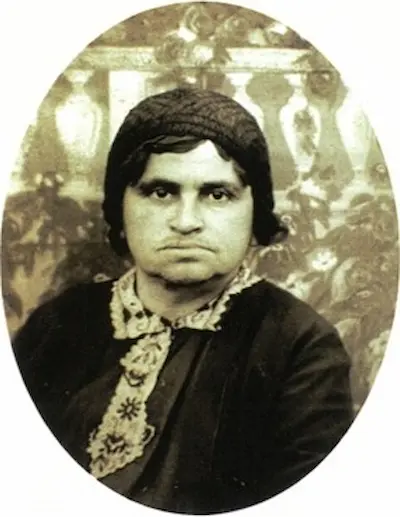 One of the only photographs of Sarah Schenirer, from her Polish ID
As a seamstress, Sarah encountered many girls and their mothers. She wrote1, “When I saw how concerned people were with the smallest detail when I was cutting and measuring their dresses, I would think to myself, ‘And what do the “garments” of their souls look like?’”
This spiritual crisis unfolding in Poland was publicly discussed at the Rabbinical Congress in Krakow in 1903. Drawn to intellectual stimulation available in the secular world, hundreds of Jewish girls were leaving Judaism. Their connection to Judaism was so superficial that some readily converted to Christianity, whether for social acceptance or for marriage. In addition, too many Chassidic girls, lured by exciting promises, naively fell victim to human trafficking and were forced into prostitution2.
At the Rabbinical Congress, rabbis and community leaders bemoaned the plight of Poland’s Jewish girls. As a solution, they discussed opening Jewish schools for girls and providing them with authentic Torah education. They encountered some opposition, along with practical difficulties. Though the conversation continued in the ensuing years, no one actually took the first step of opening a school.
As a woman, Sarah did not participate in any public discussion, nor did she have a husband to speak up for her. However, the disconnect she observed pained her immensely and she was eager to share her own love for Jewish texts with other women. In 1910, she wrote in her diary3:
When I open my books on the Sabbath and discover there the words of Torah and Midrash and so on – I forget everything else in this world and float above it in a higher realm of pure delight… The hearts of young girls are captivated by propagandistic lectures on secular subjects… I doubt very much that any girl in the gymnasium could possibly be as happy as I am during those hours when I immerse myself in sacred books.
At the same time, Sarah doubted that she could change anything. She wrote4, “[M]aybe, at some point, I will have the courage to speak these thoughts aloud. But can this really happen? I, who am shy to let out a word…”
In 1914, World War I broke out and Sarah fled from Krakow to Vienna with her family. The first time she attended a local synagogue, she was astonished to see the rabbi step up to the pulpit and address both men and women. Sarah recalled5:
Riveted to my seat, I listened with great fascination to the fiery, spirited words of the rabbi.
In his sermon, he depicted the greatness and sublimity of the historical figure of Judith6, and through her, he eloquently and passionately called upon Jewish women and their daughters to act according to the model of this Jewish heroine… Even as I was caught up in the spiritual description of the character of Judith, it occurred to me: ah, if only all those women and girls in Krakow were here now to learn who we are and where we come from.
The rabbi Sarah met in Vienna was Rabbi Moses David Flesch, who had studied in Frankfurt, where Jewish schools for girls already existed. He was accustomed to teaching women and was happy to recommend books by German Jewish thinkers to Sarah. Later, these books, along with the notes Sarah had taken at Rabbi Flesch’s weekday lectures, formed the basis of Sarah’s school curriculum7.
In the summer of 1915, Sarah returned to Krakow, determined to bring Jewish education for girls to her hometown. She recalled8, “On my first day back I presented my proposal to a small circle of well-known religious women… who listened to me with evident joy.”
But Sarah’s idea faced many practical challenges, from lack of a suitable location to skepticism from potential students. Sarah wrote9, “Nevertheless, I persevered, and by that Sabbath had prepared a lecture for a gathering of 40 girls.”
Despite Sarah’s eagerness and passion, the girls were not impressed. “I could see the ironic smiles on many of their faces, and without a fare-thee-well, some of them just disappeared,” recalled Sarah10.
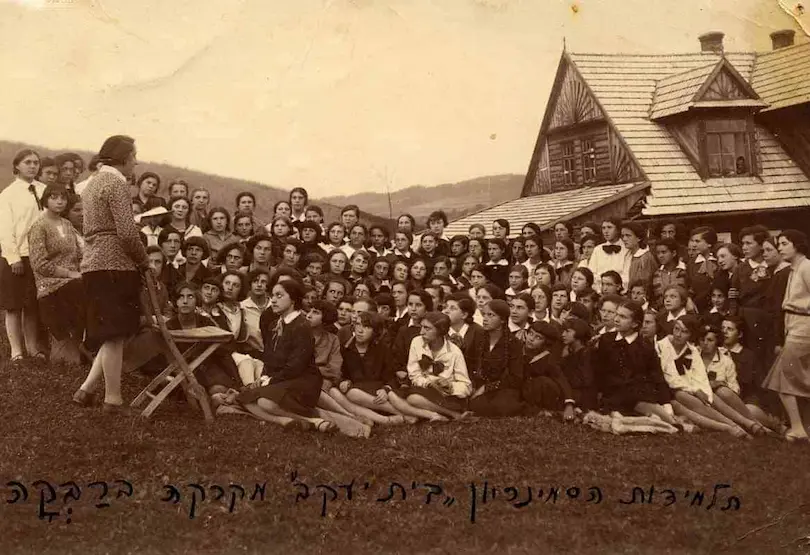 Seminary Students in Krakow
Filled with self-doubt, Sarah had to persuade herself not to give up. She wrote11, “I kept coming back to the same idea: We must open the eyes of our sisters, so they will see the great light of Israel! Forget any doubts, ignore all the obstacles! What do I care if people smile at me and mock my plan?... If the intentions are true and the goal is noble, will they not bear fruit?”
Sarah continued teaching, slowly gathered an interested audience, and founded a Jewish lending library. But she found that inspiration did not last. Girls enjoyed her lectures but did not commit to Jewish observance. Sarah reflected12, “[M]ost were young women already, and it wasn’t easy to persuade them to take on a new, truly Jewish life, with all its customs and traditions.”
Thus, Sarah came to the conclusion that she had to begin educating Jewish girls at much younger ages.
In November 1917, Sarah wrote in her diary13, “Finally, finally, the goal has been reached! I’m sitting now in my very own schoolroom.” Her first class consisted of 25 girls, “most of them children I sewed dresses for, and now I ask their mothers, Will you also allow me to provide them with spiritual clothing?” wrote Sarah14.
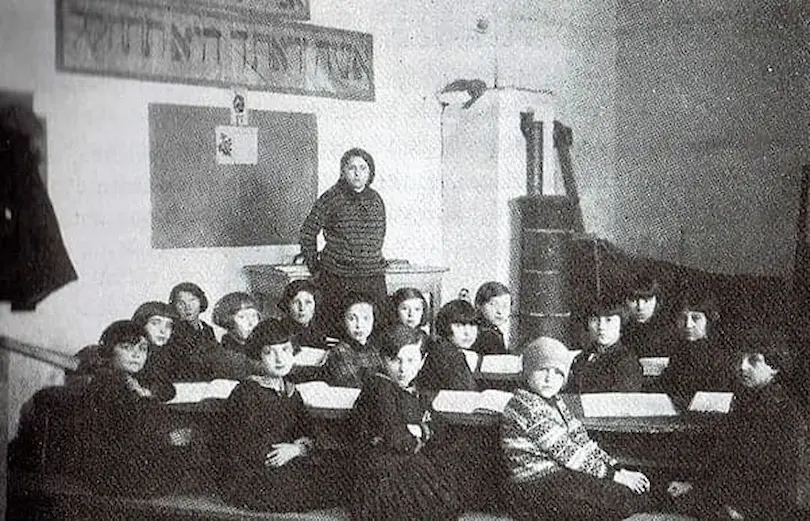 Sarah Schenirer with her students
Pearl Benisch, one of the early students, wrote that Sarah “resolved to start with these innocent little girls like me. She would tell them about the great love that our Father [God] has for His children, His concern for their well-being, the beauty of our heritage, Jewish history, and the truth of the Torah15.”
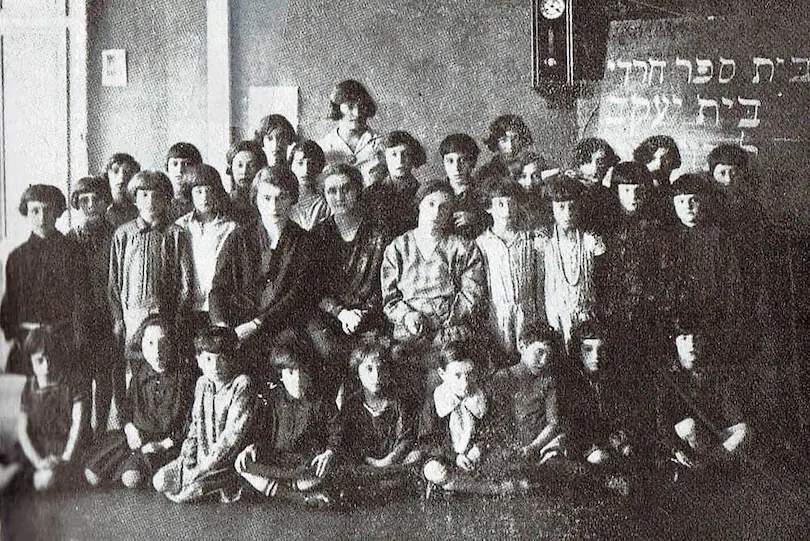
Sarah’s tiny apartment served as the classroom. It had old benches and no blackboard, but the girls’ eyes sparkled, and Sarah was overjoyed. One of her first students, who came to attend the school from a nearby town, recalled16:
We were crowded in that room during the day, but we were happy, indescribably happy, as our revered teacher opened new worlds for us… We prepared our simple meals in her kitchen… and ate at the same table… At night, we slept in the same room on the floor, and if we were lucky, we had a straw bed.
Later, Sarah would define her school’s mission: “to educate Jewish girls so that, with all their strength and with every breath, they will serve the Creator and fulfil the commandments of the Torah with seriousness and passion17.” She described the Torah as “a holy fire from the One God that gives sustenance to the Jewish soul18.” Sarah’s own passion was contagious, and her students appreciated and absorbed it.
The news of the school spread, and it grew quickly. By November, Sarah had 40 eager students. Others, especially parents of young girls, volunteered to help. Sarah found herself busier than ever.
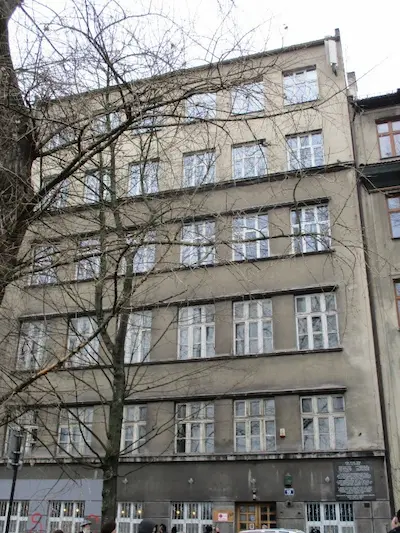 The building of the first Bais Yaakov school in Krakow. קובץ על יד, CC BY-SA 4.0 <https://creativecommons.org/licenses/by-sa/4.0>, via Wikimedia Commons
In 1919, at another rabbinical gathering, the members expressed support for Sarah’s school and offered to undertake financial responsibility for the growing project. By then, they understood that Sarah’s school was only the beginning of what would soon become a movement for Jewish girls learning Torah and developing a solid foundation in Judaism. They named the movement Bais Yaakov, after a Biblical verse in the account of the giving of the Torah, where the women are referred to as “Bais Yaakov,” the House of Jacob19.
Meanwhile, Sarah’s school was quickly outgrowing its capacity. The rabbinical organization helped Sarah move her school to “a perfectly fine apartment with eight large and fully equipped rooms20.”
In addition, more teachers were needed. Sarah responded to the need by opening the Bais Yaakov Teachers’ Seminary. Older girls studied both Torah and pedagogy. Students came to the seminary from all over Europe. Despite their diverse backgrounds, Sarah “succeeded in creating an unusual atmosphere of love, respect, and harmony,” recalls Mrs. Benisch21.
Many rabbinical and lay leaders had heard about Bais Yaakov and offered their help. Teachers, both men and women, came from Germany, Austria, and Switzerland and taught various subjects to the seminary students. Some stayed for a month or two. Others stayed for years, sacrificing personal comfort for the greater goal of teaching Torah.
With the financial support from the Jewish community, similar schools sprung up, first in nearby towns and then farther afield. Sarah was personally involved in each of these schools, where her students became teachers.
Mrs. Benish wrote22:
Frau Schenirer went from city to city and from town to town to town to organize Bais Yaakov schools. On her first trip, she took along Gittel Teitelbaum, dressed in a long skirt with a mature hairstyle to make her look older, to be the first teacher in one of those towns. The whole community attended the gathering, and Frau Schenirer introduced Gittel to the women. Gittel stood up, her dark eyes sparkling as usual when she got excited, and addressed the audience.
Impressed by the young speaker, the women responded with a resounding ovation and enthusiastically invited Gittel to teach their daughters.
Similarly, the seminary’s graduates established Bais Yaakov schools in other locations. Sarah continued to visit them, bringing books, curriculum materials, and most importantly, support and encouragement.
Miriam Lubling, who grew up in a small city in Poland, recalled23, “[T]he most important and most exciting events in our lives were Frau Schenirer’s visits. We awaited them impatiently. I can still see her face light up with joy whenever she heard ‘her’ little girls answering her questions correctly… Then she expressed her joy by dancing with us and singing her favorite songs.”
Mrs. Benisch recalled Sarah’s unexpected visit to a special evening program in Krakow24:
Suddenly, the door opened and Frau Schenirer entered. Even today I picture her vividly… She was tired. She had just come from the railroad station after a week of traveling… visiting Bais Yaakov schools… Her shoes were dusty, her clothing wrinkled. She placed her heavy black briefcase on the floor… [S]he came. Not to give a lecture at the seminary, not even to teach a class… just to join [her girls]—to listen to them and take pride in their accomplishments.
Sarah loved her students, and they responded in kind. Mrs. Benisch explains “the secret of Frau Schenirer’s success” as “the joy and enthusiasm that she instilled in her students” for Torah observance and serving God. “Her every action, her every mitzvah, filled her with such delight that her entire personality radiated enthusiasm and joy. The thought of doing God’s will—to help the needy, to care for the sick, to encourage the downtrodden, to give and give without limit, and to do it all with joy—simply made her ecstatic25.”
Mrs. Benisch carried her beloved teacher’s ideas and ideals through the horrors of the Holocaust and derived much strength from the memory of “Frau Schenirer with her outstretched hands and uplifted face, singing and praying26.”
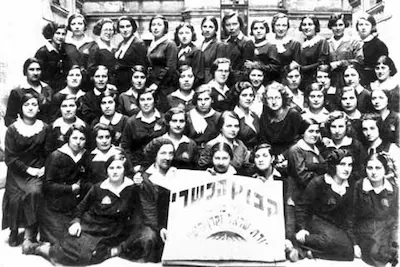 Тhe second graduating class of the Bais Yaakov in Lodz, Poland, in 1934. Jewish Women's Archive. Public domain, via Wikimedia Commons
In 1931, at age 47, Sarah married Rabbi Yitzchak Landau. Her second marriage was much happier than her first. However, it was not to last.
Towards the end of 1934, Sarah’s family and friends realized that she was very ill. Even though she did not complain and pushed herself to participate in Bais Yaakov events, she was growing weaker and thinner every day. Sarah traveled to Vienna to undergo surgery, but it was unsuccessful. When she became bedridden, she expressed her sorrow at her inability to join her Bais Yaakov students in person but continued to write to them, urging them to serve God with joy, until her passing on March 1, 1935.
Mrs. Benisch recalled that she and her friends felt “alone, orphaned27.” At the funeral, “people from all over Poland transformed the roads into a mass of black… Young and old, congregational leaders and lay people, they all came, grieving deeply, to pay their last respects…28”
In her short 51 years in this world, Sarah left a lasting impact. By the time of her death, the Bais Yaakov movement had spread throughout Poland and beyond, with 225 schools and about 36,000 students total. In the following years, it would spread beyond Europe to America and Israel. Today, there are hundreds of Bais Yaakov schools all over the world.
 Sarah Schenirer's tombstone in Krakow. CC BY-SA 4.0 <https://creativecommons.org/licenses/by-sa/4.0>, via Wikimedia Commons
Sarah did not claim original ideas or invent anything new. Jewish schools for girls existed in Germany a generation prior, and other people had discussed opening Jewish girls’ schools in Poland. However, no one else took the practical step of opening the first school.
Mrs. Benisch recalled Sarah quoting the Ethics of the Fathers, “In a place where there are no men, try to be a man29.” Sarah would tell her students that sometimes, “there are no men to care. Then you must stand up and be the ‘man’ who takes responsibility into his own hands30.”
That is precisely what Sarah did. By taking responsibility for solving a problem that others would only bemoan, Sarah Schenirer changed the course of Jewish history and ensured that Jewish girls grow up deeply connected to Judaism.