 Every Moment Is a New Beginning: The Art and Faith of Igal Fedida






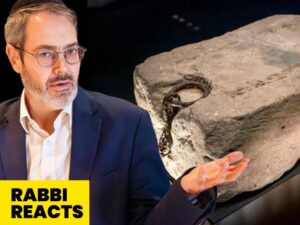
For a hundred years archaeologists have searched the plain around the Dead Sea for the city the Torah says was destroyed by fire from heaven. Rabbi Daniel Rowe travels to Jordan to visit the actual sites.
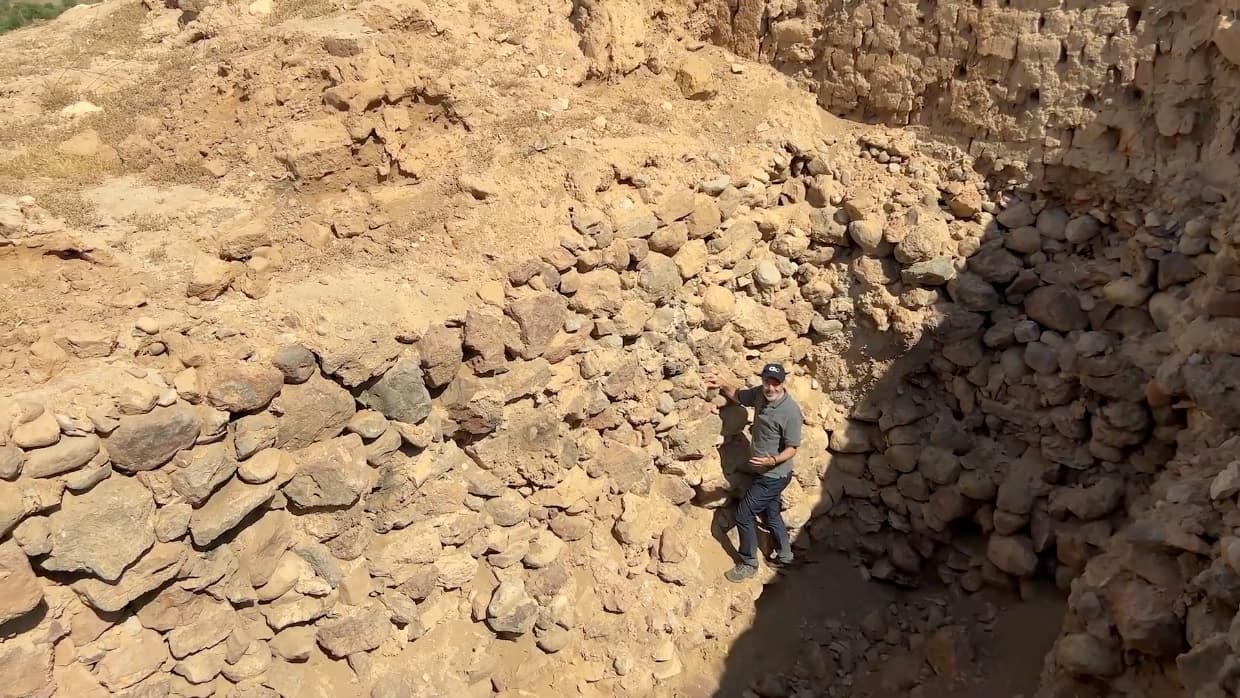
I’m standing inside an excavation trench in Jordan, and the wall in front of me holds a layer of real ash. It marks the fire that ended an enormous city, the crown jewel of the Jordan Valley, sometime in the 17th century BCE.
Could this be Sodom?
In Hebrew it’s Sedom. In English, Sodom: the Bible’s byword for evil. The book of Genesis describes it as the capital of a lush, fertile region overflowing with wealth, and yet so cruel and depraved that its cries rise up to the heavens. Abraham pleads with God to spare the city for the sake of any righteous people living there, bargaining all the way down to ten. God agrees. Ten righteous people can’t be found.
Sodom is destroyed in fire along with the towns around it. Only Abraham’s nephew Lot and his two daughters survive.
But did any of this happen? Critics say no site from Abraham’s time could plausibly be Sodom. Some recent discoveries are challenging that claim.
One warning before we start. Biblical archaeology moves in waves, because the stakes feel so high. Is the Bible true or false? With religion and politics riding on the answer, people overclaim in both directions. One artifact “proves” the story. The absence of another “proves” it never happened. Sodom is a perfect case study of both mistakes.
The hunt for Sodom began about a century ago. In 1924, William Foxwell Albright, arguably the father of modern biblical archaeology in this region, toured the southeastern corner of the Dead Sea with a scholar named Melvin Grove Kyle. On a ridge above the plain they found a ruin called Bab edh-Dhra, littered with pottery and surrounded by a large fortified enclosure. Kyle went on to write a book called Explorations at Sodom.
Albright believed the site was a sanctuary serving cities that now lay underwater at the shallow southern end of the Dead Sea. Sodom beneath the sea. That idea held for about 50 years.
Then, in 1965, archaeologist Paul Lapp excavated a cemetery beside the site and found tens of thousands of burials. That’s no sanctuary. That’s a town. In the 1970s, Walter Rast and Thomas Schaub dug the town itself, plus a second walled town about 15 kilometers south called Numeira. Both ended in fire. At Numeira, roof beams had burned to ash, doorways had been blocked up, and two women’s skeletons lay where the collapsing building crushed them.
People started saying the obvious: this must be Sodom and Gomorrah. Numeira even sounds a little like Amorah, the Hebrew name for Gomorrah. Archaeologist Bryant Wood later argued in print that Bab edh-Dhra was Sodom and Numeira was Gomorrah. You can see why. Right region, two neighboring towns, both destroyed by fire.
Then came the problems, and a textbook case of overclaiming.
The pottery dated the destruction to around 2300 BCE, far earlier than the biblical story. Radiocarbon dating, the lab method that measures the carbon left in burned wood and seeds, pushed it back further still: to at least 2500 BCE at Numeira, the Gomorrah candidate.
Worse, the two towns weren’t destroyed together. They fell about 250 years apart, and both were centuries too early for Abraham. Depending on when you date the patriarchs, the gap is somewhere between 700 and 900 years.
For many critics, that settled it. The biblical authors either invented the story or stumbled onto old burned ruins, heard rumors of towns that ended in fire, and wove them into their tales of Abraham. Walter Rast, who led the dig, titled his essay “Bab edh-Dhra and the Origin of the Sodom Saga,” treating Sodom as a biblical mistake. That view dominated for decades.
Enter Steven Collins, an American archaeologist and Bible believer who had spent years teaching that Sodom lay in the south.
On the night before taking a tour group to Bab edh-Dhra and Numeira, Collins reread every Sodom passage in Genesis, chapters 12 through 19. When he finished, something bothered him. Nothing in the text placed Sodom at the southern end of the Dead Sea. He read the passages four more times. Same conclusion. If anything, everything pointed north and east of the Dead Sea.
Look at Genesis 13:10. Abraham and Lot stand between Bethel and Ai, in the hills north of Jerusalem, about to part ways. I’ve stood there myself. Lot “lifts up his eyes” and sees the plain of the Jordan, well watered everywhere. He heads toward it and settles in Sodom.
Here’s the thing. From between Bethel and Ai, looking east, you can see the northern tip of the Dead Sea. The southern end is hidden behind the Judean hills. The green, well-watered plain Lot saw has to be at the top of the lake, where the Jordan River flows in.
Archaeologist Scott Stripling, standing at that spot, put it simply: the north end of the Dead Sea is right there, and when Lot looks out and sees the Jordan Valley watered “like the garden of God,” it’s straight across.
So Collins had his search area: the plain just north and east of the Dead Sea, beneath the Jordanian mountains. Surveys showed plenty of settlements, large and small. If he could dig only one, which should it be?
The Bible treats Sodom as the leading city of the region, so Collins went looking for the biggest site. He found one that dwarfed everything else, roughly a square kilometer in area. You could fit most of the other sites in the region inside it.
I went there. It’s massive: 36 hectares, about 90 acres, with 26 of them inside the walls. An earthen rampart 30 meters thick at its base. A monumental gate. A palace 50 meters long. By Collins’ reckoning, it’s the largest Bronze Age city anywhere in the Jordan Valley, and the largest continuously occupied site along the entire Jordan River.
Its name is Tall el-Hammam.
The archaeologists believe one building was a palace or governor’s residence. Genesis describes Lot sitting at the city gate, which Jewish tradition reads as a sign that he served as a senior judge. If that’s right, he may well have worked here. Walking across the site takes you about 500 meters, gigantic for an ancient city in this part of the world.
Standing in the upper city, I could make out the faint hills in the distance, hazy that day, where Abraham and Lot would have stood when they parted. The Torah says Lot pitched his tents all the way to Sodom. If Collins is right, this is exactly the spot Lot was looking at. And when this place went up in flames, the smoke would have been visible for miles across Canaan.
Earlier surveyors had assumed Tall el-Hammam was an Iron Age site, because Iron Age pottery covers the surface. Collins suspected otherwise. If the biblical geography fit, the city should date to the Middle Bronze Age, the era of Abraham.
He was right. Under the Iron Age walls, the dig jumped straight back 700 years. Iron Age remains sat directly on top of Middle Bronze Age ones. In other words, the Bronze Age city was utterly destroyed, and then no one built or lived there for seven centuries.
That’s strange. Cities get destroyed all the time by earthquakes or conquest. But people don’t abandon a huge, fertile site in the Jordan Valley. If the original residents leave, someone else moves in. Seven centuries of emptiness suggests something that didn’t just destroy cities but left the whole area uninhabitable.
Across the site, at the top of the Middle Bronze layers, Collins found a destruction layer: ash, charred roof beams on the palace floors, a city that burned. He also found material that looked melted. He showed us mud brick from one excavation area. Wash it off and you see bubbles, the sign of something that turned liquid. His team found melted brick, melted pottery, melted plaster. Melted everything.
Most of the ash and pottery has since been cleared, but in that trench I found ash still in place. I even picked up a stone that looked exactly like what Collins described, as if it had been through some extreme melting.
Then came the most sensational claim of all. In 2021, a paper in Scientific Reports, part of the Nature publishing group, argued that Tall el-Hammam was destroyed by a cosmic airburst: a space rock exploding above the city, melting pottery and brick and leaving behind shocked quartz. Twenty-one scientists from a range of fields signed it. Fire from heaven, confirmed by science.
A well-read academic paper gets a few hundred readers. This one was read hundreds of thousands of times, among the most viewed in academic publishing history. Then the rebuttals arrived. In 2022, scientists argued the melted material could have come from furnaces and kilns. In 2025, another paper argued that an airburst of that size couldn’t get hot enough to melt pottery. In April 2025, the journal retracted the paper. A month later, the authors republished it in another journal, with even more names attached, including Collins himself.
It’s a fiercely contested claim, and well outside anything I’d call expertise, so I’ll leave it there.
Set the airburst aside. Here’s what’s on the ground.
A site in Lot’s line of sight, exactly where he would have looked out and chosen to live. A region that was extremely fertile. The Bible describes five main cities, and the area has five main cities, along with smaller settlements. Then a fiery event, after which the settlements all around seem to end at once and the region stays uninhabitable for centuries.
That looks like a knockout case for this being the biblical region and Tall el-Hammam being Sodom. But there are critics, including textual arguments for a southern Sodom after all. Let’s hear them.
Critics of the northern site fall into two camps: those who reject the Bible’s historicity altogether, and believers like Bryant Wood who accept the Bible but place Sodom in the south. Here are the main objections.
Problem one: the dates. Collins’ team radiocarbon-dated about 26 samples from the destruction layer. They averaged around 1650 BCE. Scholars disagree about when Abraham lived. Some place him right in that period; others put him a few centuries earlier. So 1650 is either a perfect match or a serious problem, depending on whom you ask. I’m planning a full episode on dating, so for now, just know that some scholars reject the identification on these grounds.
Problem two: the five cities. Genesis 14:2 names the kings of five cities: Sodom, Gomorrah, Admah, Zeboiim, and a fifth. Collins maps them out. Sodom is clearly the big one, Tall el-Hammam, with the others as its satellite towns.
Gomorrah should be easy, since Sodom and Gomorrah always appear as a pair. Is there a twin nearby? Yes: Tall Kafrayn, a mound just down the road from Hammam. Standing on Kafrayn, the highest point around, you can see Hammam clearly. The two would have seen each other as sister towns.
Next, Zeboiim. The name is plural in Hebrew, and on the map sit two neighboring hills, Tall Bleibil and Tall Mustah, each with a settlement on top. Collins argues the plural fits a twin city on twin peaks. That’s Zeboiim.
Admah always appears alongside Zeboiim, so Collins picks the nearest town: Tall Nimrin, a couple of kilometers down the valley.
That’s four. But there’s a fifth city, Zoar, the town Lot begs the angels to spare so he can flee there. They agree. So where is it? Collins has used up every sizable town on the plain.
He ends up placing Zoar far away, on the eastern shore of the Dead Sea at the mouth of the Arnon River, in a gorge known in Arabic as Wadi Mujib. That’s 43 kilometers, or 27 miles, south of Hammam.
And that clashes with the text, because Genesis tells us how long Lot’s escape took. In Genesis 19:15, the angels rush Lot out at the crack of dawn. In verse 23, the sun has just risen when he reaches Zoar. That’s an hour or two at most. A man fleeing on foot with his wife and two daughters might cover eight or nine miles. Twenty-seven is impossible.
Problem three: Zoar really does seem to be in the south. This is also why Collins pushed Zoar so far south. And since Zoar had to be within a short run of Sodom, a southern Zoar means a southern Sodom.
First, a weaker argument. In Ezekiel 16:46, the prophet tells Jerusalem that her big sister Samaria lives on her left and her little sister Sodom lives on her right. Biblical directions assume you’re facing east, so left is north and right is south. Samaria is north of Jerusalem. A southern Sodom fits nicely. Tall el-Hammam, though, is due east of Jerusalem. Would you call that “right”?
Actually, you could. In Genesis 13:9, Abraham tells Lot, “If you go left, I’ll go right.” Lot goes to Sodom; Abraham goes to Hebron. Wherever you put Sodom, north or south end of the Dead Sea, the angle between those two paths is about 90 degrees. So the Bible can use “left and right” for a right angle. From Jerusalem, left could be north toward Samaria and right could be east. Ezekiel proves nothing either way.
The stronger evidence for a southern Zoar is much harder to dismiss.
The prophet Isaiah, in chapter 15, laments over Moab, the kingdom east of the Dead Sea. In verse 5, he describes refugees fleeing as far as Zoar, and he names other towns, including Horonaim. Every town he lists sits in the Karak district at the southeastern corner of the Dead Sea. In Isaiah’s day, Zoar was in the south.
Jeremiah says the same in chapter 48, verse 34, another lament for Moab, listing Zoar alongside Horonaim among the southern towns. Two prophets, two clear southern placements.
The evidence continues after the Bible. Josephus, the first-century Jewish historian, measured the Dead Sea for his Roman readers and placed Zoar at its southern end. Around the year 300, the church historian Eusebius appears to put it there too. In the 500s, someone laid a mosaic map of the Holy Land on a church floor in Madaba, Jordan. It’s still there, drawing tourists, and it shows Zoar, with its palm trees, at the southeastern corner of the Dead Sea. Beside it are the words “Sanctuary of Saint Lot.”
In the 1980s and 1990s, archaeologist Konstantinos Politis excavated exactly where the map points. He found that church, built in front of a cave, with Lot’s name in the mosaic floor. The same village produced more than 70 Jewish gravestones from the Second Temple period, inscribed in Aramaic and decorated with menorahs.
All of this places Zoar firmly in the south. If Lot could run there in two hours, Sodom must have been in the south too.
Problem four: Tall Nimrin. Collins’ picture has all the cities ending together in one catastrophe that left the region empty for centuries. Broadly, that’s what the archaeology shows, with one exception: Tall Nimrin, Collins’ Admah. A separate team excavated it in the early 1990s and found it outlived Hammam and the others by at least a century before falling empty like the rest. And they found no destruction layer, no ash, no fire. It simply faded away. If one event destroyed every city, how did this one carry on?
Standing at the top of Tall Nimrin, you’re on a Bronze Age settlement contemporary with the other four towns, abandoned around the same time, but never burned.
The dating question cuts both ways, and I’ll tackle it separately. The other three objections sound strong, but I don’t think they hold up as well as they seem. Some of what follows is my own speculation.
Start with this: two of the problems cancel each other out. Nimrin outlasting the other cities, and the missing northern Zoar.
Hammam is Sodom and Kafrayn is Gomorrah. Fine. But Collins assigned both twin peaks to Zeboiim because the name is plural. Two separate hills, though, should be two separate communities. And Zeboiim simply means “gazelles.” A hill full of gazelles when settlers arrived would naturally get called “the Gazelles.” So only one hill is Zeboiim. And the hill beside it? Admah, the city always paired with Zeboiim. The twin peaks are the twin cities, Admah and Zeboiim.
That frees up Nimrin. And Nimrin is Zoar.
Look at what the Torah says about Zoar. Lot is told to flee to the mountains. He says he’ll never make it in time. In Genesis 19:20 he points to a nearby town: “It’s close enough to run to, and it’s small.” The Hebrew word is mitz’ar, “a small thing,” a play on the name Zoar. The angel agrees to spare it. Later, in verse 30, Lot sees the destruction and smoke all around, leaves Zoar, and heads up into the mountains.
So Zoar has four features. It’s close enough to run to, within about two hours. It’s small. It’s on the way to the mountains. And it survives when the other towns are destroyed.
Now look at Nimrin. It’s seven or eight kilometers from Hammam, a hard walk but doable in an hour and a half to two hours. The Torah even says the angels had to hurry Lot along, as if it were just barely possible. Nimrin is a fraction of Hammam’s size. It sits at the bottom of the road that climbs into the hills. And it wasn’t destroyed. It carried on after the others fell.
Nimrin matches Zoar perfectly. Of course it outlasted the other cities: it was the one that was spared. One answer, two problems solved.
That still leaves the strong evidence for a southern Zoar. Here’s a theory, purely speculative.
Picture Nimrin after the catastrophe. It was never the region’s main city. Every town around it is gone and the land has lost its fertility. Business dries up, income disappears, travelers stop passing through. People start leaving. And indeed, over the following century, that little mound empties out.
Where might they go? Possibly to the southern end of the Dead Sea, where the land was still fertile. And they may have done what refugees often do: bring the name of their hometown with them.
The Bible itself records this happening in the region more than once. In Judges 1:26, when the city of Luz falls, a man from Luz goes to the land of the Hittites, builds a city, and names it Luz. In Judges 18:29, the tribe of Dan marches north, captures a city called Laish, and renames it Dan.
A thousand years later, when the Babylonians deported entire populations, the new villages in Babylon show up in cuneiform records with names like Ashkelon, Gaza, Tyre, and Al-Yahudu, meaning “Judah-town.” The Bible Lands Museum in Jerusalem has a remarkable collection of tablets from Judean exiles, laid out on a map so you can trace them moving further and further into exile, carrying their names along.
Modern history is full of the same thing: New York, New Amsterdam, New Hampshire. European settlers brought their old place names to America. So if Zoar’s residents left and founded or took over a new town, it’s entirely plausible they kept their name.
What does the archaeology at the southern end of the Dead Sea show? Politis, who spent 20 years there, found a large Early Bronze Age town and cemetery from a thousand years before Abraham, then almost nothing from Abraham’s era, the Middle Bronze Age. The only Middle Bronze material anywhere south of the Dead Sea is tombs, not houses, and they date to around the time Nimrin was emptying out. Then the region goes quiet until a town grows there in the Iron Age. By Isaiah’s time, Zoar is a town in southern Moab. In other words, the name may have arrived with migrants from the north and flourished only much later.
I came up with this idea on my own, then discovered that scholars far more qualified had gotten there first. Two Israeli geologists, Amos Sneh and Yoseph Yechieli, building on the work of Bible scholar Rabbi Yoel Bin-Nun, argued that the original Zoar was in the north and the name later moved south. It’s a plausible hypothesis. There’s no proof.
The biggest lesson here is about overclaiming. First Sodom is in the south. Then carbon dating rules that out, and suddenly there’s no Sodom anywhere. Then a dig in the north seems to match. Then airbursts, then no airbursts. Through all of it, not one inscription has turned up at any of these sites saying “Sodom was here” or “Gomorrah was here.” The identification of Tall el-Hammam as Sodom is Collins’ proposal, and scholars still debate it.
But here’s what we do know. Exactly in the line of sight where the Torah places it, four cities came to a sudden end in what may well be Abraham’s era, while a fifth lasted a little longer and then faded. The one that’s been properly excavated shows strong signs of a fiery destruction, and the same event very plausibly destroyed its neighbors. Much later, a town called Zoar appears in the south, which could easily be that fifth city’s survivors moving on.
At the very least, we have a striking correlation with the biblical story. Any critic who claims there’s nothing resembling it on the ground is making an overclaim the evidence no longer supports.
In the end, what matters most about this story is its message.
Sodom stood against everything Abraham believed in. Yet he never went to war with it. When its people were in trouble, in Genesis 14, he rescued them. He could have exploited the moment. He had just saved their king and freed their population. He could have forced his way of life on them, and his way was morally far better than theirs. He didn’t.
And when God announced He would destroy this rival city, Abraham begged for mercy. What if there are 50 righteous people? What if there are ten?
The lesson is that removing evil from the world is God’s business, and in the end He will. Our job is to hope evil turns to good, to do everything we can to bring people back, and to believe in humanity’s goodness the way God does. We never get to decide that people are beyond redemption. Our task is to shine a light, even in a very dark world, and hope others pick it up. Judgment belongs to God, not to us.