








 Those Shameful Thoughts and What They Really Say about You
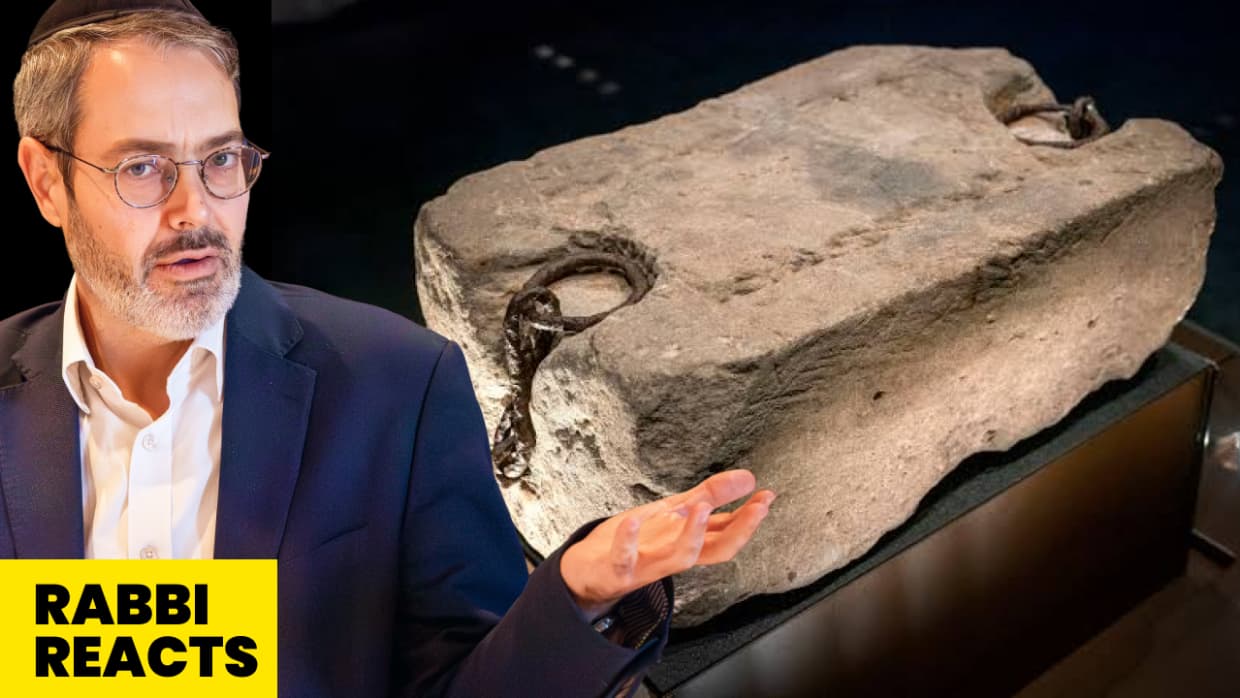





For 700 years, Scotland's kings were crowned on a stone tied to the biblical patriarch Jacob. The truth behind the legend is even more interesting.
It sounds absurd: a stone from the Bible, sitting in Scotland. This is a stone that kings fought wars over, that changed the course of history, that was stolen twice, and that traveled hundreds of miles, and according to legend, thousands more.
I'm here in Scotland with my son Avishai, hiking past waterfalls and glens near Ben Nevis. But we didn't come just for the scenery. We came to trace the story of one of the most consequential stones in the whole Bible: the stone that, according to legend, Jacob slept on the night he dreamed of a ladder reaching to heaven.
Our first stop is Moot Hill, in a place called Scone. It doesn't look like much, just a small mound. But since at least the 800s, this is where the kings of Scotland were crowned. The ceremony wasn't really about a crown. It was about the stone the king sat on.
According to legend, that stone had traveled an extraordinary route. It went down to Egypt with Jacob and his family. Generations later, a pharaoh's daughter named Scota supposedly carried it across the Mediterranean to Spain. From Spain it reached Ireland, where the ancestors of the Scots lived at the time. When they sailed to Scotland, they brought the stone with them.
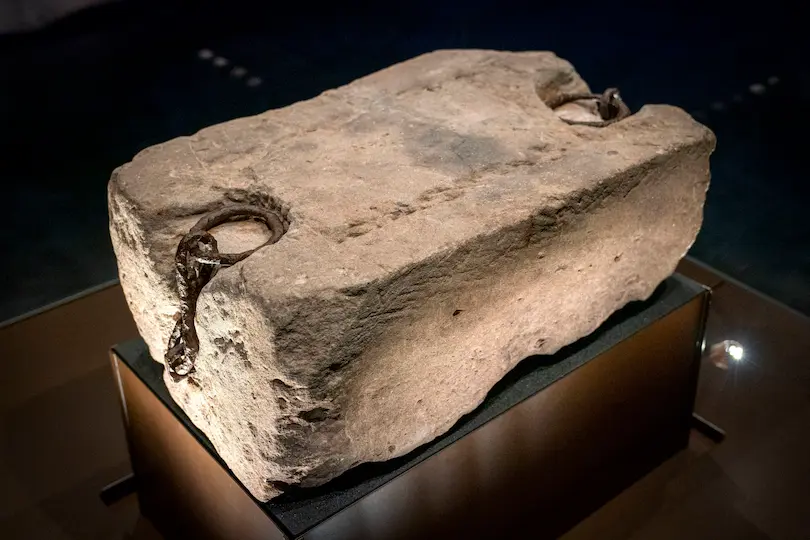
A prophecy went with it: wherever this stone rests, Scottish kings will reign. That turned the Scottish monarchy into something more than powerful. In the eyes of the people, it was biblical, a direct link to Jacob's own covenant. And that made the stone the most valuable object in the country.
Which also made it a target.
In 1296, King Edward I of England invaded Scotland and marched straight to Scone. He seized the stone and hauled it 400 miles south to Westminster, where it was built into the English coronation throne. His message was clear: if this stone carried the authority of Jacob, England would hold that authority now.
Scotland didn't accept that quietly. A year later, William Wallace led an army of farmers to victory over the English at Stirling Bridge; his statue near there still shows him gripping a sword nearly his own height. Seventeen years after that, Robert the Bruce crushed the English at Bannockburn and won Scottish independence. His statue now stands at Stirling Castle.
The peace treaty that followed called for the stone to be returned. It never happened. When England considered sending it back, crowds surrounded it and refused to let it leave. Scotland had won its freedom but not its stone. For the next 300 years, Scottish kings were crowned without it.
To follow the next chapter, we head to the Highland Folk Museum, which recreates life in Scotland during the 1600s and 1700s.
In 1603, England's queen died without an heir. Her closest living relative was a Scottish king, James, who inherited both thrones and was crowned in Westminster -- on that very stone. In a strange twist, the old Scottish prophecy had come true after all: wherever the stone sat, a king of Scotland now reigned.
That arrangement held until 1688, when James's descendant, James II, was deposed by Parliament, partly for being Catholic, partly over a broader power struggle. Parliament invited his nephew and son-in-law, William of Orange, to take the throne instead. The country split. William's supporters backed the new king. James's supporters kept his cause alive under a name drawn straight from the Bible: James's Latin name was Jacobus, the same as Jacob. His followers became known as the Jacobites.
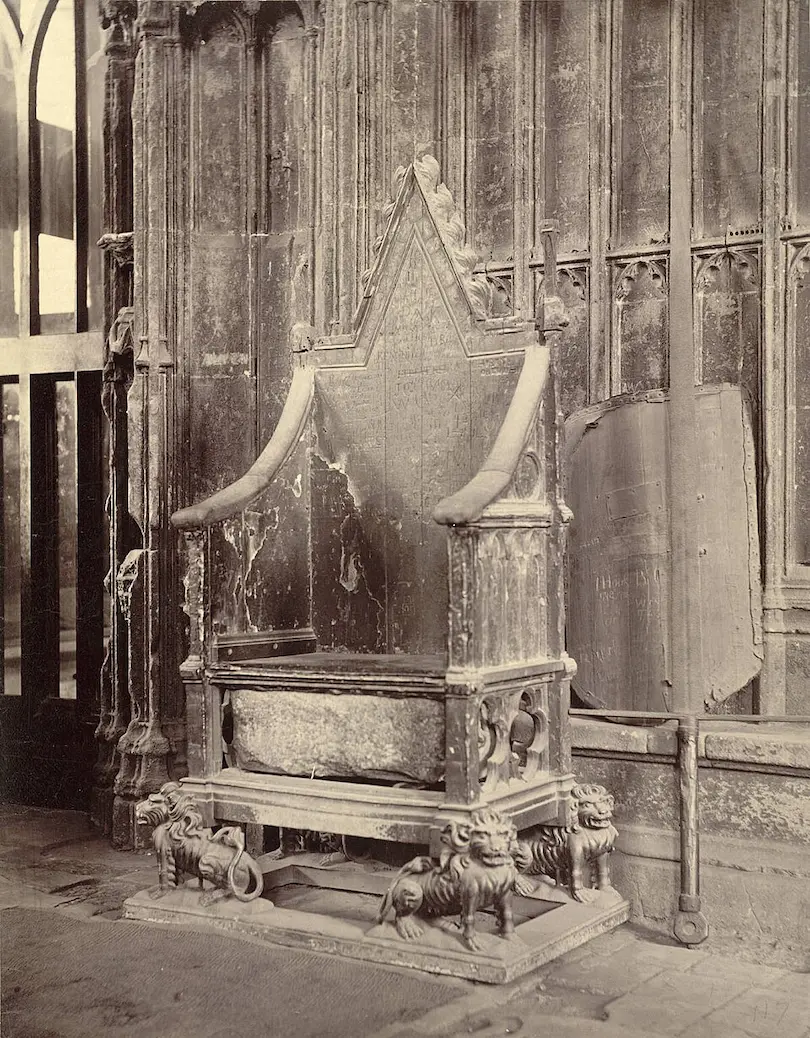 The Stone of Scone in the Coronation Chair at Westminster Abbey, photo c. 1875 – c. 1885
The fighting dragged on for decades, ending with Bonnie Prince Charlie's final defeat in 1746. That defeat also ended the traditional Highland clan way of life. Bonnie Prince Charlie fled to the Isle of Skye, which we visited as well.
In the 19th century, geologists began examining the stone. After it was returned to Scotland in 1996, they studied it far more closely, and in 1998 they pinpointed exactly where the rock had come from.
It wasn't Egypt. It wasn't Spain. It was quarried within a few miles of Scone itself.
The legend, it turns out, belongs in the same category as the Loch Ness Monster.
After Edward I seized the stone in 1296, a fierce debate broke out over Scottish independence -- one that eventually reached the Pope. England claimed both nations descended from a common ancient founder and had always been one kingdom, with London naturally on top. Scotland needed a rival claim, and a Scottish clergyman named Baldred Bisset stood before the Pope in 1301 and argued that Scottish history ran even deeper: it went back to the Bible itself, all the way to Egypt.
That may have built on an older oral tradition -- the Scots descending from Ireland, carrying a stone that had traveled from Spain, carried there by a pharaoh's daughter named Scota. Soon after, the story attached itself fully to Jacob.
It made sense at the time. Medieval kings across Europe wanted to link themselves to the biblical kings David and Solomon, who were anointed with oil poured over their heads -- which is exactly what the Hebrew word "Mashiach" (Messiah) means: one who has had oil poured on him. Scotland's story simply went further, tying its throne to the moment in Genesis when God tells Jacob, on his way back to the land, that kings will descend from him.
The stone stayed in England until 1996, apart from a failed theft attempt by Scottish students in the 1950s that cracked it. Once it returned to Scotland, it stayed there -- with one exception. When King Charles was crowned, the stone was brought back to Westminster so he could be crowned on it, just as tradition demanded.
This was probably never the actual stone Jacob slept on. But in another sense, it doesn't need to be. Jacob's dream describes something real: God's promise to Abraham, Isaac, and Jacob that all the families of the earth will be blessed through their descendants.
People are drawn to that story. Some become fixated on Israel in ways that aren't always healthy. But underneath it, that pull often comes from something deeper -- a desire to be part of a dream bigger than any one nation: that humanity can climb toward heaven, bring heaven down to earth, and become unified.
There's a reason the Hebrew word for stone, "even," is read by the sages as a combination of two words: "av" and "ben" -- father and son. A stone is solid. It endures. And so does the chain connecting one generation to the next. When that chain holds, it becomes something more than history. It becomes an offering -- humanity united, presented to its Creator.
That's a dream anyone can be part of, whether standing in Jerusalem or hiking a hillside in Scotland.









Greetings from Beit El. In the northern part of the yishuv (town) known as the artis is where Yaakov had his dream. There is a 1,000+ year old domed structure on the site where the dream of Sulem (ladder) Yaakov took place. This is an observatory, where you can see all the way to Tel Aviv on a clear day. There are other archaeological sites from the Tanach close by. Don't waste your money going to antisemitic Scotland (where Jews are victimized) to see a rock some Crusader murderer claims was associated with our Father Jacob. Come here (45 minutes north of Jerusalem) to your Jewish roots here in Beit El, Israel. Visit our our neighborhoods, and meet our people.
You are right, also Boy George should get a invitation too, for writing a pro Israel song, unfortunately a lot of countries are anti Semitic and anti Israel, only because Israel/ Jews defended themselves from being massacred on October 7, 2023 it was a mini Holocaust, my mother( obm) was in the real Holocaust, and was a Holocaust Survivor from Auschwitz-Birneau