




 Why Hating Jews Feels So Good





The Philistines supposedly showed up 500 years after Abraham and Isaac. So why does Genesis put them in Gerar? The answer lies in a recycled name and a broken pot.
Genesis chapters 25 to 28 tell the story of Isaac, Abraham’s son. A famine hits, and Isaac heads to Gerar, a town on the edge of the Negev desert, ruled by a king named Avimelech. The Torah (the Five Books of Moses) states it plainly in chapter 26, verse 1: Avimelech was king of the Philistines.
Simple enough. Except many archaeologists say the Philistines didn’t arrive in the land for another 500 years.
So let’s look at why they say that, and whether they’re right.
Abraham gets there first. He arrives in Gerar, a place run by King Avimelech, a general named Phicol, and a population called Philistines. After a tangled negotiation, they grant him rights to wells that some of their own people had seized from him.
A generation later, in chapter 26, Isaac shows up in the same Gerar, and things get messier. His father’s wells have all been blocked up by the Philistines. He reopens one, and they fight him for it. He reopens another, and they fight again. Finally he moves far enough away, reopens more of Abraham’s wells, and signs a treaty with the locals.
According to the Bible, then, Philistine rulers controlled this area around Gerar.
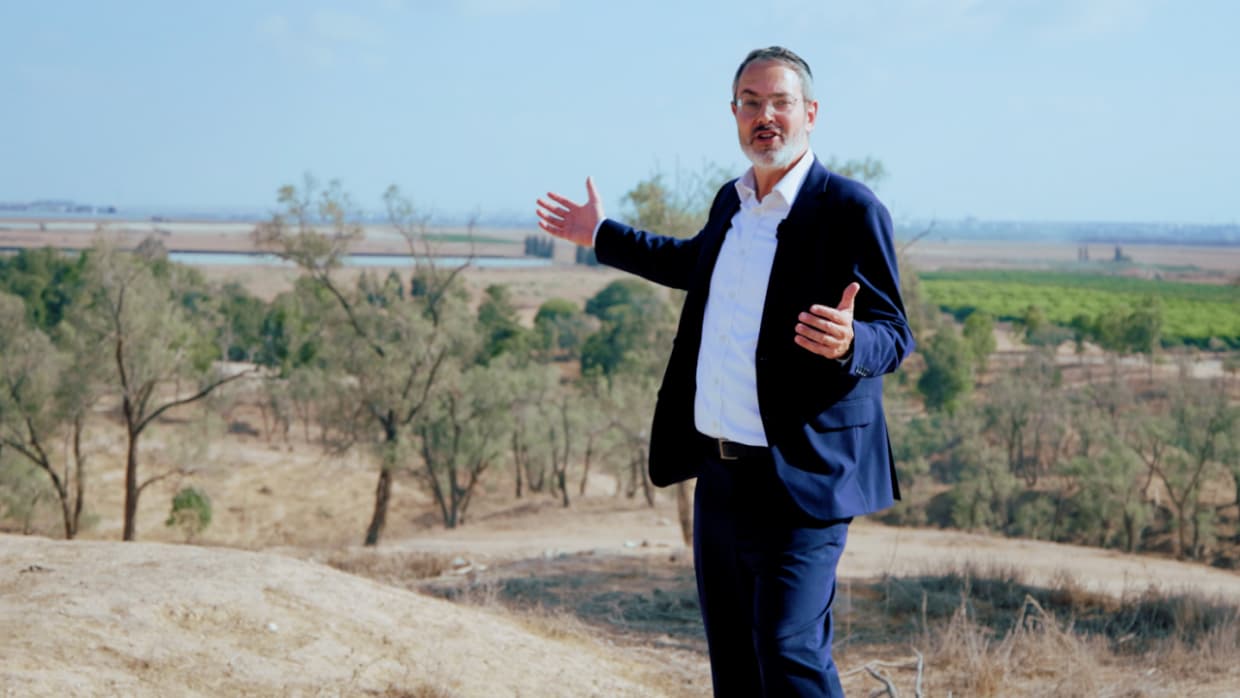
Stand at the site today and you’ll see a dried-up riverbed. This is what the Torah calls Nachal Gerar, the wadi, or seasonal stream, of Gerar. Beside it rises a tel, a mound built up over the ruins of an ancient settlement.
In 1956, Tel Aviv University archaeologist Yohanan Aharoni identified this mound as the biblical Gerar. In 1982, Eliezer Oren of Ben-Gurion University began a ten-year excavation here. When he finished, he filled the dig back in, so today it looks like a pleasant grassy hill.
At Medinet Habu in Egypt, a temple wall built by Pharaoh Ramesses III records a battle fought around 1175 BCE. Egypt had been invaded by sea by a coalition the Egyptians called the Sea Peoples, and Ramesses carved the whole battle into stone, complete with the names of the invaders. One of those names is Peleset: Philistines. As far as we know, it’s the first time the name appears anywhere in history.
After the battle, the Peleset settled along the coast south of present-day Tel Aviv, in five cities: Gaza, Ashkelon, Ashdod, Ekron and Gath. For the next 200 years, they’re the Bible’s great enemy. They fight Samson. Goliath is one of them. They battle Saul and King David, and they capture the Ark of the Covenant.
We even know what they looked like. The Bible Lands Museum in Jerusalem holds a small ivory carving of a prisoner with his arms bound behind his back. His headgear tells archaeologists he’s a Philistine.
We know their pottery, too: painted red and black, decorated with spirals and little birds, in a style straight out of Greece and Crete. Their cooking was Greek as well, and they ate pork. DNA from a Philistine cemetery at Ashkelon turns out to be partly European. These people came from across the Mediterranean, and they came around 1200 BCE.
So archaeology and Egyptian records place the Philistines’ arrival in the 12th century BCE. Yet in Bereishit, the book of Genesis, Isaac meets them centuries earlier, and so does Abraham. We’re talking about the 18th or 17th century BCE.
The critics’ explanation: whoever wrote the text lived much later, when the Philistines were the neighbors, and planted them back into a story about Abraham and Isaac. Writers do that when they don’t know their history well. They drop their own world into older stories.
Israel Finkelstein, whom we met last week arguing that camels and Arameans are fingerprints of a later author, says the same about the Philistines. In earlier episodes, though, we’ve seen the evidence increasingly support the biblical account. So how do the Philistines fit?
Kenneth Kitchen, an Assyriologist and Egyptologist at Liverpool University, spent 50 years arguing against the biblical minimalists and defending the Torah as broadly accurate. He made a powerful point.
Suppose the critics are right. Picture a priest or royal scribe in 7th-century BCE Jerusalem sitting down to write about an ancestor named Abraham or Isaac. When he imagines Philistines, he’ll imagine the ones he knows.
Every Philistine he could possibly have known lived in those same five cities, under rulers called seranim, or lords. And sure enough, every later biblical author who writes about the Philistines puts them in those five cities. They portray them as serious enemies of Israel. They describe them with iron weapons, which the later Philistines really had.
Now look at where Isaac actually meets them: in none of the five cities, but in Gerar. The ruler isn’t a seren. He’s a melech, an ordinary king. His name, Avimelech, is a perfectly common local name. There’s a king of Tyre called Abi-milku, for example.
And what do these Philistines do with Abraham and Isaac? They squabble over wells and grazing land. They’re especially wary of Isaac because he’s rich and reclaiming his father’s old wells. In the end, they make peace treaties with both men. There’s no war, no weapons, no iron, and nobody is ever called a seren.
That’s simply a different picture from what a 7th-century author knew. If the Philistines had been invented by someone looking back from the 7th, 10th, 11th or 12th century, we know exactly what they’d look like. The people Isaac meets are something else: a modest local power that makes treaties because it would rather not compete with him economically.
So who were they?
Kitchen suggests the word “Philistine” was applied to more than one group. Settlers from a Greek island, or somewhere in that region, arrived long before the 12th century BCE, and the locals called them Philistines. When a new wave landed in 1175, people said, “We know these people. Philistines.” The name got recycled.
This happened all the time in the ancient world. Take the Hittites, whom we discussed in an earlier episode. Hatti began as the name of the original people of central Turkey. A completely different people conquered them and inherited the name, so they became the Hatti, or Hittites, too. When their empire fell, the small kingdoms of Syria picked it up, different people again under the same label. Whoever lived there got the name. The Assyrian king Esarhaddon even lists Manasseh, king of Judah, among the kings of Hatti. For a thousand years, the name simply passed from one people to the next.
Amurru is a Babylonian word meaning “the west.” Over a thousand years it described desert shepherds, the kings of Babylon, a kingdom in Lebanon, and, in the Torah, the hill people of Canaan. These were unrelated groups sharing one name, because the name was really a direction. It meant whoever came toward us from over there.
On a cliff in western Iran called Behistun, the Persian king Darius carved a massive inscription in three languages around 520 BCE. The Persian version names a people called the Saka, or Scythians, horsemen from the steppes. The Babylonian version of the very same text calls them Gimirri, Cimmerians, which was the name of a different steppe people who had swept through a century earlier. The Babylonian scribes applied the old word to the new arrivals, because to them it meant people who came from that part of the world.
Yavan originally referred to one Greek tribe, the Ionians. It became the word for all Greeks in Hebrew, Arabic and Turkish, and it still is. Kittim, in Genesis chapter 10, comes from a town on Cyprus. The Bible Lands Museum displays the kind of pottery associated with the Kittim, the Mediterranean peoples from places like Cyprus. Later the same word came to mean Macedonians, and it kept shifting from there.
The pattern repeats across the ancient world. People migrated from the north or the west and got a name, and when the next group arrived from the same direction, the name was recycled. So there’s no reason to assume the Philistines of 1175 BCE were the same people as the Philistines of the 18th century BCE. Most likely there was simply a word for people who came from overseas and landed on the coast, and that word stuck around.
The Torah actually tells us where the Philistines came from, twice. Genesis chapter 10, which traces the spread of humanity, links the Philistines as a family to a people called the Caphtorim. In Deuteronomy 2:23, Moshe (Moses) says the Avvim, who once lived in villages as far as Gaza, were wiped out by the Caphtorim, who came from Caphtor and settled there. He describes this as ancient history, something that happened centuries before his own time. Centuries later, the prophet Amos says God brought the Philistines from Caphtor just as He brought Israel out of Egypt.
Caphtor is Crete, the large island south of Greece. The Egyptians called it Keftiu; the Babylonians called it Kaptara. So the Torah’s claim is that people from Crete arrived in the land and the locals called them Philistines. Many centuries later another group came, and the name carried over to them too.
We already know the later Philistines came from the Greek world. The DNA, the pottery, the animals they ate all point there. The real question is about earlier groups. In Abraham’s day, Crete belonged to the Minoan civilization. Did any Minoans make it to this land back then?
In 1933, a French team digging at Mari, a mound on the Euphrates in Syria, uncovered a royal palace holding 20,000 clay tablets: letters and accounts from the 1700s BCE. In those letters, Kaptara (Crete) appears as a trading partner. A man from Crete receives a shipment of tin. A Cretan weapon is sent as a royal gift. Cretan cloth and vessels pass through the palace storerooms.
In 1989, at Tel Kabri near Nahariya in northern Israel, excavators found a 17th-century BCE Canaanite palace with a painted plaster floor and wall frescoes done in the Minoan style, using Minoan techniques. The work was so expert that archaeologists concluded the painters themselves must have been Cretans. Cretan palace pottery has also turned up at Hazor in northern Israel and at Ugarit in Syria.
Cretans were here, living, trading and working, during the lifetimes of Abraham and Isaac. No one disputes that.
So the only question left is whether they were in Gerar, in large enough numbers that the group there could be called Philistines.
Tel Haror sits about 20 kilometers west of Beersheba, on the stream the Torah calls Nachal Gerar.
Why this particular hill? The biblical text itself supplies the clues. Genesis chapter 10 places Gerar on the road to Gaza: near Gaza, though not in it. Genesis chapters 20 and 26 show the king of Gerar making treaties as far away as Beersheba. In the biblical picture, then, Gerar has to be a major site, one whose king could project power all the way down the river.
As it turns out, Tel Haror is by far the largest site in the area occupied during the time of Abraham and Isaac. The only comparable site lies much farther west, and it couldn’t have controlled the region with this huge site sitting between it and Beersheba.
Gerar also has to lie on the wadi, since Isaac travels along that valley digging wells. Tel Haror sits right on top of it.
A minority of archaeologists still favor other sites, such as Tel Gamma or Tel Sera. Most, though, say the evidence points here: the right place, the right period, the right water source, and big enough that whoever held it would have ruled the whole area and could make treaties in Beersheba, 20 kilometers away.
Yohanan Aharoni identified Tel Haror as Gerar back in 1956. There are other candidates nearby, but most scholars consider this the strongest. Eliezer Oren of Ben-Gurion University excavated it for ten years starting in 1982.
The lower city alone is enormous. Above it rises the upper city, and the whole site covers about 40 acres, roughly 20 soccer fields. Most residents probably lived in the lower city. From the top, you can see how lush the surroundings are, a true oasis in the ancient world.
According to the archaeologists, this is where Isaac and Rebecca, Yitzchak and Rivka in Hebrew, came to stay, and where Avimelech famously looked out his window and saw them together. It’s easy to imagine the couple lodged in a guesthouse in the lower city, with Avimelech in the royal quarter of the upper city, peering down through their window.
Beneath the later town, Oren found a city from the Middle Bronze Age, roughly 2000 to 1550 BCE: the era of Abraham and Isaac. It covered 40 acres, ringed by earthen ramparts with a ditch in front. Inside stood a sacred precinct with a Syrian-style tower temple, its walls perhaps ten meters high, packed with the bones of sacrificed animals and pottery that once held animal offerings. Within the precinct was a well more than ten meters deep. A temple with a well inside it.
Excavators uncovered a very large temple here, along with pits where worshippers had left jars and other offerings. And somewhere in or very near this spot, they found something remarkable: an object inscribed with signs that clearly came from Crete.
In the central precinct lay a broken piece of pottery. Not much to look at. But its clay comes from the southern coast of Crete, and three signs were scratched into it before it was fired, meaning they were written in Crete itself. The signs are in the Minoan script, the writing of the Cretan palaces, which nobody has managed to fully decipher. The shard dates to around 1600 BCE. Oren published it in 1996, and it’s one of only two pieces of Minoan writing ever found in this country.
Let’s be clear about what this shows. An object from Crete, bearing Cretan writing, in the temple of Gerar around 1600 BCE: that much is uncontroversial. So Cretans were definitely present in Gerar. Whether they were traders, residents or a ruling class is an open question.
The timing is what’s striking. This is roughly when Isaac would have been in Gerar. The Kabri frescoes date to the 17th century; the shard to around 1600. The Torah describes a town on the edge of the Negev with a local king, a foreign general and a connection to Crete. And in the temple of the best candidate for that town, from that very century, sits an object from Crete with Cretan writing on it.
Another find came from the eastern side of the temple area: a chalice, a tall vessel typically used in temple rituals for pouring libations. This one was made from local clay, so it wasn’t imported. Yet whoever made it gave it distinctly Minoan design features.
So more than one find suggests that someone, or a group of people, living in the temple area had strong ties to Crete. Shaping local pottery in a Minoan style is rare when you’re simply importing goods. Add the Minoan writing, and the picture sharpens. Just down the road at Lachish, more Minoan writing has been discovered.
Gary Rendsburg, a professor of biblical studies at Rutgers University, wrote that there’s something remarkable about finding Minoan writing at precisely this spot, and he connected it to the argument we saw from Kitchen. Before Kitchen, the scholar Yehoshua Grintz was the first to propose that “Philistine” was likely a recycled term for successive waves of migrants from the Mediterranean. Rendsburg’s point: what a coincidence that at this site, at the time of Isaac, we have evidence of a Cretan, Minoan elite.
And the Torah itself says the Philistines our ancestors met had come from Crete.
Most of the Isaac and Philistines story in chapter 26 isn’t really about the town of Gerar. It’s about wells. The Philistines stop up the wells Abraham dug. Isaac reopens them and digs new ones, and the shepherds of Gerar fight him over each one. Each well gets a name. The first is Esek, meaning “quarrel.” The second is Sitnah, “hostility.” The last is Rechovot, “room,” because finally nobody fought and there was room for him.
That one chapter captures the whole economy of the region. This is essentially desert, and the only way to live and thrive here is with a well. A well waters your flocks, and it also brings in wealth, or its ancient equivalent. When travelers pass through, your well makes you the trading hub of the area.
Not far from the temple, excavators found a very large well. A city this size needed a water supply inside its walls, so it could hold out if enemies came. With all the filled-in ditches, it’s hard to tell today exactly what was where. But the picture is clear enough. If this was the central town, and this was the well everyone depended on for supplies, it’s easy to see why the locals would be furious at Abraham or Isaac for digging what they saw as a rival well just a few kilometers downstream.
The Torah’s focus on Isaac redigging his father’s wells is fascinating, and the key point is easy to miss. It goes beyond geography and economics.
Abraham bursts onto the scene with an explosive world of new ideas. God calls him on a journey to build the family that will bring blessing to all humanity. He travels from Haran in the far north to the land of Canaan, all the way down to Egypt, meeting powerful rulers wherever he goes. He becomes a great figure in the land.
Isaac never leaves. God tells him he’s not allowed to. He’s meant to stay put, even through a famine. And what does Isaac do? He redigs his father’s wells.
Throughout the Torah, a well represents a source of life, physically and spiritually. In our own lives, wells open up all the time: a burst of excitement, a new idea, a fresh start. Then they get filled in, just as the Philistines filled in Abraham’s wells. The real work is digging them out again and making that inspiration last. A new project, a new relationship, new spiritual growth, whatever it is, the work of redigging so it becomes permanent: that’s Isaac.
The role of Isaac and Rebecca in the Torah is to stay rooted, to take Abraham’s inspiration, his stories and the wells he dug, and turn them into something that endures. Their obstacle is the Philistines. And Isaac turns those opponents into long-term treaty partners.
The medieval commentator Nachmanides (Ramban) teaches that the three contested wells represent the three Temples, and the three times Isaac’s descendants would face a fight over them.
The first is Esek, “quarrel.” Neighboring nations with economic designs on the land, Assyria and Babylon, come to fight over it. When we fail to fulfill our role of shining light to the world, their claims may fall short of legitimate, but you can at least understand why they want the land for themselves.
Then we return and build the Second Temple, a second wellspring, a second source of life. This time the challenge comes from Rome, an empire from across the sea, fighting for imperial domination and ego rather than for its own neighborhood. That’s Sitnah, “hostility.” Pure adversity, with no shred of legitimacy.
Eventually comes the Third Temple, the third wellspring, redigging what Abraham and Isaac dug. That’s Rechovot, “room.” There will be room for everyone, so no one will fight. In a world run on ego, space is always scarce and everything feels crowded. In a world of humility, where people recognize the one God who loves all His creations, suddenly there’s room for you, for me and for everyone else. We’ll have a living spring that no one fights over, because it truly makes room for all.
At first, the story of Abraham and Isaac in Gerar looked like a glaring anachronism. How could there be Philistines? Didn’t they come later? But once you see how names were recycled, how waves of people kept arriving, and how Cretans, possibly a Cretan elite, were present at sites like this one, the story looks archaeologically quite plausible.
And the message of Abraham and Isaac is that people who start out as rivals, people we quarrel with, can become partners. In the short term we may have to fight. In the long term, they too can join us, as all humanity comes together around the vision of one God. That’s the deeper meaning of the wells of Gerar. The Philistines begin as adversaries and become Israel’s partners, foreshadowing a history full of struggle that will eventually lead to a Third Temple, a third home for God on earth, bringing all humanity together in a world of tremendous blessing.
In the next episode, we follow Jacob as he flees his brother and journeys back to Haran, where he finds a well, a wife (or two), and builds the family of Israel. We’ll explore his bizarre dealings with his uncle Lavan, who nearly destroys the family and the whole project of Israel at its birth, and see how archaeology sheds new light on those episodes.