




 “I Don’t Want to Work for a Jew”
6 min read
14 min read
3 min read
13 min read




3 min read


They inadvertently shifted the whole map of Jewish life and stopped building community.
When the Conservative movement allowed Jews to drive to synagogue on Shabbat in the 1950s, it was trying to solve a real problem. Families were moving to the suburbs. Synagogues were farther away. If people couldn’t walk, they wouldn’t come. Their solution? Let them drive—just to synagogue, just on Shabbat.
It felt reasonable. It felt inclusive.
But looking back, even the leaders who made that decision admitted it came with a cost they hadn’t foreseen.
Rabbi Ismar Schorsch, a former head of the Jewish Theological Seminary, later reflected that by permitting driving, they “gave up on the desirability of living close to the synagogue and creating a Shabbos community.”
They didn’t just change a rule in Jewish law—itself a big no-no, they shifted the whole map of Jewish life.
And with that shift, something subtle but powerful began to unravel.
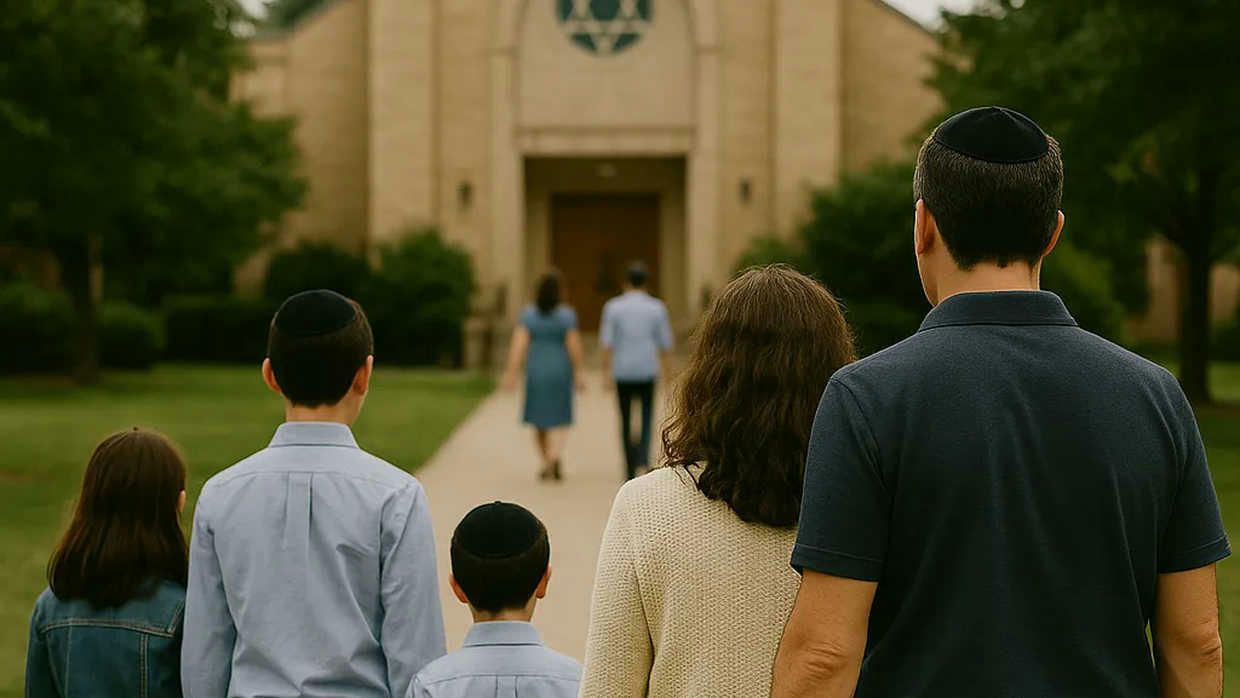
The Shabbat walk to synagogue wasn’t just about observance. It was about presence. About life lived together.
You’d see your neighbors. Your kids would run ahead to their friends’ homes. You’d hear Hebrew on the sidewalk. Smell cholent from the windows. Run into someone who’d invite you over for lunch.
You didn’t need to plan a “Shabbat experience.” You were living inside one.
And all of that—everything that made Shabbat more than a ritual, everything that made Jewish life feel whole—depended on one quiet rule:
We don’t drive on Shabbat.
That rule kept us close. And closeness kept us Jewish.
At first, it was just a short drive. But over time, the distances grew. People didn’t need to live near a synagogue. They didn’t need to live near each other. So they didn’t.
We traded the walk for convenience. And slowly, without noticing, we lost the spontaneous Shabbat invites, the kids with kippahs on scooters, the public Jewish life we didn’t have to schedule—we just lived it.
We got space. But we lost belonging.
You don’t need to be Orthodox to feel the ache of distance. You just need to be a Jewish parent wondering why it’s so hard to give your kids what you had.
You want your children to speak Hebrew, feel proud, marry Jewish, have Jewish friends. But that doesn’t happen in a vacuum. It happens in proximity.
Not just to Jewish ideas—but to Jewish people.
To thrive, Jewish identity needs more than pride. It needs neighbors. It needs a walkable Jewish world.
You can’t give your child the exact life you had. But you can give them something better than drifting.
You can give them belonging. Direction. People to grow up with.
And the good news is: you’re not alone.
There are schools—like Zucker Jewish Academy—and others across the country that are designed to support families just like yours: families who may not have grown up religious, but are serious about raising strong, connected Jewish children.
Through organizations like the Jewish Education Initiative, it’s possible to find a Jewish school and community that fits your family—and to access support to make it affordable.
If you want your kids to grow up with identity, clarity, and community—you have to build it.
Start with a Jewish school. Build from there.













The author makes many assumptions about his Jewish audience, particularly that all of us should live in an urban environment - or have jobs that allow us to do so. In fact, many Jews live in locations where this is not feasible, be it on a farm, a regional (or rural) hospital, or some other location where "walking distance" is measured in miles not yards. Are all Jews required to be urban dwellers and lock ourselves into shtetls or ghettos? For those of us who live in rural areas or countries with small Jewish populations, it may be literally impossible to live near a shul. Should we all be restricted to the small subset of professions that would permit this?
Does it really matter if they drive or run or swim to shul? Yes, I know, 'thou shall not set fire' and an engine starting is 'fire'. Let us focus less on how we get to shul and more on how we treat our loved ones, our neighbors, friends, strangers, our environment. Let us focus on making sure that every human has food, shelter, education and that we protect our home, the Earth, from those that view it just as a piece of real estate and whose hearts are in the shape of a dollar sign, shekel, Euro or gold bar.
What I believe too!
Much more important than if Jews drive to shul or cycle, walk, skate or use a pogo stick to get there is what is in our hearts and what we focus our work in this world on. The biblical prophets repeat again and again that God cares nothing for prayers and sacrifices of animals but what he asks is for us to make sure that the widow, the orphan, the poor are all fed and clothed, caring for each other. The prophets also emphasize that we are all created in a divine image, not just Jews, and that we must care for all humanity. Sadly, too many of us Jews choose to focus on the endless laws laid down by the priests, and forget the spirit of love and tzedek, and too many of us choose to ignore the fact that the first humans were not Jews or Irish or Americans but Adam and Chava (or 'Lucy').
The Prophets are important voices reminding us of the spirit of the law. However, the letter of the law is of more importance. Of course we should love our neighbors, but if I hate my neighbor, it’s more important that I begin with the Torah commandment, “You must not murder.” Furthermore, the laws were not “laid down by the priests.” The Torah came to us from G-d. The elucidations in the Oral Law, the Talmud, were discussed and ultimately written down by the ancient teachers, rabbis. Being a Kohen doesn’t really come into it.
'The Torah came to us from G-d.' What is your proof?
You can read a translation of the Torah. You can also discuss it with a qualified Rabbi
Aren't all rabbis qualified?
Unfortunately no.
Problem is that when you only focus on the social justice and tzedek, you feel that since everyone is the same, there is no need to marry within your faith. The endless laws are there for a reason. To keep our identity intact. Jewish law is designed for us to care about humanity. Paying wages on time, no gossiping about others. But we need to focus on our Halacha and traditions. Otherwise we will end up with kids who think resistance by any means is justified.
It is a must to drive to the Shul in Stockholm, since many of us are living 30 km outside the center there the Great synagogue is. The idea that we shall live close is not possible due to the cost of flats, and also the lack of awaileable flats. To do just this king of articles is not to any help at all. It is better that people do come to the Shul regardless if it si by car or underground- train. WE are living in 2025 not in 1880, then this was m ore possible in smaller towns and keeper Flats and houses.
I have a suggestion that you boys of strict orthodoxy. be friendly and open and acceptable to your more liberal Jewish sisters and brothers and particular those that have been converted as such. That if something will make miracles in the community. The diversity has hurt me much.
On any shabbos, you'll see the streets and roads of Tel Aviv choc-a-bloc with traffic.
We lived near a shul and walked there on shabbos. He loved it! My son went to a modern orthodox school until high school and we almost lost him to marrying a non jew. Thank G-d, they have broken up but he has no desire to return to more observant life style
I disagree with this. I don’t think allowing people to drive to Shul on Shabbat has decreased numbers. It has provided people who live in places with excessive heat or cold to be more observant. It has given people with mobility issues (handicapped or recovering from surgery or cancer) the ability to be more observant. It has actually been a factor in my return.
Sounds good but not unfortunately statistics don't support this, as reform and conservative synagogues continue to lose membership and intermarriage skyrockets.
This is not because they either walk or do not walk to shul. The membership weakens due to lack of Jewish education and practice, as well as who their friends are.
Where, outside of Israel, does Sam Mitzman imagine that one would hear Hebrew spoken in the streets of Jewish communities? Or can’t he distinguish it from Yiddish , which was in common use?
and how is driving to shul essentially different from the fiction of the eruv, that pretends that a few square miles constitute the perimeters of a person’s home?
For that matter, how did prohibitions on modern devices like the automobile become Halachakly forbidden?
there are larger problems in American Jewish life - such as the abysmal state of Jewish education - than whether Jews drive to shul
Not following Torah-true halachah, or bending it out of shape to make it more convenient, is the biggest problem!
(And the "abysmal state of Jewish education" is so problematic when the basic principles of Judaism are overridden.)
The Eruv is not a fiction. If a whole community come together and take the time, trouble, energy and money to make a boundary that contains all of them, then that justifiably makes that enclosed area a shared one within which they can all carry. The whole complex prohibition of carrying was defined by the greatest Rabbinic leaders and "they who prohibited certain actions(as a stringency/safeguard) are the same ones who permitted those actions", relaxing those safeguards under carefully defined conditions
The prohibition against driving, otoh, doesn't necessarily have anything to do with carrying and is an out and out forbidden activity. Your last question involves you spending time studying the subject, preferably with an orthodox Rabbi/teacher
Wonderful reinforcement story. We must come together as a whole to overcome the possibility of getting lost among the masses. Imagine walking and rejoicing the new day. Blessed be.
When I loved in Venezuela, it became top dangerous to be walking to shil, even if ir was on the same neighborhood. People started moving to other neighborhoods and still needed to drive. Then I moved to Chile and was not able to afford living where the community was. Now I am in Spain and ir Is even worse. Thankfully I am able to drive
Try Israel. You can live literally anywhere and be within walking distance of a synagogue. And there are plenty of Latino Jews everywhere so you will feel culturally comfortable
How about making Shuls wheelchair accessible that they can come to Shul that way, make all Shuls wheelchair accessible that disabled people can come to Shul on Shabbat and Yom Tov, or create Shuls in people's houses that don't have a Shul close by, it sad when Jews live to far and have a dilemma about getting to Shul, these neighborhoods should fins a solution for this kind of problem without violating the Shabbat law, also having a valid Eruv too
Every shul I have belonged to is wheelchair accessible.
Then you are very lucky!
I guess when people get old and can't walk to Shul they try to live in a assisted living facility with a Shul near by, it is sad when you can't get to Shul when you get old. Some people are not old but have disabilities that makes hard to get to Shul, unfortunately most Shuls are not wheelchair accessible which would help a lot, in these types of situations, some people have Shuls in their homes , the word for it is House in Yiddish, my mom( obm) told me about story that religious Jews threw stones at people that went through the Holocaust on Shabbat, I forget if they dressed not modestly or was in a vehicle, but you dipon't throw stones at people on Shabbat that also violations Shabbat and you can hurt people like that, also this attitude does not help kiruv, it does the opposite
Let’s follow this logic all the way to the end, now- in the practical reality of the North American suburban communities the majority of us live in:
Which will end the Jewish community faster?
1. People who WANT to go to shul, make Judaism a part of their family life, and commit to driving there so they can be connected together as Jews?
2. Or people who say you are NOT welcome and you should stay isolated and excluded until you decide to pack up & move into their specific community (who already say you are unwanted because you are not “Jewish enough” for them in the first place).
How ironic this article comes on Omer day 26- Hod of Netzach: Humility in Endurance. Perhaps some humility could be used here from those who insist their way is the most “righteous” way.
I hear the frustration—and the longing behind it. This isn’t about judging those who drive. Many are doing what they can to stay connected, and that matters. But the piece wasn’t saying “you’re out”—it was asking what kind of Jewish life we want to build long-term. Halacha isn’t about superiority. It’s about structure that sustains us across generations. If we want a Judaism that lasts, we need both accessibility and integrity. This isn’t about purity—it’s about building something whole, together.
Building something “whole” and sustainable long term, means looking at practical realities today instead of idealism.
I am fortunate to live in a city with a thriving Jewish community and neighborhood in Montreal. Not everyone has this resource. Ultimately, communities come together and are sustainable through PARTICIPATION. Anything that facilitates this connection and participation ensures survival. It’s common sense. Will you keep a language alive if you are the only one who understands it if you have no one else to speak to?
Telling people they are better off being isolated and excluded is backwards and self-righteous.
I agree with you completely, and disagree with this article. I would love nothing better than to be able to live within walking distance of a Shul. The cost these days in most communities is prohibitive. Not driving to Shul prevents my husband and I from going. I would love nothing more, as did my father. He had to stop going to the shul which he so loved.
But your father merited a great deal by not driving / being driven to shul on Shabbos or Yom Tov!
People who cannot live within reasonable walking distance to a shul but want to daven with a minyan usually manage to find an alternative that suits them.
Not if they are disabled!
This article was not about righteousness. If anything, it was about the sociology of the way communities that don't observe shabbath fall apart. This isn't a critique, rather, it's a report.
Too bad you feel that way. I hope you find your peace and connection with Hashem
So the question to be asked is, is it better to stay at home and try to daven without a minyan and community or to drive there and daven and be with everyone.
Without a Torah this would be a reasonable question and probably social concerns would override, however with a Torah you are suggesting that committing a capital crime should be legitimized because it is more comfortable for your lifestyle and social concerns.
It’s a real question—and it comes from the right place: wanting to stay connected. The challenge is that halacha doesn’t just guide what we value, but how we live those values. Driving on Shabbat isn’t a small thing—but neither is isolation. That’s why it’s so important not to navigate this alone. With good guidance, people often find paths they didn’t know were possible. It’s not about choosing between halacha and community—it’s about finding ways to honor both, with care and clarity.
In my mind it is better to drive to shul and daven with everyone. We need the community. We also need, as in the past, gatherings of adults (30-50) to be able to meet other unmarried and be together as Jews.
Living in a walkable distance from a shul?
So as to achieve closeness?
ie, living in a ghetto!
I don't think living in a ghetto is a right idea.
Judaism must constantly reinvent itself or it will stultify.
reinvent itself as in permitting Shabbos desecration, a capital crime in the eyes of G-d? Many have tried to reinvent Judaism in such ways and all have failed and gone lost. The true Torah nation will live forever.
As if Jews don't drive on Shabbos!
I don't think any American Jews would ever agree to living in a ghetto.
I hear your concern—but I think there’s a false choice being presented. I live in a suburb with people of all backgrounds. But many Jewish families here chose to live within a mile of each other—not to isolate, but to build something meaningful together around the shul. The school came first. The synagogue grew around it. That’s how we anchored the community.
Kids walk to each other’s homes. Families drop in on Shabbat. Judaism becomes something lived—not just attended. That’s not a ghetto. That’s rooted community. In a culture that often leaves people isolated, that kind of closeness doesn’t limit life. It deepens it. We’re not cutting ourselves off—we’re creating space to live Jewishly, together.
Robert, you can think whatever you want, but when Jews stop observing shabbath, within a few generations, if not sooner, they disappear as Jews, DESPITE "reinventing themselves." The Pew demographic studies clearly show this.
I didn't say stop observing shabbos.
I just pointed out that American Jews drive on Shabbos.
Everybody in this forum knows that that's true.
If Jews had to live within a walking distance of a shul, ie, within one mile, then all that would happen is that a Jewish ghetto would be created.
I think I can confidently say that American Jews will refuse to live in a ghetto.
You mean that irreligious / non-observant American Jews drive on Shabbos, but statistics show that it doesn't usually take more than a couple of generations for these Jews to assimilate completely and lose their heritage.
Define what you mean by ghetto: one could say the same about some gated communities!
I live within a block of two schuls, with half a dozen more within a mile. It's not a ghetto, but a tight knit community in which you know your neighbors, greet each other in the street, and help others in need. The word is COMMUNITY, not ghetto
There are many significant issues that make it difficult - if not impossible - for some to attend shul if they have to walk. So, for those who do not want to violate Jewish law but whose disabilities (or other circumstances) make walking to shul impossible, they just stay home on Shabbat/Yom Tov and only go to shul when it is not Shabbat/Yom Tov, when driving is permissible (e.g., on Purim and, of course, for regular weekday services). That is truly a loss.
One solution might be for more shuls to have "dorm rooms" for congregants who cannot walk to shul. They can drive there on Friday afternoon and stay overnight for Shabbat/Yom Tov, so that they can attend shul unencumbered by the issues preventing them from walking from shul, yet without driving to shul on Shabbat/Yom Tov.
So now you do away with Shabbat and Yom Tov dinners? Doesn't sound good to me.
You are absolutely right . This should the way and the only way!
I am sure many of us would love to be close enough to walk to shul. But for some of us, circumstances make that nearly impossible. Age, disability, family circumstances, finances, all play a role. Right now, I am unable to even drive, so I do another “forbidden” thing - I watch online. I do miss and long for, a close in-person community. But when that is not possible, what are the options? Abandon shul altogether?
Thank you for sharing this. I hear the longing behind your words—and the struggle is real. Age, disability, and isolation are real barriers. But the question isn’t just “do I abandon shul?”—it’s “how do I live a deeper Jewish life, even with limits?” Judaism isn’t just about showing up—it’s about building rhythm and connection. And rooted in our DNA—from Avraham onward—is kindness. That’s why Jewish life overflows with support networks and creative solutions. With the right questions, asked with care, real doors can open.
See if you can AUTOMATE your online experience so you don't desecrate shabbath.
Walking to shul may be realistic in Brooklyn or Manhattan, but not in towns that don't have a synagogue (or three) on every block.
It’s true—most towns don’t have shuls on every block. But I moved to a suburb where under 100 Jewish families chose to live within walking distance of each other—not to isolate, but to build something lasting. A school came first, then a shul. Now kids walk to friends, Shabbat is shared, and community feels real.
Sociologists say where a child grows up is the biggest predictor of their future—income, education, identity. People move all the time for jobs, schools, or convenience. What if we moved with deeper purpose? Not just to make a living—but to build a life.
Every time we moved, from the Philadelphia, Bronx, Manhattan, MD suburb, San Diego, and back to MD, the top criterion was that we be in reasonable walking distance to shul. That often meant smaller homes, but that was not our top priority. Now that we are looking into retirement options, we would love to live in a less dense area, but that may not be feasible if a home within 1/4 mile of shul is not available.
Had a Rabbi ah who lived in Jersey. The nearest shul was at least 2 miles away. He walked with his sons every Shabbat and holiday. One of his sons said it was the best bonding experience he and his siblings had. And today the son lives in a community with plenty of shuls but his congregation is a 45 minute walk
That doesn’t work for many people.
Walking to Shul
on Shabbos/Yom Tov is such a joyous experience to Have!!
The teshuva of the Conservative movement never allowed one to drive on Shabbat. It only allowed one to be a passenger in a car on Shabbat. But as Rabbi Steven Pruzansky articulately says in this lecture, that nuanced point was lost on all members of the Conservative synagogues.
Listen here: https://www.yutorah.org/lectures/801281
the best Jewish education your kids can have is in Israel - where being Jewish is 24/7, not just Shabbat. Now we have the opportunity that our parents didn't really have, to have a Jewish community like no other.
Tel Aviv is just one city in Israel, and yes, even Tel Aviv has actual shuls and community. There is nothing better than coming home to the land given to us by Hashem.
That’s wonderful. I expect you realize that it’s not feasible for everyone at any time.
I have read that for Israeli government emergency use, there are Shabbat compliant vehicles. I have long wondered if it’s ever been considered that could be used by the disabled in the US.
I was disabled for awhile after a major health crisis. Prior to that, I had always walked to our OJ shul. While disabled, my husband pushed me to shul in a wheelchair a few times,
I dont appreciate this. I am deaf. I am mobility inconvenienced for now. If I could walk the block .5 to shul, I would not be able to walk up the stairs. If I used the ramp to get up to the women's section I will not be able to see who is davening or lip read (from that distance) what is being said. If I stay home I don't get socialization. Or connected to community. If I drive 1 mile to conservative shul I can walk in and meet people who will help me and let me use my phone to transcribe drosha so I know what's being said. A friend knows to tell me if they are announcing mishaberach so I can stand and participate too. I also wear rechargeable hearing aids and need a CPAP at nite. I grew up orthodox. But I am not valued in the Orthodox community. I did not appreciate your article.
Truly sorry to read this
I'm lucky the rabbi here is willing to help me find a friendly finger to show me where the davening is. I feel more accepted. But I know I'm my heart that it's wrong. So I need as article like this to make me feel worse!
So it is my understanding that when attending Chabad services, some folks drive and some walk. I walk to my Orthodox Shul, but I have seen people being dropped off in front of the Shul. Guess what?! Your mode of travel to Shul is none of my or anyone else’s business!!
Ok. I accept that. What about being able to follow the davening? Who's business is it to help me know the page? The language (Hebrew or English), the drosha? Thank you for not caring that I drive on shabbos. I want to feel like I belong in shul, too .
Re: Knowing the page. If I can help someone out, then it is my obligation to do so. Plenty of women have helped me when I was in need!
Ask the rabbi to get someone to help you. Of COURSE you belong in schul!
I hear how painful this has been—and I’m grateful you shared it. What you’re asking isn’t just about access. It’s about belonging. And you’re right to expect that. I want to say gently: halacha isn’t what failed you. But if a community doesn’t make space for your reality, even unintentionally, it can feel like it did. That’s not what Torah is meant to be. There are halachic paths that can honor your needs—with real guidance and care. You matter. And a Judaism that doesn’t show you that isn’t finished growing yet.
All legit claims. I personally go on shabbath to an elderly man, help him get dressed, walk him to 2 flights, schelpping his walker & slowly walk to schul with him, doing the same at at schul stairs. It’s giving life to him to be able to daven with a minyan & get an ‘aliyah & answer to qaddish. There are sabbath permitted small vehicles to take you to schul. The derasha could be printed BEFORE. No need to stand during mi sheberach. Hearing aids are allowed, there are sabbath permitted CPAPs. You can have your cake & eat it to. You ARE valued in the orthodox community. I’m sorry the article upset you & I wish you good health & blessings!!!
Also, an interpreter can be hired by the congregation, and yes, in the women's section to accommodate your needs. Your shul may be required by law to be accessible to the disabled-- they may have to install a ramp. Check with the laws of your state. But I'm pretty sure that there is a way to address and solve every issue you've mentioned, both halachically and practically. As an aside...there is a man up the street from me who is being treated for cancer and no longer has the strength to walk to shul. A minyan comes to his house to daven! THAT is community!
What happens when we become elderly and our joints cannot support us and the walking becomes difficult should we give up going to Shul on Shabbat
Is it appropriate to be wheeled in a wheelchair or a motorized scooter that would violate the Shabbat
Is has been difficult for me to imagine walking to Shul long distance sweating which is energy being created which is contraindicated and prohibited in Shabbat I have difficulty reconciling this concept
Joseph there is no problem to reconcile - walking or even running and sweating is not prohibited labor on Shabbos. Driving a car (i.e. igniting a fire) very much is prohibited labor on Shabbos. It is inappropriate to violate the Shabbos no matter how much annoyance or hardship or offense it causes you.
This is such an important question—and one that speaks to something deeper: What happens when our bodies change, and we still want to belong? Shabbat isn’t about avoiding sweat. It’s about stepping back from shaping the world—and entering a different rhythm. Walking, even with effort, is still within that rhythm. And where that’s not possible, halacha does have paths—with care, with guidance, and with dignity. You’re not being pushed out. You still belong. And your presence still matters.
I live in an orthodox neighbourhood & every shabbath we see people wheelchaired to schul. Contact a rabbi & ask for help.
I am not Jewish but your Faith is the parent of my Faith. And this article is right on the spot for all people. Without community, without family it is impossible to grow close to each other. It would be a beautiful world if all of humanity realized what you have said here. I don't know if it is possible this side of Heaven to have such a thing as the kind of community here stated but oh my goodness wouldn't it be wonderful? Thank you for reminding us we need community.