








 The Shofar Is Silent, Remember to Breathe

13 min read
9 min read
7 min read




The remarkable story of a group of boys who were forced into the gas chambers, yet came out alive.
The Hungarian Jews were deported to Auschwitz 82 years ago. Approximately 440,000 Jews were sent during the deadliest period in Auschwitz’s existence, with thousands gassed and cremated daily.
Dr. Mengele took a particularly sadistic pleasure in selecting Jews for the gas chambers and crematorium on the High Holidays, specifically targeting religious Jews for death on those days. He would point and tell those not selected, “This is where we are burning your family.”
Surviving the gas chambers was unheard of. Once the doors locked, it was the end. Yet remarkably, one day 51 boys survived. How?
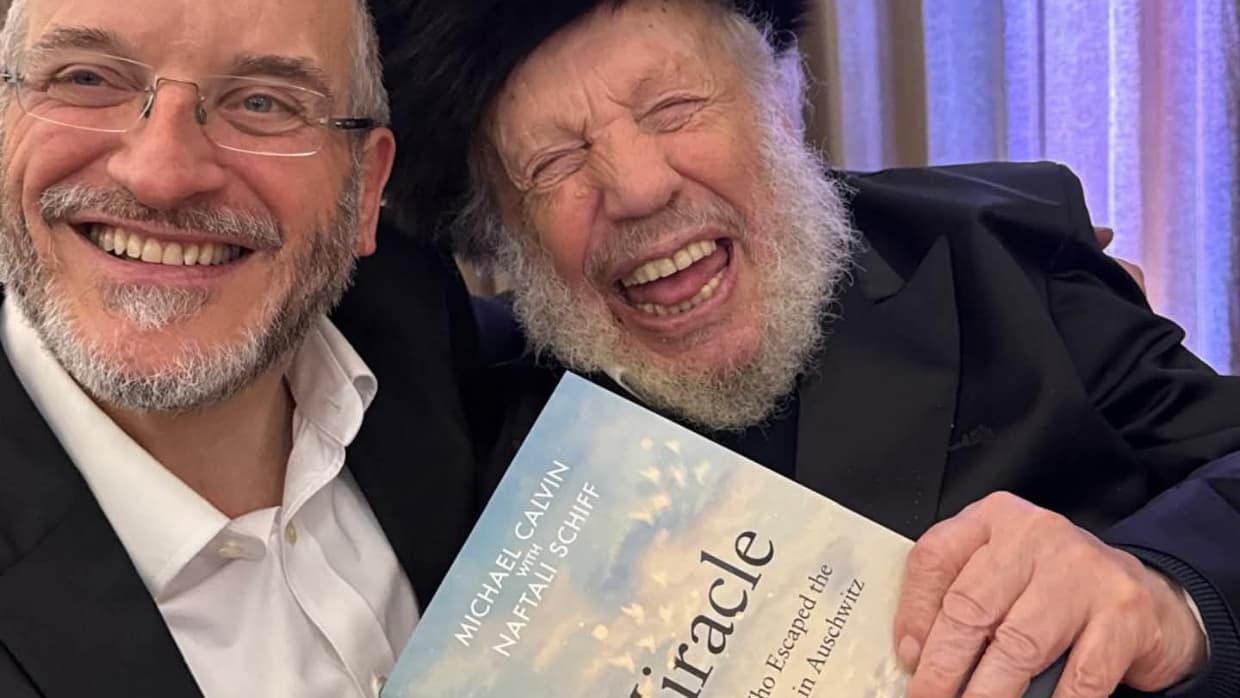
Over a period of 25 years, across four countries, a painstaking search led Rabbi Naftali Schiff, director of the documentary Undeniable and co-author of the recently published book Miracle: The Boys Who Escaped the Gas Chamber in Auschwitz, to conduct firsthand interviews with six of these survivors, each with a unique and powerful story of their own.
When these boys arrived in Auschwitz in June and July of 1944, they survived the initial selections while most of their parents and siblings did not.
On Hoshana Rabbah, a holiday that takes place during Sukkot, a few hundred boys were selected for death and locked inside the barracks. By that point, they knew exactly what would happen the next day. The religious boys recited viduy, the confessional prayer before death. The night seemed endless as most of the children were crying, screaming, and praying.
On Simchat Torah morning, the door to the barracks opened and the boys were ordered to get out and march to gas chamber number five.
They were pushed inside and the door was shut and bolted behind them. Other prisoners could hear the screams of Shema Yisrael from outside.
The teenagers could see the Zyklon B was being brought toward the chamber through the small aperture windows. They were frozen, unable to utter a word. They waited for the gas to start coming in.
At the last second, the door opened. Nazis started screaming and pulling groups of boys out. There was shouting, confusion, and commotion. They were looking for 50 strong boys. They selected the 50 they wanted and somehow another boy managed to escape unseen—in total 51 survived.
No one knows for certain why the boys were inexplicably ordered to come out. Some historians believe there was a power struggle between Mengele and another commander named Schwartzhuber who felt some prisoners could still be used for labor.
The first thing some of the boys did upon returning to the barracks was dance, as is customarily done on the holiday of Simchat Torah, celebrating the simultaneous end and immediate commencement of a new cycle of the reading the Torah. How did some have the strength to maintain their faith, to pray, to cling to whatever Jewish observance they could in the concentration camps?
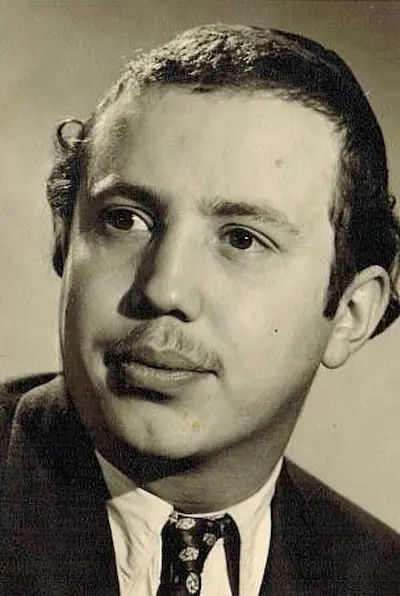 Hershel Herskovic 1950.
Naftali felt that only the survivors could give authentic answers to these searing questions.
“There is a moral authority to people who have lived through life in the extreme,” Naftali told Aish.com. “I wanted to get closer to the source.” Through JRoots, Naftali and his team has brought more than 30,000 people to Poland, accompanied with survivors.
Naftali interviewed six of the 51 boys extensively. One was Hershel Herskovic, 99, now living in London. Two weeks before the end of the war, after surviving the Simchat Torah episode and the infamous death march, he was taken into the woods where the Nazis intended to shoot the remaining prisoners.
Out of the corner of his eye, he saw a Red Cross vehicle and managed to escape toward it. He begged for food and they gave him some. He asked for more, explaining that his brother and cousin were still back there dying. They told him, “You’re free. Keep going in the opposite direction. Don’t go back.”
But he refused to leave them to die and instead risked his life and chose compassion.
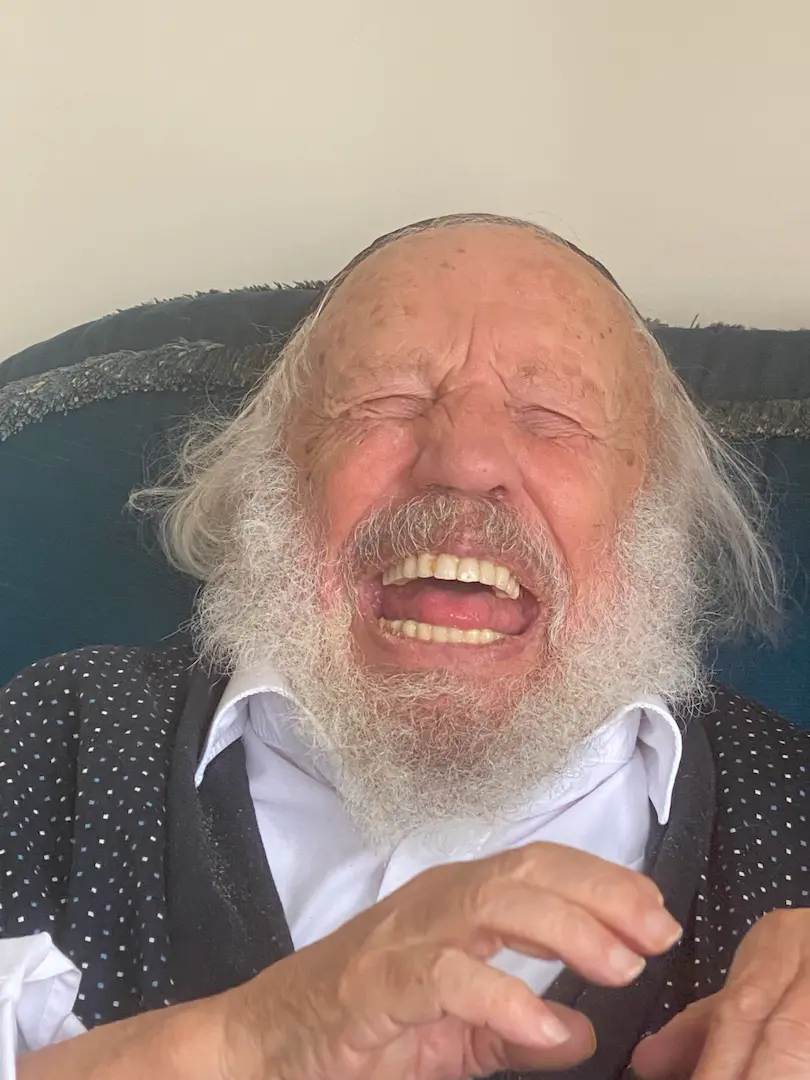 Hershel Herskovic
He snuck back into the forest. Everyone jumped on top of him trying to grab at the food. Shots rang out. A Nazi struck him on the head. Between his injuries and the typhus he was combating, he went blind within a week.
Eventually he made it to England, where the Jewish Blind Society took him in. They wanted to rehabilitate him and even tried to send him to law school. But Hershel was never the type to follow orders.
Naftali said, “He told me that as a teenager in Auschwitz, he once complained directly to Mengele that the block master was stealing food. He was a gutsy kid! The Jewish Blind Society in England also struggled with him because he refused to follow their rules including to use a white stick.”
At one point they sat him before a committee and explained, “You are in England now, not Nazi Germany. We want to protect you. If you walk into the road without a white stick, you’ll get run over.”
Hershel replied, “I will never carry a white stick. I didn’t surrender to the Nazis. I’m not surrendering now.”
At Hershel’s grandson’s wedding just last month, he was there in a wheelchair, still strong. He took out his white stick that he does not use for walking and instead held it aloft more like a scepter or baton, conducting the music with it—a symbol not of surrender, but of victory.
Naftali added, “Just three weeks ago, Hershel’s grandson suggested I challenge him to an arm wrestle. He won!”
Herschl’s cousin, Chaim Schwimmer, also survived and has over 200 descendants.
While hoping for survival even in the gas chambers, the following line from the Talmud became his mantra: “Even if a sword rests upon a person’s neck, he should not give up hope for mercy.” He never stopped praying.
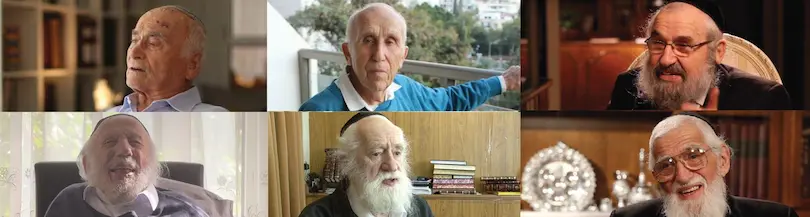 The six survivors featured in the documentary, Undeniable.
Later during the death march when Chaim could no longer bear the cold and was ready to give up, Hershel physically carried him forward by putting Chaim’s hands into his own pockets to warm him and schlep him along the agonizing road to survival.
David Leitner, known in Israel as “Dugo”, was another boy who survived.
The night before deportation, his mother baked small challah rolls—bukelech—and gave one to each child. As they were being taken away by the Nazis, she told him, “Duvid, you are going to survive. You are going to get to Israel, where bukelech grow on trees.”
Dreaming of those delicious rolls helped him survive the Death March in the winter of January, 1945. Years later, in Israel, he was taken to Shuk Machane Yehuda, the Jerusalem marketplace, and the smell of falafel overwhelmed him; he thought it smelled just like bukelech.
He devoured two falafels, eating them in peace in Jerusalem, a small component of his revenge.
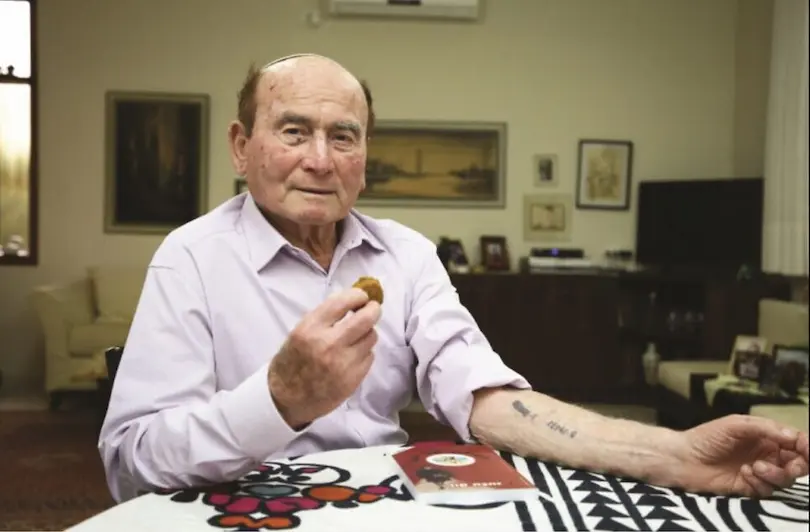 David Leitner
Now, every year on January 18th, the date the death march away from Auschwitz began, he goes back to that same spot and orders two falafels. It has become known as “Dugo’s Falafel Day” and presidents and dignitaries have joined his custom.
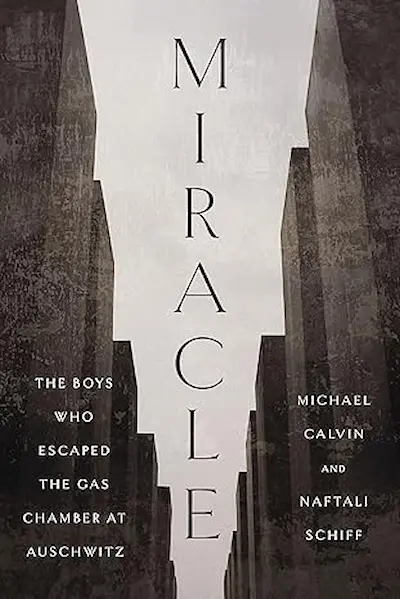
Naftali recently co-wrote a book recounting the story, called Miracle, which immediately became a bestseller in England. “I originally disagreed with the publisher's insistence on this title because I worried it might seem insensitive to the memory of the more than one million Jews who were murdered in Auschwitz. But during the current period of Jewish history—after October 7th, during a time of so many challenges and also so many extraordinary survivals—I came to realize something: the fact that the Jewish people survive at all is indeed a miracle. We are tiny in number. Statistically, we should either be enormous like other populations or extinct entirely. Yet we are still here. Each one of us, a miracle. The very existence of the Jewish people is a miracle!
“After October 7th, for many Simchat Torah became an end. But what many, including our enemies, cannot comprehend is that Simchat Torah is also the beginning of the new Torah cycle. That is the Jewish story. The perceived end is also always a new beginning. These 51 boys were saved on Simchat Torah. We rise again and we always have.”
The Jroots documentary Undeniable tells the story of six of the 51 boys whom Naftali tracked down and interviewed over a period of 21 years in Jerusalem, London, Manchester, Montreal, Netanya, and New York.
In the court case against Holocaust denier David Irving, the defending lawyers they chose not to rely primarily on survivor testimony; they feared the prosecution would attack elderly survivors as unreliable witnesses. Instead, they brought in Professor Robert Jan van Pelt, a world expert and forensic architect who had extensively studied Auschwitz and Holocaust denial.
They can take away our bodies, but we are not going to let them destroy our spirit!
Upon hearing about the little-known story of these 51 boys, van Pelt said, “As one of the leading experts on Auschwitz, I’d never heard of such a story…the 51 boys who came out alive. So incredible! I needed to go back to this place…I needed to see for myself if this is possible.”
Naftali brought him to Auschwitz where he walked them through the archives and the physical evidence he had presented in court.
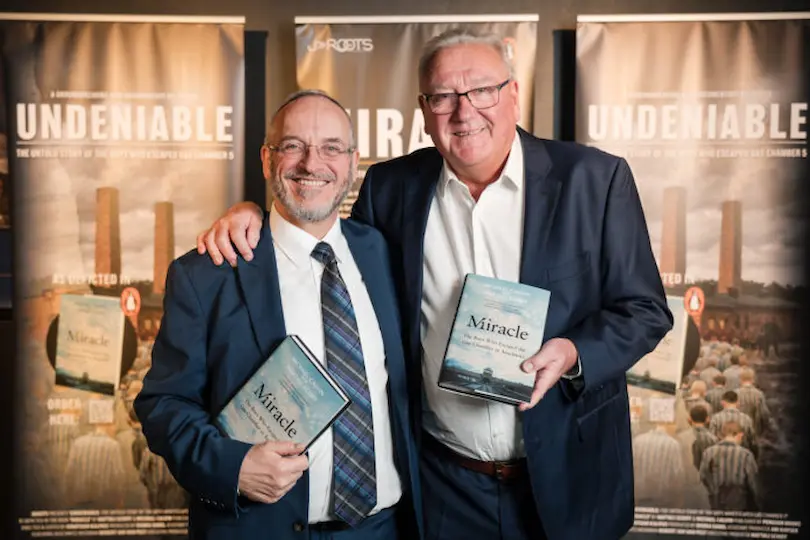 Naftali Schiff and co-author Michael Calvin
 The documentary is more than the testimony of six survivors. At a time of rising antisemitism and Holocaust denial, the convergence of survivor testimony with expert analysis and archival evidence the film became a powerful vehicle to combat Holocaust denial.
As they marched toward the gas chamber Dugo recounted that they said to one another: “They can take away our bodies, but we are not going to let them destroy our spirit!”
That is the strength that defined these boys and empowers the Jewish people.
Click here to order a copy of Miracle: The Boys Who Escaped the Gas Chamber at Auschwitz









If I can have contact information on whom to talk to so that I can find out more and also give you what information I have.
my father was one of the 51 boys. His name was Menachem Mendel Weinberger zl.
Oy. Sitting at my desk with shivers. The video clip has touched me. Shivers down my spine - such horror - and yet such beauty looking at each of these survivors. Thank you.
Wonderful.
A joyous essay!
Wonderful, moving article. I don't write "story" for that might put a gloss of fiction of these events. That can be attested to as factual is very important in today's culture and to counter holocaust deniers.
My mother, A"H, died on March 15, 2026 at the age of 102! She told me (and I recorded it in a book published for the family, titled "Selected From Above") that twice she was in the gas chambers in Auschwitz, and water came pouring out instead of gas. Truly, miracles!
Esther Farbstein wrote about these boys in chapter 10 of her book Hidden in the Heights: Orthodox Jewry in Hungary During the Holocaust - "The Barracks of the Boys from Hungary," published 12 years ago. I know that Dugo of falafel fame is, unfortunately, no longer alive; nor is Yosef Zalman Kleinman, who was a witness in the Eichmann Trial. The chapter in Farbstein's book is absolutely fascinating, relating how the boys supported each other, how they spent their days (they were not taken to work), the selections the boys went through during the days of the High Holidays, how Rabbi Zvi Hirsch Meisels sneaked a Shofar into the barracks and blew for them, etc. etc.
I was privileged to meet four of the survivors of those barracks here in Israel.
This is a story that I've heard as a child from my father who was one of the boys. He was always wondering if anyone else is still alive.
Is it possible to get contact information, so that I can speak to them if they maybe remember my father.
I can put you in contact with Esther Farbstein who will know.
Hello Pinchos. I work with Rabbi Schiff at JRoots and helped produce the film, 'Undeniable'. How amazing that your father was one of the boys. Please send me an email at dsobel@futures.org and I can help you from there. Many thanks
Wonderful heartwarming article. During our current times we need these true stories to show the world the Holocaust was real.
Thank you!
Unbelievable! Unless you know that everything is for the ultimate good, and there is none but HIM.