








 Seven Reasons for Hope on October 8







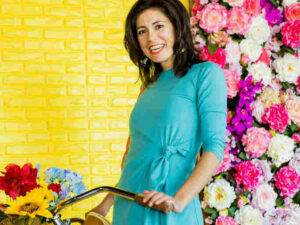
Mia Adler grew up with no idea she was Jewish. A decade later, she's a mother, an Israeli, and a modest fashion designer with something to say about dignity.
There's no way you're not Jewish. That's what a group of Israeli girlfriends told Mia Adler on a trip to India, years before she ever considered herself Jewish at all.
Mia grew up in the south of France with no connection to Jewish life. She didn't know her father had Jewish roots until that trip, when her new friends noticed something familiar in her and pressed her to explain it. The only clue she had was a memory: her grandmother, wearing a hamsa (a hand-shaped amulet common in Jewish and Middle Eastern culture) around her neck throughout Mia's childhood.
That one detail was enough to send her looking. What she found was a story she now describes simply as assimilation. She has Jewish cousins who married non-Jews, and their children are no longer considered Jewish according to Jewish law. It's a quiet kind of loss that happens across generations, without anyone deciding it should. Mia didn't want that ending for her own story, so she started asking questions, and the questions led her to Israel.
Her first visit left her certain of something she couldn't fully explain. She felt at home in a way she hadn't felt in any of the countries she'd lived in or studied in before. That feeling sent her looking for a conversion program in Tel Aviv, a year-long process she calls one of the best years of her life. Moving to Israel followed.
Today Mia lives in Jerusalem, married with two children, and she hasn't stopped thinking about the family she left behind in that story of assimilation. She can't undo generations of distance in a conversation, but she's found small ways to hand pieces of Jewish life back to the relatives who never had them. She gave her father a mezuzah (a small parchment scroll inscribed with the Shema, the declaration of God's oneness, affixed to a doorpost as both a symbol of faith and a source of protection for the home). Her husband said the blessing with him. He put it up immediately, and loved it.
Our conversation kept circling back to something Mia has spent a decade working through personally: modesty, or as it's called in Hebrew, tzniut. She converted with every intention of dressing modestly, and it still took her ten years to actually feel like herself in modest clothing. Long skirts and covered tops that technically met the standard left her feeling like she was wearing a costume. "I looked religious," she told me. "I didn't look like Mia."
I understood that more than she probably realized. Before I became observant, my own way of dressing looked nothing like it does today. When I first started covering up, I did it by disappearing into shapeless, oversized clothing, what's known in Yiddish as frumpy. I gained weight in the process without fully realizing I was hiding. It took years to find my way back to feeling like myself: comfortable, put together, and still fully within the boundaries of tzniut.
That's the tension Mia's fashion brand was built to resolve. She wanted clothing that was modest without erasing her. Her designs lean on British tailoring and French detail, built almost entirely from natural fabrics like cotton and linen, because in Israel's climate, she says, everyone should be wearing linen all summer. She favors pieces meant to last: a well-cut dress or a matching set she can return to season after season, in different colors, rather than an endless rotation of things that need to be matched from scratch every morning. As a mother running a business, she doesn't have the bandwidth for that kind of decision fatigue, and neither, frankly, do I.
What struck me most was how she defines modesty itself. Not as a set of rules to follow, but as a kind of dignity that starts before you get dressed at all. She put it simply: there's nothing more dignified than a woman dressing modestly, so much so that no one looking at her would even think to call it modest. They'd just call it beautiful.
Motherhood, she told me, changed her more than marriage did, more than conversion did. It reshaped her identity in ways she's still catching up to, and she's honest that she hasn't found perfect balance between raising two young children and building a brand. What she has found is a creative drive that doesn't shut off, even on the hardest days, which is how a modest swimsuit line, inspired by Grace Kelly, is currently in the works.
Her closing message was the one I most wanted our listeners to hear: don't feel guilty, and don't give up. Growth happens in small steps, not overnight transformations. She started with skirts, then added hair covering more than a year later, learning the reasoning behind each practice as she went. That's not a coincidence. Change that lasts is usually the kind that's understood, not just adopted in a moment of inspiration.
Mia's still figuring out her own balance, in fashion and in life. But watching her build both with such intention was a reminder that dignity was never about the clothes to begin with.












Great - open and real!
Same here. Why is the name of Mia's clothing brand not mentioned? I would love to take a look.
What is the name of the clothing line? I'd like to go to Mia's website...
… I found it: https://www.houseofherladyship.com/
Mia’s brand is not mentioned in the interview or the article which are both great and inspirational. We can support Mia by knowing a brand name and having a link to her website if she has one.