






 Those Shameful Thoughts and What They Really Say about You

17 min read
8 min read
9 min read




A descendant of Spanish conversos rediscovers her family's secret hidden faith.
At age 13, I was attending Catholic school in my hometown of Pereira, Colombia in the Andean foothills, where we grow the world’s best coffee.
One morning, my friend Sandra came running over. “Beatriz! You were in my dream last night!”
“What happened?” I asked.
“We were in a dark, dirty dungeon with stone walls,” she said breathlessly. “We were held as prisoners in chains.”
My eyes widened as I imagined sounds of clanging doors and echoey footsteps.
“A big, terrifying man wearing a hood took us out of the dungeon,” she said. “He led us to a square with lots of people shouting. In the center was a huge pile of firewood. These were Inquisitors, preparing to burn us alive at the stake!”
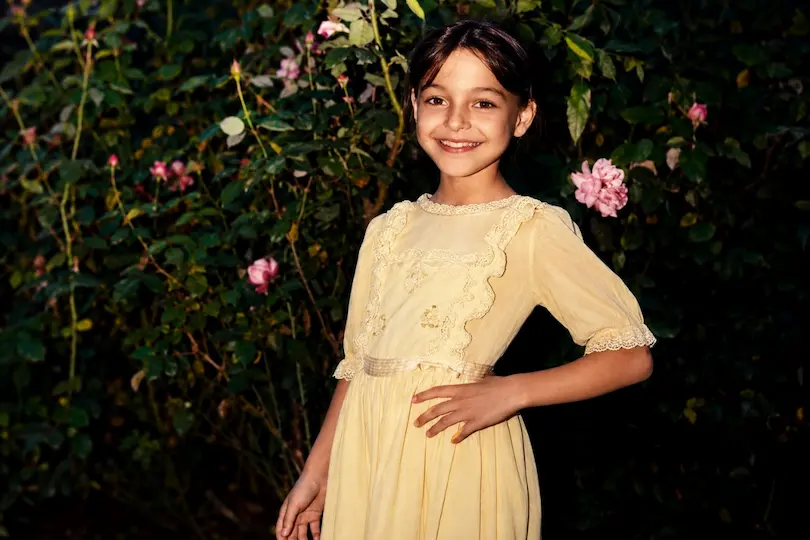 Nine years old, around the time of my first communion.
I was stunned. Me? In the Inquisition? At school, we were told that the Inquisition was all about imprisoning, torturing, and executing bad people, like witches and violent criminals. What did this have to do with me?
I dismissed the dream as childish fantasy. Little did I know how it would come back to haunt me.
When I was five years old, my father left us and moved to Venezuela. My mother was left alone to raise me and my two older siblings. Yet we were happy, surrounded by a large extended family of grandparents and cousins.
My mother was a deeply spiritual woman. She read Psalms on her own and told me stories from the Bible. I felt a deep love for Israel, though I didn’t know much about it, only that it was the land that God gave His people.
My mother encouraged me to explore my interests. At first it was sports. One day, she took me to a music teacher. My eyes bulged at the beautiful piano. He evaluated my musical inclination and told my mother, “This girl has unique talent. You must encourage her to continue with music.”
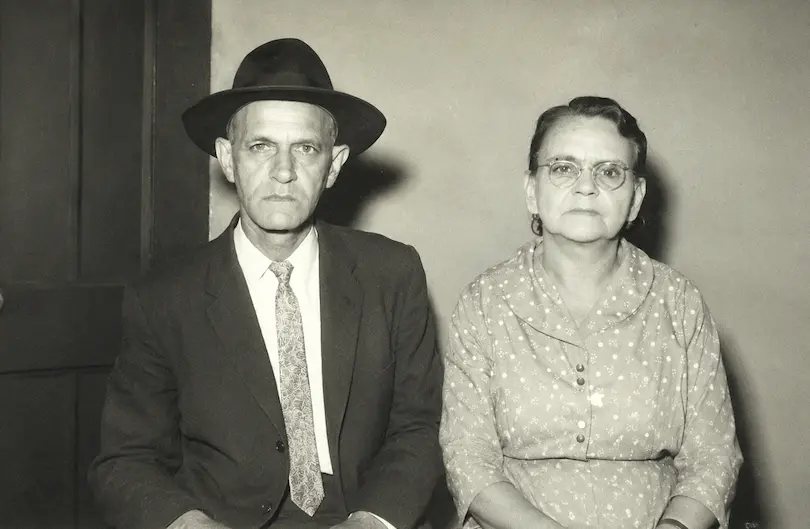 My mother's parents in Colombia, circa 1990.
That began my lifelong passion for music and a career as a singer, composer, and producer. Eventually, I earned a master’s degree in music theory and taught at university.
I never liked going to church. I wasn’t inspired and felt I didn’t fit in. Plus, the rituals seemed strange. I had my first communion at age nine, surrounded by candles and eerie silence. I approached the altar and the priest gave me a cracker (“host”) and wine, explaining, “This is the flesh and blood of Jesus.”
I stared at the cracker. The thought of eating human flesh made me nauseous.
“I don’t think I can chew it,” I said.
The priest smiled. “Don’t worry. Let it melt in your mouth.”
I thought that was even more disgusting.
My brother Carlos, who was 16 when our father left, became a father figure to me. When he joined the air force and became a pilot, I eagerly awaited his visits. He’d take me fishing and teach me lessons about life.
One day, when I was 18, Carlos asked me, “Do you want to be a friend of God?”
It was a strange question. In Catholic Colombia, we were taught not to talk directly to God, just to confess to the priest if you did something wrong. “Do what the Church leaders say,” we were told, “or be condemned to eternal wrath and hellfire.”
God was someone to fear, not to befriend.
Fortunately, my mother instilled in me a love for God, and my brother’s proposal to “be God’s friend” resonated with me. I began attending Evangelical Protestant Bible study groups where I felt love and fellowship. I became a church leader and directed the choir. In contrast to the strict Catholic liturgy I grew up with, I was encouraged to speak directly to God in my own words. Shortly afterward, I began writing songs dedicated to “My Friend, God.”
A few years later I got married, but it quickly fell apart. I found myself single, lonely, frightened – and pregnant. How would I support my baby?
I juggled work, music studies, and Christian study groups, while my mother stepped in to help raise my son. Her quiet faith and constant encouragement gave me the courage to continue my spiritual search.
Soon a major crisis arose. I was told by a pastor that based on the New Testament a divorced woman must either reconcile with her ex-husband or remain single forever.
I’d made a big mistake in getting married so young, but I wanted to marry again – and there was no way I was going back to my ex-husband.
I was curious what the Old Testament said about all this. I discovered in Deuteronomy 24 that when a woman becomes divorced, she leaves the house “and marries another man.” I presented this to my Christian teachers but they waved it off. “The Old Testament is no longer relevant,” they said.
That answer unsettled me. The Old Testament was given by God, and according to Numbers 23:19, "God does not change His mind."
The more I studied, the more questions emerged. Why is the Christian Sabbath observed on Sunday, when the Torah says Saturday? Even the Spanish word for Saturday is Sábado – Sabbath. Also, why does the Torah command observance of the Jewish festivals as “the law forever,” yet Christians observe none of them? Doesn’t Deuteronomy 13 say not to add or subtract anything from the Bible, and anyone who does so is a false prophet?!
When I sought answers from Christian clergy, they’d shrug and say, “It’s a mystery. Stop asking so many questions. Just have faith.”
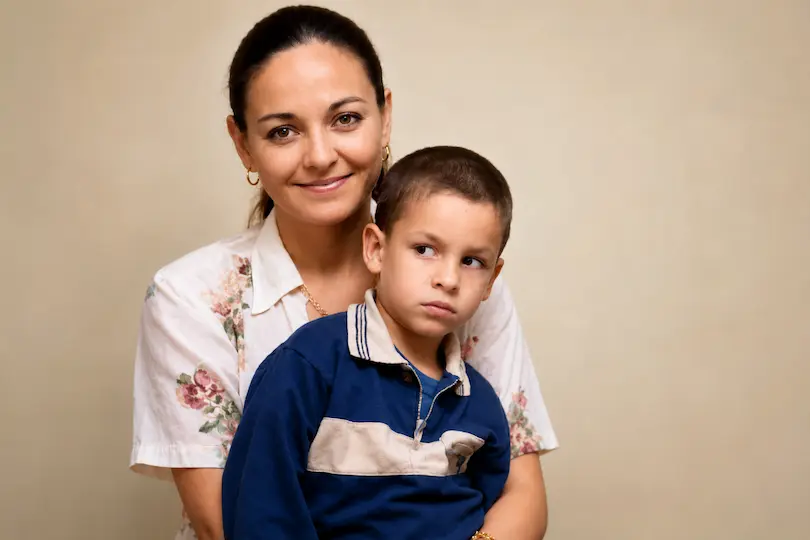 With my son, Juan Camillo, while I was working and studying music at university.
I continued to look elsewhere for answers. I went online and typed in “Judaism in Spanish,” which brought me to AishLatino.com. The more I explored, the more I was surprised at how familiar some of the Jewish laws and customs were.
For example, my grandmother would always salt fresh meat before cooking it. And when my grandfather slaughtered a chicken, he’d cut the neck, then hang it upside down to let the blood drain to out. No one in my family knew why. Imagine my surprise to read that slaughtering at the neck and salting the meat to draw out the blood is mainstream Jewish practice.
There were other signs as well. The men in my family all wore a poncho that resembles a tallit katan. And we called a snack of bread and pastries “parva,” though nobody knew that’s the Hebrew term for “neither dairy nor meat.” Even the villagers in our region were mocked for their accent, which I later discovered was heavily influenced by Ladino, the ancient Judeo-Spanish language.
These discoveries left me confused. What was my heritage? Were these random family customs, or pieces of a hidden Jewish identity?
I did a deep dive into Colombian history and discovered that the Inquisition had little to do with witches. The real story is that when Spain decreed to expel all Jews in 1492, many decided to “convert” to Catholicism, yet continue to practice Judaism in secret. These pseudo-converts were called “conversos,” or in Hebrew, bnei anusim – forced ones.
In response, Spain launched a brutal Inquisition to root out and persecute these hidden Jews. Thousands of conversos were tortured and burned alive at the stake
Many conversos, seeking to escape the murderous Inquisition, set their sights on North and South America. My region of Colombia, I discovered, was first settled by Spanish conversos. (DNA tests show that Columbus had Jewish roots.)
Tragically, the forces of hatred followed these conversos to the New World. By 1610, the Inquisition had established a headquarters on Colombia’s Caribbean coast. Once again, the conversos fled, this time to the remote mountainous region of Antioquia, where 15 generations later, I grew up.
I conducted genealogical research and traced my lineage back 20 generations to Yehuda Hazay, a Jewish man who lived in 15th century Spain. While many of his descendants converted to Catholicism, I was thrilled to find proof of my Jewish roots. My DNA test even shows a trace of Ashkenazi Jewish.
As I continued studying, questioning, and clarifying my religious beliefs, I came to understand that the Christian concept of messiah was formulated to accommodate first century pagans, and that a “human God” is a contradiction in terms.
With this information, I wasn’t sure what to do next. There were very few opportunities to connect with Jews in Colombia. In my city of Pereira, the last remaining synagogue had closed its doors 40 years earlier. In addition, Colombia’s Jewish community discouraged inquiries, fearing they’d be overwhelmed by the estimated 12 million descendants of conversos.
Fortunately, I had a friend who was on a similar path of questioning Christianity. She contacted rabbis in Costa Rica and Miami, who came a few times to teach us. I began observing the day of rest on Saturday and made an effort to celebrate the Jewish holidays.
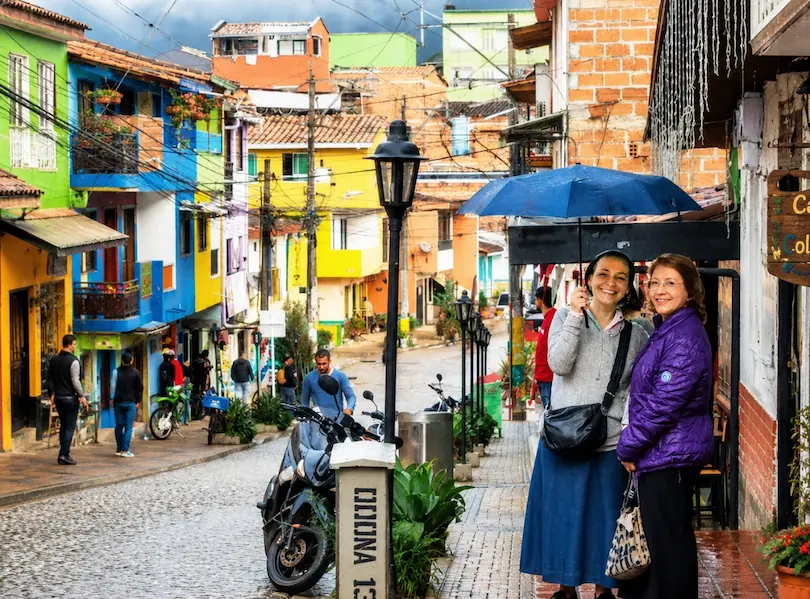 Alba Ruth and I renounced Christianity together. Visiting her in Colombia.
That’s when we renounced our Christian identity. We were free to observe Jewish biblical tradition without the constant supervision and questioning of the Christian community.
Then I made a life-altering decision. Like Abraham and Sarah, I left my country, my birthplace, and my family, and embarked on a journey to the land of the Jews: Miami! My niece in south Florida kindly invited me to live with her until I got settled.
In Miami, I attended the synagogue of the rabbi who’d been teaching us in Pereira. Yet I was confused by how they spoke of Jesus as a “Jewish prophet and messiah.”
It turns out the rabbi was not Jewish at all, but a Messianic Christian.
I needed to search elsewhere. But where?
Since the Messianic “rabbi” always spoke harshly against Orthodox Judaism, I figured that was the best place to look.
A few weeks later, I attended a Shabbat program at an Orthodox synagogue in Aventura, Florida. I felt a spiritual connection like I’d never experienced before. I was also drawn to the rabbi’s authenticity and sincerity. We spoke and I shared my story. “If you want to keep coming,” he said, “you’ll need to convert to Judaism.”
I knew very little about what that meant but I wanted to become part of the Jewish people and observe the commandments. So I enrolled in a conversion course, moved into the rabbi’s neighborhood, and immersed in studying and practicing every aspect of Jewish life.
After two years, the big day finally arrived. I emerged from the mikveh and the Beit Din declared in unison: "Kosher, kosher, kosher." It was exhilarating beyond words. I felt that my soul had come home, closing the circle on a 500-year journey.
I embraced my new life, working at a Jewish school during the day and teaching music at night. I was busy and had little time for dating. Besides, I wanted to live in Israel and had already filed paperwork to make aliyah.
One day, a friend said, “You’re so serious about Torah. I think you need a rabbi as a husband.”
What are the odds of marrying a rabbi in Israel? It seemed impossible. I prayed for it anyway.
In January 2021, I contracted Covid and was isolated at home. That was a good time to post my profile on an online dating site, with a prayer that God send my ideal partner.
A few days later, I received a message from someone who had worked with converts and wanted to wish me success in finding my match. This man sounded intriguing. I read his profile and discovered he was a rabbi in Israel. I couldn’t believe it.
But we lived on different continents and didn’t share the same mother tongue. Plus, with the pandemic, the chances of anything developing between us were near zero.
But my curiosity was piqued and we began communicating by phone and messages. After a few months, he came to Miami for Passover to meet me in person.
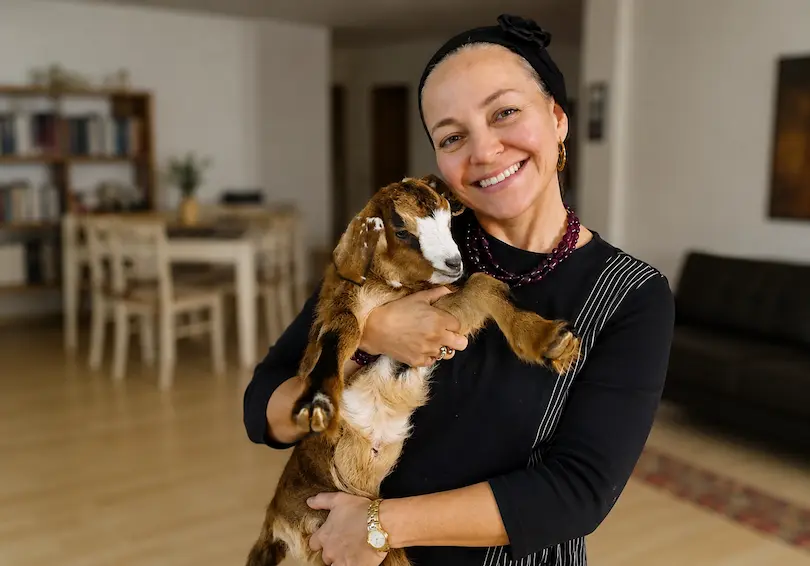 With a baby goat in Yavne'el, Israel.
That Passover was transformational. My previous Seder experiences were communal, with everything happening so fast that I missed a lot. This time, we were a small group and my future husband led the Seder, explaining everything in detail.
When we arrived at the final song, Chad Gadya, I followed the story about the little goat, the cat, the dog… Something seemed familiar. “The stick, the fire, the water, the ox, the butcher…”
“Wait!” I shouted. “I know this song! As a child in Colombia, we sang it in Spanish!”
Could it be? Here at this momentous occasion, one of my first Passovers as a Jew, meeting my future husband, I’d discovered another clue left by my converso ancestors, pointing to my Jewish heritage.
We continued dating in America, and two months later were married in a small ceremony at the local synagogue. We waited a few months for the airports to reopen, then flew “home” to Israel.
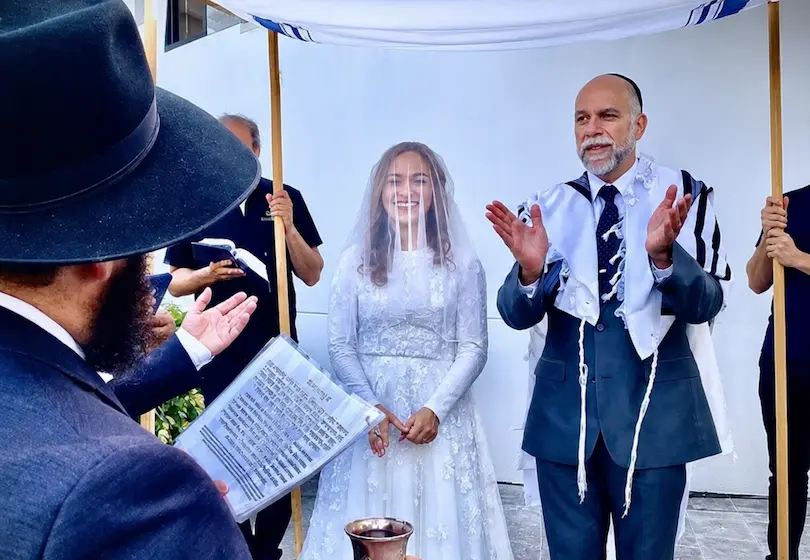 Our outdoor Covid wedding in Aventura, Florida.
Today we live in Jerusalem. Every day, I pinch myself. I am busy writing and producing a musical adaptation and film of my family's converso journey. I hope this will inspire other descendants of conversos to explore their Jewish roots.
Sometimes I think back to Sandra's dream all those years ago. We couldn’t imagine why two frightened girls stood at the fires of the Inquisition. It would take decades for me to understand that the dream foretold a wonderful new beginning.
Like the little goat in the Haggadah, after centuries of wandering, I’d finally come home.





Shalom, Thank you so much for sharing your story. I also descend from Conversos and I want to return to Am Yisrael!
What an amazing story!
Welcome home! I am so happy for you!
Your story touched my heart and reminded me of my childhood struggle with Catholicism, early adulthood searching desperately through other denominations, and the spiritual joy of discovering Judaism as the truth.
It wasn't until after my Orthodox conversion that my mother (1st generation American of Italian, Spanish & French ancestry) recalled her mother lighting Shabbat candles while praying in the same language as I did. As a curious child when she asked her mother about their ancestors, she was told "that is a closed book, we don't talk about". A rabbi later said my family might have been conversos.
Baruch Hashem, we are living the Yeshayahu 11:12 prophecy of the ingathering of Hashem's people from the four corners of the earth.
Beautiful story! The name Pereira appears in the Sephardi side of my family, from Spain via Amsterdam.
Such a Beautiful story!
What a beautiful coming home story! I am so glad that you found your way.
Yes Periera has long considered a place settled by Jews. Las Vellitas is a celebration that may have something to do with the Jewish people that settled in Paisa another region.
This is a hugely inspiring story .
I am also a hidden, crypto, jew!! I discovered this about 20 years ago. The journey has been incredible!!
Incredible considering people still deny the existence thus denying the Spanish Inquisition
That was one of the most beautiful stories ever. I wish you all the blessings. This is from a 70+ year old conservative Jew who now identifies as a Zionist Jew seeking all Jews to accept and welcome their identities and heritage.
What an incredible story on an incredible journey thank you so much for sharing everything you wrote.
What a wonderful story...God's hand is in every thing that happens!
What an absolutely inspiring story! I would love to interview you for our Reemerge Project! Please find me online! My name is Dani Rotstein. It would be an honor to speak with you! http://www.reemergeproject.com
Thank you for writing your story. I had to chuckle at "... the land of the Jews ... Miami"! It absolutely used to be, for many years. For years, I have wondered why Jewish people have rejected Yeshua as the Messiah, Imanuel, God with us and your article gave me great insight, an "aha" moment.
Welcome home, sister!
What a wonderful and inspiring story. Your persistence and dedication to finding your answers led you on a remarkable journey and created a new life for you and your son. Thanks so much for sharing your story.
Robin.. thank you so much for your comment! HaShem Has Been Good to us leading us to comeback home🌸
Welcome to Jerusalem, my beloved home too for the last 9 years. Your story is meaningful, and from what I have seen at She'arim ( a wonderful seminary for young women in Har Nof) there are quite a number of South American bnei anusim who have discovered their emotional roots and are or have already converted to Orthodox Judsism. May your life now be filled with nothing but blessings.
Jenny thank you so much!! Amen!! You're right! Every day more B'nei Anusim are coming back to Judaism BH! In my city thank G-od now there is a Jewish community of Bnei Anusim, also in other cities in Colombia, they are join Am Israel💕
A wonderful story of connection and reconnection. Thank you for sharing 🩵
Thank you Ana🌸🌸 my pleasure💙
Increíble e inspirador testimonio! Tus ta tatarabuelos han de estar tan orgullosos de ti, cantando en el cielo en hermoso ladino! BH que se cumplieron todos los anhelos de tu corazón!
Sara Eliana, your story is very inspiring. I love you, Devora
Dear Devorah💕 than you for you comment! Love you too🌸
What happened to your son?
Where is your son living now ? Did he go through a conversion process with you ?
What an inspiring story. You are an inspiration Sara Eliana.
I too share your same passion for music. Piano 🎹 is my instrument. Conservatory of Music, classically trained. Up to grade 10. Played in concerts, competitions. Guitar and singing also.
I keep returning
" home to Israel" and studied there as well.
Blessings to you and your family for good health, happiness and peace.... forever.
Today is Rosh Chodesh Av and the beginning of the 9 days.
( Wed july 15 26)
Kol tuv
Yehudis / Judy
And I am so happy I got to know you and you became my cousin, when I found your husband and my cousin. I thank H’Shem for that! Love you!
Love you to my dear Rosa💕😘
This beautiful article brought me to tears. I'm always intrigued by those who find Judaism, but to RETURN to Judaism after generations, is even more compelling and amazing. I think its a clear illustration of G-d's actove hand in our lives. Welcome home.
I would love to know when her film comes out.
BzH! I'm working on the animated movie about Bnei Anusim.. in the firsts stage but with G-d's help we'll be able to finish sooner than later🌸
I have the privilege of knowing Sara personally, and I can honestly say she is one of the most remarkable people I know. Her strength, kindness, and unwavering commitment to Torah, mitzvot, and chesed are truly inspiring. Together with her husband, Rabbi Shmuel, they are a true Kiddush Hashem and a beautiful example of living a life rooted in Torah and love for Am Yisrael. May Hashem continue to bless them with abundant bracha as they inspire so many others. Yasher koach!
Felicidades! Mazel Tov! Bienvenida a la familia! Baruch haba-ah l’mishpocha!
Todah Rabah Stephane💕!
Wonderful and extremely interesting
Thank you so much Helen 🌸
Wonderful!
Thank you Bracha 💕
What a beautiful story of a Jew returning home! ¡Buena Suerte, Sarah!
Muchas gracias Ellen 🌸
Fascinating.
Thank you Geoff☺️
Brucha Haba'a
בְּרוּכָה הַבָּאָה
Welcome Home!
Thank you Jeffrey☺️
May you go from strength to strength. Welcome home!
Amen , and your home is in Israel the Jewish homeland
Amen ve amen!! Than you Sarah🌸
I would like to contact the author and connect with her. Does she have an email? I have a personal story that .might interest her. I have a special interest in conversion. who revert. If I return to Jerusalem where I once lived I would like to meet the author in person
Beautiful important story - it was all meant to be- through you, you brought your whole family of centuries back home! Mazel Tov!
I guess there were signs that your family had Jewish roots, I read other stories about converso family with sweeping the floor a certain way, and other little hints that families used to remember they stemed from Jews, is there a group like people like you, that there family were converso and went back to Judaism, they might be more people like you, that had the same life experience, these people I think will be happy to find people like themselves, it is very helpful in the long run, Mazel Tov , to all that return to their Judaism
That is true, there are a lot of stories about customs like that in my region and other countries in Latin America.. and BH every day more and more descendants of conversos are coming back everywhere, and a number already made Aliyah or are in the process🥳 amen!! Thank you Judy
You're right Darlene. Thank you🌸