






 An Open Letter to Billy Crystal


7 min read
3 min read




Two pro-Israel advocates give incoming Jewish college students the information they need during this critical time.
College campuses have been ground zero for antisemitism since October 7. There have been assaults on Jewish students, encampments that block Jews from going to class, and hateful imagery and language directed towards Jews and Israel. In many instances, colleges ignore or give excuses for this behavior instead of rightfully stamping it out.
Jewish high schoolers across the nation are wondering: Should I go to college? If so, should I only go to a Jewish school? What should I do if I face antisemitism on campus?
In their new book, “10 Things Every Jew Should Know Before They Go to College: An Illustrated Guide,” authors Emily Schrader and Blake Flayton, two pro-Israel advocates who made aliyah from the United States, give incoming Jewish college students the information they need during this critical time. Their tips are accompanied by illustrations from artist Kimberly Brooks.
Both Emily, a journalist, and Blake, a writer, experienced antisemitism on their college campuses long before October 7. Emily saw an “apartheid wall” at her alma mater, USC in Los Angeles, while Blake witnessed anti-Israel activism at George Washington University.
“Because of that, I am particularly passionate about the subject of Jewish empowerment on campus,” Blake said. “Right after October 7th, I thought for a minute, perhaps naively, that antisemitism would recede – how could anyone come out so strongly against Israel after we just witnessed? But when I saw it return in full force, even before Israel had a single troop in Gaza, I realized the time was now for this project.”
Emily, who has been reporting on the war from Israel, echoed a similar sentiment.
“Unlike most students, I’ve faced the full byproduct of what these anti-Israel protesters has been calling for, and I cannot remain silent any longer,” she said. “Students need to be equipped with the basics of this issue simply to attend university — and while it’s awful, it’s also the reality and we need to be prepared for that.”
Kimberly became aware of rampant antisemitism back in 2021, when she was going live on Clubhouse to promote one of her projects. She saw people spreading lies about Jews.
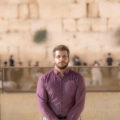
 Blake and Emily
“Having two kids in college at that time, I was also keenly aware of how students bore the brunt of this ignorance and demonization,” she said. “As an artist and painter who happens to be Jewish, the subject itself is out of my range. But I knew that if I partnered with experts in the Middle East and used a similar illustrated layout, that we could make a big difference in reaching the audience most affected by these lies.”
When reading the book, prospective college students will discover 10 easy to digest pieces of information every Jew should know and utilize it to hopefully have a more positive and productive experience at school.
This section describes what it means to be a Jew, talking about how “Jew” comes from the word “Judea,” and that “To be Jewish is to descend from an ancient and storied civilization. It is to be part of a people, a tribe, a culture, a nation, an ethnicity, and a religion, all at once.” There are explanations of the different types of Jews (Sephardi, Ashkenazi, etcetera) and a brief history of the Jewish people.
“Israel, ‘the Jewish state,’ is the only country in the world in which the Jewish people comprise a majority. Israel was reborn in 1948, at the same time as many other states around the world. As the Jewish state, Israel strives to reflect the values of the Jewish people. Israel balances being a safe haven for all Jews in the world and also being a liberal democracy where religious and ethnic minorities are protected by law.”
This section goes over major cities and landmarks like Jerusalem and the Kotel, Tel Aviv, Haifa, and Tzvat, and provides facts about the country’s cuisine, kibbutzim, art and architecture, Supreme Court and basic laws, and Hebrew, the official language.
This section details the Middle East, Israel’s neighborhood. “The region is composed of dozens, if not hundreds, of different peoples, religions, languages, and cultures, a diverse mosaic, but the region’s history of conquests, expulsions, and even genocides have made surviving as ‘different’ extraordinarily difficult,” Emily and Blake write. They give a brief overview of the countries surrounding Israel, like Iran, Egypt, Saudi Arabia, the UAE, Lebanon, and Jordan, and show each country’s relationship with the Jewish State. It also doesn’t shy away from Iran’s terror and dark influence over the Middle East.
The authors call this “The Big O.” They explain what is meant by “occupation” and how it is used in protests on college campuses. It shows the history of the occupation of the region, and how the Jewish people got back their homeland in 1948. “On May 15, 1948, David Ben-Gurion declared the independence of the new state of Israel. Jordan, Syria, Egypt, Iraq, and Lebanon immediately declared and waged war on Israel, and Israel won after a year of bloody fighting, which had begun before the official declaration of the state,” Emily and Blake write.
It also goes into who are the Palestinian people: “The understanding of who is a ‘Palestinian’ has shifted over time. There has never been a Palestinian state. The name itself is not mentioned once in the holy books of Judaism, Christianity, or Islam. The name Palestine, initially ‘Syria Palestina’ was first given to the region when the Roman Emperor Hadrian elected to punish the Jews of the land who had revolted against Rome one too many times. As for the origin of the name, Palestina came from the word Philistines, an enemy nation of the Israelites, ethnic Greeks, from biblical times.”
This details the scam that anti-Israel figures use, how they tell lies about refugees and use the situation to spread terror and hatred of Israel. It goes over UNWRA and its corruption, the Palestinian leaders like Yahya Sinwar, a mastermind of October 7 who stole refugee aid and became a millionaire, and Ismail Haniyeh, the former political leader of Hamas who was a billionaire living a life of luxury in Qatar before the Mossad assassinated him in 2024.
The United Nations initially helped the Jewish people but have since taken a negative turn. Emily and Blake write, “It is a misconception that Israel was created as a response to the Holocaust. In fact, because of the six million Jews who were murdered by the Nazis, many thought there might not be enough people to constitute a Jewish state. In the case of Israel’s birth, the powers and authority of the United Nations were used for good. Unfortunately, the original intentions of the institution have strayed significantly since its early days, making the world a more dangerous place.”
They give a timeline of what happened in the UN and how it relates to the Jewish State as well as highlights Hillel Neuer, who runs UN Watch, an NGO that combats anti-Israel bias at the UN.
This chapter is all about antisemitism, the world’s oldest hatred. Emily and Blake detail antisemitism throughout the ages, as well as today, and shows common lies about Israel like, “I’m anti-Zionist, not antisemitic” or “Israelis/Jews are white.” They end the chapter with an uplifting note: “In the post-Holocaust age, the Jewish people do have a land, an army, and political power of their own. Jews should take pride in who they are and work to understand why the Jewish people have outlasted every civilization that sought to destroy them.”
The media has, by and large, not been a friend of Israel pre- or post-October 7th. The authors write, “The media regularly presents the Israeli Palestinian conflict as if Israel is the superpower and the Palestinians are, without question, the underdog. The reality is that Jews are a miniscule percentage of the population, and Israel is an even smaller country surrounded by twenty-two Arab nations.” They go over social media platforms, censorship, and how legacy media has portrayed the conflict, often skewing it in favor of the Palestinian side, with concrete examples. For instance, regarding The Washington Post, “The paper referred to Hamas leader Ismail Haniyeh after his assassination in Tehran as ‘politically pragmatic.’”
Antisemitism on college campuses is nothing new, which Emily and Blake describe in this chapter. They also show what has happened at colleges since October 7th, detail the Jewish organizations on campus like Hillel and Chabad, and encourage students to participate in campus life.
Even though we live in a difficult moment, this chapter has a positive message: “Regardless of how impossible circumstances may seem, the values and culture of the Jewish people endure. As dark as it may feel at times, whether on campus or in the streets of an American city, Jews today are the luckiest in history.”
They encourage readers to take action by studying in Israel, learning Hebrew, educating yourself, and making aliyah, like they both did.
Both Emily and Blake agree: Jews can attend college if they want to, despite the antisemitism there.
“They should go, but only if they’re willing to speak up against it,” Blake said. “Jewish students who want to just skate by going to classes and hanging out with friends in the face of a mob – particularly at schools like Columbia, Harvard, NYU, etcetera, I think the best place for them would be at a Jewish university or in Israel. But students who have some fire in them to confront lies and misconceptions about our people, they should apply and attend these schools, so we have a fighting force there.”

With this guide, Emily and Blake hope that students become educated and can find their voice and stand up for what they believe in.
“In the United States, we live in a country in which the constitution and the laws actually protect Jewish civil rights, and we should be using that,” Emily said. “It isn’t the time to abandon ship. It’s the time to fight back and demand what is rightfully ours.”










Excellent points regarding the deepening anti Semitic crises we are experiencing world wide. Hamas will not release the hostages and the killing and suffering of Palestinian's will continue. This breeds hatred towards Netanyahu , Israel and the Jewish People! The war must end soon!
To Reuven: didn't your mom teach you use your words before resorting to your fists? There may be moments that demand discussion with those who are ignorant. How about "You blame Israel? Let's talk about Israel." And times to avoid those who are not ready to listen.
If, as a Jew, you know who you are and love our ways, you will navigate this world with joy and pride. You can do it at the University of Florida, or Yale, which, like many colleges, have centers for Jewish life, plenty of Jewish students, and university leaders who care about all students.
When you have completed your schooling, you're going out into a world with all kinds of people and beliefs, including antisemitism. You will learn to deal, I am certain. That's part of a valuable education.
Hi Jonathan, Thanks for taking time to respond to my comment. You should know that I am speaking from a lifetime of experience. Having served in the IDF during the Yom Kippur War and other events some 50 years ago I know when to talk and when to fight. What prompted me to express this opinion was the report several months ago that Jewish kids had to lock themselves in the library at Columbia and wait for the Campus security to come and save them. This reminded me of the "protected" Jews (Schutzjuden) in the Middle Ages who were kept unarmed, unable to defend themselves and had to rely on the goodwill of the regional lord to bail them out. That, for me, falls under "Never Again". The "demonstrators" at the universities are not interested in discussions, they are our enemies.
Any Jewish high schooler who wants to head to college should consider his options and preparations. Where to attend college? Forget the North East, i.e. Ivy League etc. There are plenty of great schools from Florida to Texas who are mostly pro-Israel and respectful of Jewish students and Judaism. If you expect antisemitic encounters here are my suggestions: 1. start a self-defense training, like Krav Maga, as early as possible. 2. Learn how to use the tactical military grade walking stick (no license required, available on Amazon). 3. When you arrive on campus find out where the central control for lawn sprinklers and water hoses are; with this one can get rid of the garbage of the antisemitic campsites in short order. Remember- you cannot argue with hate-mongers who physically attack you.
What is going on in some colleges and universities is like what happened in Nazi ( may their name be erased) Germany in the 1930s/ 1940s instead of the year 2024/ 2025, Jews should be protected from anti Semitic thugs and terrorists
Great work!
When the tent cities went up, I realised why it’s called a “camp-us”!
I fully agree!