







 The FlyDubai Miracle









Subjected to violent antisemitism, Jews in the Roman Empire attempted to fight back. Their attempts failed, but their oppressors ultimately lost the war.
When the Roman Empire took control of Judea in the 1st century BCE, the Romans didn’t have an easy time ruling over the free-spirited Jewish people. The most famous conflict, the Great Jewish Revolt, led to the destruction of the Second Temple in 70 CE. The Bar Kochba revolt in 132-135 CE led to the destruction of the city of Beitar and the razing of Jerusalem to the ground.
A less-known conflict took place in between those two events, in 115-117 CE, towards the end of the reign of Emperor Trajan. It is known as the Kitos War in Jewish sources and as the Diaspora Revolt among historians.
Due to the scarcity of historical records and the antisemitism of the chroniclers who do mention it, the Kitos War has often been misunderstood and misinterpreted. As usual, the Jews tend to get blamed for the disturbances and Jewish actions are described as extremely violent.
The Jews didn’t perpetrate senseless violence against the Greeks and Romans during Trajan’s reign. They would have preferred to live in peace.
However, modern historians, particularly Professor Miriam Pucci Ben-Zeev of the Ben Gurion University, have shown that the Jews did not perpetrate senseless violence against the Greeks and Romans during Trajan’s reign. In fact, the Jews would have preferred to live in peace, but they were constantly subjected to violent antisemitism. The attacks on their persecutors were a desperate attempt at self-defense.
By the beginning of the 2nd century CE, though Jews remained the majority in the Land of Israel, the Jewish diaspora had spread throughout the Mesopotamia and North Africa. The Jewish communities especially affected by the Kitos War and the events surrounding it were Alexandria in Egypt, Cyrenaica in today’s Libya, and Cyprus, an island in the Mediterranean Sea.
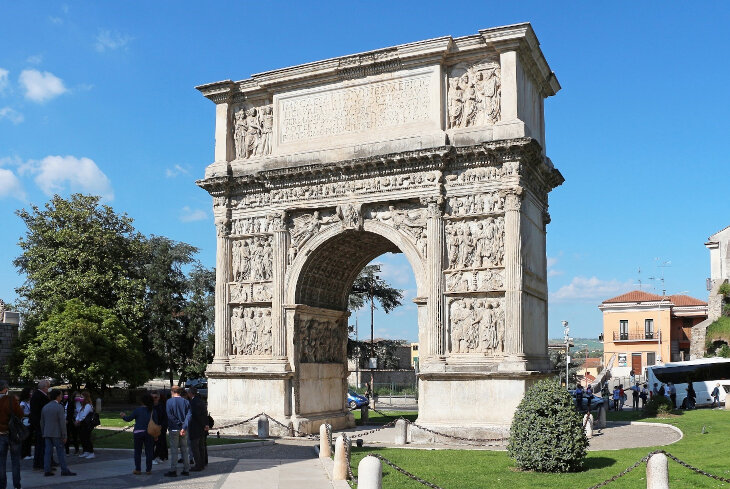 Arch of Trajan in Benevento, Italy. Bernard Gagnon, CC0, via Wikimedia Commons
A large and thriving Jewish community existed in the Parthian Empire in Mesopotamia, where Jews had lived since the Babylonian Exile half a millennium earlier. Parthian Jews were granted religious freedom and civil autonomy. The cities of Nisibis and Nehardea became known as centers of Jewish learning.
In 114 CE, the Roman Emperor Trajan embarked on a campaign to conquer the Parthian Empire. At first, the campaign was successful, as Trajan took control of Armenia and northern Mesopotamia. Though the Parthian Empire fought back, it was slowly losing territory.
The Jews living in the Parthian Empire were faced with a dilemma. They much preferred the benevolent laid-back Parthian rule over the violent and controlling Roman rule. But if they were to join the Parthians and fight against the Romans, would that harm the Jews living under the Roman rule?
Rabbi Chaim Dov Rabinowitz, contemporary Biblical commentator and author of books on Jewish history, wrote1:
Quandaries of this sort have always served as a source of calamity to the Jewish Nation. Usually, though, they have no choice but to take up arms and participate in the defense of their homeland, for if they choose instead to take a neutral stance, it would arouse the animosity of their gentile compatriots. Consequently, in the end the Jews of Babylon elected to aid the Parthians and fought mightily to repel the Roman invaders.
As we will see, this decision of the Parthian Jews had dire consequences for Jews living in lands ruled by Rome.
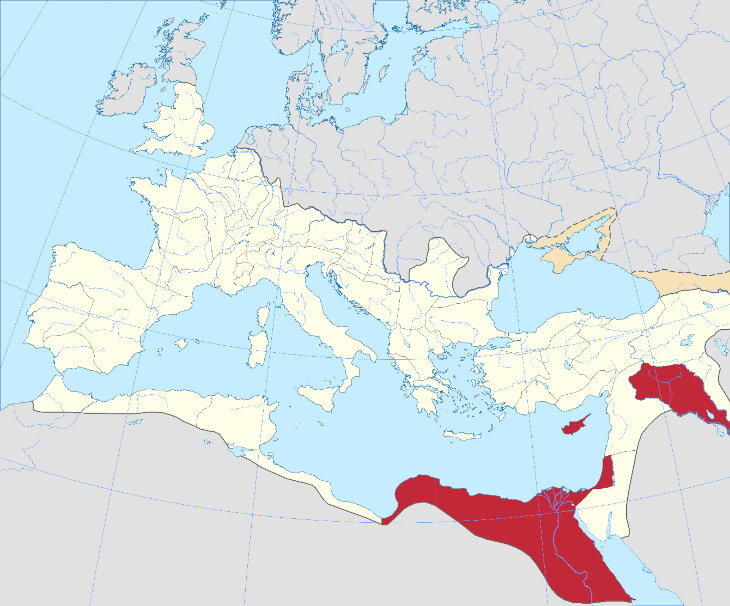 Roman provinces involved in the Diaspora Revolt, marked in red. The Roman Empire is marked in yellow. Mariamnei, CC0, via Wikimedia Commons
Meanwhile, the Jews living in Alexandria, Egypt had their own troubles.
Alexandria was founded by Alexander the Great in the 4th century BCE. In addition to the native Egyptians, many Greeks came to live in the new metropolis. According to Josephus, Jews had lived in Alexandria ever since the city was founded.
After Alexander the Great’s death, his vast empire was divided among his generals. Alexandria came under the rule of Ptolemy I Soter, who founded the Ptolemaic dynasty. The Ptolemies were Greeks. Under their rule, the Greeks of Alexandria received more rights and privileges than the Egyptians, who were considered second class citizens.
The status of Jews under the Ptolemy rule varied, but overall, they were able to retain much autonomy. Jews of Alexandria had religious freedom, access to education, and economic opportunities. The community prospered and built a magnificent synagogue. The Talmud says2, “Whoever did not see the great synagogue of Alexandria never saw the glory of Israel.”
Alexandria remained under Ptolemaic rule until it was conquered by the Roman Empire in 30 BCE. Under the Roman rule, the relations between the Greeks and the Jews of Alexandria deteriorated. No longer the highest class, the Greeks were now competing with the Jews for the rights and privileges both had previously taken for granted.
Professor Angelo Segre explains3:
The monster of antisemitism soon reared its head. The Alexandrians asserted that they were hostile to the Jews because the latter had twice betrayed them; but the real reason was recrudescence of chauvinistic Alexandrian nationalism. In an age when its citizens were being martyred for the Greek cause, the upper classes of Alexandria could scarcely view with indifference the presence in their midst of a Jewish community which insisted vociferously upon equal citizenship but at the same time viewed with abhorrence any identification with the common life and mores.
In response to the Greeks, the Romans reduced Jews’ status to the lowest class. The Jews, in return, inundated the Romans with petitions demanding restoration to their previous status.
Tensions grew, and in 38 CE the Greeks of Alexandria perpetrated what was perhaps the first pogrom in Jewish history, which is described in detail by the Jewish scholar Philo of Alexandria4.
In 66 CE, during the Great Jewish Revolt, when anti-Jewish sentiments in Alexandria ran high, the Greeks again attacked the Jews. As Professor Segre explains5:
Every Jewish war brought its train of pogroms or “retributive” excesses in the Greek cities. This was especially true of Alexandria, where the position was aggravated by the fact that the emperors never took a decisive line in favor of either the Jews or the Alexandrians, preferring to use each, as the occasion might demand, as a pawn in the game of Roman policy.
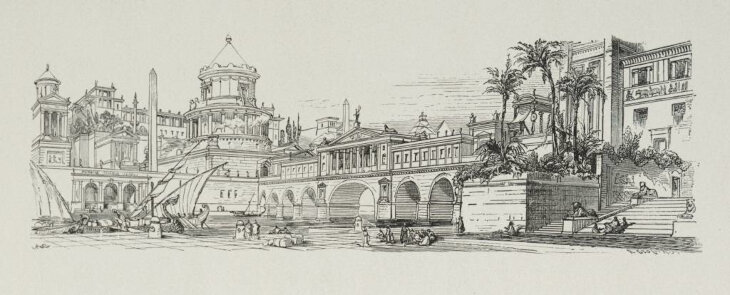 Line drawing of a scene from Alexandria in ancient times, 1878. Gnauth, Adolf, via Wikimedia Commons
During the reign of Emperor Trajan, the Jews of Alexandria again suffered from antisemitic violence. In their quest for justice, they appealed to the emperor.
Papyrus records report Alexandria’s Jewish community’s complaints regarding the violence perpetrated by Alexandrian Greeks. Professor Ben-Zeev, who dates the records to 115 CE, analyzes their contents6:
The disorders appear to have been violent in nature. Explicit reference is made to the use of arms... and the Jews… contend that their dwellings had been set alight… and that “fire and steel” were being prepared against them. Two episodes are mentioned, the first of which occurred in the city prison… [The exact nature of the incident is unclear, but as a result] certain Jews were wounded…
The second event… occurred in the theater. It would appear that theatrical shows of a farcical nature had been staged with patently antisemitic intentions.
Though the details of these events are not preserved, it is clear that Alexandrians were incited against the Jewish community. The perpetrators of the violence were slaves, but the incitement came from their owners, the upper strata of Alexandrian society.
The Roman authorities took the Jews’ complaints seriously. The emperor sent a judge to Alexandria, who conducted a trial and found sixty Greeks guilty. Their slaves, who perpetrated the attacks, were executed. The Greeks themselves were sent into exile.
The Greeks remaining in Alexandria considered the verdict unjust. They sent a delegation to Emperor Trajan to appeal it. The Jews, in turn, sent their own delegation.
At the time, Trajan was in the midst of his Parthian campaign. Professor Ben Zeev presumes that he received both delegations in Antioch, in today’s Turkey.
Trajan’s benevolent attitude towards the Jews represents a change in Roman policy.
Several incomplete accounts of the meeting with Trajan exist. It is difficult to determine exactly what took place, but Trajan clearly saw the Jews as being in the right. He reproved the Greeks and rejected their attempts to shift the blame on the Jews.
Professor Ben Zeev notes that Trajan’s benevolent attitude towards the Jews represents a change in Roman policy. Perhaps the Greeks in Alexandria expected to get away with their violence against the Jews because that is what had happened after previous pogroms in Alexandria.
Though the Roman authorities expressed support for the Jews, the Greeks of Alexandria continued perpetrating antisemitic attacks. Antisemitic sentiments spread throughout Egypt, as well as to Cyrenaica and Cyprus. Perhaps a contributing factor was the lack of Roman military forces capable of maintaining order, as most of the Roman Empire’s military was deployed in the Parthian campaign7.
Desperate to protect themselves and their families, and perhaps encouraged by the emperor’s support, the Jews made the fateful decision to fight back against their attackers.
In Alexandria, Jews destroyed pagan temples – likely sources of anti-Jewish incitement. They also seized the local waterways.
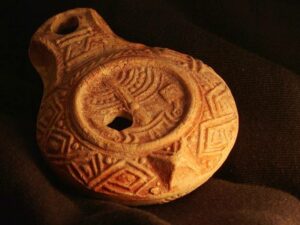
In Cyrenaica, the Jews also destroyed pagan temples, as well as the road between the city of Cyrene and its port, Apollonia. The next emperor, Hadrian, placed a milestone there commemorating the repair of the road “which had been overturned and smashed up in the Jewish revolt8.” On a different road, the Jews incised in the rock surface an image of the menorah, perhaps implying control over the route.
In Cyrene, the Jews damaged or destroyed the theater, the gymnasium, the bath complex, the civic archive, and other administrative buildings. Professor Allen Kerkeslager writes9:
The symbolic associations of these structures suggest that Jewish hostility was directed especially toward the Gentile civic and religious institutions most easily identified with Jewish oppression. Evidence from other sites is less extensive but indicates similar targets.
In Cyprus, the Jews also fought with the local Greeks. Exactly what transpired there is unclear.
There are few contemporary accounts of the events. The “Jewish revolt” is reported by Cassius Dio, a Roman historian who lived half a century later. Dio attributes terrible atrocities to the Jews, such as cannibalism. Though too many historians are happy to believe Dio’s account, Professor Ben Zeev points out that Dio attributes the same atrocities to anyone considered “Barbarian,” such as the Britons when they revolted against the Romans in 61 CE or the Bucoli who revolted in Egypt in 171 CE10. Thus, his accusations are no more reliable that today’s accusations of genocide against Israel.
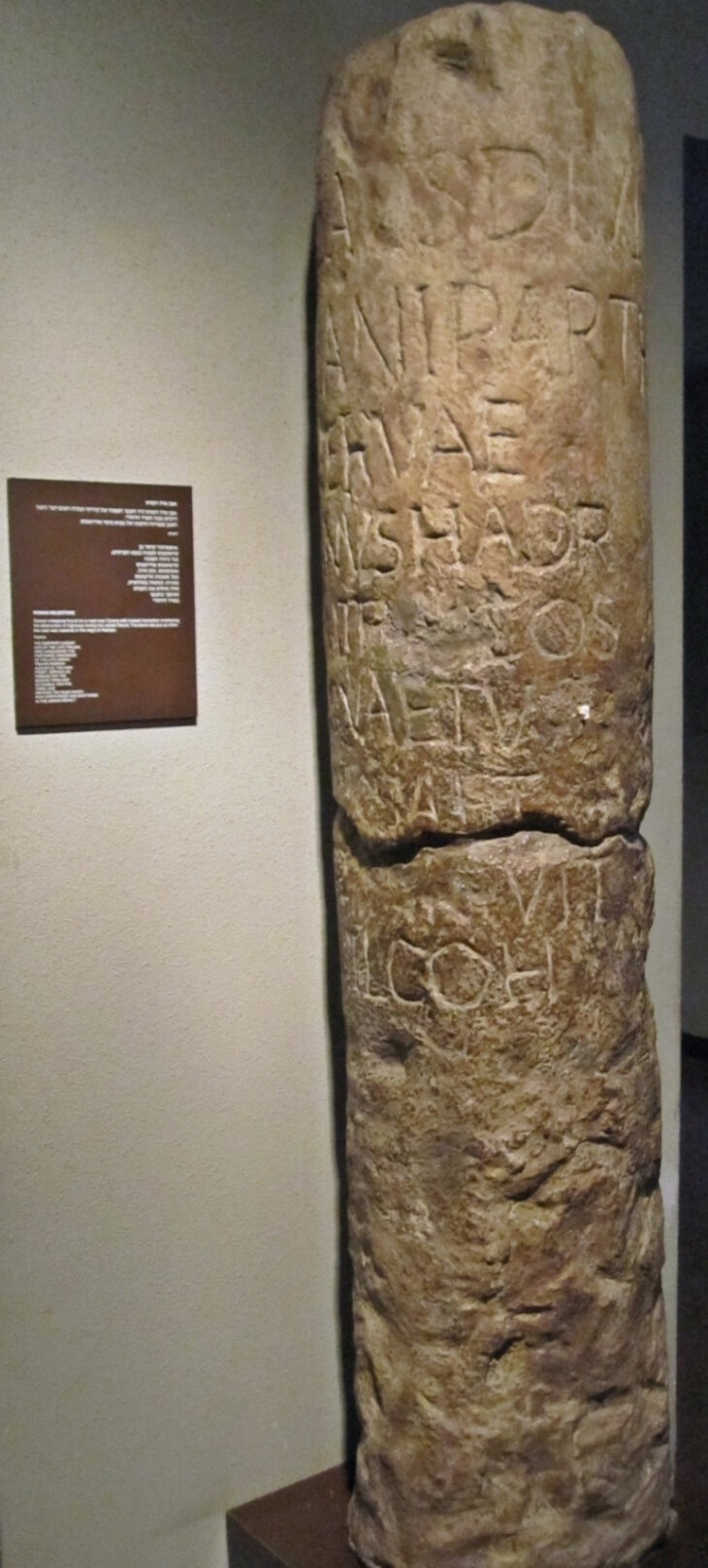 Photo of Exhibit at the Diaspora Museum, Tel Aviv - Beit Hatefutsot. Replica of Roman milestone found at Shahhat, on a road near Cyrene, with incised inscription mentioning the destruction of highways during the Jewish Revolt. The stone was put up when the road was repaired in the reign of Hadrian. Sodabottle, via Wikimedia Commons
At this point, Trajan was having trouble in Parthia. As his troops advanced further east, the provinces he had already conquered were rebelling against him. The population of those provinces included many Jews, who were now participating in fighting the Romans.
The disturbances in Egypt, Cyrenaica, and Cyprus interfered with the supply chain of grain to the soldiers, jeopardizing Trajan’s campaign even further.
Some historians, ancient and modern, have accused the Jews of conspiring against the Roman Empire and coordinating their attacks. This is highly unlikely, as the Jews of Mesopotamia and the Jews of North Africa had very different aims. It is also not plausible that they would have been able to communicate across such distances.
Nevertheless, despite his previous sympathy to the Jews, Emperor Trajan reverted to the familiar Roman attitude of antagonism towards Jews, wherever they might be located. He diverted some of his troops from the Parthian front and sent two of his generals to suppress the “Jewish revolt.” Marcius Turbo was sent to North Africa and Cyprus, and Lucius Quietus was sent to northern Mesopotamia.
In Mesopotamia, Quietus destroyed the main Jewish communities. In Alexandria, Turbo, with the assistance of the local Greeks, massacred the Jewish community and destroyed the magnificent synagogue described in the Talmud.
Greek historian Arrian, a younger contemporary of Trajan, wrote11, “Trajan was determined above all, if it were possible, to destroy the [Jewish] nation utterly, but if not, at least to crush it and stop its presumptuous wickedness.”
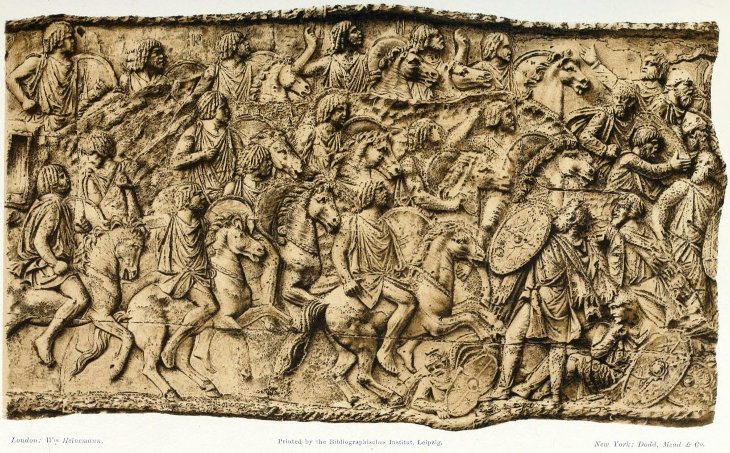 Moorish cavalry under Lucius Quietus fighting against the Dacians. From the column of Trajan in Rome.
Both generals were ruthless. In Mesopotamia, Quietus destroyed the Jewish communities of Edessa, Nisibis, and Nehardea. In Alexandria, Turbo, with the assistance of the local Greeks, massacred the Jewish community and destroyed the magnificent synagogue described in the Talmud12. The Jews of Cyrenaica and Cyprus didn’t fare any better.
Professor Allen Kerkeslager wrote13:
The campaign of ethnic cleansing appears to have been a devastating success. A gap in the extant evidence for Jews in Cyrenaica confirms that the area was essentially emptied of Jews by their migration into Egypt and the subsequent Gentile massacres of stragglers. Few if any Jews survived anywhere in Cyprus. Papyri and inscriptions testify to the annihilation of entire Jewish communities in many parts of Egypt. Only in remote areas on the fringes of Roman control could any Jews have remained alive in the affected regions.
As a reward for his accomplishments in Mesopotamia, Trajan appointed Lucius Quietus governor of Judea. In Jewish sources, Quietus is called Kitos, and the events of this time are called the Kitos War14.
The existing records are unclear on how the Jews of Judea were affected by these events, but Quietus/Kitos is not perceived favorably by Jewish sources.
Trajan lost in his war on Parthia. He attempted to return to Rome but fell ill and died on the way. His war on Jews, and his attempt at a final solution, had also ultimately failed. Though he was responsible for the massacres of many thousands of Jews, the Jewish people survived.
Emperor Hadrian saw the powerful and successful Quietus as a threat to his power. He accused Quietus of treason and had him executed.
Emperor Hadrian, who succeeded Trajan, saw the powerful and successful Quietus as a threat to his power. He accused Quietus of treason and had him executed. Thus, Quietus had also ultimately lost his war against the Jews.
To commemorate the many victims of the Kitos War, the Jewish sages instituted a prohibition against brides wearing elaborate crowns on their wedding day15.










This is a really good article!
The date of the Diaspora unrests, however, is not 115-117 but rather 116-117. See my book Diaspora Judaism in Turmoil, 116/117 CE: Ancient Sources and Modern Insights (Leuven: Peeters, 2005).
Great article! The likelihood of Jewish cannibalism is extremely low, given the Jewish dietary laws. The only evidence of such a thing is in Eichah (Lamentations), and even there it seems that starving women ate the flesh of their already dead children.
I hope to read more about this period.
I read Hadrian's nephew converted to Judaism, and there is a Torah commentary he wrote in Aramaic
Every essay written by Yehudis Litvak is a gem. She makes history come alive, whether the topic is about a relatively unknown event or an era we only thought we knew (her Chanukah series of books were truly enlightening).