







 What Two Hebrew Words Reveal About Israeli Democracy
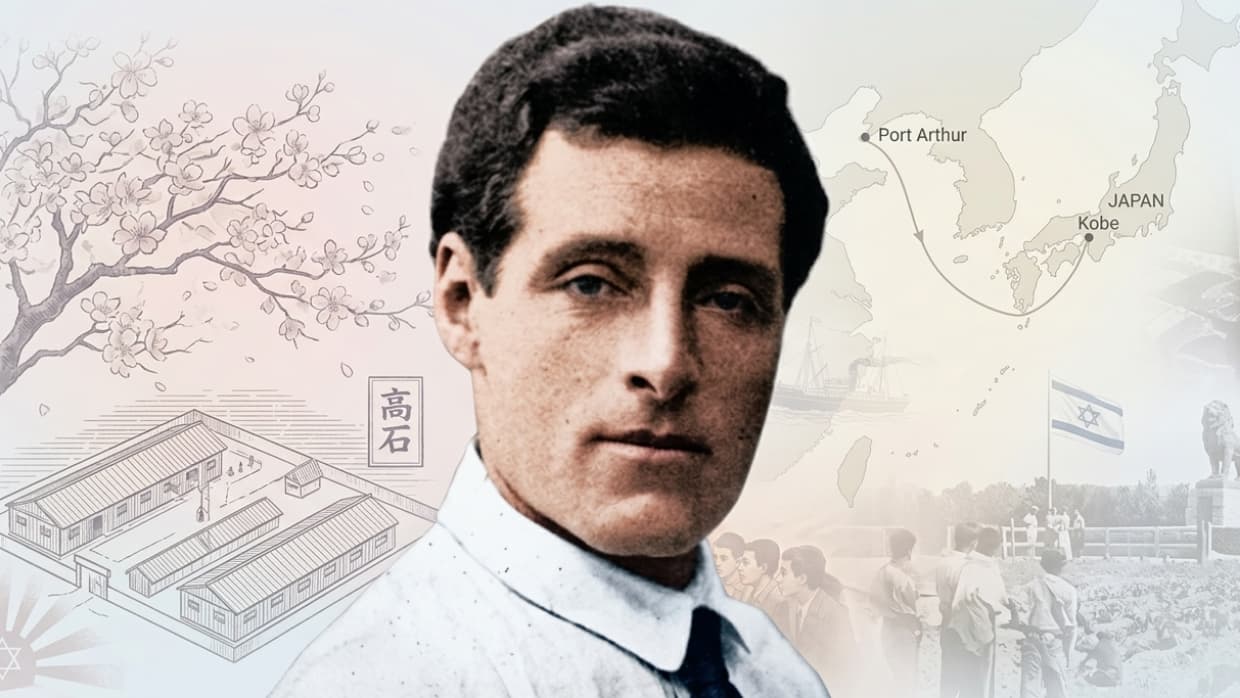






Joseph Trumpeldor spent a year in a Japanese POW camp and came out a Zionist legend.
Every Israeli schoolchild knows the name Joseph Trumpeldor. He is the quintessential Zionist icon, a one-armed Jewish soldier who, in March 1920, led a small band of pioneers defending Tel Hai, a remote farming outpost in the Galilee, against a vastly superior Arab force. Outnumbered and mortally wounded in the battle, his reported last words were “tov lamut be'ad artzeinu – it is good to die for our country." That phrase became the rallying cry of a generation.
In an era when the Jewish people had no state, no army, and no recognized right to the land they were trying to rebuild, Trumpeldor's willingness to fight and die for it planted the seed of what would eventually become the ethos of Jewish self-defense in British Mandatory Palestine. In a time when Jews were a minority navigating hostile neighbors, a skeptical colonial administration, and their own internal debates about whether armed resistance was even legitimate, Trumpeldor's self-sacrifice paved a clear path forward.
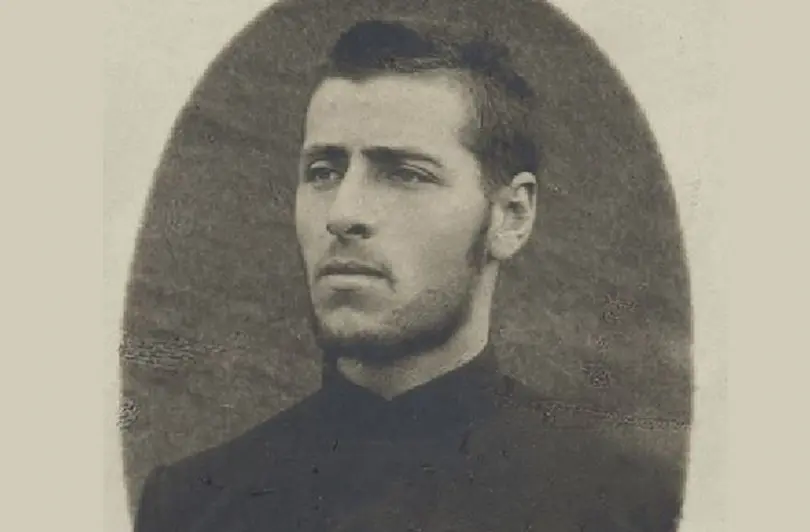 Joseph Trumpeldor in Japanese captivity, the photo was probably taken in 1904.
But before he was the martyr of Tel Hai, and long before he led the Zion Mule Corps at Gallipoli during World War I, Joseph Trumpeldor underwent a transformation that reads more like a thriller than a biography.
While Trumpeldor is legendary for his courage as a Jewish soldier and his martyrdom defending the Land of Israel, he was arguably forged in the most unlikely place: a Japanese prisoner-of-war camp in Takaishi. It was there, among the cherry blossoms and the rigorous discipline of Meiji-era Japan, that Trumpeldor took charge of his fellow Jewish prisoners, built a Zionist organization from nothing, and earned the reverence of a "Samurai" from his captors.
Born in 1880 in Pyatigorsk, Russia (in the Caucasus), Trumpeldor was the son of a Cantonist, a Jewish civilian forcibly inducted into the Tsar's army as a child. His father, Vladimir Wolf (Ze'ev) Trumpeldor, had served 25 years in the Russian military yet remained a devoted Jew, which was considered rare among Cantonists, most of whom lost touch with their Jewish identity and traditions over half a lifetime of army service.
This dual identity -- loyalty to the state combined with unyielding Jewish pride -- was the air Joseph breathed from birth.
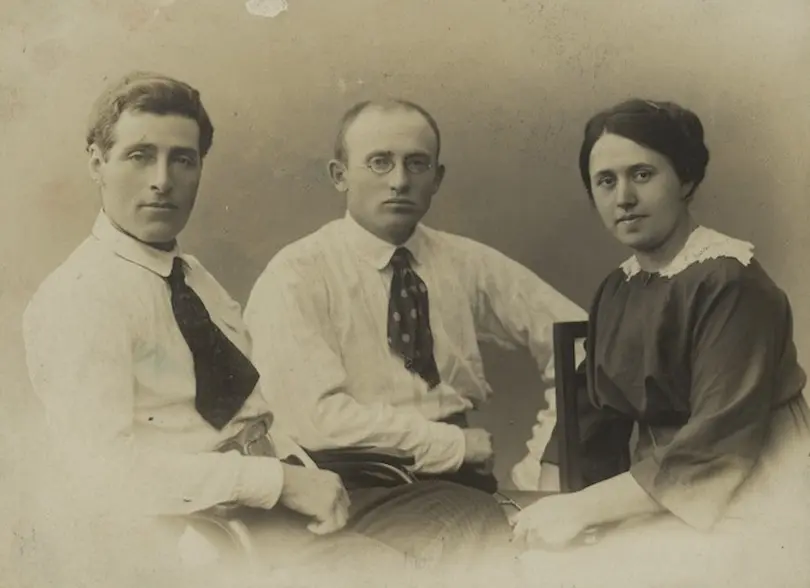 Joseph Trumpeldor, Hannah and David Blotserkovsky. The photo was taken during Trumpeldor's visit to Russia in 1913.
Growing up outside the Pale of Settlement where most Russian Jews were forced to live, Joseph was largely removed from traditional shtetl (Jewish village) life. While 97% of Jews in the Russian Empire spoke Yiddish as their mother tongue in the late 19th century, Joseph grew up speaking Russian in a semi-assimilated home. Influenced by Tolstoy's teachings and communal ideals, he became a vegetarian and considered himself a political pacifist in his teenage years.
He briefly attended a Talmud Torah (Jewish elementary school) as a child but was primarily educated in Russian state schools, where he excelled in his studies. Despite his academic success, he was denied entry into high school (the gymnasium) due to the Numerus Clausus -- a quota limiting the number of Jews allowed into Russian institutions. He returned home to Pyatigorsk and learned dentistry from his brother Herman. Reflecting on that period, Trumpeldor later wrote:
"Along with other Jews, I drank from the cup of suffering and humiliation since childhood because with contempt or hatred, they called me 'Zhid' or deprived me of rights given to other Russian citizens. In me, there is national pride and a high spirit." 1
Despite the discrimination, Trumpeldor never turned bitter. He had a remarkable tendency to find the positive side of even the worst situations and always pushed toward creative solutions.
When Trumpeldor was 17, the First Zionist Congress opened in Basel, Switzerland. He couldn't attend, but news of the event galvanized him. Shortly after, he established his own branch of the Zionist movement in his hometown and chaired it for the next five years.
In 1902, Trumpeldor was drafted into the Russian military. Despite his anti-militaristic views, he refused to let people associate Jews with weakness or cowardice. He resolved to be the most loyal and daring soldier in the Russian army. Two years later, he volunteered for the 27th Siberian Infantry Regiment and was sent to Port Arthur, Russia's largest naval base in East Asia (present-day Lushun District, China, on the Yellow Sea west of Korea). Not long after, the Russo-Japanese War broke out.
Japan, viewing Russia's military presence in East Asia as a direct threat, launched a Pearl Harbor-style surprise attack on the Russian fleet at Port Arthur on the night of February 8, 1904. Russia had the third-largest navy in the world at the time, and a third of it was stationed there. Trumpeldor's regiment was sent into the surrounding hills to build defensive fortifications against the Japanese advance.
Though he was officially a medical assistant, he volunteered for the "Hunting Unit" -- the Russian equivalent of special forces -- whose job was to go out into the "Grey Zone" at night: cutting barbed wire, scouting Japanese artillery positions, and launching raids to disrupt enemy siege trenches. Even there, he faced antisemitism. One commander declared, "There are no cowards or traitors in the unit because there are no Jews among us!" 2 Rather than shrink from it, Trumpeldor proudly and publicly declared his Jewish identity. He was determined to prove that Jews were strong and loyal.
During the brutal Siege of Port Arthur, a piece of shrapnel shattered his left arm, requiring amputation above the elbow. Most men would have taken their honorable discharge and gone home. Trumpeldor did the opposite. In a letter to his parents, he wrote:
"Again, I ask you not to feel sorrow for me; firstly, even if you do, it will not change anything, and secondly, many people have lost both their right and left hands, yet they still live. Moreover, I hope that even with my one right hand, with which I write this letter, I will succeed in life to a degree that even those with two hands would envy me." 3
He then made an extraordinary request of his commanders: not only to remain in the military, but to return to the front lines. "I have one hand left, but it is my right hand, and therefore I wish to share the life of my comrades as before. I ask His Excellency to grant me a sword and a pistol." 4
He returned to the trenches, fighting with such ferocity that he was promoted to Senior Sergeant and awarded the Saint George Cross, 3rd degree. During a formal military review honoring his bravery, he was placed in command of the Third Company, quickly winning the deep respect and loyalty of his men.
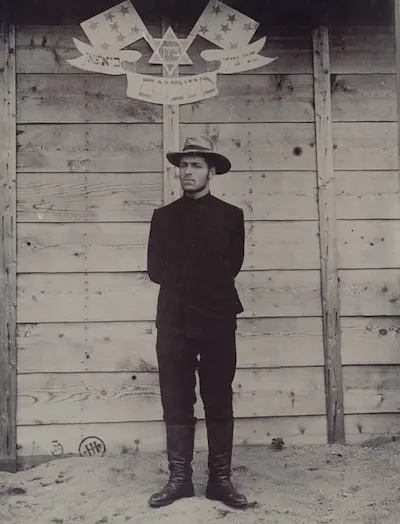 Joseph Trumpeldor in Japanese captivity, above you can see the symbol of "Children of Zion Prisoners in Japan".
Despite the bravery of Trumpeldor and his comrades, Port Arthur surrendered on January 2, 1905. The Japanese, having noticed the highly decorated amputee officer, offered to release him under the 1899 Hague Convention, of which Japan was a signatory. Trumpeldor, however, refused, publicly declaring his preference to remain with his brothers-in-arms until every last one of them was freed. He marched onto the ships alongside nearly 25,000 other Russian soldiers, bound for prisoner-of-war camps in Japan.
Joseph Trumpeldor, like his Biblical namesake, was not just a prisoner but earned the admiration of both his fellow captives and his guards. His confidence and relentlessly positive demeanor made him a natural leader in the Japanese POW camp -- and especially among the Jewish soldiers he would live alongside for the next year.
Of the 70,000 Russian POWs captured during the Russo-Japanese War, 1,739 were registered as Jewish. They were scattered across 29 POW camps throughout Japan. In each camp, prisoners were housed in barracks organized by ethnic nationality (the Russian Empire was a mix of Russians, Ukrainians, Poles, Latvians, and others). Jews in Tsarist Russia were also classified as an ethnic nationality, so each camp had a sub-section of exclusively Jewish barracks. Trumpeldor, who had rarely spent time among so many of his own people, found himself reconnecting with his roots. Most of these Jewish soldiers had been drafted into the Tsar's army against their will, forced to serve a monarch who despised them, only to be captured by a Japanese army that didn't understand them. Trumpeldor took it upon himself to raise their morale and worked tirelessly to meet their humanitarian and religious needs.
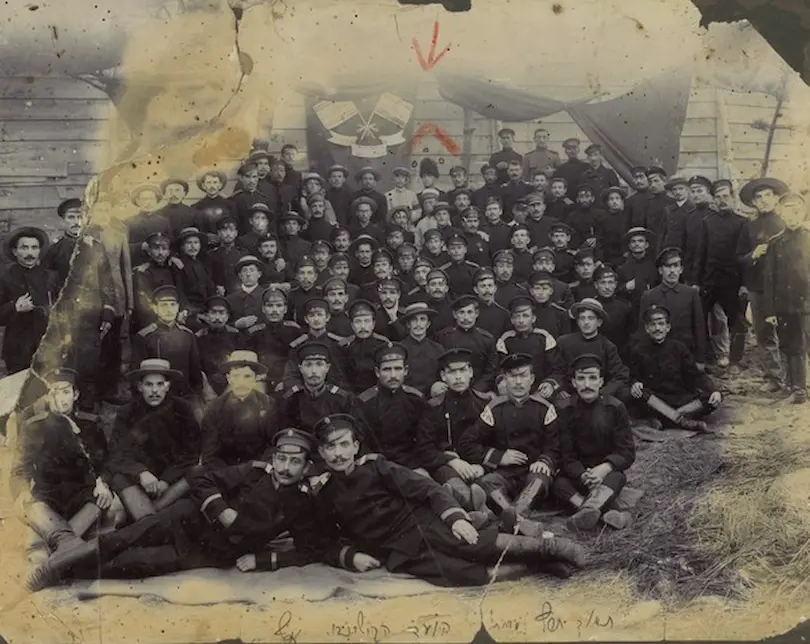 A group photograph of eighty-six Jewish soldiers in the Russian army, in a prisoner-of-war camp in the town of Takaishi. The photo was taken as a souvenir of their joint activities in the association "Sons of Zion Prisoners of War in Japan". In the last row, Joseph Trumpeldor is marked in red pencil – wearing a fur hat. Behind him is the emblem of the Jewish Prisoners of War Association.
Inside the Takaishi camp, Trumpeldor transformed captivity into a functioning community. He didn't merely organize for survival -- he built the foundations of Jewish communal life. Under his direction, the Takaishi Society of Jewish POWs emerged, complete with its own lending institutions, vocational workshops, and cultural programming. He established a theater troupe to keep spirits high. Understanding the spiritual weight of their exile, he worked with Japanese camp administrators to secure the essentials of Jewish practice: baking matzah (unleavened bread) for Passover, sourcing a Torah scroll and prayer shawls, and ensuring everyone could send handwritten holiday blessings home.
When a fellow Jewish soldier died of his wounds, Trumpeldor secured permission for a proper Jewish burial, including having three Jewish prisoners recite Psalms beside the deceased overnight. Burial shrouds were prepared, and the funeral was performed in the presence of ten Jews, forming a minyan.
The Takaishi Society also ran welfare and educational projects. It created a relief fund for needy prisoners, supported craftsmen in the camp, and built a library from donated books. In March 1905, under Trumpeldor's supervision, a school was founded where volunteer teachers offered classes to both Jewish and non-Jewish prisoners. Trumpeldor himself prepared Russian grammar materials and obtained basic textbooks for students who couldn't read. 5
His impact as a mentor was profound. A fellow prisoner wrote to "Joseph ben Ze'ev Trumpeldor" (Joseph, son of Ze'ev Trumpeldor), thanking his tireless teacher for the care and education that had changed his life behind barbed wire.
The Japanese camp administrators were deeply moved. In Trumpeldor's selfless leadership, they recognized something they held sacred: Bushido -- the samurai code of honor. His absolute devotion to duty, combined with the stoic dignity with which he bore his physical disability, struck a deep chord. They saw him not as a defeated prisoner, but as a noble warrior-philosopher. To them, his willingness to sacrifice his own comfort for the spiritual and physical survival of his men embodied the ultimate samurai virtues of loyalty, benevolence, and martial honor. It forged a legacy of mutual respect that Japanese historians still honor today.
Trumpeldor's immersion among his Jewish brothers-in-arms was the most exposure he had ever had to his own people. He connected with them, shared their longing for freedom, and collectively dreamed of a better future. It ignited a fierce Jewish pride that burned strong for the rest of his life.
Beyond his religious, cultural, and educational work in the Takaishi camp, Trumpeldor also founded an organization called "The Children of Zion in Japanese Captivity" -- a group of 120 dedicated members focused on the future of the Jewish people in a Jewish homeland. Through it, he raised money for Zionist causes, collecting small donations from fellow Jewish POWs.
Though technically prisoners, the Japanese authorities allowed them to send/receive money from abroad, accumulate personal savings, and earn limited income through crafts or paid work. Trumpeldor channeled these resources toward Zionist causes, including the Jewish National Fund, which had just begun planting trees in the Land of Israel the previous year (1904). The funds also supported newly built Jewish schools and libraries in Jaffa and Jerusalem. He even reached out to the Seventh Zionist Congress in Basel to pledge the support of the captive exiles toward various Jewish infrastructure projects in the Land of Israel.
Letters to and from the outside world were permitted. Japan's unusually humane treatment of Russian POWs was a calculated, state-sponsored strategy to demonstrate its status as a modern, civilized nation to the Western world. Whatever Japan's internal motivations, the prisoners -- Jewish and non-Jewish alike -- benefited from a remarkable degree of autonomy.
In the interest of spreading Jewish nationalism among his fellow prisoners, Trumpeldor authored and edited a weekly camp newspaper called The Jewish Life, printed in both Yiddish and Russian, which circulated among Jewish POWs throughout Japan. It covered Zionism, Jewish national revival, and cultural life in captivity -- with articles on future Jewish settlement in the Land of Israel, Hebrew language and cultural renewal, education, and debates over Jewish identity and assimilation. It also reported on camp activities, schools, libraries, and the mutual-aid projects organized by the prisoners themselves. Though confined behind barbed wire, they had access to newspapers, books, mail, and correspondence from abroad, allowing the paper to engage with the wider Zionist movement in real time.
Jewish POWs who were close to Trumpeldor testified that his most enduring dream was building a cooperative settlement in the Land of Israel. He began drafting plans for a small group of idealistic pioneers to immigrate there after their release and build a new kind of Jewish community in their ancestral homeland. To find backing for this vision, he wrote letters from the camp to Zionist leader Menachem Ussishkin (then based in Ukraine), outlining his blueprint for a Jewish future in the Land of Israel.
Following the signing of the Treaty of Portsmouth in late 1905, Trumpeldor was released from Takaishi. His departure was marked by an unforgettable scene: thousands of Russian prisoners hoisting the one-armed Jewish officer onto their shoulders and shouting in tribute, "Behold, a true man! Look at him!"
Back in Russia, his valor at Port Arthur was recognized at the highest levels. Trumpeldor was promoted to officer's rank -- a rare achievement for a Jew in the Tsar's army -- and personally decorated by the Tsarina. But his heart remained tethered to the cooperative settlement he had dreamed about in captivity. In 1912, Trumpeldor fulfilled that dream and made aliyah (immigrated to Ottoman Palestine). Settling first at Migdal on the shores of the Kinneret (Sea of Galilee) and later working at Degania, the world's first kibbutz (communal agricultural settlement), he threw himself into physical labor -- proving that a pioneer could clear swamps and plow fields even with a single arm.
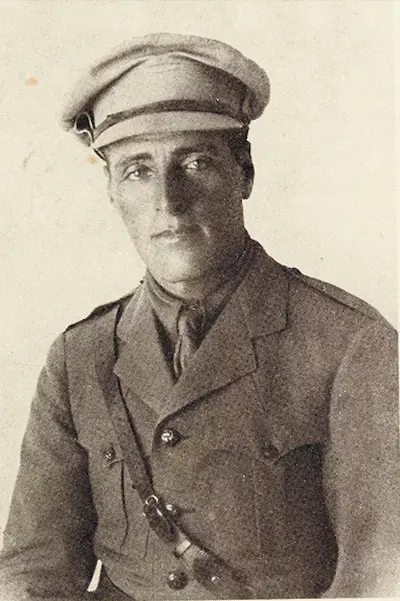
When World War I erupted, Trumpeldor's geopolitical pragmatism led him to Alexandria, Egypt, where he crossed paths with Ze'ev Jabotinsky. Together, they championed a bold idea: a Jewish military unit fighting alongside the Allies to liberate Palestine from Ottoman rule. While Jabotinsky initially balked at the British offer to form a logistics unit rather than a frontline combat force, Trumpeldor famously countered that "any trench is a trench" -- recognizing the enormous political value of a Jewish army under any name. The Zion Mule Corps was born in 1915, with Trumpeldor as its operational commander. He led the unit with distinction through the grueling Gallipoli Campaign, proving Jewish bravery under fire and laying the literal and symbolic groundwork for what would eventually become the Jewish Legion and, ultimately, the Israel Defense Forces.
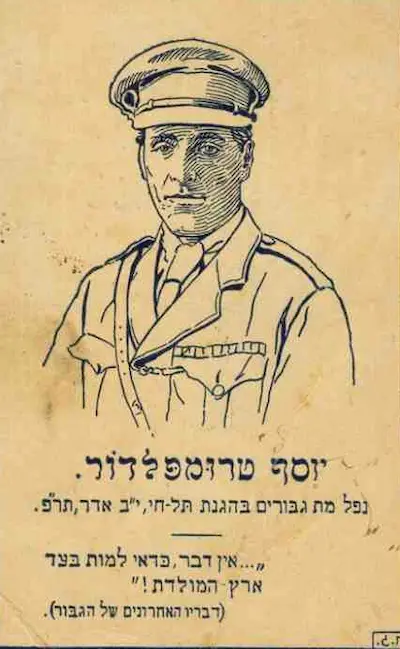 Poster: Collection of Judaica Postcards Named After Joseph Trumpeldor.
By late 1919, Trumpeldor's focus shifted back to agriculture and security in the Upper Galilee, where the collapse of the Ottoman Empire had left a dangerous power vacuum between British and French mandatory zones. Local Arab insurgencies against French rule threatened a string of isolated Jewish farming communities in the Hula Valley, most notably Metula, Kfar Giladi, and Tel Hai. Recognizing the strategic threat, Trumpeldor was dispatched to organize the defense of these exposed northern settlements. He arrived at Tel Hai as regional commander, immediately instilling discipline among a handful of young, inexperienced pioneers. For Trumpeldor, these outposts were not merely farms -- they were the physical borders of the future Jewish state. He believed political borders are drawn by the plow and defended by the rifle, and he refused to abandon a single inch of Jewish territory despite overwhelming odds.
The standoff at Tel Hai reached a bloody climax on March 1, 1920, when a large band of armed Shiite villagers, led by Kamal el-Hussein, arrived at the gates under the pretext of searching the outpost for French soldiers and weapons. To avoid a confrontation, Trumpeldor permitted them to enter the main courtyard, but a misunderstanding erupted into violence when an Arab fighter attempted to disarm a female pioneer in the upper room, prompting her to scream. Trumpeldor immediately ordered his men to open fire, and a brutal close-quarters battle broke out. In the fierce firefight in the exposed courtyard, Trumpeldor was struck in the abdomen by several bullets. Mortally wounded, he continued directing the defense until reinforcements arrived.
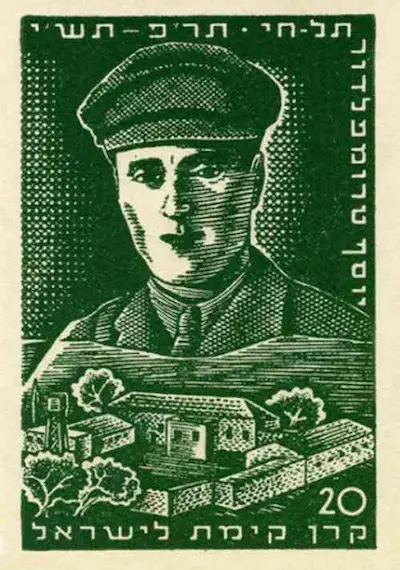 Stamp with the portrait of Joseph Trumpeldor. Designer: Kraus Franz, 1950
He was evacuated toward Kfar Giladi that evening but died of his wounds along the trail. Seeing the grim faces of the doctor and his comrades, Trumpeldor -- even in his final moments -- sought to comfort them. He said ein davar ("never mind" -- "it's not a big deal") and then spoke his famous last words: "It is good to die for our country." Until the very end, in the worst possible circumstances, he managed to radiate calm and give hope to those who looked up to him.
For future Jewish generations, Joseph Trumpeldor’s legacy delivers a timeless, multifaceted message of synthesized identity and resilient leadership. His life shattered the archetype of the passive diaspora Jew, forging a new model of the halutz (pioneer) equally at home with a book, a plow, or a rifle.
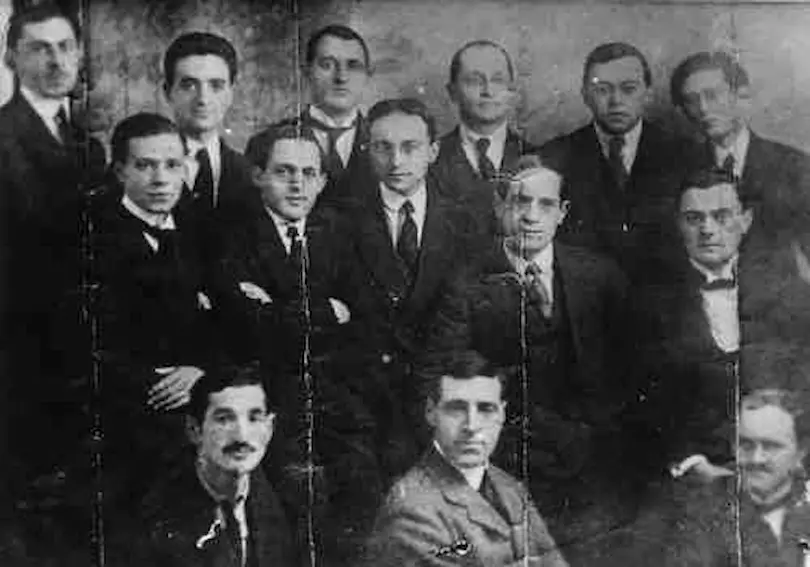 Ze'ev Jabotinsky (second from left) and Yosef Trumpeldor (forward) with their fellow founding members of the battalion at Gallipoli.
Trumpeldor demonstrated that true leadership is rooted in service and absolute solidarity with one's people -- whether in a Japanese POW camp or the isolated outposts of the Upper Galilee. His final declaration was not a glorification of death but a validation of purposeful living: a reminder that a sovereign nation is built through dedication, mutual responsibility, and the courage to defend one's community against all odds.
In Israel, Trumpeldor is commemorated by the Roaring Lion monument, sculpted by Abraham Melnikoff, which stands over the mass grave of the eight defenders at Tel Hai, gazing out toward the Golan Heights. The city of Kiryat Shmona ("Town of the Eight") is named after the eight casualties at Tel Hai, Trumpeldor among them. Dozens of streets and youth movements across the country bear his name, weaving his deeds into the daily geography of the nation.
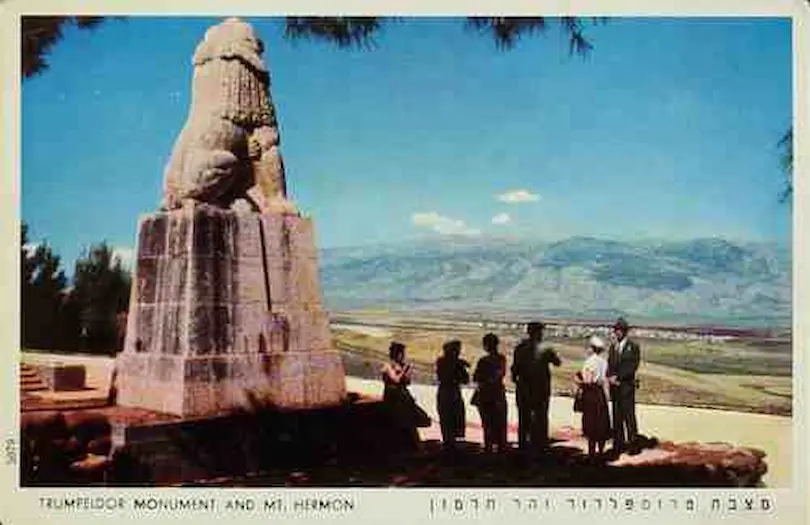 The "Roaring Lion" Monument in Tel Hai. 1930s. Pritzker Family National Photograph Collection, National Library of Israel
Though Trumpeldor made his biggest impact on Israeli society and folklore, his memory is also preserved in Japan, despite his having been a POW there for only a year. In 2006, an exhibition in Japan commemorating the Russo-Japanese War dedicated a special wing to his story -- not merely as a soldier of the Tsar, but as the visionary leader who embodied the spirit of Bushido (the Japanese code of honor). It is the story of a Jewish Samurai named Joseph Trumpeldor.
With thanks to the National Library of Israel for the photos.
1 https://www.izkor.gov.il/%D7%99%D7%95%D7%A1%D7%A3%20%D7%98%D7%A8%D7%95%D7%9E%D7%A4%D7%9C%D7%93%D7%95%D7%A8/en_65f5a245f59dc69bd165261439da8ac7
3 Ruth Becky-Colodny, "The Enigma of Trumpeldor," Haaretz, February 16, 2013.
4 https://www.izkor.gov.il/%D7%99%D7%95%D7%A1%D7%A3%20%D7%98%D7%A8%D7%95%D7%9E%D7%A4%D7%9C%D7%93%D7%95%D7%A8/en_65f5a245f59dc69bd165261439da8ac7
5 https://www.academia.edu/8291472/Between_Loyalty_to_the_Empire_and_National_Self_Consciousness_Joseph_Trumpeldor_among_Jewish_Russian_POWs_in_Japan_1905_










What selflessness! It's hard to grasp. We have brave soldiers also today, but Trumpledor really is a hard act to follow.
Sincere thanks for this piece.
Allow me to alert you, however, if I may, that in the group photo identified in its caption as that of the founding members of the [Jewish] Gallipoli Battalion, EITHER Ze'ev Jabotinsky is mislocated --- caption reads: "second from left" for Jabo (he's, in fact, 2nd from the right; top row) --- OR, perhaps the original photo used for printing here was actually a negative? Best wishes, and again thank you SO much for this.
What an inspiring life.. A true hero of our Nation of Israel! I never understood my late mother’s teenage diary writing about Trumpeldor in 1934 Germany before the family escaped to South Africa!
Sad that our family didn’t go to Israel at that time, but it’s all history now as five of my grandchildren are now living in our beautiful Jewish State ….more of our family will IMH follow in the next years to come! Am Yisroel Chai!
And may I add, besides being a remarkable human being and an amazing Jew, he was also very, very handsome!
Sorry, besides the awe inspiring and touching story and his incredible deeds of valor, he had the bearing and looks of a leader, like Dovid Ha Melech.
What an amazing historical recollection. There is a continuation of Trumpeldor’s story after he died defending Tel Hai. It is the creation of the Betar Zionist youth movement by Zeev Vladimir Jabotinsky in 1923. Betar stands for “Brit HaNoar Al Shem Trumeldor. The vision was to emulate Trumpeldor’s valor in the youth of antisemitic Europe. The greeting between Betarim was “Tel Chai” not hello or shalom. The song of Betar, its anthem was written by Jabotinsky, and was sung at every meeting. It was the revelation of the new Jew. The youth learned to be proud, because they were crowned with the diadem of King David. He wanted every Jew to learn and speak Hebrew. He visioned the Jewish people rising up from “the pit of decay and dust” a proud and fierce nation. What a visionary - 🇮🇱 today
Unbelievable! I was rivetted by this article. I felt like I was in High School and back in one of our beloved principal's (Rabbi Binyomin Steinberg Z"L)historia classes.
I didn't know there was a connection, between Japan and Jews a thought it was a myth, I guess it may not be a myth
cont
My mother( obm) got smuggled into Israel after going through the Holocaust, and was in then Palestine when they declared Israel a state, and the girls in Auschwitz-Birneau that got hanged for trying to blow up the crematorium, said before being hung " who ebpver lives through this horror go to Palestine to build a country( which is now called Israel) my mom( obm) told me this, so being a descendant of a Holocaust Survivor( obm) makes the land of Israel very important to Jews wherever a Jew happens to be
This is a fantastic article. I'm studying the connection between the Jewish and Japanese peoples. This article gives me new insight into the impact of Joseph Trumpeldor on the Japanese view of the Jews before the amazing events of WWII. Thank you! (I'm going to update my next talk!)
Thanks to G-D - who blessed & instilled in Joseph - spiritually - mentally - emotionally & physically - with the sills - & talents that were needed there - at that time - to be a Jewish leader - & develop the multi-national respect for Jews - much as He did for Moses. May G-D do so now - bless someone new - to lead us safely through - our current distressing position in the world . May G-D - also cause our enemies - to be filled with the ability to know the truth - or suffer total confusion - in all they do to cause chaos.
Fantastic article. Thank you.
May his memory be blessed. May his example be followed by many.
I think it has been, especially since the October 2023 Massacres.
Amen to both