








 Seven Reasons for Hope on October 8
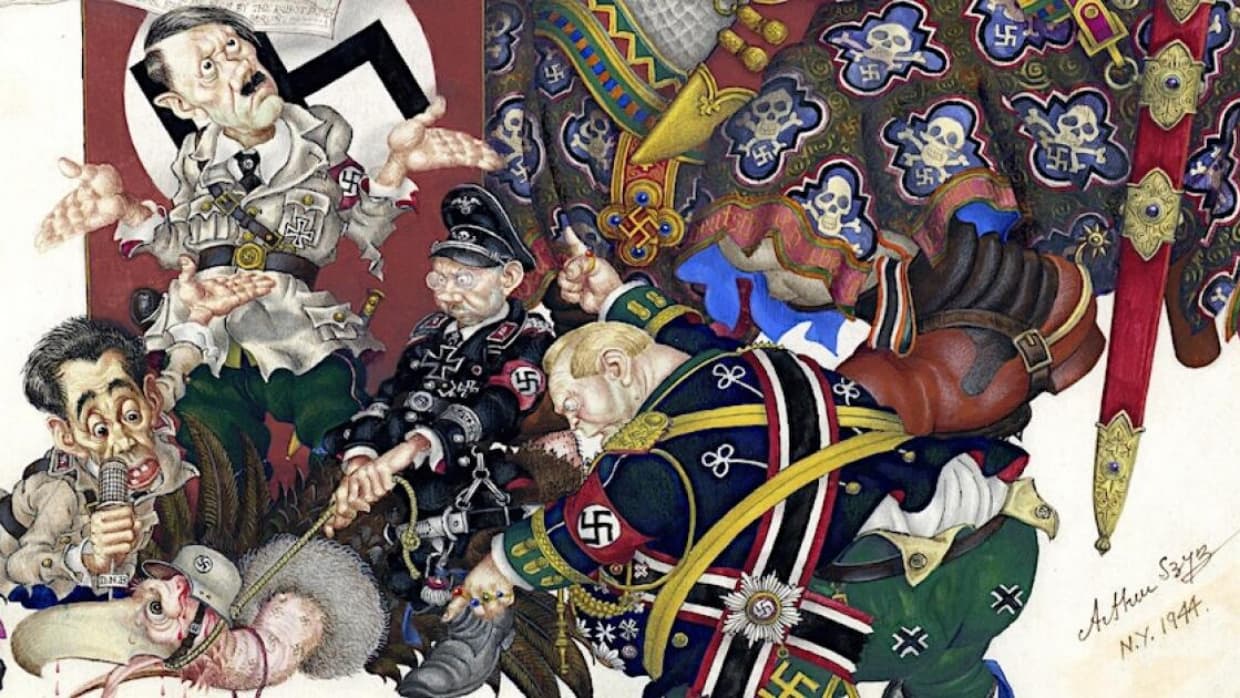






His rifle was his paintbrush, and he became one of the most feared weapons in the Allied arsenal.
History has fought fascism with armies, speeches, and uprisings. Arthur Szyk fought it with a paintbrush and a fearless imagination.
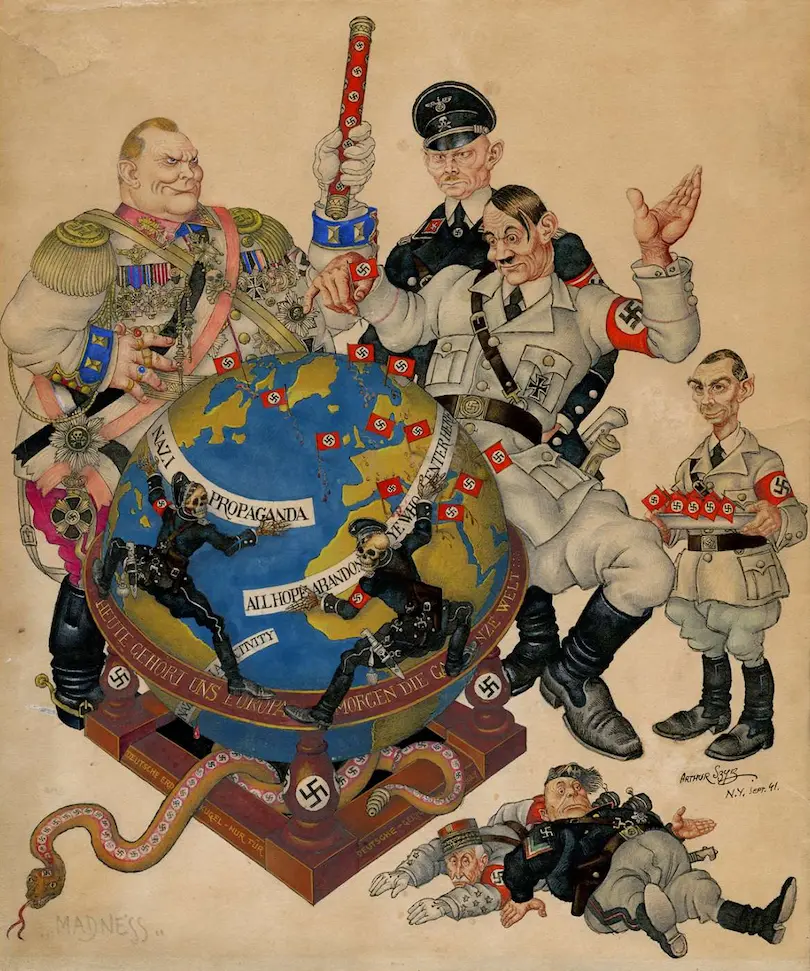
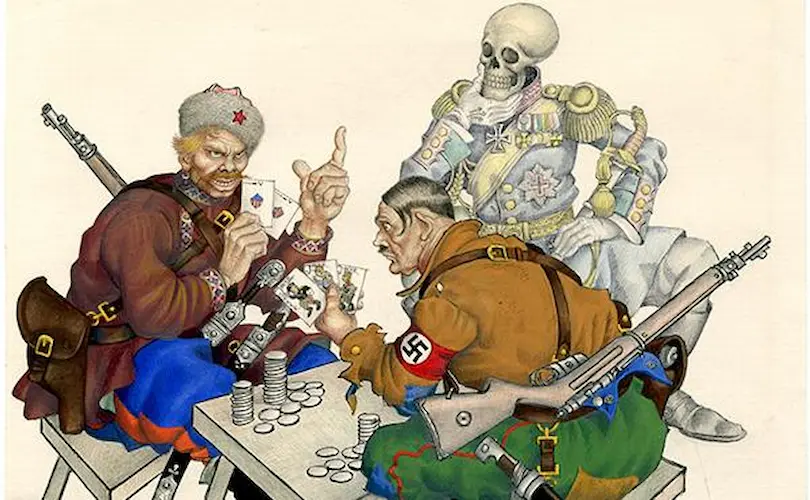
Szyk became internationally renowned for two things: his breathtaking, jewel-like miniature style and his ferocious political art, especially his anti-Nazi caricatures during World War II.
He never picked up a rifle to fight tyranny. His weapon was a paintbrush, and in his hands it became something fierce. Born in Poland and shaped by the gathering storms of the 20th century, Szyk used the delicate language of ornate illustration to deliver blistering blows against Nazism. His drawings were so sharp and unflinching, they circulated across the Allied world as rallying cries in their own right.
Now, New York City’s Museum of Jewish Heritage celebrates his work with a major retrospective.
Arthur Szyk was born in 1894 to a well-to-do family in Łódź, Poland, immersed from childhood in art and his Polish-Jewish heritage. His first lesson in the power of art came early: a caricature of the czar got him expelled from school. By 1909, at just 15, he was studying at the famed Académie Julian in Paris. He returned home three years later to work as an editorial cartoonist and designer in Krakow.
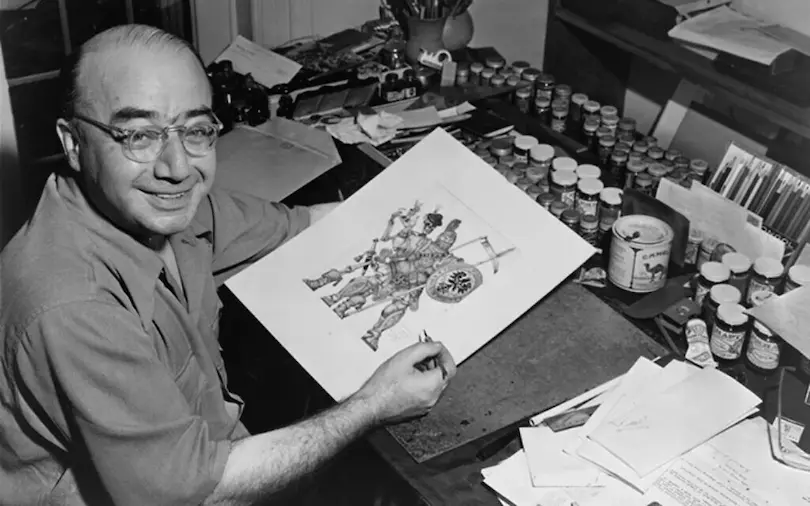 Szyk working at his desk
His travels through Palestine and the Middle East, research for an exhibition on modern Jewish pioneers, deepened his commitment to Zionism. Then World War I abruptly redirected his path. Conscripted as a Russian army lieutenant and later appointed director of propaganda for the Polish Army during the Polish-Soviet War, Szyk kept creating art whenever he could.
Even during military service, Szyk never stopped working. In 1919 he published his first book of caricatures, a biting satire of post-WWI Germany. Two years later he returned to Paris, where his 1922 solo exhibition sold out and launched a flourishing career illustrating limited-edition fine press books. The success supported his growing family, but Hitler's rise soon redirected his artistic focus.
Sensing the danger Nazism posed, Szyk cut short a U.S. trip in 1934 and returned to Łódź, determined to confront the threat through art. In the mid-1930s he poured that urgency into the Haggadah, reimagining the Exodus story as a contemporary struggle.
Szyk created his own Haggadah, recasting the ancient drama in modern terms, portraying the Hebrews as Eastern European Jews and the Egyptians as Nazis. The parallels were unmistakable.
Illustrated haggadahs have a long history, with examples dating to the 14th century. But even within that rich tradition, Szyk's version stands apart. Containing 48 jewel-like miniature paintings, it is widely regarded as one of the most beautiful and emotionally powerful haggadahs ever produced. Created in the shadow of Hitler's rise, it became a luminous act of defiance, an artist's fierce affirmation of his people and their story.
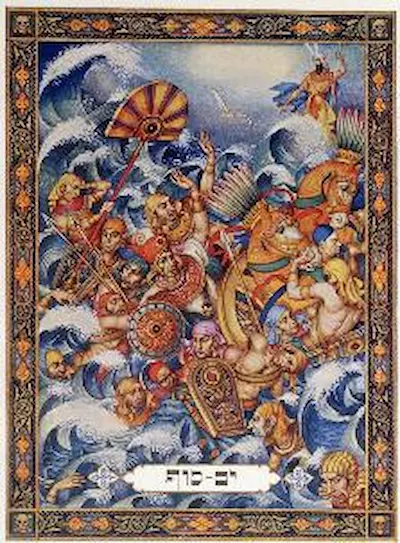 The Splitting of the Sea, depicted in the Szyk Haggadah
Szyk drew a sharp connection between the biblical Exodus and the mounting dangers of 1930s Europe. The Times of London praised his work in 1940, writing, "The Szyk Haggadah is worthy to be placed among the most beautiful of books that the hand of man has produced."
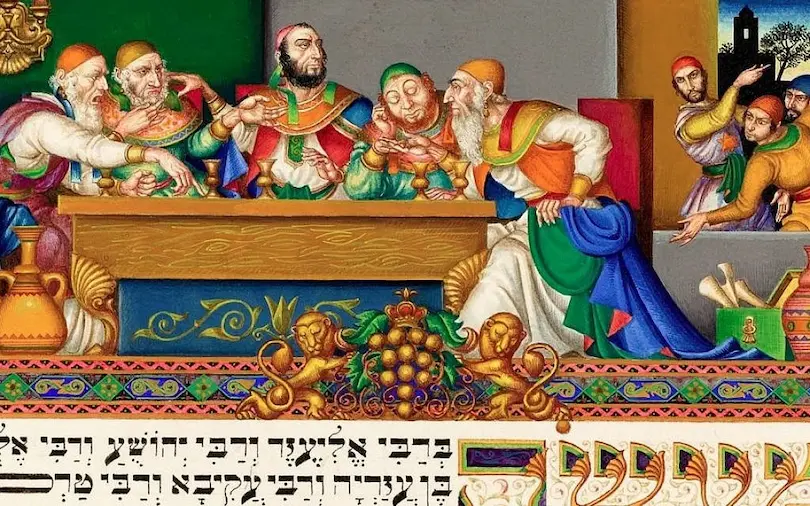 The Rabbis in Bnei Brak
Szyk arrived in New York in 1940 determined to publish his searing political cartoons and push Americans toward the Allied cause. He quickly earned the nickname "a soldier in art," waging his own campaign for democracy and for the survival of Europe's Jews with every drawing he made.
In early 1941, G.P. Putnam's Sons published The New Order, a collection of Szyk's blistering caricatures and the first American book to take direct aim at the Nazi regime. By the time Pearl Harbor was attacked, Szyk's work was everywhere. His unmistakable portraits of Hitler, Mussolini, and Hirohito appeared on magazine covers and postcards, in newspaper editorials, on war bond posters, at USO bases, and in U.S. War Department pamphlets and films. He had become part of the visual language of the American war effort.
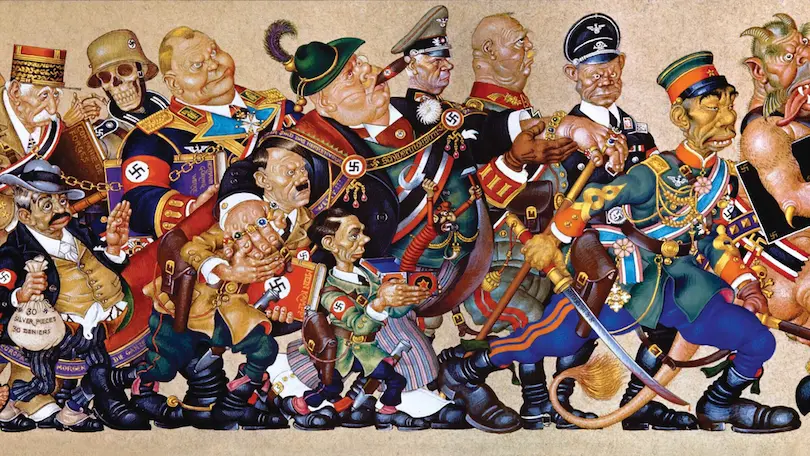 Arthur Szyk’s 1942 ‘Satan Leads the Ball’
Szyk wielded his pen and brush with such force that First Lady Eleanor Roosevelt called him a "one-man army." In her My Day column she wrote that his work "fights the war against Hitlerism as truly as any of us who cannot actually be on the fighting fronts today."
Szyk had signaled his mission years earlier. Speaking to the American press in 1934, he declared that an artist, especially a Jewish artist, "cannot be neutral in these times," and pledged to serve his people with every skill he possessed.
He kept that promise. During World War II he became the country's leading anti-Nazi artist and a central figure in the movement to rescue Europe's Jews. No one produced more activist imagery urging Americans to confront the Nazi threat, and no Holocaust artist of the era was reproduced more widely.
Running from December 7, 2025, through July 26, 2026, the Museum of Jewish Heritage in New York City presents Art of Freedom: The Life & Work of Arthur Szyk, a sweeping exhibition bringing together over 100 works from his prolific career, including several searing wartime pieces. The show casts Szyk not only as a masterful anti-fascist artist whose imagery shaped public consciousness, but as a profoundly Jewish voice whose moral urgency continues to echo in our own time.
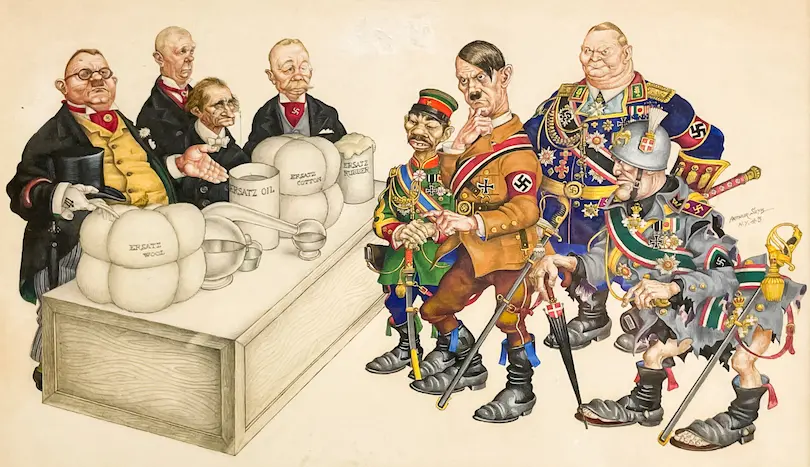
The museum's Curatorial Director, Sarah Softness, put it plainly: "What makes this exhibition important for 2026, 250 years on from the American Revolution, is how he framed freedom as something to fight for. He loved America and was granted citizenship in 1948."
Szyk died in 1951 at 57, at his home in New Canaan, Connecticut. He left behind the legacy of an artist who made freedom his life's work, confronting tyranny with beauty, exposing cruelty with precision, and insisting that art must serve humanity's highest moral obligations.
At the heart of his work is a fierce conviction: that images have the power to confront brutality, summon moral courage, and champion freedom, not for Jews alone, but for all humanity.
SOURCES






I have a copy of the Arthur Szyk Haggadah that I cherish. I also have an old set of Fairy Tales from Hans Christian Anderson and the Brothers Grimm which he also illustrated which were my mother's in the 1930's. As a child I was always mesmerized by his illustrations. The evil characters were truly evil and good ones, good.
Dan, Thank you for your article- I shall be in Israel in June delivering 3 talks about Arthur Szyk. Perhaps your readers may wish to know about them? Irvin Ungar
On my Bar Mitzvah in 1970 I received a gift from a congregant who was a survivor of the camps, a beautiful Haggadah that was fully illustrated and calligraphic in Hebrew by Arthur Scyk. It has a blue velvet cover with a inlaid golden chalice on the front. I also have a music box that was given to me by my Grandmother that plays the Hatifka also illustrated by him as well. As a part time artist myself studying all the styles of the greats his creative genius and artistic style stands out among the greats.
What amazing gifts you received!
Yes, one of my most prized possessions. Thank you for your acknowledgement as well as this remarkable journal you shared.
The paintings are masterful. They profoundly show the evil of Hitler.
Another historical lesson I have learned thanks to Dan Rich.
Thanks for your kind words, Philip.
Unfortunately I didn't learn about this important artist, until I found this article on my computer today, his work is inspiring and creative and also other Jews fought Hitler ( Y"S) with their art, also Jewish comic book authors and illustrators fought with the skill of the paintbrush or words and illustratortions, which was a different way to fight the Nazi ( Y"S) regime
Glad you found this, Judy.
Wow, inspiring!
His figures are so breathtaking. They look like illustrations from Medieval texts. And, please, one must take into context that these figures were exaggerated caricatures. They were created to ignite feelings of urgency and patriotism. And viewed with that in mind, they can appreciated for the incredible works of art that they are.
I was a frequent guest, when I lived in Brooklyn, to the home of a British immigrant family for Shabbos and Yom Tov meals. At Pesach, they had the most beautiful haggadahs I'd ever seen. I was fascinated by the gorgeous artwork, like nothing I'd ever seen in a Jewish book. It was the haggadah by Arthur Szyk. I'll bet that family was sitting on multiple thousands of dollars' worth of those haggadahs and didn't even know it.
What a fantastic memory, Esther, Thanks for sharing it!
Didn't he also design the Aron Kodesh for a synagogue in NYC?
Yes!! Arthur Szyk designed a famous 26-foot Aron Kodesh for the Forest Hills Jewish Center in 1949. Crafted from bronze and gold leaf, this massive 3D artwork features holiday symbols and the Lions of Judah.
Wow, that artist made such a impressive Aron Kodesh to go to the Forest Hills Jewish Center
Yes, the Forest Hills Jewish Center in Queens. It. was dedicated in 1949 and majestically stands 30 feet tall.
Guard the exhibition carefully! NYC is no safe place today for anything Jewish.