








 The Macklemore Mess: What Pink Got Right and Everyone Else Got Wrong
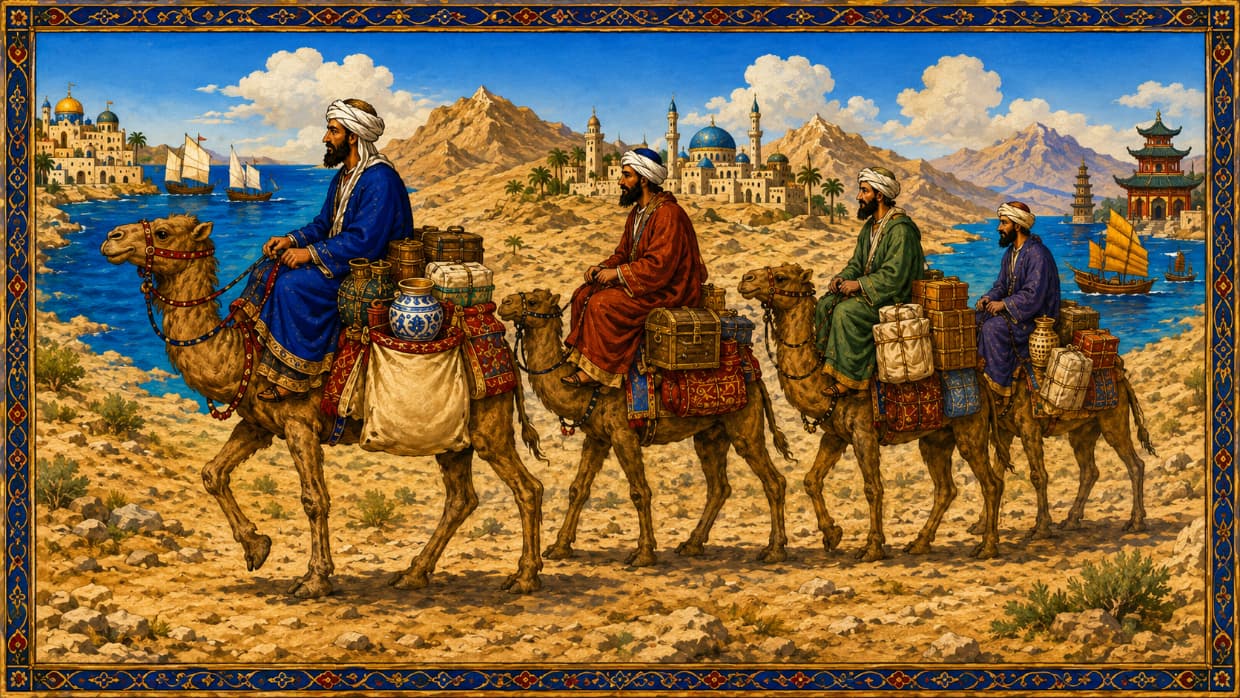








A thousand years before FedEx, Jewish merchants moved silk, spices, and gems across 6,000 miles. They also carried something far more precious.
In the ninth century, a network of Jewish merchants was moving goods across 6,000 miles, from the markets of Spain to the ports of China. They sailed the Persian Gulf and crossed deserts by caravan, carrying silk, spices, and gems in their cargo holds and trade contracts in their packs.
But they also carried letters that connected scattered Jewish communities across three continents, and helped safeguard the survival of a people and their faith.
The Radhanites were a powerful Jewish merchant network active from the 8th to 11th centuries, often regarded as history’s first transcontinental trade network.
These were the Radhanites, a powerful Jewish trade network active between the 8th and 11th centuries. They represent perhaps the first transcontinental trade network in history. They were also at the vanguard of communication "technology," which was vital to Jewish preservation and continuity.
An Arab geographer named Ibn Khordadbeh was the first to report on these merchants. He describes them trading a wide range of commodities: spices, silk, musk, aromatics, furs, metalwork, precious metals, gems, and more. Historians believe a sizable portion of all transcontinental trade during those centuries was coordinated by, or in some way connected to, the Radhanites.
The origin of the name Radhanite is still debated. Some link it to the Radan region near Baghdad, others to the Rhone Valley of France, and others to a Persian phrase meaning "he who knows the way." The sheer variety of theories says something about the staggering scope of their trading range, which spanned extensive land and sea routes.
What made these mysterious merchants so successful?
Let's start with some basic skills that Jewish merchants brought to the table.
For starters, Jews had high rates of literacy, largely because of the religious requirement to learn the Torah and other sacred texts. The rise of the Islamic caliphates elevated both the size and sophistication of economies under Muslim control and beyond. Literacy and numeracy became valuable commodities in commercial centers, and Jews had both. This was particularly important as written contracts became ever more crucial to commerce.
Today we have so many tools to help us translate foreign languages. Imagine them all gone – no Google Translate, no dictionaries or printed matter of any sort, even a paucity of writing implements.
True mastery of languages was essential if you were to successfully trade across lands and seas. Jews, by dint of their religion and status, were more likely to be bilingual or polyglot. The Radhanites were thought to be fluent in Arabic, Persian, Greek, Frankish, and Slavic tongues. Amongst themselves they probably used Hebrew, Judeo-Arabic, and Persian.
The Radhanites traded as far east as China. Did they speak Chinese, too? That’s unknown but Chinese trade documents from that period were discovered in the famous Cairo Geniza in the Ben Ezra Synagogue of Cairo.
The world the Radhanites operated in was dominated by two large powers, the Islamic Abbasid Caliphate in the East and the Carolingian Franks — the dynasty of Charlemagne, who ruled much of Western Europe — in the West. These two power systems were often at odds, if not in direct conflict.
At the time Jews were unique among traders, as they occupied a neutral position among these two powers and were thus accepted in both worlds. Even the most gifted Christian or Muslim traders were at a disadvantage when they weren’t on their “home court.” Jews had no “home court advantage,” as they were not fully accepted anywhere. This is usually a disadvantage, but in that period, it gave them the ability to operate freely in multiple worlds.
While the above skills and circumstances were important, there was one factor that made the Radhanites exceptional. It’s what we today call Jewish Geography. No matter where they were, the Radhanites could always count on meeting and working with fellow Jews.
No matter where they were, the Radhanites could always count on meeting and working with fellow Jews.
This enabled the Radhanites to extend credit and enforce contracts in a way that other traders could not. It also meant that if a trader had a crisis, he could lean on a Jew he had only met, since fellow Jews, however recently acquainted, are never strangers.
The Radhanites were at the center of trade for centuries, responsible for moving many of the key commodities and valuables of the time. But they were also couriers of letters that traveled between rabbis and Jewish communities, carrying the Responsa—written rabbinic rulings and answers to questions on Jewish law and practice.
When far-flung communities needed to know an answer to a question of Jewish law — whether a particular animal was kosher, how a marriage contract should be handled, what a community should do in a time of persecution — their local leaders and rabbis would write letters to the prominent sages of the age. But there was no postal service then, no Federal Express. It was merchants like the Radhanites who had the responsibility of carrying and delivering these letters to their destination through their vast network.
That a question posed by a Jewish community in Marseilles could, months later, receive a learned reply from a sage in Baghdad — and that this exchange could be trusted to a merchant crossing mountain passes, open seas, and hostile borders — is nothing short of a miracle.
The real purpose of their trips was commerce; they agreed to also serve as couriers. But perhaps on a deeper level, the letters they carried represented the underpinning of their success. The Radhanites were largely successful because of attributes they had gained by adhering to their faith. They undoubtedly viewed carrying those letters as a privilege or, in today’s parlance, a way of “giving back.”
The Radhanites ended up becoming guardians of a living tradition at a time when the Jewish world was scattered and vulnerable. The Responsa they carried answered legal questions and helped to stitch together a dispersed people, giving far-flung communities a shared language of law, practice, and faith.
Many of these letters were later collected into volumes that remain foundational to Jewish scholarship to this day. The silk and spices are long gone, but the words endure.














Fantastic article, great responses and The physician by Noah Gordon a great book
This "cross pollination" ennabled the Sephardic communities to maintain a coherence in their religous practices.
While studying history at S.U.N.Y. Binghamton in the early 1970 my mentor, Norman Stillman, told my class about the caravans that left Spain every year carrying She'elot from Spanish communities on a six year journey to Bahdad and back. They stopped at many Jewish communities along the way (North Africa) and picked up additional she'elot and brought them to the great Yeshivas in Sura and Pumbedisa. The gedolim them reviewed the she'elot and provided t'shuvot. The caravans brought these answers back to Spain but also stopped at the towns they hade stopped at on the outward bound journey. They provided answers to the she'elot that they picked up from those towns and they also provided the she'elot and t'shuvot from the other towns that they picked up along the way.
The article doesn't reveal the fate of the Radhanites.
What happened to them?
If the Radhanites did originate in Spain (as I was taught), then their continued effectivity was limited by Hosdai ibn Shaprut. Hosdai ibn Shaprut was the great minister of the Spanish caliph in the 10th century. While acting a the caliph's prime minister he also embarked on a program to make the Spanish Jewish community the predominant one in the Mediterranean world. He imported a posek, Moshe ben Hanoch, to make the Spanish Jewish community independent of Sura and Pumbedisa. He largely succeded. This is a very short answer to a very complicated question and bears a lot of study.
I have been very much intrigued by the trade system operated by Jewish tradesmen, and couriers. I have wondered if in Europe, an the middle east if there were not resentments among the non-Jewish Europeans, that lasted for centuries.
I am wondering if this hostility and resentment might have been the inspiration for William Shakespeare's play, "The Merchant of Venice", and I wonder if scholars of previous eras pursued that influence for the plot.
Very good article you wrote.
Very interesting. This history suggests a reason why Europe was so interested in establishing trade routes to the east in the 15th and 16th centuries: they knew about Jewish trade routes hundreds of years before and these routes could not be reestablished. Perhaps, the Spanish court even knew that Columbus was Jewish and chose him for that reason.
Fascinating article. I wished there was a bibliography attached.
1. In the 10(?) century, Rabbenu Gershon issued a cherem against opening correspondence/mail. There would seem to be a direct link between his cherem and Jewish involvement in trade both within feudal Europe, the silk road, etc.
2. Small Jewish communities were established along the silk road to facilitate Jewish involvement.
Very interesting.
What an extremely interesting article. So very informative. These people were amazing travellers carrying goods and letters and Torah studies in all directions. What strength and determination they had.
So, this was going on centuries before Marco Polo (c. 1254–1324).
There is an excellent novel by Noah Gordon called "The Physician" in which this Jewish transcontinental network plays a major role. The lead character is not Jewish, but travels with a Jewish caravan from France to Isfahan in Persia to study medicine at the noted school/hospital there. He learns enough about Judaism while in the caravan to pretend to be Jewish and live a Jewish life in Isfahan since Christians were not permitted in the school but Jews were. He doesn't convert to Judaism but the novel gives a detailed description of the feelings of the Arabs toward the Christians and the Jews. It is a wonderful novel, and I recommend it to all -- if you can fiind a copy of it. It was first published in Great Britain in 1986, but it has been reprinted in paperback in the U.S. quite often.
Agree Morton, I love that book. I have my own copy. Noah Gordon is a great writer. My son Ben also lives in Mod'iin with his family.
Zebululan the founder of the marine trades?